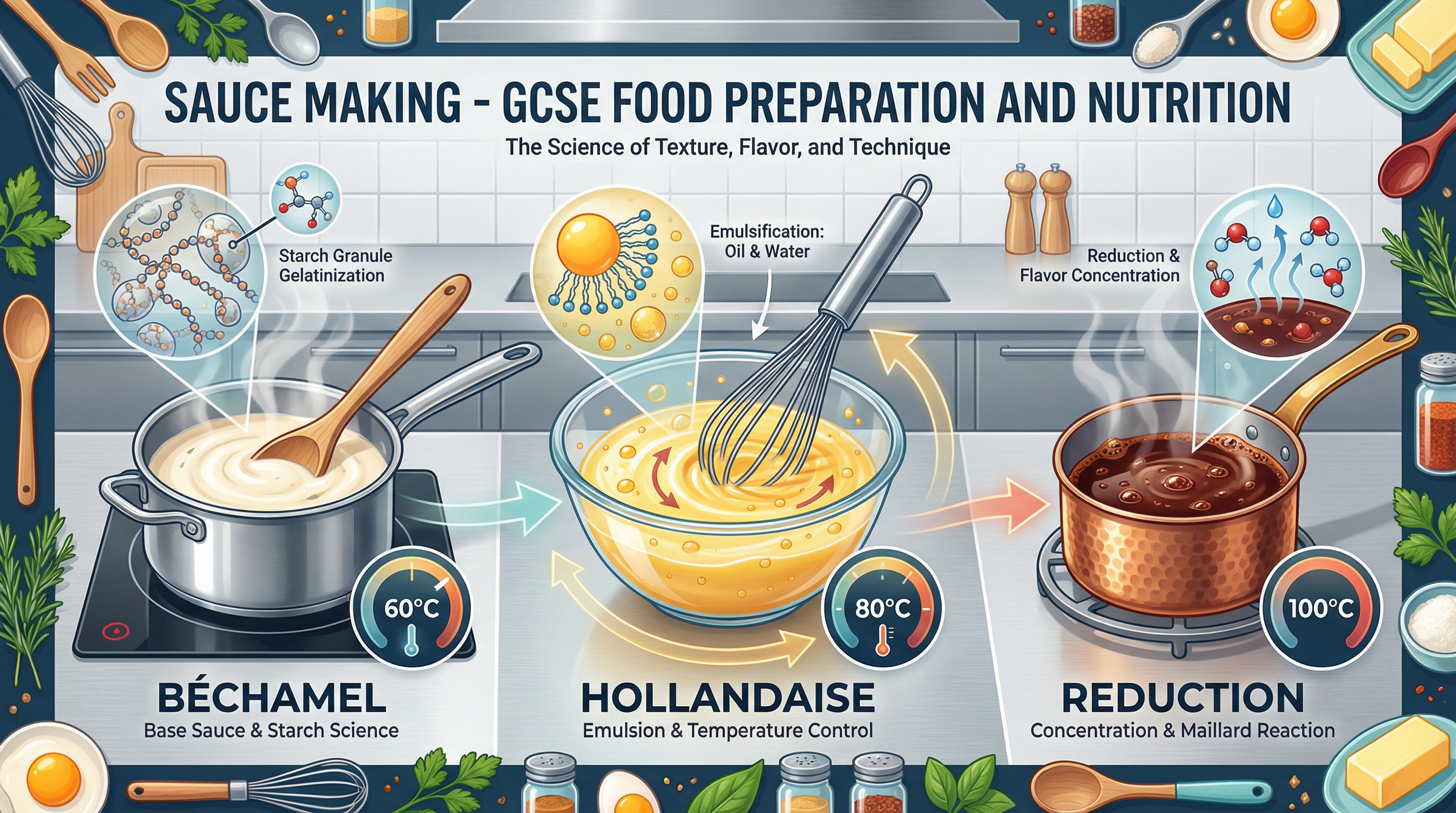
Sauce making

    Mastering sauce making is a gateway to understanding core food science principles for the AQA GCSE exam. This guide deconstructs the science of gelatinisation, emulsification, and reduction, providing the specific knowledge required to secure top marks by linking the functional properties of ingredients to sensory outcomes.", "podcast_script": "SAUCE MAKING PODCAST SCRIPT - AQA GCSE Food Preparation and Nutrition Duration: 10 minutes Voice: Female, warm, conversational, enthusiastic educator [INTRO - 1 minute] Hello and welcome to your GCSE Food Preparation and Nutrition study podcast! I'm here to help you master one of the most scientifically fascinating topics on the AQA specification: sauce making. Now, I know what you might be thinking - sauces? Really? But trust me, this topic is absolutely packed with marks-earning potential. Examiners LOVE sauce making questions because they test your understanding of the science behind cooking, not just the practical skills. And the best news? Once you understand the three key processes - gelatinisation, emulsification, and reduction - you'll be able to tackle any sauce question with confidence. In the next ten minutes, we're going to break down the science, explore what examiners are looking for, highlight the most common mistakes students make, and finish with a quick-fire quiz to test your recall. So grab a pen, get comfortable, and let's dive into the delicious world of sauce science! [CORE CONCEPTS - 5 minutes] Let's start with the big one: gelatinisation. This is the process that thickens starch-based sauces like béchamel, and it's tested in almost every exam paper. Here's what you absolutely must know. Gelatinisation is the process where starch granules absorb liquid, swell, and eventually burst to create a thick gel network. But here's the crucial detail that separates a Level 2 answer from a Level 4 answer: you need to know the TEMPERATURES at which this happens. At 60 degrees Celsius, starch granules begin to absorb water and swell. Between 60 and 80 degrees, they continue swelling. At 80 degrees Celsius, the granules burst, releasing amylose and amylopectin molecules. And at 100 degrees - boiling point - gelatinisation is complete, and you get that smooth, thick sauce consistency. Now, here's where students lose marks: saying "the sauce thickens because it gets hot" is NOT enough. You must explain that the starch granules swell and burst, forming a gel network. And don't forget - constant stirring is essential to prevent lumps. If you don't agitate the mixture, the starch granules stick together instead of dispersing evenly. Let's move on to emulsification - this is all about getting oil and water to mix, which they naturally don't want to do. Think mayonnaise or hollandaise sauce. The magic ingredient here is lecithin, found in egg yolk. Lecithin is an emulsifier. It has a hydrophilic head - that means water-loving - and a hydrophobic tail - that means oil-loving. When you whisk egg yolk with oil and an acidic liquid like lemon juice or vinegar, the lecithin molecules surround tiny oil droplets. The hydrophobic tails face inward into the oil, and the hydrophilic heads face outward into the water phase. This creates a stable emulsion. Examiners will award marks if you can identify lecithin as the emulsifier and explain its dual nature. Don't just say "egg yolk helps them mix" - explain HOW it works at a molecular level. Now, the third process: reduction. This is when you simmer a liquid sauce to evaporate water, which intensifies flavour and increases viscosity. The key here is understanding that as water evaporates, the concentration of flavour compounds increases, and the sauce becomes thicker because there's less liquid relative to the solids. A common exam question asks you to explain why a reduced sauce has a stronger flavour. The answer: evaporation removes water but leaves behind the flavour molecules, so the concentration increases. Simple, but you need to use the word "concentration" or "evaporation" to get full credit. One more thing about reduction - it's often combined with the Maillard reaction in meat-based sauces. The Maillard reaction occurs when proteins and sugars are heated together above 140 degrees Celsius, creating complex brown flavours. This is why a reduced meat jus tastes so rich and deep. [EXAM TIPS & COMMON MISTAKES - 2 minutes] Right, let's talk exam strategy. The AQA mark scheme rewards candidates who use precise scientific language and link functional properties to sensory outcomes. What does that mean in practice? First, always use specific temperatures. Don't say "heat the sauce" - say "heat to 100 degrees Celsius to complete gelatinisation." This shows depth of knowledge. Second, when describing faults in sauces, give the scientific reason. If a sauce is lumpy, don't just say "they didn't stir it." Say "the sauce is lumpy because the starch granules were not agitated during heating, causing them to clump together instead of dispersing evenly." That's a Level 4 answer. Third, know your ratios. A standard roux uses a 1 to 1 ratio of fat to flour, and then a 1 to 10 ratio of roux to liquid. So for 50 grams of butter and 50 grams of flour, you'd add 500 millilitres of milk. This comes up in multiple-choice questions all the time. Now, the biggest mistake students make: confusing gelatinisation with coagulation. Gelatinisation is about STARCH thickening. Coagulation is about PROTEIN setting, like when you make custard and the egg proteins set. Don't mix these up! Another common error: saying an emulsion is stable "because you whisked it." No! It's stable because the emulsifier - lecithin - surrounds the oil droplets and prevents them from recombining. Always explain the role of the emulsifier. And finally, for dietary adaptations: if a question asks how to make a sauce suitable for someone with coeliac disease, you need to substitute the wheat flour with a gluten-free starch like cornflour. But here's the key - you must also explain that cornflour still undergoes gelatinisation, so the functional property is maintained. That's the kind of detail that gets you into the top mark band. [QUICK-FIRE RECALL QUIZ - 1 minute] Okay, time to test yourself! I'll ask a question, pause for a few seconds, then give you the answer. Ready? Question 1: At what temperature do starch granules begin to burst during gelatinisation? ... The answer is 80 degrees Celsius. Question 2: What is the name of the emulsifier found in egg yolk? ... Lecithin. Question 3: What is the ratio of fat to flour in a standard roux? ... 1 to 1. Question 4: Why does a reduced sauce have a more intense flavour? ... Because water evaporates, increasing the concentration of flavour compounds. Question 5: Name one gluten-free starch that can replace wheat flour for someone with coeliac disease. ... Cornflour, or you could also say rice flour or potato starch. How did you do? If you got all five, brilliant! If not, go back and review those sections. [SUMMARY & SIGN-OFF - 1 minute] Let's wrap up. Today we've covered the three essential processes in sauce making: gelatinisation, where starch granules swell and burst at specific temperatures to thicken a sauce; emulsification, where lecithin in egg yolk allows oil and water to mix by surrounding oil droplets; and reduction, where evaporation intensifies flavour and increases viscosity. Remember: examiners want to see scientific language, specific temperatures, and explanations that link ingredients to outcomes. Don't just describe what happens - explain WHY it happens at a molecular level. Before your exam, make sure you can explain each process step-by-step, identify common faults and their causes, and adapt recipes for dietary needs while maintaining functional properties. You've got this! Sauce making might seem complex, but once you understand the science, it all makes sense. Good luck with your revision, and remember - precision, explanation, and scientific terminology are your keys to top marks. Thanks for listening, and happy studying!

    10
    Min Read
    3
    Examples
    5
    Questions
    0
    Key Terms
    🎙 Podcast Episode
    Sauce making
    0:00-0:00

    Study Notes

    header_image.png

    Overview

    Sauce making is a fundamental culinary skill that forms a cornerstone of the AQA GCSE Food Preparation and Nutrition specification. Beyond simply creating delicious accompaniments, this topic delves deep into the scientific principles that govern how ingredients interact. Examiners place a heavy emphasis on a candidate's ability to articulate the chemical and physical changes that occur during processes like gelatinisation, emulsification, and reduction. Understanding these concepts is not just about practical cooking; it is about demonstrating a robust knowledge of food science. This guide will equip you with the precise terminology, temperature points, and scientific explanations needed to excel in the exam. We will explore the functional properties of key ingredients, analyse common sauce faults from a scientific perspective, and provide worked examples that show you how to structure high-level responses. By mastering the content in this guide, you will be prepared to explain not just what happens in the pan, but why it happens at a molecular level, which is the key to unlocking the highest marks.

    sauce_making_podcast.wav

    Key Scientific Principles

    Gelatinisation: The Science of Starch Thickening

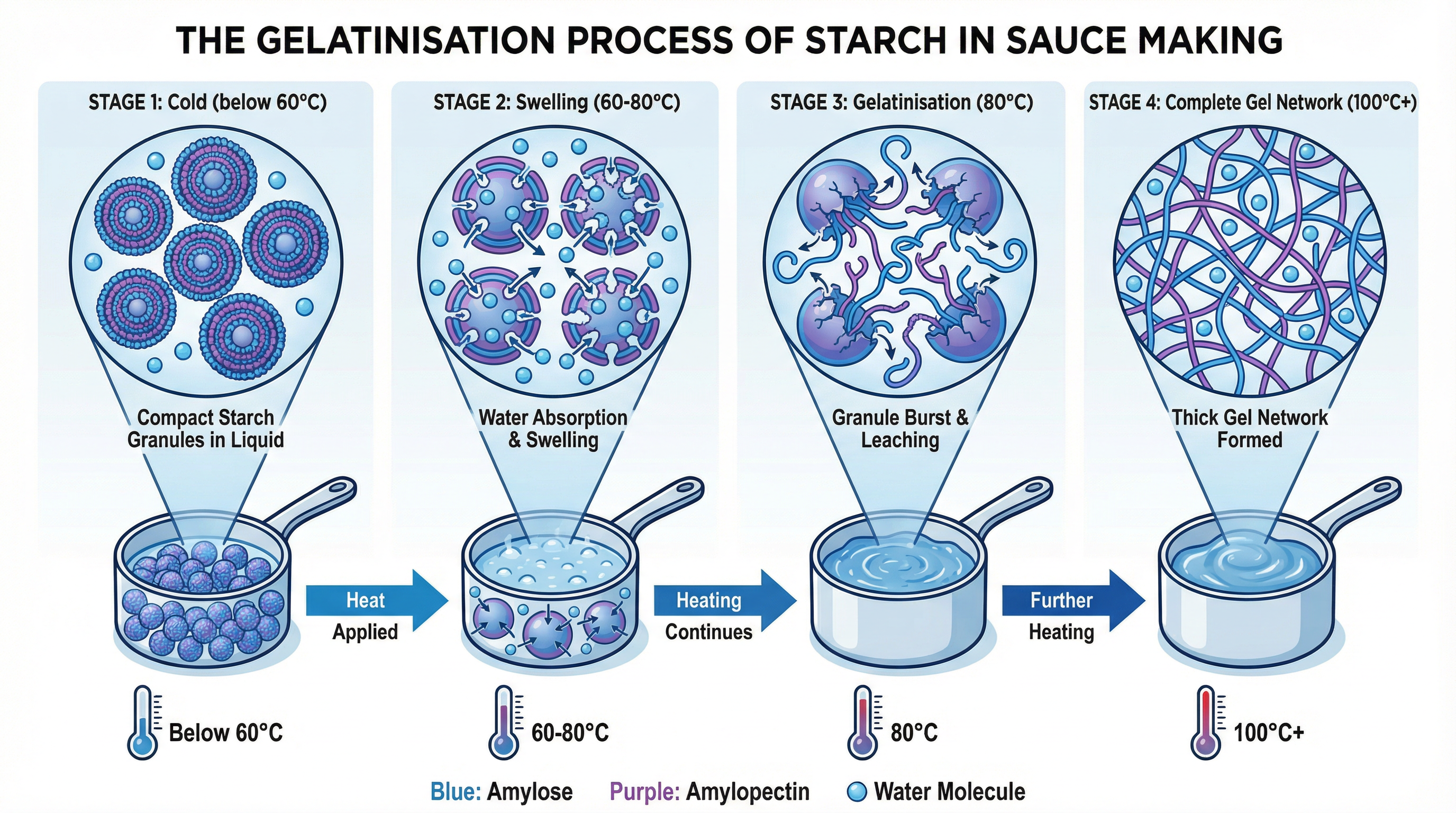
    What it is: Gelatinisation is the process by which starch granules absorb liquid when heated, causing them to swell and burst, which in turn thickens the liquid. This is the primary method for thickening sauces like béchamel, velouté, and cheese sauce.

    The Process Step-by-Step:

    1. Cold Liquid (Below 60°C): Starch granules (e.g., from flour) are suspended in the cold liquid but remain separate and do not absorb much water.
    2. Heating (60°C - 80°C): As the temperature rises to 60°C, the starch granules begin to absorb the surrounding liquid and swell significantly. Continuous stirring (agitation) is vital at this stage to prevent the granules from sticking together and forming lumps.
    3. Bursting Point (80°C): At approximately 80°C, the swollen granules rupture (burst), releasing long-chain starch molecules (amylose and amylopectin) into the liquid.
    4. Gel Formation (100°C): As the sauce reaches boiling point (100°C), these starch molecules form a complex three-dimensional network that traps water molecules. This network is what gives the sauce its thick, viscous, and smooth texture. The sauce must reach this temperature to achieve its maximum thickness and to cook out the raw taste of the flour.
    gelatinisation_process.png

    Why it matters for the exam: Candidates must use precise temperatures and terminology. Simply stating that the sauce 'thickens with heat' will not receive many marks. Credit is given for explaining the swelling and bursting of starch granules and the formation of a starch-protein network. You must also be able to explain the importance of agitation.

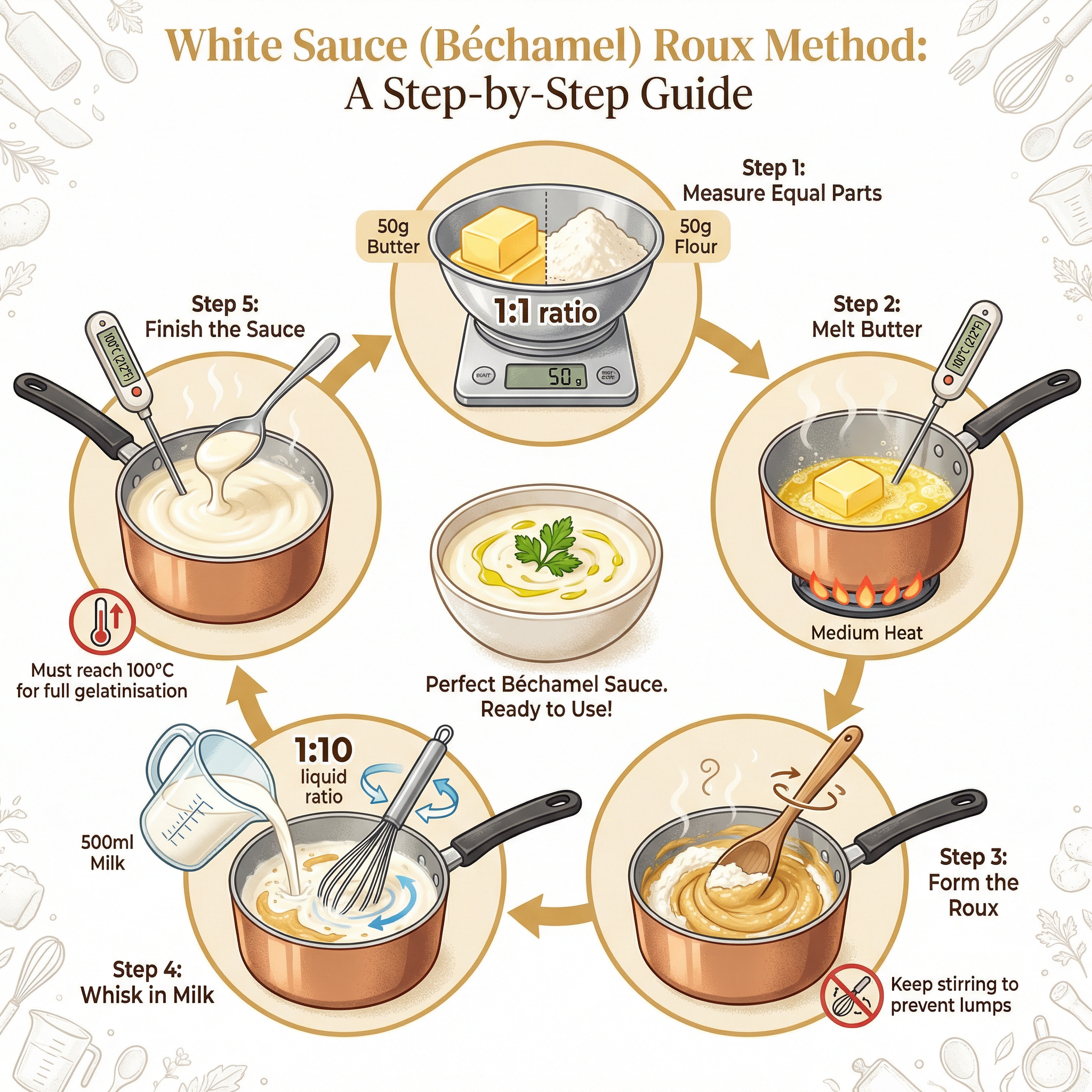
    Specific Knowledge: Know the key temperatures: 60°C (swelling starts), 80°C (granules burst), 100°C (gelatinisation complete). Remember the standard ratio for a roux-based sauce: 1 part fat : 1 part flour : 10 parts liquid (e.g., 50g butter, 50g flour, 500ml milk).
    roux_method.png

    Emulsification: Making Oil and Water Mix

    What it is: Emulsification is the process of dispersing one liquid (like oil) into another liquid with which it is immiscible (like water or vinegar). This is essential for creating stable sauces like mayonnaise, hollandaise, and vinaigrettes.

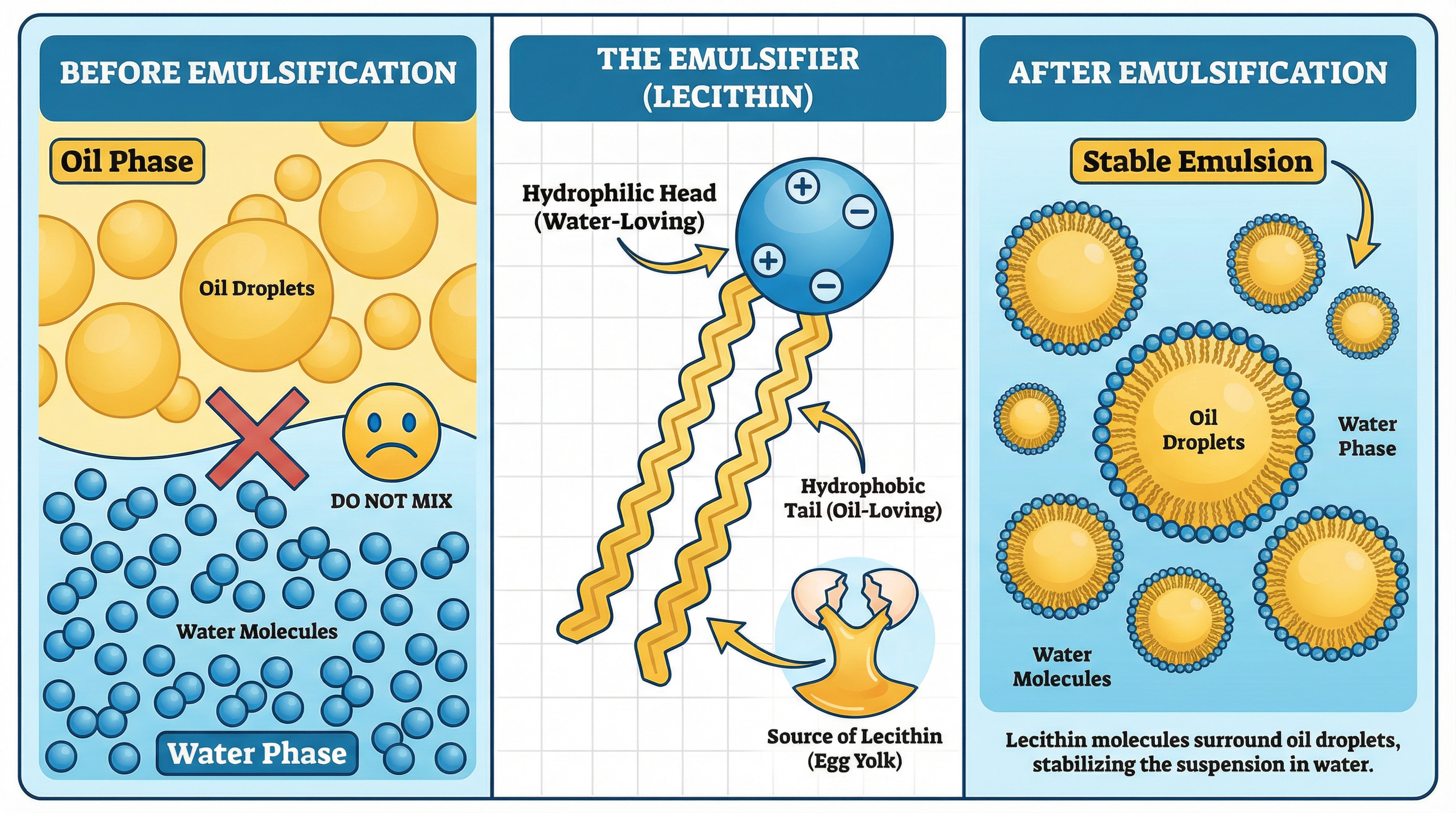
    The Key Component - The Emulsifier: An emulsifier is a molecule that has a water-loving (hydrophilic) head and an oil-loving (hydrophobic) tail. In sauce making, the most common emulsifier is lecithin, which is found in egg yolks.

    How it works:

    1. Immiscible Liquids: Oil and water naturally separate into layers because their molecules are not attracted to each other.
    2. Introducing the Emulsifier: When egg yolk is whisked with an acidic liquid (like lemon juice or vinegar), the lecithin molecules are dispersed.
    3. Creating the Emulsion: As oil is slowly added while whisking vigorously, the lecithin molecules arrange themselves around the tiny oil droplets. The hydrophobic tails point inwards, into the oil droplet, while the hydrophilic heads face outwards, into the surrounding watery liquid. This creates a stable suspension of oil droplets in water, preventing them from separating.
    emulsification_diagram.png

    Why it matters for the exam: Marks are awarded for identifying lecithin as the emulsifier and explaining its dual hydrophilic/hydrophobic structure. You must be able to describe how this structure allows it to bond with both oil and water to create a stable emulsion. High-level responses will also discuss factors that can cause an emulsion to break (e.g., adding the oil too quickly, incorrect temperature).

    Specific Knowledge: Lecithin (from egg yolk) is the key emulsifier. Know the difference between a temporary emulsion (like a vinaigrette, which separates on standing) and a permanent emulsion (like mayonnaise, which remains stable).

    Reduction and Coagulation

    Reduction: This is the process of simmering a sauce for a period to allow some of the water to evaporate. This has two main effects:

    • Intensifies Flavour: As water is removed, the concentration of flavour compounds from the other ingredients (e.g., stock, wine, herbs) increases, resulting in a richer, more potent taste.
    • Increases Viscosity: With less water, the sauce naturally becomes thicker.
      Why it matters: You need to explain that flavour is intensified due to the increased concentration of flavour molecules.

    Coagulation: This is the change in the structure of protein from a liquid to a solid or thicker liquid, brought about by heat, acid, or enzymes. In sauce making, this is most relevant to egg-based sauces like custard.

    • The Process: When an egg-based sauce is heated, the protein chains unfold and then join together, trapping the liquid within their network. This causes the sauce to thicken and set.
    • Temperature Control: This process is highly temperature-sensitive. If heated too quickly or to too high a temperature (above 85°C for egg proteins), the proteins will over-coagulate, squeezing out the trapped liquid and causing the sauce to curdle or scramble.
      Why it matters: Candidates must differentiate between coagulation (protein-based) and gelatinisation (starch-based). For coagulation, you must stress the importance of gentle heating and temperature control to avoid curdling.

    Second-Order Concepts

    Causation

    • Lumps in a Roux Sauce: Caused by adding liquid too quickly to the roux, or insufficient agitation (stirring/whisking). This prevents the starch granules from dispersing evenly before they begin to swell, causing them to clump together.
    • A Split Mayonnaise: Caused by adding the oil too quickly, which overwhelms the emulsifier (lecithin) and prevents it from surrounding the oil droplets effectively. It can also be caused by the ingredients being too cold.
    • A Curdled Custard: Caused by overheating the egg proteins (above 85°C). The proteins over-coagulate, tighten, and squeeze out the liquid they were holding, resulting in a grainy, separated texture.

    Consequence

    • Correct Gelatinisation: The consequence is a smooth, viscous, and stable sauce that coats the back of a spoon. The raw flour taste is eliminated.
    • Stable Emulsification: The consequence is a thick, creamy, and glossy sauce where oil and water remain combined, providing a rich mouthfeel.
    • Successful Reduction: The consequence is a sauce with a deep, concentrated flavour and a syrupy consistency, often seen in high-end restaurant dishes like a jus.

    Change & Continuity

    • Change: The primary change during sauce making is the transformation of state from liquid to a thicker, more viscous liquid or semi-solid gel. Ingredients undergo irreversible chemical and physical changes (e.g., starch granules bursting, proteins denaturing).
    • Continuity: The base ingredients (fat, flour, liquid, eggs) and the fundamental scientific principles have remained the same for centuries. A béchamel made today follows the same principles of gelatinisation as one made 200 years ago.

    Significance

    Understanding the science of sauce making is significant because it moves a candidate from being a recipe-follower to a knowledgeable food scientist. It allows for the prediction of results, the diagnosis and correction of faults, and the creative adaptation of recipes for different dietary needs (e.g., using cornflour for a gluten-free diet) while still achieving the desired functional and sensory outcomes. This is a key skill assessed by AQA.

    Dietary Adaptation Skills

    Examiners frequently test a candidate's ability to adapt a standard sauce recipe for specific dietary needs. This requires you to justify your ingredient choices based on their functional performance.

    Dietary NeedStandard Ingredient to ReplaceReplacement IngredientScientific Justification
    Coeliac Disease (Gluten-Free)Wheat Flour (in roux)Cornflour, Arrowroot, or Potato StarchThese are all gluten-free starches that still undergo gelatinisation when heated with a liquid. They will swell and burst to thicken the sauce, performing the same functional role as wheat flour.
    Lactose IntoleranceCow's Milk (in béchamel)Lactose-free milk, Soya milk, Oat milkThese liquids can still be used as the medium for gelatinisation. The starch granules will absorb these liquids just as they would cow's milk. Note that flavour and colour may be affected.
    Vegan DietButter (in roux), Milk, Eggs (in hollandaise)Oil or vegan spread, Plant-based milk (soya, oat), Silken tofu or aquafaba (for emulsification)For a roux, oil can replace butter as the fat. For emulsification, a different emulsifying agent is needed as lecithin from eggs cannot be used. This is a more complex adaptation requiring knowledge of alternative emulsifiers.
    Low-Fat DietButter/Fat (in roux)Use a slurry (starch mixed with cold water)To reduce fat, a roux can be avoided. A slurry of cornflour and water can be added to the hot liquid. The gelatinisation process will still occur, thickening the sauce without the need for fat.

    Worked Examples

    3 detailed examples with solutions and examiner commentary

    Practice Questions

    Test your understanding — click to reveal model answers

    Q1

    Explain two reasons why a white sauce may have a lumpy texture. (4 marks)

    4 marks
    standard

    Hint: Think about the role of temperature and agitation in the gelatinisation process.

    Q2

    A recipe for hollandaise sauce instructs the user to use a bain-marie. Explain the scientific reason for this. (3 marks)

    3 marks
    hard

    Hint: Hollandaise contains eggs. What happens to egg protein when it gets too hot?

    Q3

    Evaluate the use of cornflour as an alternative to plain flour for thickening a sauce. (6 marks)

    6 marks
    hard

    Hint: Consider its functional properties, dietary applications, and any differences in the final sensory characteristics.

    Q4

    Describe the function of lecithin in a mayonnaise. (2 marks)

    2 marks
    standard

    Hint: Think about its special molecular structure.

    Q5

    Explain why a reduced meat stock has a more intense flavour than a standard meat stock. (3 marks)

    3 marks
    standard

    Hint: What happens to the water and what happens to the flavour molecules?

    More Food Preparation and Nutrition Study Guides

    View all

    Food preservation methods

    AQA
    GCSE

    Unlock top marks in your AQA GCSE Food exam by mastering the science of food preservation. This guide breaks down how stopping microbial growth through temperature, water removal, and chemical means is not just a cooking technique, but a core scientific principle essential for food safety and product development.

    Food waste

    AQA
    GCSE

    This study guide tackles the critical issue of food waste, a key component of the AQA GCSE Food Preparation and Nutrition specification (Section 5: Food Provenance). It explores the environmental, economic, and social impacts of waste, providing candidates with the specific knowledge and exam techniques needed to achieve top marks. Understanding this topic is vital for explaining the link between consumer behaviour and global food sustainability.

    Food miles and sustainability

    AQA
    GCSE

    This study guide delves into the critical topic of food miles and sustainability, a key area of the AQA GCSE Food Preparation and Nutrition specification. It explores the environmental impact of our food choices, equipping candidates with the analytical skills needed to evaluate food provenance and secure top marks in their exam.

    Cooking methods

    Edexcel
    GCSE

    Mastering cooking methods is fundamental to excelling in your GCSE Food Preparation and Nutrition exam. This guide breaks down the core science of heat transfer and chemical changes, giving you the precise language and analytical skills examiners reward. Move beyond simply following recipes to scientifically justifying your cooking choices for top marks.

    Seasonal foods

    AQA
    GCSE

    This study guide explores the crucial topic of seasonal foods within the AQA GCSE Food Preparation and Nutrition specification. Understanding seasonality is vital for exam success, as it connects directly to food provenance, sustainability, and the organoleptic qualities of ingredients, allowing candidates to achieve higher marks by demonstrating a deep and applied knowledge of where food comes from.

    Energy balance and its relationship to weight management.

    OCR
    GCSE

    This study guide provides a comprehensive, exam-focused breakdown of energy balance and weight management for OCR GCSE Food Preparation and Nutrition. It decodes the science of BMR and PAL, explains the calorific value of macronutrients, and provides specific strategies to help candidates secure top marks by avoiding common pitfalls and using precise terminology.