Energy balance and its relationship to weight management.

    This study guide provides a comprehensive, exam-focused breakdown of energy balance and weight management for OCR GCSE Food Preparation and Nutrition. It decodes the science of BMR and PAL, explains the calorific value of macronutrients, and provides specific strategies to help candidates secure top marks by avoiding common pitfalls and using precise terminology.

    5
    Min Read
    3
    Examples
    5
    Questions
    0
    Key Terms
    🎙 Podcast Episode
    Energy balance and its relationship to weight management.
    0:00-0:00

    Study Notes

    header_image.png

    Overview

    This topic explores the fundamental principles of energy balance, a cornerstone of nutritional science. For the OCR GCSE exam, candidates are expected to demonstrate a precise understanding of the relationship between energy intake (the food we consume) and energy expenditure (the energy our bodies use). This includes defining Basal Metabolic Rate (BMR) and Physical Activity Level (PAL), and explaining how their interplay determines whether an individual gains, loses, or maintains weight. Examiners will award marks for the ability to apply this knowledge to real-world scenarios, calculate energy requirements, and analyse the health consequences of long-term energy imbalance. Mastery of this area is crucial, as it not only forms the basis of many exam questions but also connects to broader topics such as macronutrients, diet-related health conditions, and menu planning.

    Key Concepts

    The Three States of Energy Balance

    What it is: Energy balance is the relationship between the energy consumed from food and drink (intake) and the energy used by the body for basic functions and physical activity (expenditure). It can be in one of three states.

    Why it matters: This is the core concept. Questions will require you to identify and explain these states in different contexts.

    Specific Knowledge:

    • Positive Energy Balance: Intake > Expenditure. Leads to weight gain as excess energy is stored as adipose tissue.
    • Energy Balance: Intake = Expenditure. Leads to stable weight.
    • Negative Energy Balance: Intake < Expenditure. Leads to weight loss as the body uses stored adipose tissue for energy.
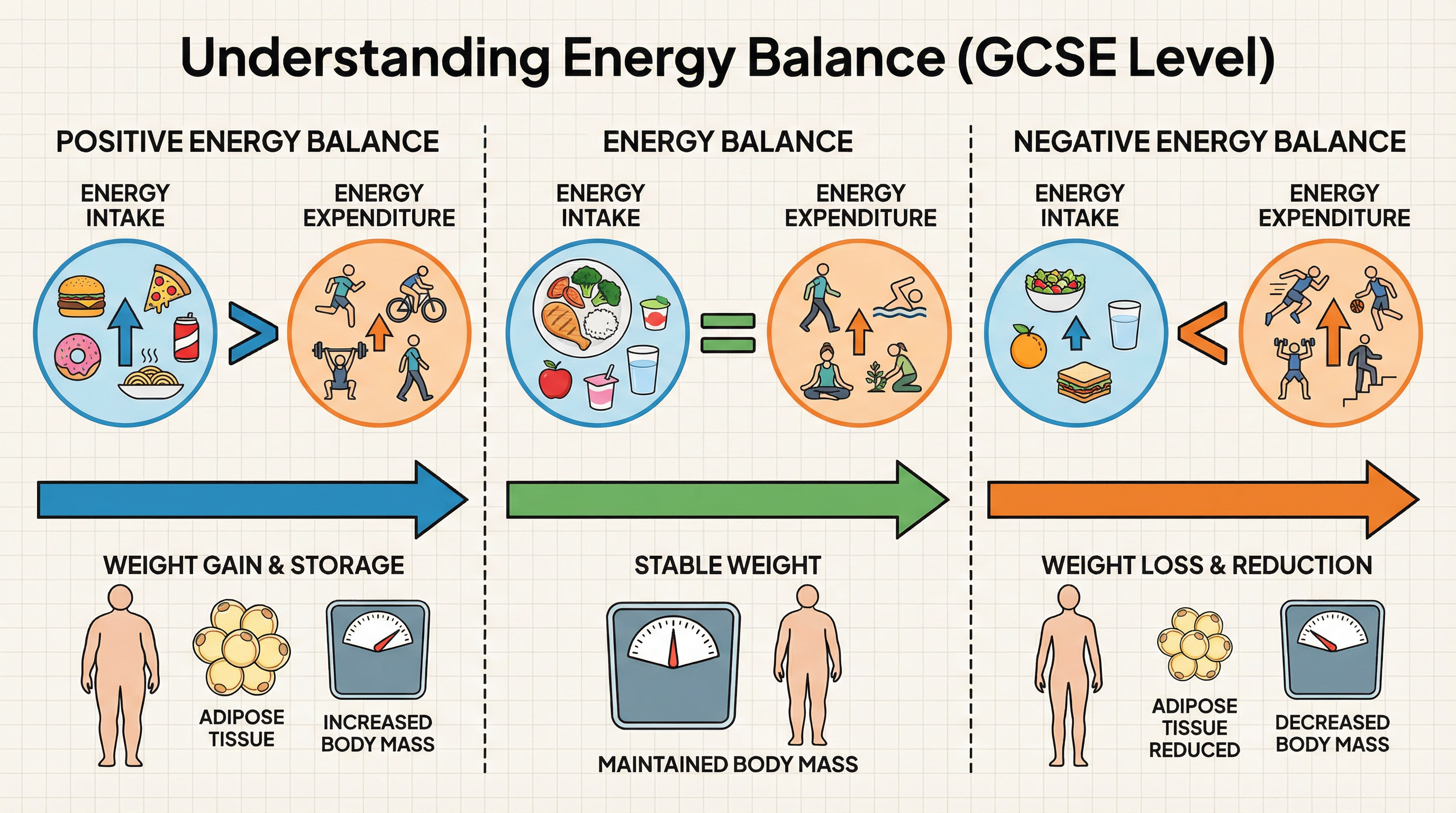
    energy_balance_diagram.png

    Basal Metabolic Rate (BMR) & Physical Activity Level (PAL)

    What they are:

    • BMR: The minimum amount of energy the body needs to function at rest. This includes processes like breathing, circulation, and cell repair. It accounts for 60-75% of total energy expenditure.
    • PAL: The energy used during physical movement. It is expressed as a multiplier to calculate total energy needs.

    Why they matter: These two components make up total energy expenditure. You must be able to define them and explain the factors that affect them.

    Specific Knowledge:

    • Factors affecting BMR: Age (decreases with age), Gender (males generally higher), Body Size & Composition (more muscle = higher BMR).
    • PAL Values: Sedentary (e.g., office worker) ≈ 1.4, Moderately Active (e.g., regular walking) ≈ 1.6, Vigorous (e.g., athlete) ≈ 1.9.
    • The Formula: Total Energy Requirement = BMR × PAL. You must know and be able to use this formula.
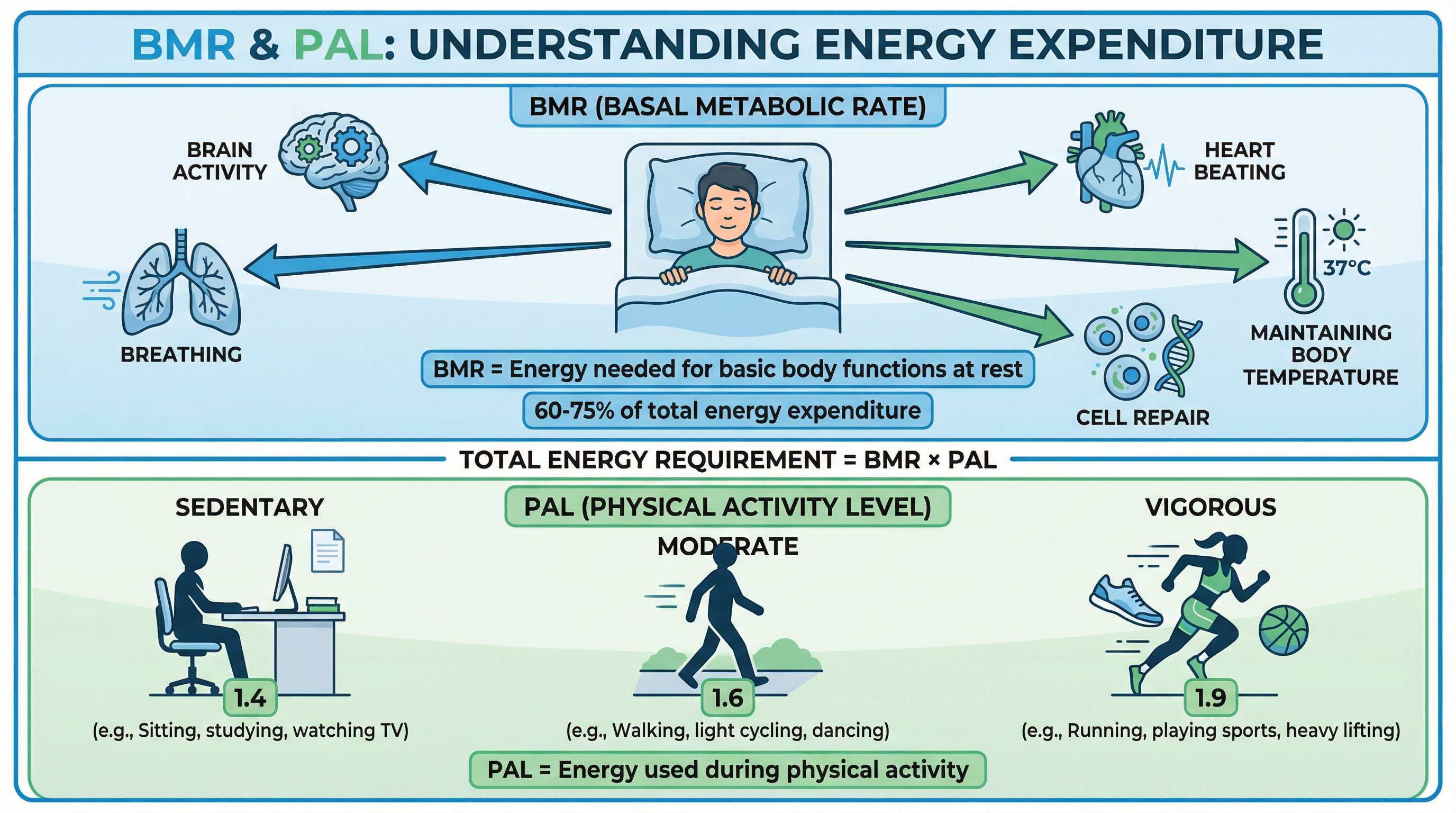
    bmr_pal_diagram.png

    Macronutrient Energy Values (Atwater Factors)

    What they are: The amount of energy (in kilocalories) provided per gram of each macronutrient.

    Why it matters: These values are essential for any calculation question involving the energy content of food. They also explain why some foods are more 'energy-dense' than others.

    Specific Knowledge:

    • Fat: 9 kcal/g
    • Protein: 4 kcal/g
    • Carbohydrate: 4 kcal/g
    • Alcohol: 7 kcal/g (often included in questions)
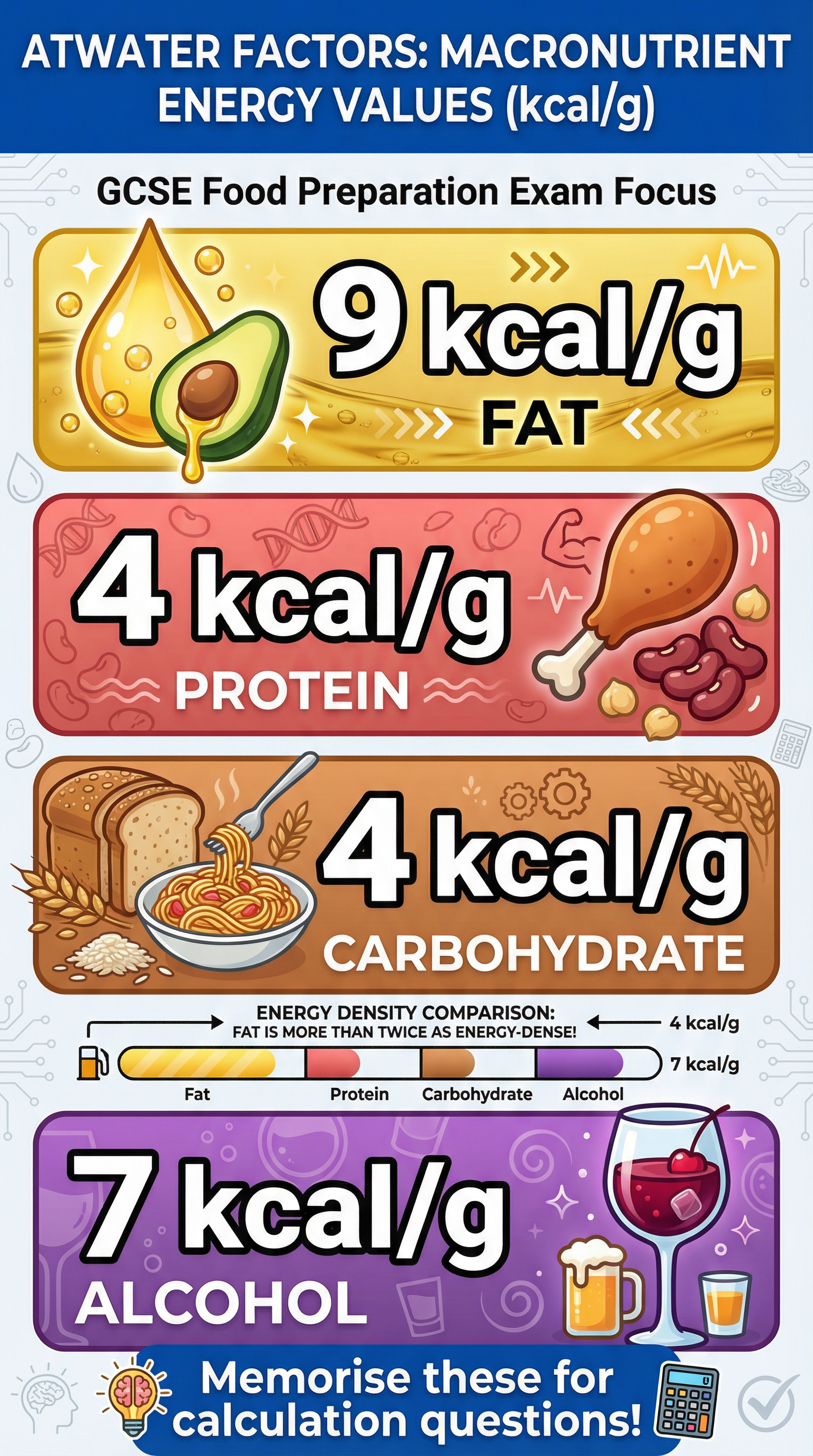
    macronutrient_values.png

    Second-Order Concepts

    Causation

    • Cause of Weight Gain: A sustained positive energy balance, where energy intake consistently exceeds expenditure. This is often caused by a combination of consuming energy-dense foods high in fat and free sugars, and a low Physical Activity Level (sedentary lifestyle).
    • Cause of Weight Loss: A sustained negative energy balance. This is achieved by reducing energy intake, increasing energy expenditure, or a combination of both.

    Consequence

    • Consequences of Positive Energy Balance: Long-term positive energy balance leads to obesity. This significantly increases the risk of developing diet-related health conditions, most notably Type 2 diabetes and Coronary Heart Disease (CHD). Credit is given for naming these specific conditions.
    • Consequences of Negative Energy Balance: While often intentional for weight management, a severe or prolonged negative energy balance can lead to malnutrition, muscle loss, and nutrient deficiencies.

    Worked Examples

    3 detailed examples with solutions and examiner commentary

    Practice Questions

    Test your understanding — click to reveal model answers

    Q1

    Explain why a construction worker has higher energy needs than an office worker of the same age and gender. (6 marks)

    6 marks
    standard

    Hint: Think about the two components of energy expenditure: BMR and PAL. How do they differ between these two individuals?

    Q2

    Describe two factors, other than gender, that affect a person's Basal Metabolic Rate (BMR). (4 marks)

    4 marks
    standard

    Hint: Think about how the body changes over a lifetime and how body composition affects energy needs.

    Q3

    A food product contains 10g of fat, 20g of carbohydrate, and 5g of protein per serving. Calculate the total energy in kcal for one serving. (4 marks)

    4 marks
    standard

    Hint: Use the Atwater factors for each macronutrient and sum the results.

    Q4

    Explain two health risks associated with a long-term positive energy balance. (4 marks)

    4 marks
    standard

    Hint: Name specific diet-related diseases linked to obesity.

    Q5

    To what extent is increasing physical activity the most effective method for weight management? (8 marks)

    8 marks
    high

    Hint: This is an 'assess' question. Argue for and against this statement, then come to a conclusion.

    More Food Preparation and Nutrition Study Guides

    View all

    Food preservation methods

    AQA
    GCSE

    Unlock top marks in your AQA GCSE Food exam by mastering the science of food preservation. This guide breaks down how stopping microbial growth through temperature, water removal, and chemical means is not just a cooking technique, but a core scientific principle essential for food safety and product development.

    Food waste

    AQA
    GCSE

    This study guide tackles the critical issue of food waste, a key component of the AQA GCSE Food Preparation and Nutrition specification (Section 5: Food Provenance). It explores the environmental, economic, and social impacts of waste, providing candidates with the specific knowledge and exam techniques needed to achieve top marks. Understanding this topic is vital for explaining the link between consumer behaviour and global food sustainability.

    Food miles and sustainability

    AQA
    GCSE

    This study guide delves into the critical topic of food miles and sustainability, a key area of the AQA GCSE Food Preparation and Nutrition specification. It explores the environmental impact of our food choices, equipping candidates with the analytical skills needed to evaluate food provenance and secure top marks in their exam.

    Cooking methods

    Edexcel
    GCSE

    Mastering cooking methods is fundamental to excelling in your GCSE Food Preparation and Nutrition exam. This guide breaks down the core science of heat transfer and chemical changes, giving you the precise language and analytical skills examiners reward. Move beyond simply following recipes to scientifically justifying your cooking choices for top marks.

    Seasonal foods

    AQA
    GCSE

    This study guide explores the crucial topic of seasonal foods within the AQA GCSE Food Preparation and Nutrition specification. Understanding seasonality is vital for exam success, as it connects directly to food provenance, sustainability, and the organoleptic qualities of ingredients, allowing candidates to achieve higher marks by demonstrating a deep and applied knowledge of where food comes from.

    Organic food production

    AQA
    GCSE

    This study guide delves into the crucial topic of Organic Food Production for AQA GCSE Food Preparation and Nutrition. It provides a comprehensive overview of the principles, practices, and regulations governing organic farming, equipping students with the knowledge to evaluate its environmental and economic trade-offs effectively.