Study Notes
Overview
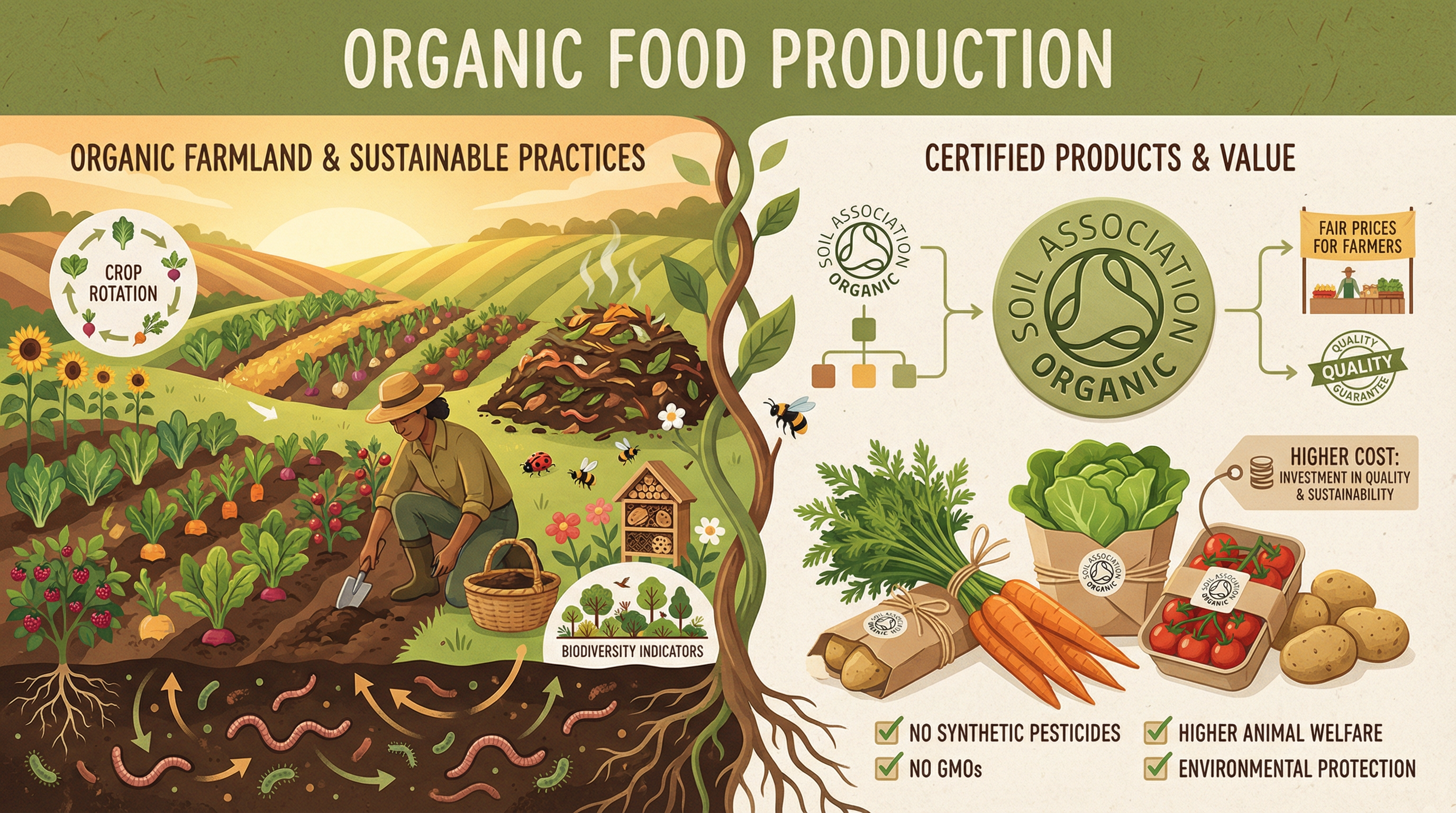
Organic food production is a key component of the Food Provenance module for the AQA GCSE specification. This topic requires candidates to move beyond a simple definition of "organic" and engage with the complexities of a regulated, active farming system. Examiners expect a detailed understanding of the principles underpinning organic agriculture, such as the promotion of biodiversity, the maintenance of soil health, and high standards of animal welfare. A critical aspect is the ability to evaluate the trade-offs between these environmental benefits and the economic realities of lower yields and higher consumer costs. This guide will equip you with the specific knowledge and analytical skills needed to dissect exam questions, reference key certification bodies like the Soil Association, and construct well-supported arguments that attract maximum marks.
Key Concepts & Principles
The Organic Farming System
What it is: Organic farming is a holistic system of agriculture that avoids the use of synthetic pesticides and artificial fertilisers. It is not simply farming without chemicals, but an active management approach that focuses on building a healthy, fertile ecosystem. Candidates must understand that it is a legally defined and regulated standard.
Why it matters: For the exam, you must demonstrate that you understand organic farming as a proactive system. Marks are awarded for explaining how organic methods work, not just stating that they are "good for the environment.".
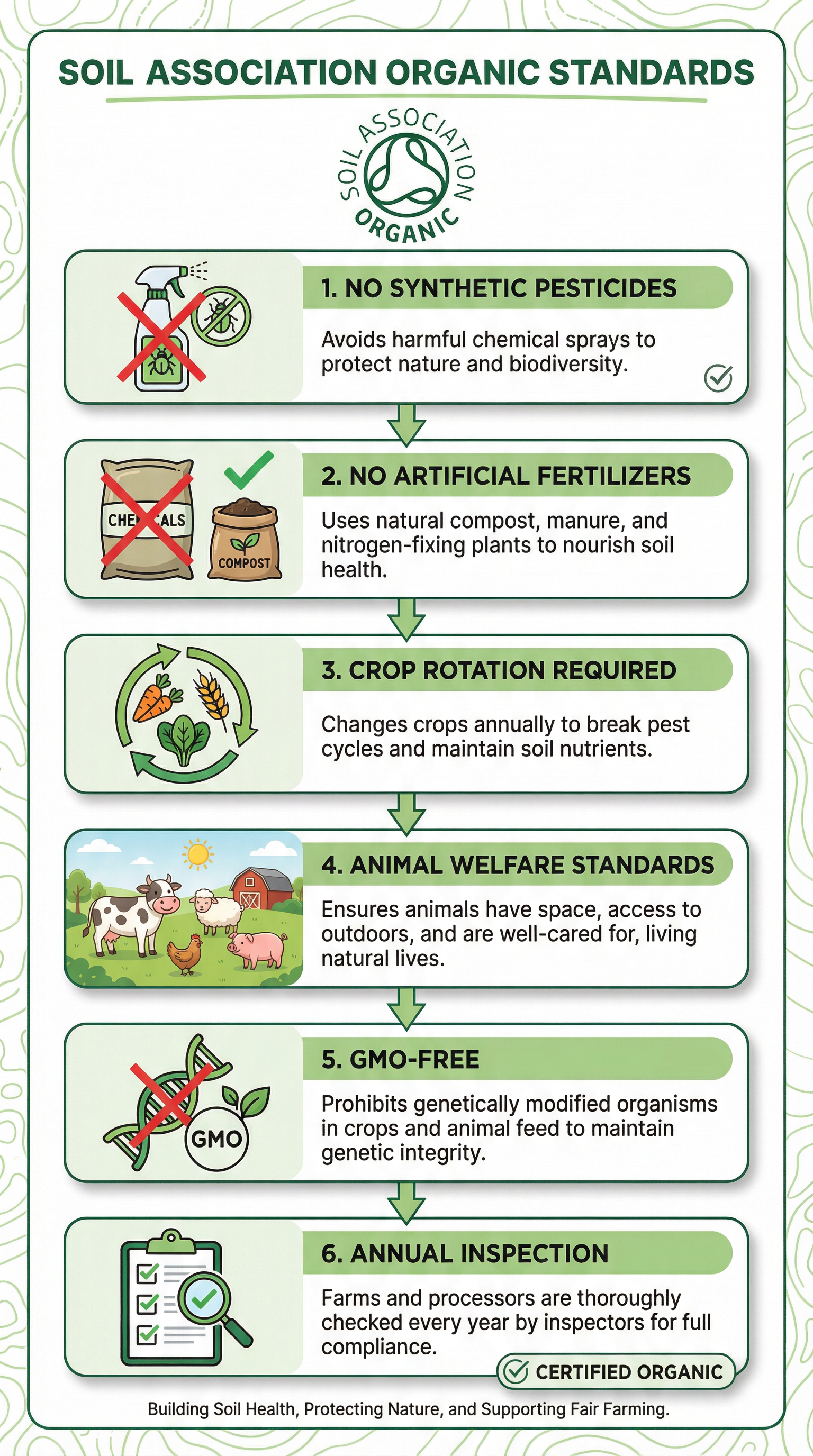
Specific Knowledge: Mentioning the Soil Association as the UK’s leading organic certification body is essential. Their standards are the backbone of the organic movement in the UK.
Core Practices
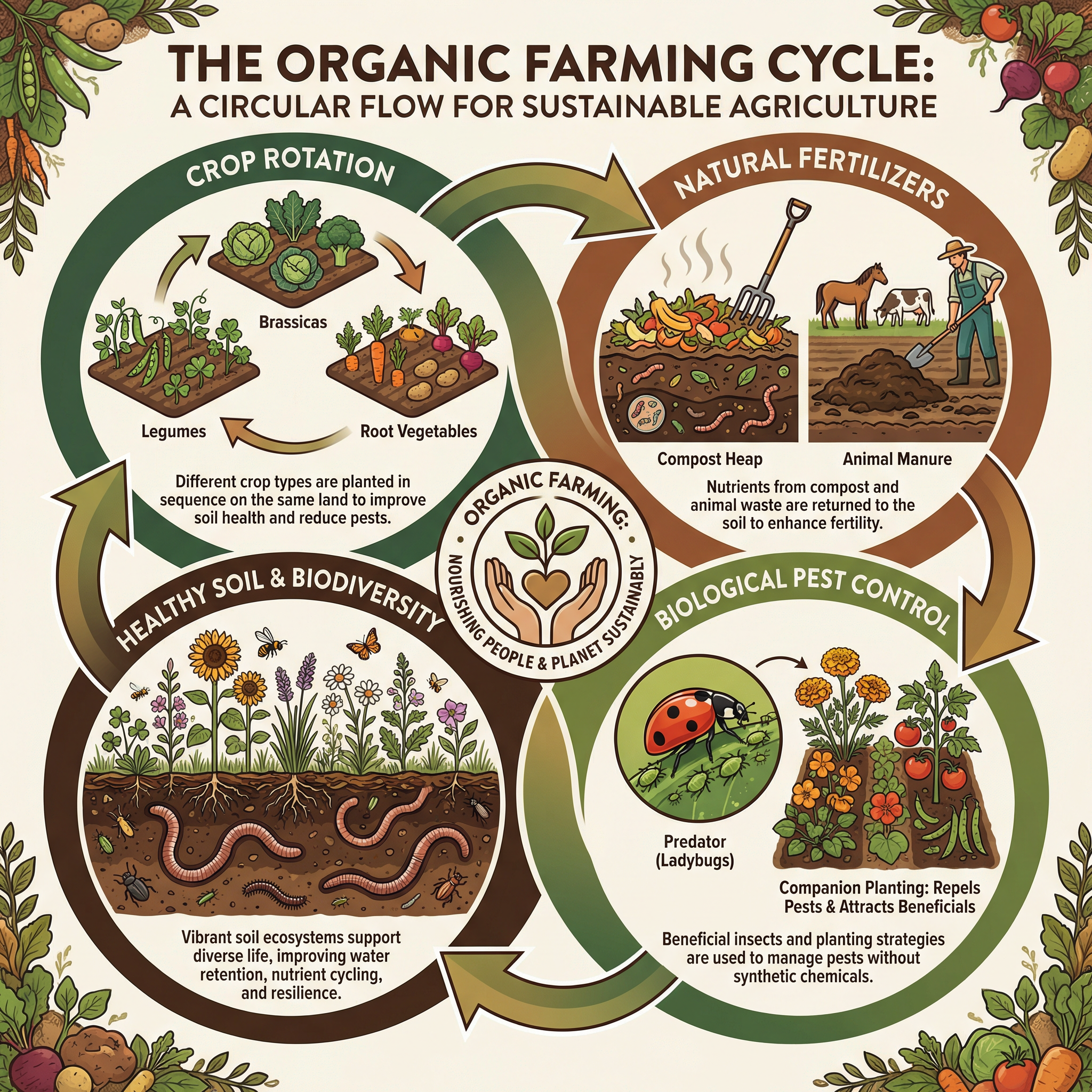
- Crop Rotation: Different crops are grown in a planned sequence on the same piece of land. This breaks the life cycles of pests, improves soil fertility (e.g., by planting nitrogen-fixing legumes), and prevents soil erosion. For example, a farmer might plant potatoes one year, followed by beans the next, and then wheat.
- Natural Fertilisers: Instead of synthetic nitrogen-based fertilisers, organic farmers use compost, animal manure, and green manures (crops grown specifically to be ploughed back into the soil). This improves soil structure and releases nutrients slowly.
- Biological Pest Control: This involves using natural predators to control pests (e.g., encouraging ladybirds to eat aphids) and companion planting (e.g., planting marigolds to deter whitefly). This avoids the need for synthetic pesticides, which can harm wildlife.
- Animal Welfare: Organic standards place a strong emphasis on animal welfare, requiring that animals are genuinely free-range, have plenty of space, and are fed a natural, organic diet.
Evaluation: The Great Debate
Examiners frequently set questions that require you to evaluate the pros and cons of organic production. You must present a balanced argument.
Arguments FOR Organic Production (Benefits)
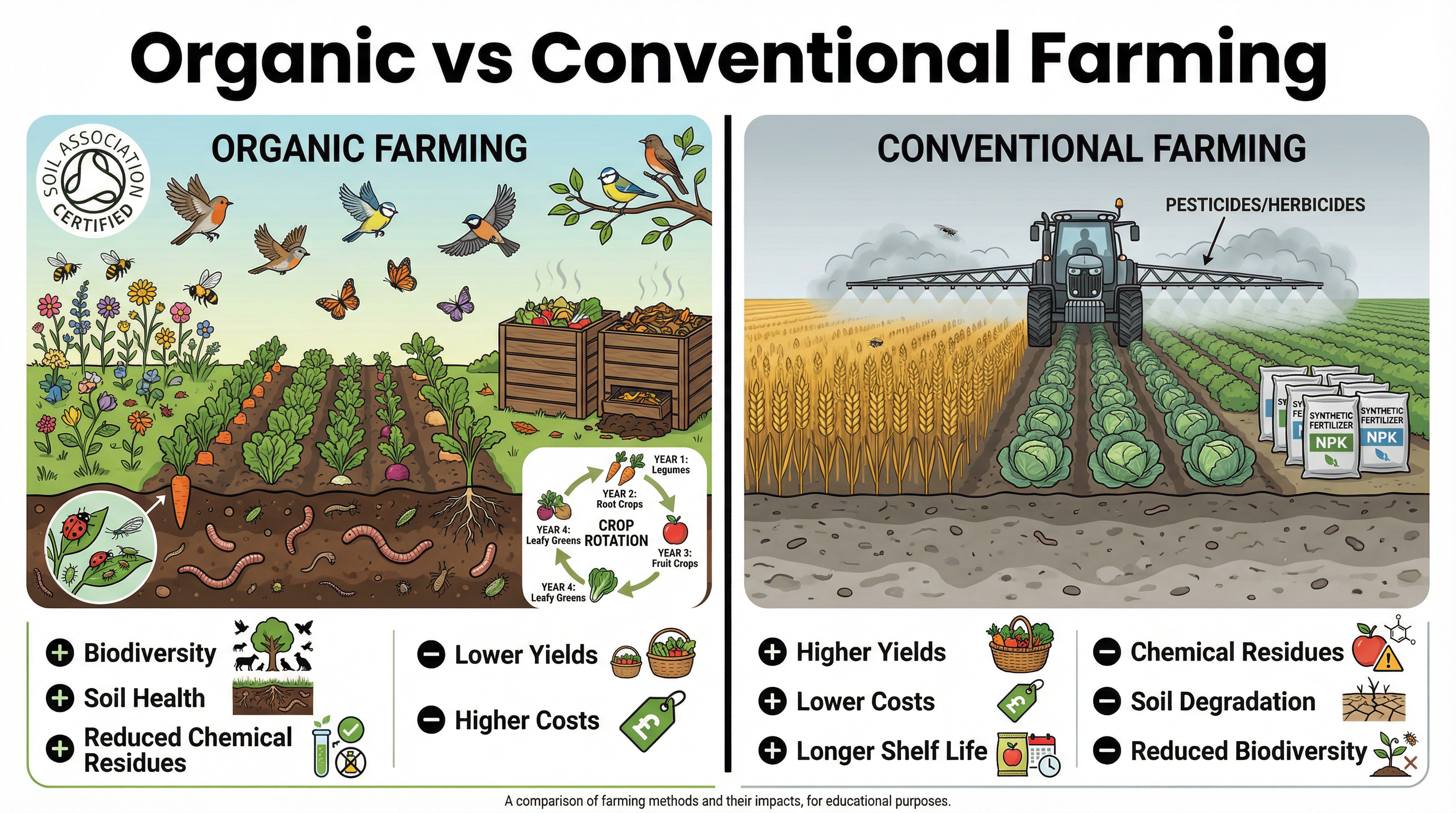
- Increased Biodiversity: Organic farms support up to 50% more wildlife, including birds, bees, and butterflies, due to the absence of broad-spectrum pesticides and the presence of varied habitats like hedgerows.
- Improved Soil Health: The focus on natural fertilisers and crop rotation builds soil organic matter, making it more fertile and less prone to erosion.
- Reduced Chemical Residues: Consumers who buy organic food reduce their exposure to pesticide residues.
- High Animal Welfare: Organic standards for animal welfare are among the highest in the world.
Arguments AGAINST Organic Production (Drawbacks)
- Lower Yields: Organic farms typically produce 20-25% less food per hectare than their conventional counterparts. This is a critical point when discussing global food security.
- Higher Cost: Lower yields and more labour-intensive methods mean that organic food is more expensive for the consumer. This can be a significant barrier for many households.
- Land Use: Because yields are lower, more land is required to produce the same amount of food, which has its own environmental implications.
- Shorter Shelf-Life: Some organic produce may have a shorter shelf-life as it is not treated with post-harvest fungicides or waxes.
",
"podcast_script": "ORGANIC FOOD PRODUCTION PODCAST SCRIPT
AQA GCSE Food Preparation and Nutrition
Duration: Approximately 10 minutes
Speaker: Female educator, warm and engaging tone
[INTRO - 1 MINUTE]
Hello and welcome to your GCSE Food Preparation and Nutrition study podcast! I'm here to help you master the topic of Organic Food Production, which is a crucial part of your Food Provenance module. Whether you're revising for your exam or building your understanding from scratch, this episode will give you everything you need to earn top marks.
Today we're going to explore what organic farming actually means, how it differs from conventional farming, the role of certification bodies like the Soil Association, and most importantly, how to answer exam questions on this topic with confidence. We'll also look at common mistakes candidates make, so you can avoid them.
So grab your notes, get comfortable, and let's dive into the world of organic food production.
[CORE CONCEPTS - 5 MINUTES]
Let's start with the fundamentals. What exactly is organic food production? In simple terms, organic farming is an agricultural system that prioritises environmental sustainability, animal welfare, and natural processes over chemical inputs and intensive methods. But here's the key point for your exam: organic farming is NOT just about "doing nothing" or "letting nature take its course." It's an active management system with strict regulations.
The Soil Association is the UK's leading organic certification body, and you absolutely must mention them in your exam answers. They set the standards that farmers must follow to label their products as organic. These standards include no synthetic pesticides, no artificial fertilizers, mandatory crop rotation, high animal welfare standards, prohibition of GMOs, and annual inspections. If a farm wants to display that Soil Association logo, they have to pass rigorous checks every single year.
Now, let's talk about the farming practices themselves. Organic farmers use crop rotation, which means they change what they grow in each field every year. For example, they might plant legumes one year to fix nitrogen in the soil, then root vegetables the next year, then brassicas, and so on. This breaks pest cycles naturally and maintains soil nutrients without synthetic fertilizers.
Instead of chemical fertilizers, organic farmers use natural fertilizers like compost and animal manure. This is crucial for your exam: you need to distinguish between natural and synthetic fertilizers. Natural fertilizers release nutrients slowly and improve soil structure, whereas synthetic fertilizers can cause eutrophication if they run off into waterways. Examiners will award marks for making this distinction.
For pest control, organic farming relies on biological methods. This means using natural predators like ladybugs to eat aphids, or companion planting where certain plants repel pests naturally. For example, planting marigolds near tomatoes can deter certain insects. This approach supports biodiversity, which is a major environmental benefit of organic farming.
Speaking of biodiversity, this is where organic farming really shines environmentally. Because organic farms avoid synthetic pesticides and use diverse crop rotations, they support much higher levels of wildlife. Studies show organic farms have thirty percent more species on average, including birds, bees, butterflies, and soil organisms like earthworms. This is a key point for evaluation questions.
But here's where you need to show balance in your exam answers. Organic farming has significant drawbacks too. The yields are typically twenty to twenty-five percent lower than conventional farming. This means organic farms produce less food per hectare. When you're answering a question about whether organic farming can feed the world, you must acknowledge this limitation. Lower yields mean higher costs for farmers, which translates to higher prices for consumers. This is a major barrier to organic food becoming mainstream.
Let me give you some specific figures to use in your exam. Organic food typically costs thirty to fifty percent more than conventional equivalents. For example, organic chicken might cost eight pounds per kilogram compared to five pounds for conventional. Examiners love specific examples like this, so try to memorise a few price comparisons.
Another important point: organic does NOT mean pesticide-free. This is a common misconception. Organic farmers can use certain approved natural pesticides and fungicides. The difference is these are derived from natural sources rather than synthesised in a lab. So don't write "organic food has no chemicals" because that's not accurate and you'll lose marks.
Now let's address some terms that candidates often confuse. Organic is NOT the same as free-range, locally sourced, or seasonal. These are all separate provenance categories. Free-range refers to animal housing, local refers to food miles, and seasonal refers to when food is naturally harvested. You can have organic food that's imported from abroad, or conventional food that's locally sourced. Keep these categories distinct in your answers.
[EXAM TIPS & COMMON MISTAKES - 2 MINUTES]
Right, let's talk exam technique. This topic appears most commonly in extended writing questions worth six, nine, or twelve marks. For these questions, you must use the PEE structure: Point, Evidence, Explanation. Don't just list facts. Make a point, back it up with specific evidence like the Soil Association standards or biodiversity statistics, then explain why this matters.
Always provide balanced evaluation. If the question asks you to evaluate organic farming, you need to present both sides. Talk about environmental benefits like increased biodiversity and reduced soil erosion, but also acknowledge economic drawbacks like lower yields and higher consumer costs. Examiners reward nuanced answers that show you understand the trade-offs.
Here are the most common mistakes candidates make. First, stating that organic food is scientifically proven to be more nutritious. The evidence for this is actually mixed. You can safely say organic food has fewer chemical residues, but don't claim it has more vitamins as a blanket fact. Second, describing organic farming as passive or easy. Remember, it's an active system requiring crop rotation planning and biological pest management. Third, failing to mention certification bodies. Always reference the Soil Association or equivalent when discussing regulation.
For timing, allocate about one to one and a half minutes per mark. So a twelve-mark question should take fifteen to eighteen minutes including planning time. Plan your answer before you write. Jot down three main points you'll cover, for example: Environment, Animal Welfare, Economy. This structure will keep your answer focused and comprehensive.
Use command words correctly. "Describe" means give two developed features with supporting detail. "Explain why" means provide multiple causes and link them together. "Evaluate" or "How far do you agree" means present evidence on both sides and reach a clear judgement. Understanding these command words is crucial for hitting the right assessment objectives.
[QUICK-FIRE RECALL QUIZ - 1 MINUTE]
Let's test your knowledge with some quick-fire questions. Pause after each one and try to answer before I give you the response.
Question one: Name the UK's leading organic certification body.
Answer: The Soil Association.
Question two: What percentage lower are organic crop yields compared to conventional farming?
Answer: Approximately twenty to twenty-five percent lower.
Question three: Give two examples of natural fertilizers used in organic farming.
Answer: Compost and animal manure.
Question four: What is crop rotation and why is it important in organic farming?
Answer: Crop rotation is changing what you grow in each field annually. It breaks pest cycles and maintains soil nutrients naturally without synthetic inputs.
Question five: True or false: Organic farming uses no pesticides at all.
Answer: False. Organic farming can use certain approved natural pesticides, just not synthetic ones.
How did you do? If you got all five, brilliant! If not, go back and review those sections.
[SUMMARY & SIGN-OFF - 1 MINUTE]
Let's wrap up with the key takeaways. Organic food production is an active farming system regulated by bodies like the Soil Association. It uses crop rotation, natural fertilizers, and biological pest control to support biodiversity and soil health. The main benefits are environmental, including increased biodiversity and reduced chemical residues. The main drawbacks are economic, with lower yields leading to higher costs for consumers.
For your exam, remember to reference specific certification bodies, distinguish between natural and synthetic inputs, provide balanced evaluation, and use the PEE structure for extended answers. Don't confuse organic with other provenance categories, and always back up your points with specific evidence.
You've got this! Organic food production is a manageable topic once you understand the key principles and can evaluate the trade-offs. Keep practising those exam-style questions, and you'll be ready to earn top marks.
Thanks for listening, and good luck with your revision!