Food additives

    This guide delves into the science of food additives, a critical component of the OCR GCSE Food Preparation and Nutrition exam. It explores how substances like preservatives and emulsifiers work, why they are essential for modern food production, and how to critically evaluate their use, ensuring you can secure maximum marks.

    5
    Min Read
    3
    Examples
    5
    Questions
    6
    Key Terms
    🎙 Podcast Episode
    Food additives
    0:00-0:00

    Study Notes

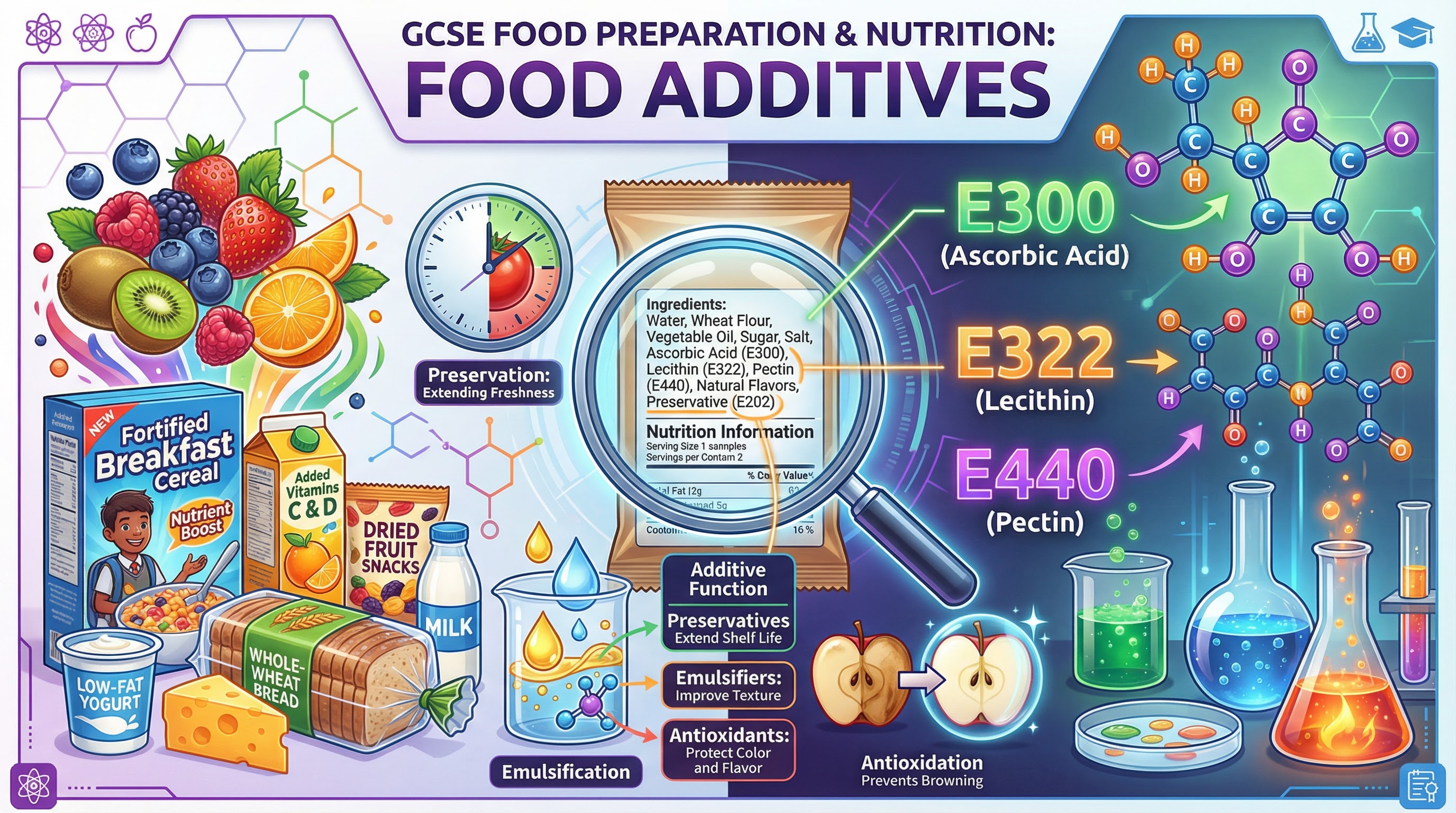
    Header image for Food Additives

    Overview

    Food additives are substances added to products to perform specific technological functions, such as preserving freshness, improving texture, or enhancing appearance. For the OCR J309 specification, candidates must move beyond a simple definition and demonstrate a robust scientific understanding of how these additives work. Examiners expect you to analyse the technological necessity of additives against potential consumer health concerns, using precise terminology and specific, named examples. This topic requires you to link the chemical properties of an additive to its function, for instance, explaining how the molecular structure of an emulsifier allows it to bind with both oil and water. High-level responses will consistently evaluate the trade-offs involved in food production, such as extending shelf-life versus the risk of allergic reactions. This guide will equip you with the detailed knowledge and analytical skills required to excel.

    Listen to our 10-minute revision podcast on Food Additives.

    Key Additive Groups

    To gain credit, candidates must be able to categorise, explain, and give examples for the main additive groups. Vague answers stating additives 'improve food' will not be awarded marks.
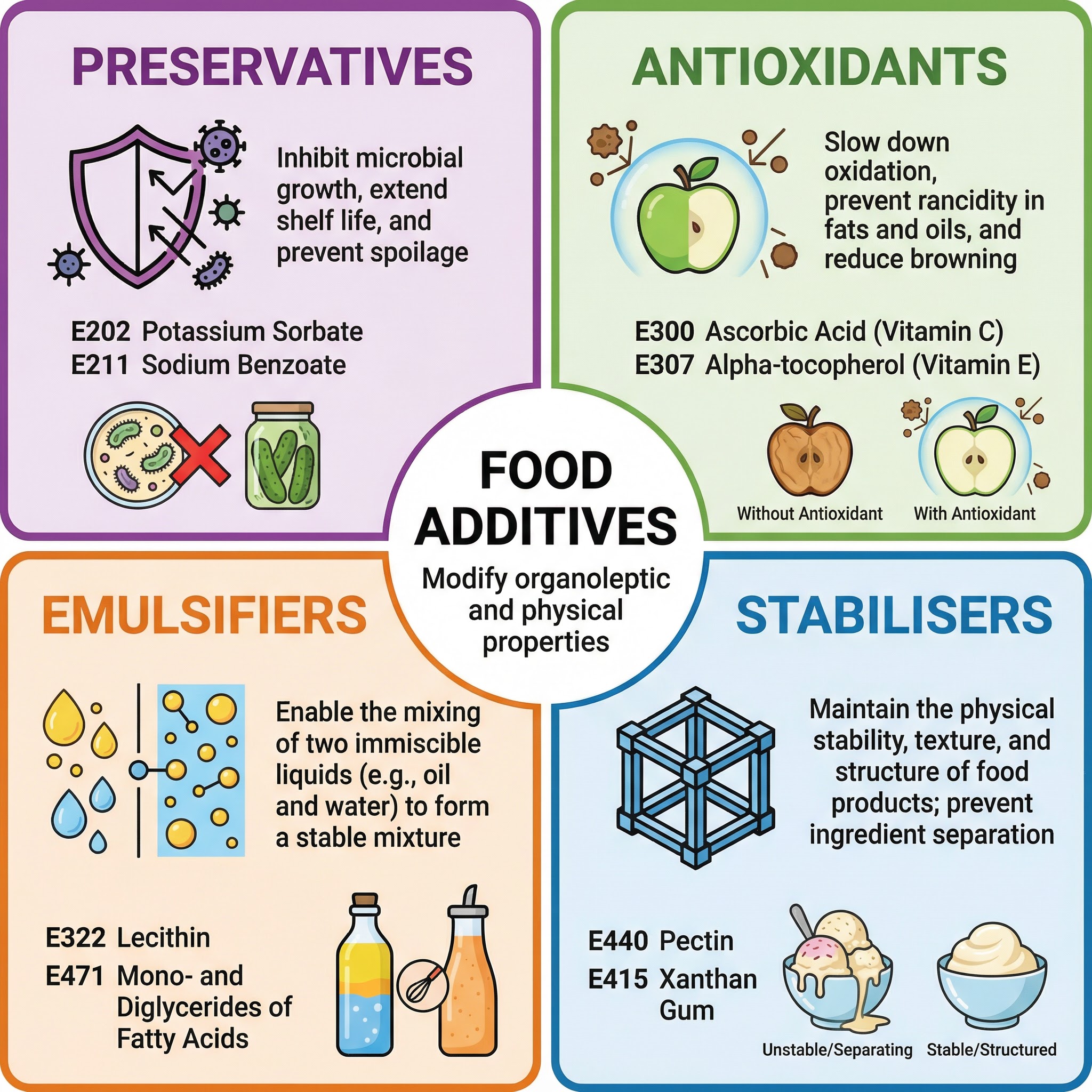
    The four main groups of food additives and their functions.

    1. Preservatives

    Function: To inhibit the growth of pathogenic microorganisms like bacteria, yeasts, and moulds, thereby extending the shelf-life of a product and preventing foodborne illness. They are a critical defence against food spoilage.

    Mechanism: Preservatives work by creating an environment that is hostile to microbes. This can be by altering the pH of the food or by interfering with the microbe's cell membrane or enzymes.

    Specific Knowledge:

    • Natural Example: Salt (Sodium Chloride) used in curing meats.
    • Artificial Example: Sodium Benzoate (E211), commonly used in acidic foods like carbonated drinks and jams.

    2. Antioxidants

    Function: To prevent or slow down the process of oxidation. Oxidation causes fats and oils to become rancid (oxidative rancidity) and leads to the enzymatic browning of cut fruits and vegetables.

    Mechanism: Antioxidants are reducing agents that readily donate electrons, neutralising free radicals before they can damage the food molecules. This protects the food's flavour, colour, and nutrient content.

    Specific Knowledge:

    • Natural Example: Ascorbic Acid (Vitamin C, E300), found in citrus fruits.
    • Artificial Example: Butylated Hydroxytoluene (BHT, E321), often used in breakfast cereals and fat-based products.

    3. Emulsifiers

    Function: To enable the mixing of two or more immiscible liquids, such as oil and water, to form a stable mixture known as an emulsion.

    Mechanism: Emulsifier molecules are characterised by having a hydrophilic ('water-loving') head and a hydrophobic or lipophilic ('water-hating' or 'oil-loving') tail. The hydrophilic head is attracted to the water molecules, while the hydrophobic tail is attracted to the oil droplets, forming a stable bridge between them and preventing them from separating.

    Specific Knowledge:

    • Natural Example: Lecithin (E322), found in egg yolk and soybeans. It is essential for making mayonnaise.

    4. Stabilisers

    Function: To help maintain the uniform dispersion of substances in a food. They provide a smooth, consistent texture and prevent ingredients from separating out.

    Mechanism: Stabilisers are often large molecules that form a network or gel structure within the food, trapping other molecules and preventing them from moving around. This gives the product 'body' and a stable structure.

    Specific Knowledge:

    • Natural Example: Pectin (E440), a polysaccharide extracted from citrus peel and apples, used to set jam.
    • Artificial Example: Xanthan Gum (E415), used to thicken sauces and in gluten-free baking.

    Natural vs. Artificial Additives

    A common misconception is that all food additives are synthetic 'chemicals'. Examiners award credit for candidates who can distinguish between natural and artificial sources and understand that both are subject to the same rigorous safety testing by the Food Standards Agency (FSA).
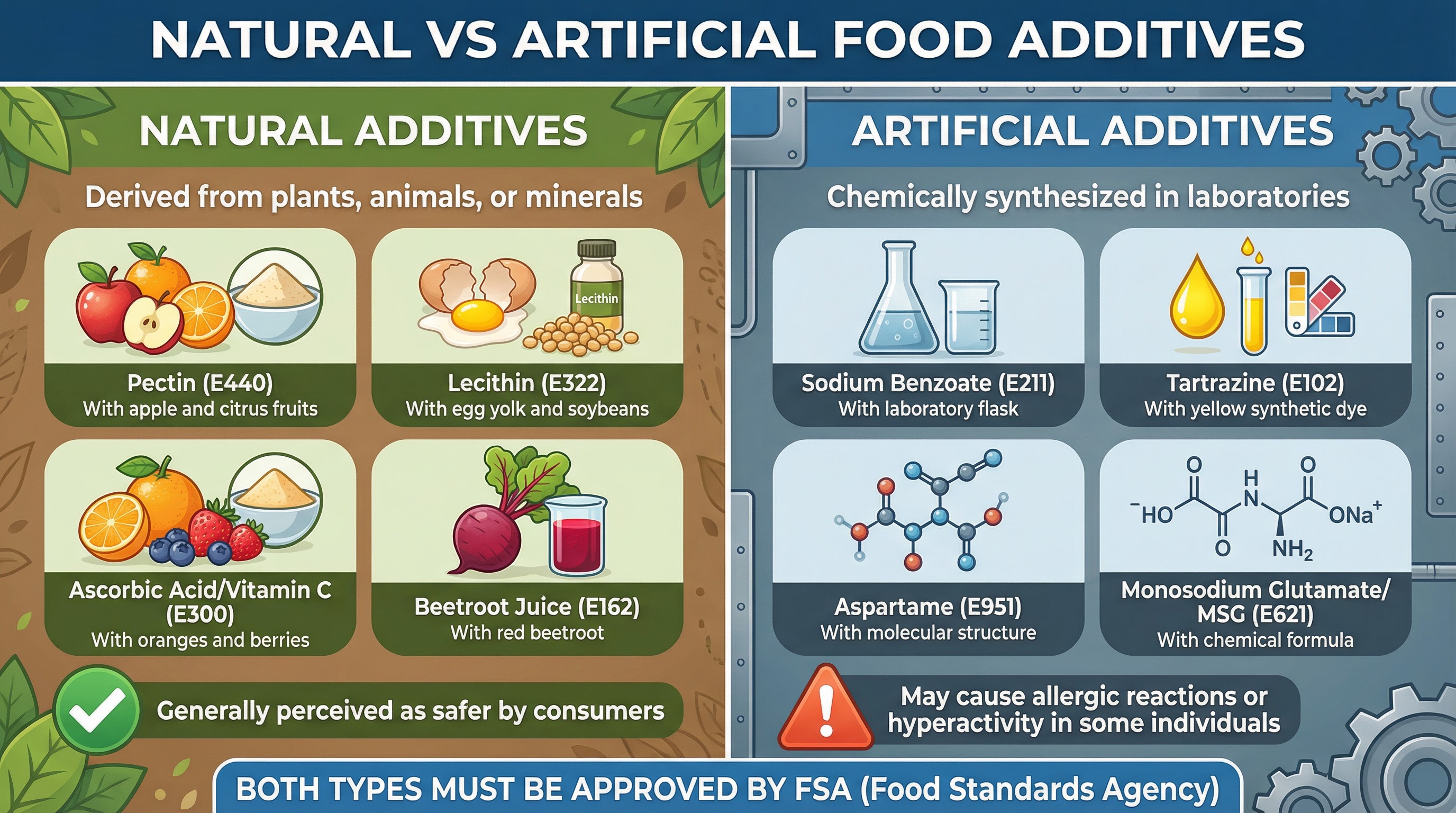
    Comparison of natural and artificial additives.

    • Natural Additives: Derived from natural sources like plants (e.g., Beetroot Juice, E162, for colour), animals, or minerals. Consumers often perceive them as safer, but they can still cause allergic reactions in some people.
    • Artificial Additives: These are synthesised chemically in a laboratory to mimic natural substances or to create compounds not found in nature. They are often cheaper to produce and more stable. However, some, like certain artificial colourings (e.g., Tartrazine, E102), have been linked to hyperactivity in children.

    Visual Resources

    2 diagrams and illustrations

    The four main groups of food additives and their functions.
    The four main groups of food additives and their functions.
    Comparison of natural and artificial additives.
    Comparison of natural and artificial additives.

    Interactive Diagrams

    1 interactive diagram to visualise key concepts

    Emulsification ProcessHydrophobic Tail AttachesHydrophilic Head AttachesOil DropletEmulsifier MoleculeWaterStable Emulsion

    Diagram showing how an emulsifier molecule uses its hydrophobic tail and hydrophilic head to bind oil and water.

    Worked Examples

    3 detailed examples with solutions and examiner commentary

    Practice Questions

    Test your understanding — click to reveal model answers

    Q1

    State two functions of food additives. (2 marks)

    2 marks
    easy

    Hint: Think about the main reasons why manufacturers add substances to food.

    Q2

    Explain how an antioxidant prevents a sliced apple from turning brown. (4 marks)

    4 marks
    standard

    Hint: Focus on the chemical reaction and how the additive interferes with it.

    Q3

    A manufacturer of salad dressing is choosing between using a natural emulsifier like lecithin or an artificial one. Discuss the factors that might influence this decision. (6 marks)

    6 marks
    standard

    Hint: Think about cost, effectiveness, and how consumers might view the product.

    Q4

    Identify an additive that could be used to prevent jam from separating and explain its function. (3 marks)

    3 marks
    easy

    Hint: What type of additive helps maintain structure?

    Q5

    Evaluate the statement: 'The use of food additives is essential in modern food production'. (12 marks)

    12 marks
    hard

    Hint: This is a top-level essay question. Argue for and against the statement, considering safety, choice, cost, and health. Come to a justified conclusion.

    Key Terms

    Essential vocabulary to know

    More Food Preparation and Nutrition Study Guides

    View all

    Sauce making

    OCR
    GCSE

    Unlock top marks in your OCR GCSE Food Preparation and Nutrition exam by mastering the science of sauce making. This guide breaks down the core principles of gelatinisation, emulsification, and reduction, providing the precise scientific language examiners want to see."

    Safe food handling practices

    OCR
    GCSE

    Mastering safe food handling is non-negotiable for a high grade in OCR GCSE Food Preparation and Nutrition. This guide moves beyond basic hygiene, delving into the microbiological principles and precise temperature controls that examiners reward. Understanding this science is the key to unlocking top-level marks and ensuring food is safe.

    Dietary Reference Values (DRVs)

    OCR
    GCSE

    Master Dietary Reference Values (DRVs) for your OCR GCSE Food Preparation and Nutrition exam. This guide breaks down the science of nutritional requirements, showing you how to apply DRV knowledge to different life stages and analyse diets like a pro to secure top marks.

    Pastry making

    OCR
    GCSE

    Pastry making is a cornerstone of the OCR GCSE Food Preparation and Nutrition specification, testing candidates' scientific understanding of ingredient functionality, chemical processes, and practical technique. Examiners award marks for precise knowledge of fat-to-flour ratios, accurate explanation of shortening and plasticity, and the ability to link functional properties to sensory outcomes. Mastering this topic demonstrates your grasp of food science principles that underpin professional culinary practice.

    Food security and global food challenges.

    OCR
    GCSE

    This study guide delves into the critical issues of food security and global food challenges, a core component of the OCR GCSE Food Preparation and Nutrition specification. It explores the complex interplay between food production, sustainability, and ethics, equipping candidates with the analytical skills to tackle high-mark exam questions."

    Ethical considerations and Fair Trade

    OCR
    GCSE

    This study guide delves into the critical topic of ethical considerations and Fair Trade in food production, a key area of the OCR GCSE Food Preparation and Nutrition specification. It provides a detailed examination of how consumer choices impact global food supply chains, animal welfare, and the livelihoods of producers in Low Income Countries (LICs), equipping students with the analytical skills needed to excel in their exams."