Study Notes
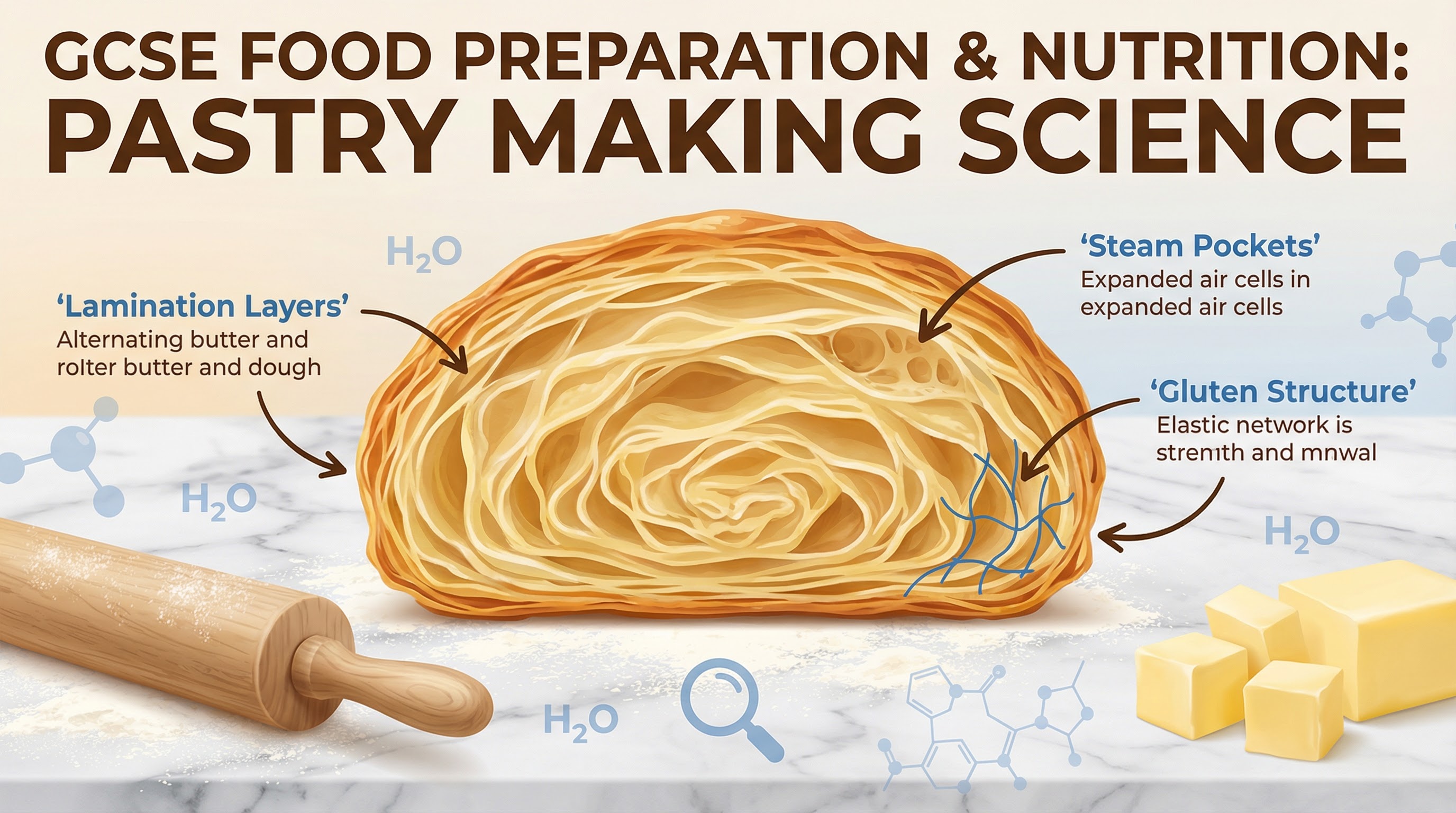
Overview
Pastry making represents one of the most scientifically rigorous areas of the OCR GCSE Food Preparation and Nutrition specification. Candidates must demonstrate not only practical competence but also a deep understanding of the functional properties of ingredients and the chemical and physical processes that occur during preparation and baking. The specification requires mastery of four distinct pastry types: shortcrust, puff, choux, and suet. Each employs different ingredient ratios, mixing methods, and raising agents, and examiners will test your ability to explain these differences with precision. This topic accounts for significant marks across Assessment Objectives, particularly AO2 (application of knowledge) and AO4 (analysis and evaluation), making it essential for candidates aiming for top grades. Understanding the science behind shortening, plasticity, dextrinisation, and steam expansion will enable you to answer extended-response questions with the analytical depth examiners reward.
The Four Types of Pastry
Shortcrust Pastry
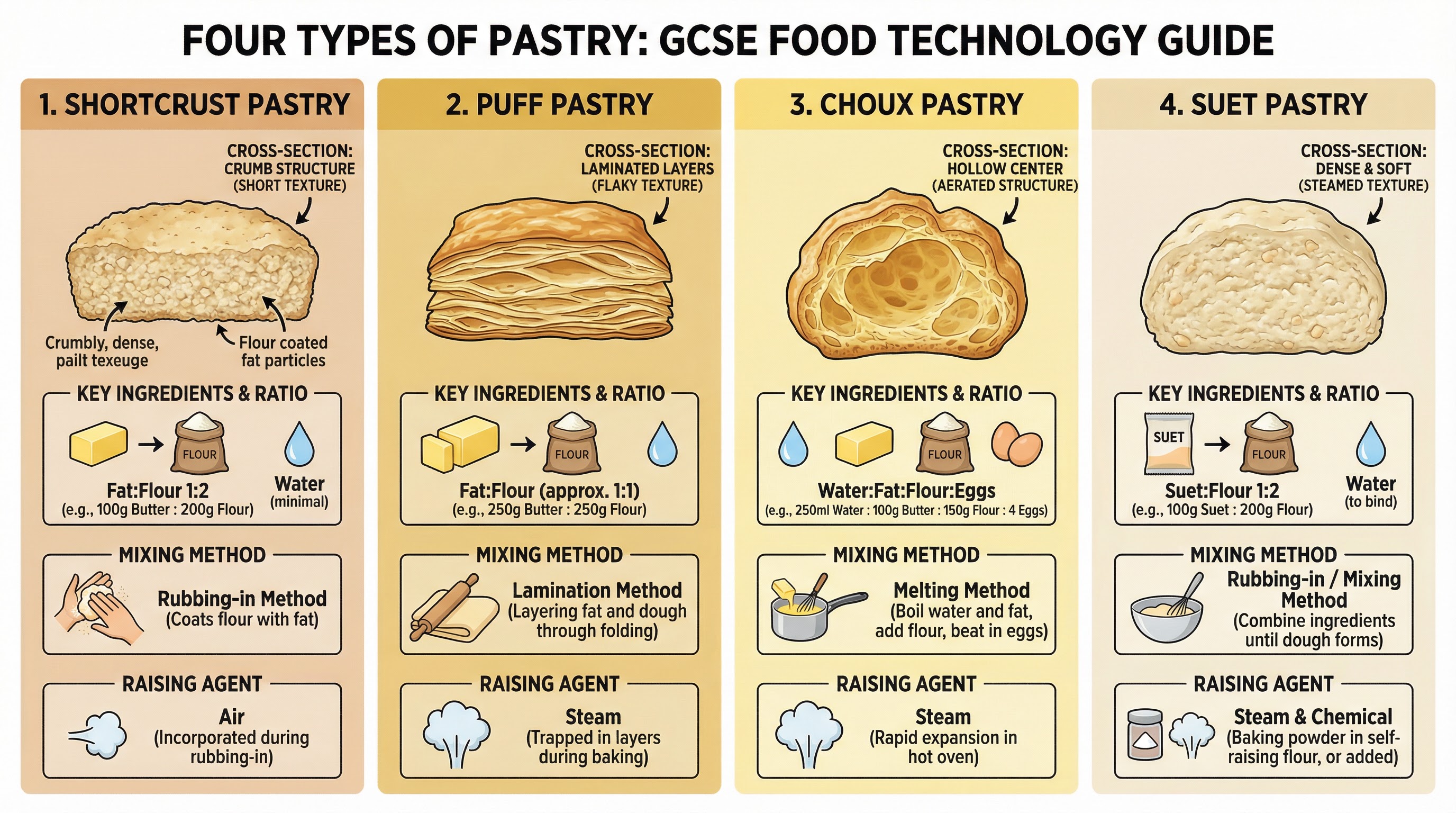
Fat-to-Flour Ratio: 1:2 (e.g., 100g butter to 200g plain flour)
Mixing Method: Rubbing-in method
Raising Agent: Air (incorporated during rubbing-in)
Sensory Characteristics: Crumbly, short texture; friable; golden colour; tender bite
Shortcrust pastry is the foundation pastry type, used for sweet and savoury pies, tarts, and quiches. The rubbing-in method involves using fingertips to coat flour particles with fat until the mixture resembles fine breadcrumbs. This technique is critical because it determines the final texture. The fat-to-flour ratio of 1:2 is a frequent low-tariff recall question in examinations, and candidates must be able to cite this precisely. Water is added sparingly to bind the dough, but excessive water leads to gluten overdevelopment and a tough, elastic pastry. The raising agent is air, trapped during the rubbing-in process and expanded by heat during baking. Examiners will penalise candidates who incorrectly identify baking powder as the raising agent in shortcrust pastry.
Puff Pastry
Fat-to-Flour Ratio: Approximately 1:1 (e.g., 250g butter to 250g strong plain flour)
Mixing Method: Lamination (layering fat and dough through repeated folding and rolling)
Raising Agent: Steam (generated from water in butter and dough)
Sensory Characteristics: Flaky, layered texture; light and crisp; golden-brown surface
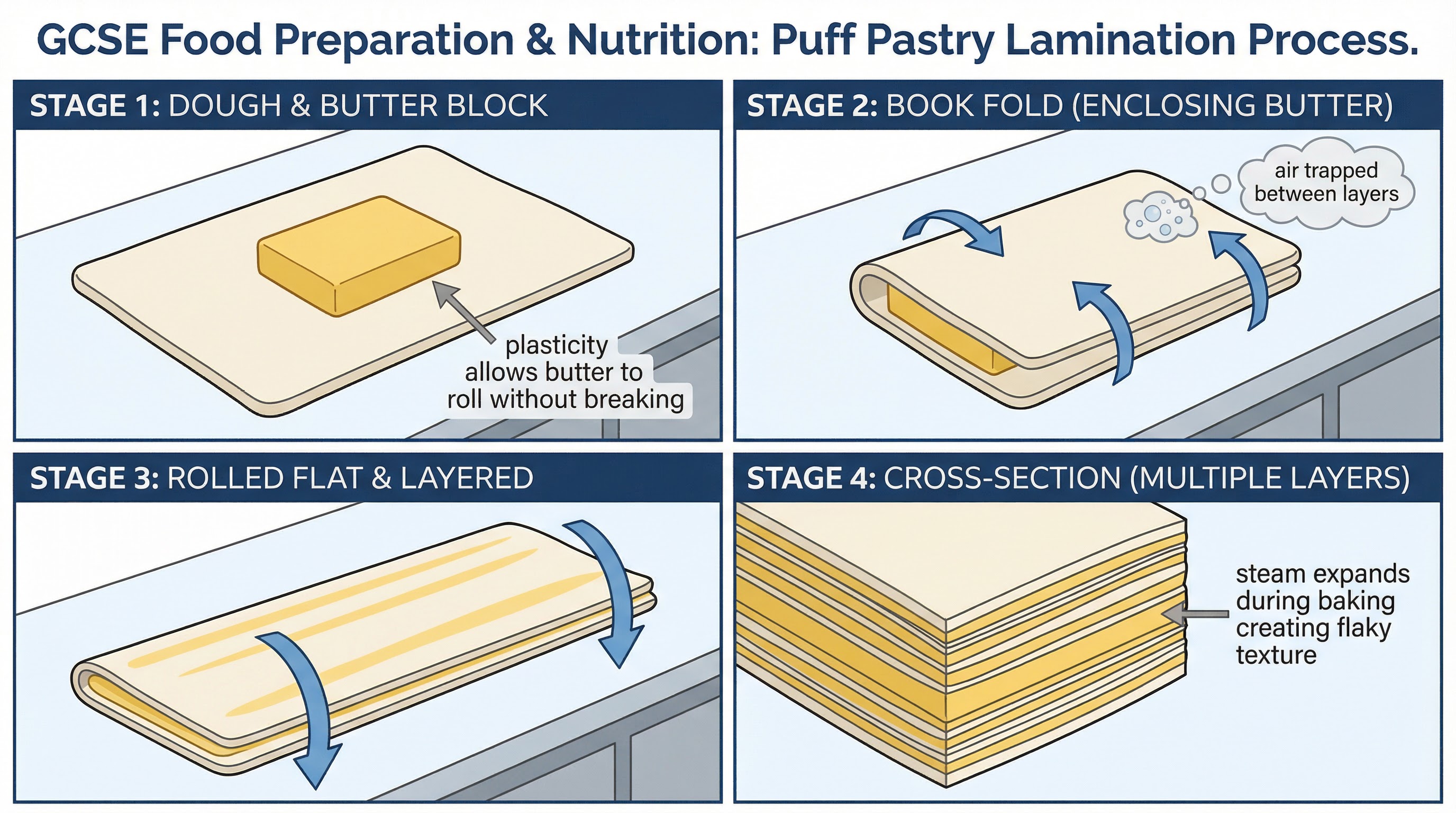
Puff pastry is a laminated pastry created by encasing a block of butter within dough and then repeatedly rolling and folding to create hundreds of thin, alternating layers of fat and dough. The fat-to-flour ratio is roughly 1:1, and strong plain flour is specified because gluten development is required to provide the structure that holds the layers. The key functional property is plasticity: the ability of butter to roll thin without breaking or melting. Butter must remain cold and solid during lamination; if it melts, the layers merge and the characteristic flaky texture is lost. During baking, the water content in both the butter and the dough converts to steam, which expands and pushes the layers apart, creating the distinctive rise and flakiness. Examiners frequently ask candidates to explain the lamination process and the role of plasticity, and responses must link these functional properties to the final sensory outcome.
Choux Pastry
Ingredient Ratio: High water content (e.g., 250ml water, 100g butter, 150g strong plain flour, 4 eggs)
Mixing Method: Melting method (boil water and fat, beat in flour, incorporate eggs)
Raising Agent: Steam (from high water content)
Sensory Characteristics: Hollow center; crisp outer shell; light and aerated structure
Choux pastry is unique among the four types because it uses a melting method and incorporates eggs. The process begins by boiling water and butter together, then beating in strong plain flour to form a thick paste (panade). Eggs are then added one at a time, beating vigorously to incorporate air and create a smooth, glossy batter. The raising agent is steam, generated from the exceptionally high water content (approximately 250ml water to 150g flour). When choux pastry enters a hot oven (typically 200°C), the water rapidly converts to steam, which expands and inflates the pastry, creating a hollow center. The strong plain flour provides the gluten structure necessary to contain the steam and maintain the shape. Candidates must specify strong plain flour in their responses, as plain flour lacks sufficient gluten. A common error is stating that baking powder is the raising agent in choux pastry; examiners will deduct marks for this mistake.
Suet Pastry
Fat-to-Flour Ratio: 1:2 (e.g., 100g suet to 200g self-raising flour)
Mixing Method: Rubbing-in or mixing method
Raising Agent: Steam and/or chemical (baking powder in self-raising flour)
Sensory Characteristics: Soft, dense texture; steamed rather than baked; pale appearance
Suet pastry uses suet, a hard animal fat from around the kidneys of cattle or sheep. The fat-to-flour ratio is 1:2, identical to shortcrust, but suet pastry is typically steamed rather than baked, making it ideal for traditional British dishes such as steak and kidney pudding, suet dumplings, and jam roly-poly. Self-raising flour is often used, which contains baking powder as a chemical raising agent. However, steam also plays a role during the steaming process. The texture is soft, dense, and moist, contrasting with the crisp, flaky textures of baked pastries. Suet has a higher melting point than butter, which contributes to the characteristic texture.
Key Scientific Processes
The Shortening Effect
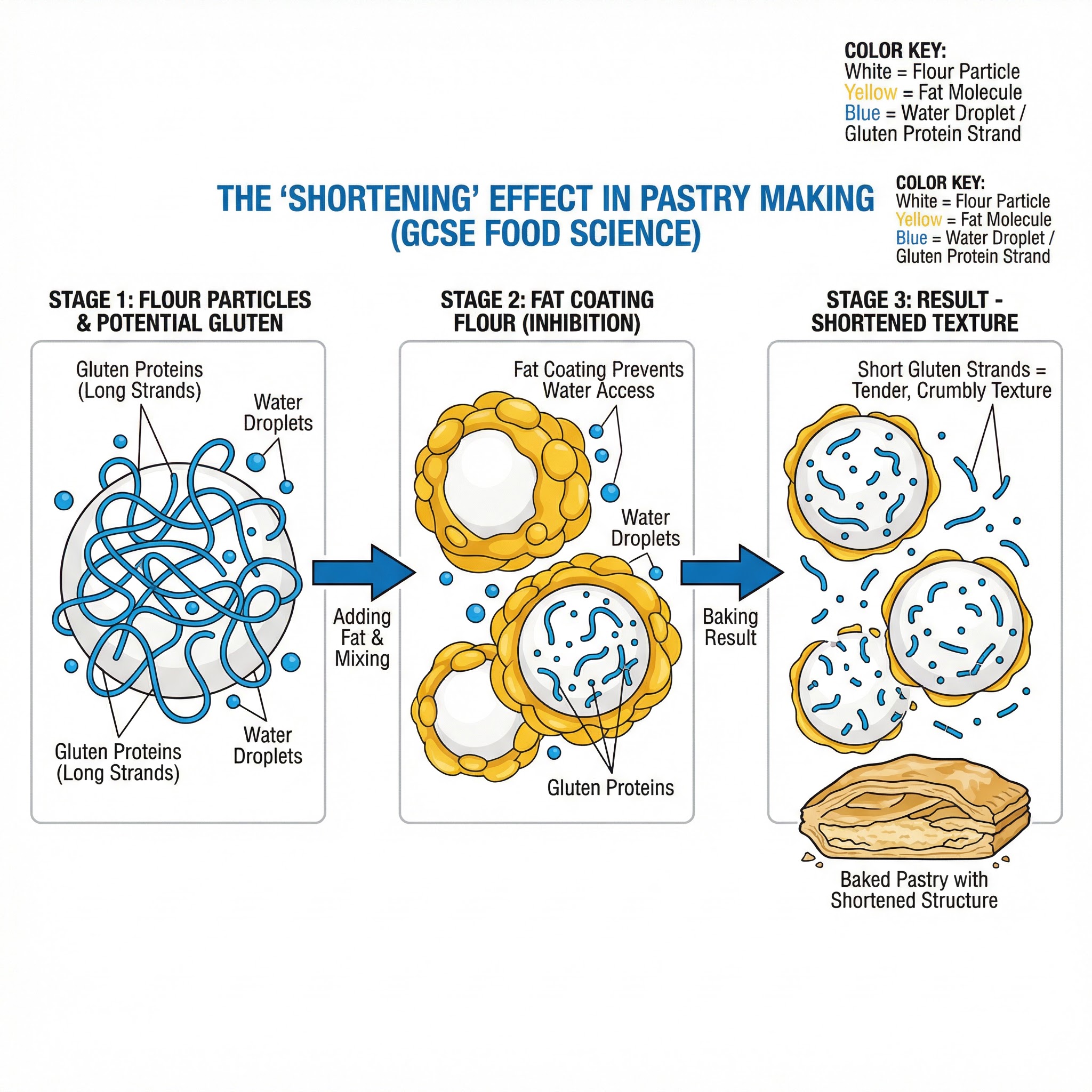
The shortening effect is the single most important scientific concept in pastry making, and examiners will award marks for accurate, detailed explanations. Shortening refers to the ability of fat to inhibit gluten development, resulting in a tender, crumbly texture. When flour is mixed with water, the proteins glutenin and gliadin combine to form gluten, an elastic network that provides structure in bread but is undesirable in pastry. Fat molecules coat the flour particles, creating a hydrophobic barrier that prevents water from reaching the gluten proteins. This inhibits gluten formation, resulting in short gluten strands rather than long, elastic networks. The final texture is described as "short," meaning it breaks cleanly rather than stretching. Candidates must be able to explain this process in extended-response questions, explicitly stating that fat coats flour particles, prevents water access to gluten proteins, and results in a tender, crumbly texture.
Plasticity
Plasticity is the functional property of fat that allows it to be rolled thin without breaking or melting. This property is critical in laminated pastries such as puff pastry, where butter must remain solid and pliable during the repeated rolling and folding process. If butter is too cold, it becomes brittle and breaks; if too warm, it melts and merges with the dough, destroying the layers. Butter has an ideal plastic range between approximately 15°C and 18°C. Examiners will credit responses that link plasticity to the successful creation of laminated layers and the final flaky texture.
Dextrinisation
Dextrinisation is the chemical process by which starch breaks down into dextrins when exposed to dry heat. This occurs on the surface of baked pastry, producing the characteristic golden-brown colour and a slightly sweet, toasted flavour. Dextrinisation begins at temperatures above 160°C. Candidates must distinguish dextrinisation (browning of starch) from caramelisation (browning of sugar) and the Maillard reaction (browning involving proteins and sugars). Examiners will penalise incorrect use of these terms.
Aeration and Steam as a Raising Agent
Steam is the primary raising agent in puff and choux pastry. When water is heated above 100°C, it converts to steam, which occupies approximately 1,600 times the volume of liquid water. In puff pastry, steam trapped between laminated layers expands, pushing the layers apart and creating the flaky rise. In choux pastry, the high water content generates steam that inflates the pastry from within, creating a hollow center. Candidates must be able to explain the role of steam in both contexts and link it to the final structure and texture.
Named Example Bank
- Shortcrust Pastry Ratio: 100g butter to 200g plain flour (1:2 ratio)
- Puff Pastry Ratio: 250g butter to 250g strong plain flour (1:1 ratio)
- Choux Pastry Ingredients: 250ml water, 100g butter, 150g strong plain flour, 4 eggs
- Suet Pastry Ratio: 100g suet to 200g self-raising flour (1:2 ratio)
- Baking Temperature for Choux: 200°C (high heat to generate rapid steam expansion)
- Plasticity Temperature Range: 15°C to 18°C (ideal range for butter in laminated pastry)
- Dextrinisation Temperature: Above 160°C (starch breakdown begins)
- Steam Expansion Factor: Water expands approximately 1,600 times when converted to steam
- Gluten Proteins: Glutenin and gliadin (combine with water to form gluten)
- Sensory Descriptors: Friable, flaky, crisp, golden, tender, short, crumbly, aerated
Podcast Episode
Listen to the 10-minute podcast episode for an engaging audio summary of pastry making science, exam tips, and quick-fire recall questions. The episode covers all four pastry types, key scientific processes, and common mistakes to avoid.
Synoptic Links Across the Specification
Pastry making connects to multiple areas of the OCR specification, and examiners reward candidates who demonstrate synoptic understanding by linking topics across the course.
Link to Protein and Gluten Development: The shortening effect in pastry making directly contrasts with bread making, where gluten development is desirable. In bread, strong flour and kneading encourage long gluten networks for elasticity and structure. In pastry, fat inhibits gluten to create tenderness. Candidates should be able to compare and contrast these processes.
Link to Raising Agents: Pastry making demonstrates three types of raising agents: air (shortcrust), steam (puff and choux), and chemical (suet with self-raising flour). This links to the broader topic of raising agents in baked goods, including biological raising agents (yeast) used in bread and buns.
Link to Sensory Evaluation: Pastry provides excellent opportunities for sensory analysis. Candidates should be able to describe texture (friable, flaky, short), appearance (golden, layered), and taste (buttery, slightly sweet from dextrinisation) using precise terminology. This links to the sensory evaluation component of the specification.
Link to Functional Properties of Ingredients: Pastry making exemplifies the functional properties of fat (shortening, plasticity, aeration, flavour), flour (structure, bulk), water (binding, steam generation), and eggs (binding, enrichment, colour). These functional properties apply across multiple food preparation contexts.