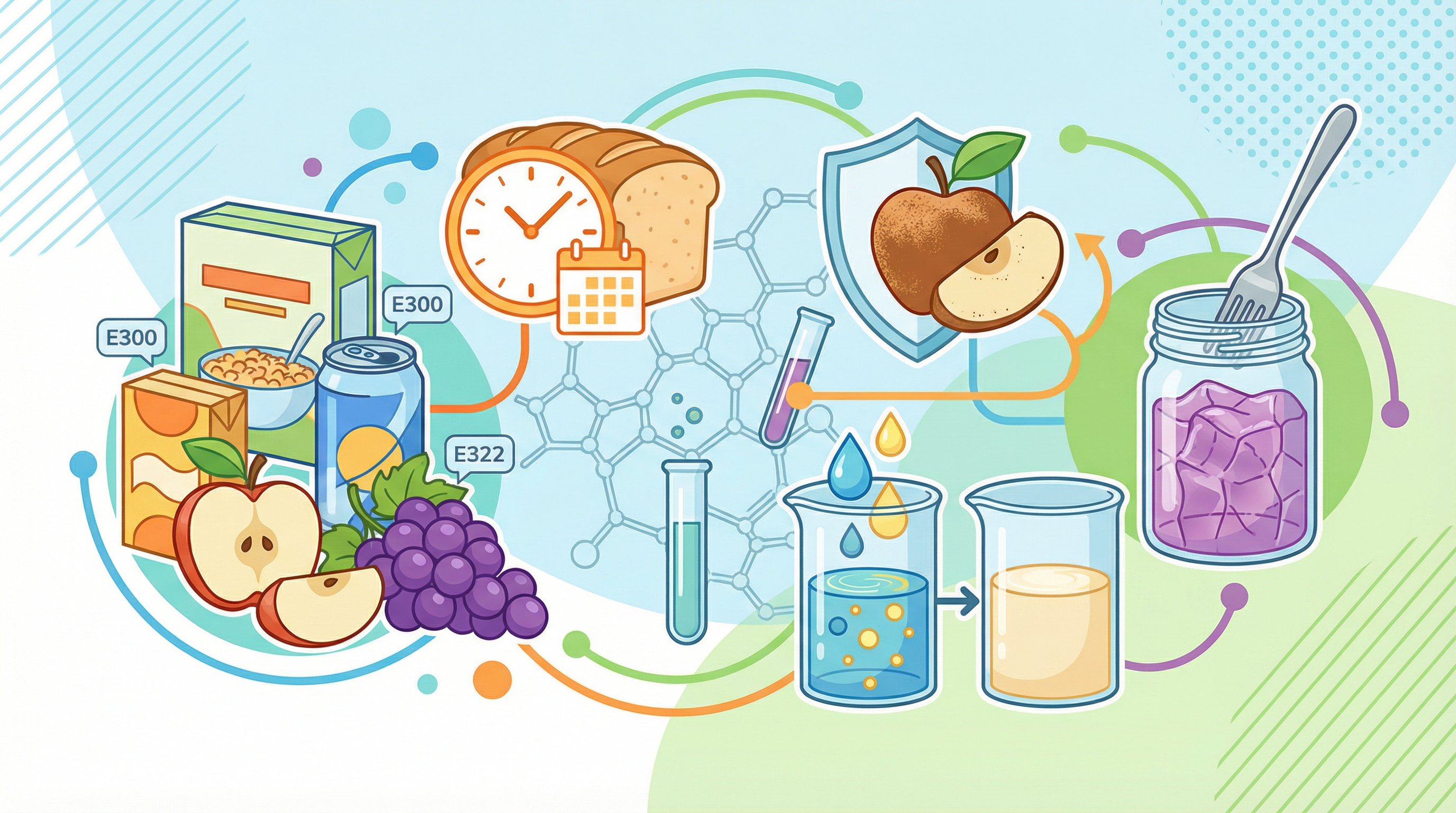
Food additives and their functions. — OCR GCSE study guide illustration

    Food additives and their functions.

    Unlock top marks in your OCR GCSE Food Preparation and Nutrition exam by mastering the science of food additives. This guide demystifies preservatives, antioxidants, emulsifiers, and stabilisers, showing you exactly how they work and what examiners want to see for a high-grade response.

    5
    Min Read
    3
    Examples
    5
    Questions
    6
    Key Terms
    🎙 Podcast Episode
    Food additives and their functions.
    0:00-0:00

    Study Notes

    Header image for OCR GCSE Food Additives

    Overview

    This study guide provides a comprehensive analysis of food additives, a core component of the OCR J309 GCSE specification. Understanding additives is not merely about listing E-numbers; it requires a scientific appreciation of their function. Examiners expect candidates to explain how these substances modify the properties of food, from extending shelf-life to improving texture and appearance. This guide will break down the four principal categories of additives: preservatives, antioxidants, emulsifiers, and stabilisers. We will explore their chemical mechanisms, provide specific examples (both natural and artificial) that you must memorise, and analyse the technological benefits versus consumer health concerns. By engaging with the content, worked examples, and exam tips provided, you will be equipped to answer questions with the precision and analytical depth required to achieve the highest marks.

    Listen to our revision podcast on Food Additives.

    The Four Key Types of Food Additives

    Examiners require you to be able to distinguish clearly between the four main functional groups of additives. Credit is awarded for using precise scientific language to describe their purpose.
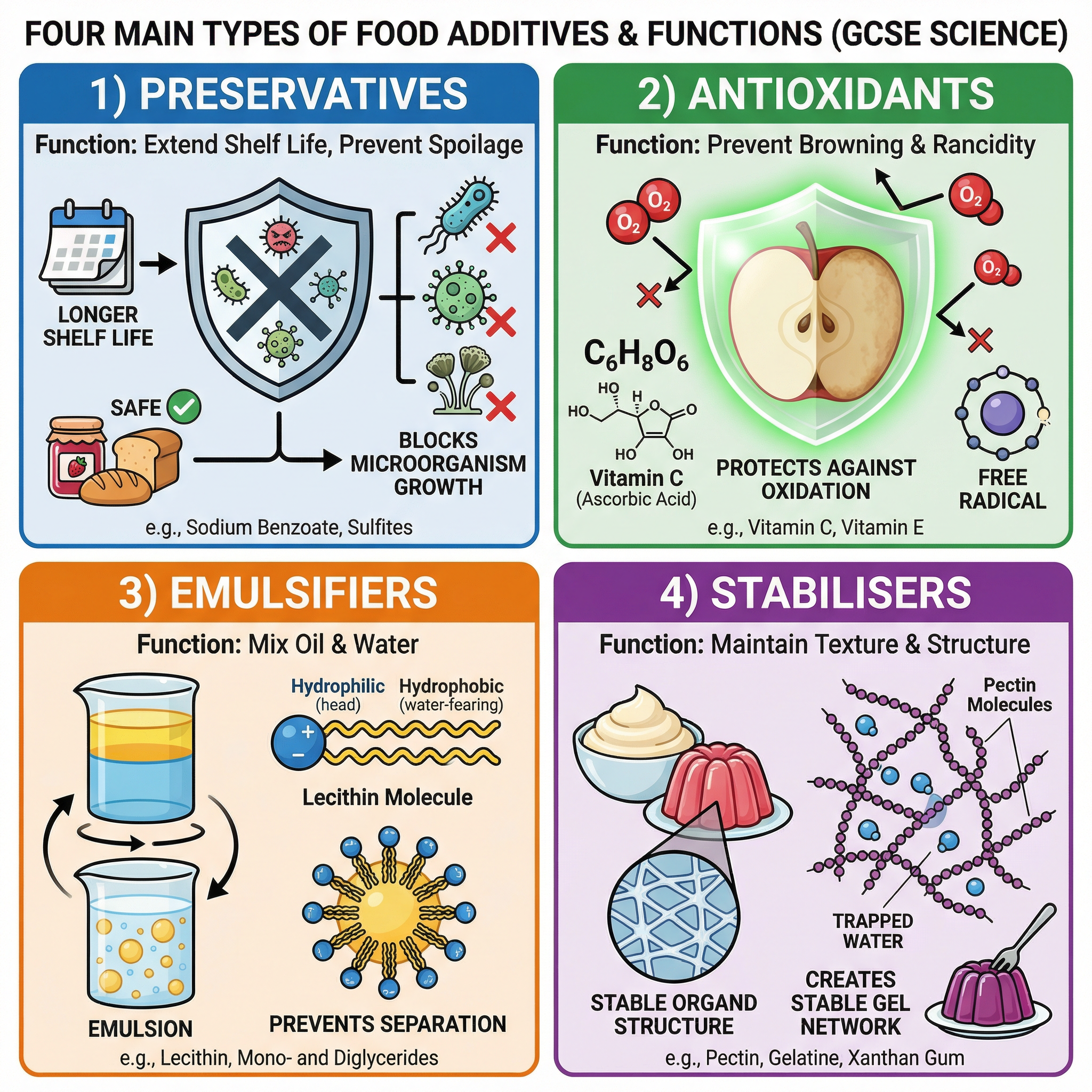
    The Four Main Functions of Food Additives

    1. Preservatives

    Function: To inhibit the growth of pathogenic microorganisms such as bacteria, yeasts, and moulds, thereby extending the shelf-life of food and preventing foodborne illness.

    Mechanism: Preservatives work by creating an environment that is hostile to microbial life. This can be through various means, such as altering the pH of the food or interfering with the microbe's cell membrane or enzymes.

    Specific Knowledge: You must be able to name both natural and artificial examples.

    • Natural: Salt (sodium chloride) used in curing meats like bacon; Vinegar (acetic acid) used in pickling.
    • Artificial: Sodium Benzoate (E211) found in acidic foods like soft drinks and jams; Sulphites (E220-E228) used in wine and dried fruits to prevent microbial spoilage.

    2. Antioxidants

    Function: To prevent the chemical process of oxidation, which causes fats and oils to become rancid and cut fruit surfaces to brown.

    Mechanism: Antioxidants are substances that are easily oxidised themselves. They 'sacrifice' themselves to react with oxygen before it can damage the food components. This is a crucial distinction from preservatives; antioxidants prevent chemical spoilage, not microbial spoilage.

    Specific Knowledge:

    • Natural: Ascorbic Acid (Vitamin C, E300) is added to fruit juices and cut fruits to prevent enzymatic browning. Tocopherols (Vitamin E, E306-E309) are added to fatty products.
    • Artificial: Butylated Hydroxyanisole (BHA, E320) and Butylated Hydroxytoluene (BHT, E321) are used in products containing fats, such as cereals, chewing gum, and vegetable oils.

    3. Emulsifiers

    Function: To enable the mixing of two immiscible liquids, such as oil and water, to form a stable mixture called an emulsion.

    Mechanism: Emulsifier molecules have a dual structure: a hydrophilic (water-loving) head and a hydrophobic (water-hating/oil-loving) tail. The hydrophobic tail dissolves in the oil droplets, while the hydrophilic head dissolves in the surrounding water, creating a stable bridge between them and preventing them from separating.

    Specific Knowledge:

    • Natural: Lecithin (E322), found in egg yolk and soya beans, is the classic example used to stabilise mayonnaise.
    • Artificial: Mono- and di-glycerides of fatty acids (E471) are widely used in ice cream, margarine, and baked goods to create a smooth, uniform texture.

    4. Stabilisers

    Function: To help maintain a uniform dispersion of substances in a food. They are used to give food a firm, consistent body and texture, and to prevent the separation of ingredients (like in an emulsion).

    Mechanism: Stabilisers are large molecules that form a three-dimensional network within the food, trapping water molecules. This increases the viscosity of the product and provides structural support, preventing ingredients from settling out.

    Specific Knowledge:

    • Natural: Pectin (E440), extracted from citrus peel and apples, is the gelling agent responsible for setting jam and marmalade. Gelatine, from animal collagen, is used in jellies and mousses.
    • Artificial: Xanthan Gum (E415) is used to thicken sauces, salad dressings, and is common in gluten-free products to provide texture.

    Natural vs. Artificial Additives

    It is a common misconception that all additives are synthetic 'chemicals'. Examiners award credit for recognising that many additives are derived from natural sources. However, you must also be able to evaluate the use of both natural and artificial additives, considering their technological necessity against consumer perceptions and health concerns.
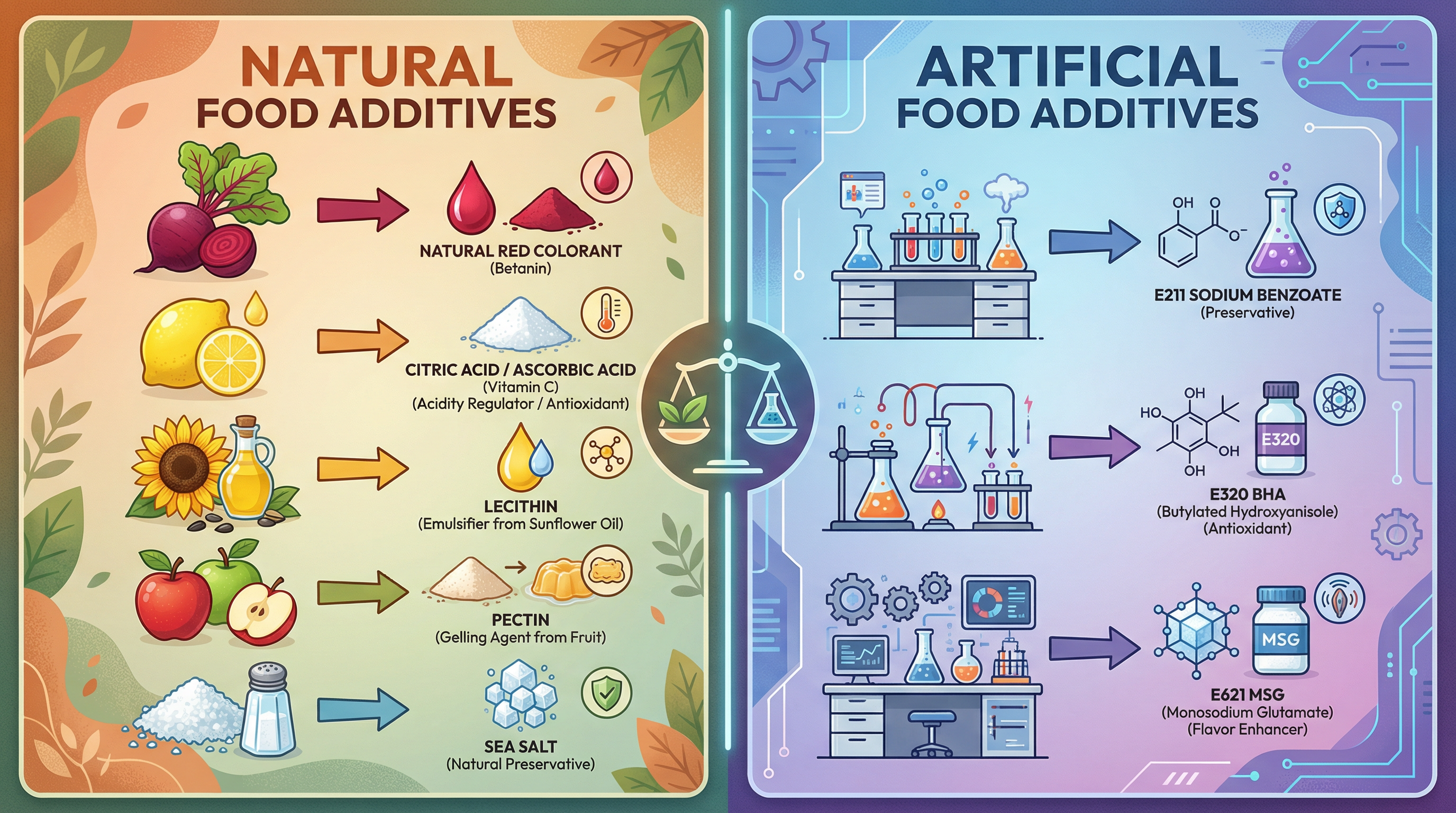
    A Comparison of Natural and Artificial Additives

    Worked Examples

    3 detailed examples with solutions and examiner commentary

    Practice Questions

    Test your understanding — click to reveal model answers

    Q1

    State two functions of food additives. (2 marks)

    2 marks
    easy

    Hint: Think about the main reasons manufacturers add substances to food.

    Q2

    Explain how an antioxidant, such as Vitamin C, prevents a sliced apple from turning brown. (3 marks)

    3 marks
    standard

    Hint: Focus on the chemical reaction and how the additive interferes with it.

    Q3

    A manufacturer wants to make a salad dressing. Explain why lecithin is a suitable additive. (4 marks)

    4 marks
    standard

    Hint: Think about the ingredients in a salad dressing and how they behave when mixed.

    Q4

    Evaluate the statement: 'All food additives are harmful and should be removed from our food.' (8 marks)

    8 marks
    hard

    Hint: This is an 'evaluate' question, so you need a balanced argument with a final judgement.

    Q5

    Compare the functions of preservatives and antioxidants. (4 marks)

    4 marks
    standard

    Hint: Directly compare them - what is the key difference in what they prevent?

    Key Terms

    Essential vocabulary to know

    More Food Preparation and Nutrition Study Guides

    View all

    Food preservation methods

    AQA
    GCSE

    Unlock top marks in your AQA GCSE Food exam by mastering the science of food preservation. This guide breaks down how stopping microbial growth through temperature, water removal, and chemical means is not just a cooking technique, but a core scientific principle essential for food safety and product development.

    Food waste

    AQA
    GCSE

    This study guide tackles the critical issue of food waste, a key component of the AQA GCSE Food Preparation and Nutrition specification (Section 5: Food Provenance). It explores the environmental, economic, and social impacts of waste, providing candidates with the specific knowledge and exam techniques needed to achieve top marks. Understanding this topic is vital for explaining the link between consumer behaviour and global food sustainability.

    Food miles and sustainability

    AQA
    GCSE

    This study guide delves into the critical topic of food miles and sustainability, a key area of the AQA GCSE Food Preparation and Nutrition specification. It explores the environmental impact of our food choices, equipping candidates with the analytical skills needed to evaluate food provenance and secure top marks in their exam.

    Cooking methods

    Edexcel
    GCSE

    Mastering cooking methods is fundamental to excelling in your GCSE Food Preparation and Nutrition exam. This guide breaks down the core science of heat transfer and chemical changes, giving you the precise language and analytical skills examiners reward. Move beyond simply following recipes to scientifically justifying your cooking choices for top marks.

    Seasonal foods

    AQA
    GCSE

    This study guide explores the crucial topic of seasonal foods within the AQA GCSE Food Preparation and Nutrition specification. Understanding seasonality is vital for exam success, as it connects directly to food provenance, sustainability, and the organoleptic qualities of ingredients, allowing candidates to achieve higher marks by demonstrating a deep and applied knowledge of where food comes from.

    Organic food production

    AQA
    GCSE

    This study guide delves into the crucial topic of Organic Food Production for AQA GCSE Food Preparation and Nutrition. It provides a comprehensive overview of the principles, practices, and regulations governing organic farming, equipping students with the knowledge to evaluate its environmental and economic trade-offs effectively.