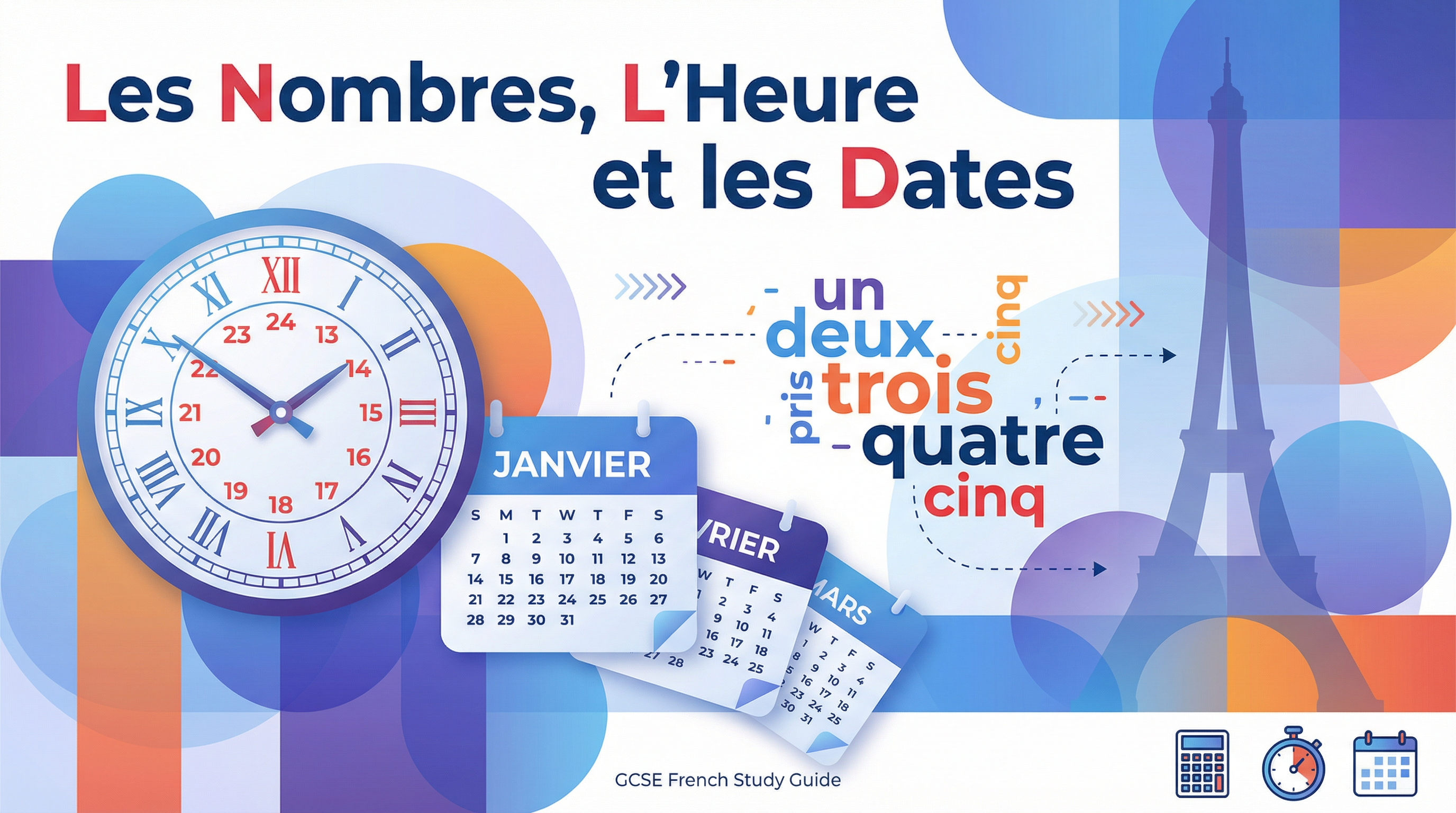
Understanding numbers, times, and dates — Edexcel GCSE study guide illustration

    Understanding numbers, times, and dates

    Edexcel
    GCSE
    French

    Mastering numbers, times, and dates is non-negotiable for a top grade in GCSE French. This guide breaks down the essential rules, from the 24-hour clock to tricky number formations, giving you the precision needed to impress examiners across all four papers.

    5
    Min Read
    3
    Examples
    5
    Questions
    6
    Key Terms
    🎙 Podcast Episode
    Understanding numbers, times, and dates
    0:00-0:00

    Study Notes

    Mastering French Numbers, Times, and Dates.

    Overview

    Edexcel GCSE French demands absolute precision in the transcription and production of quantitative data. Mastery of cardinal/ordinal numbers, the 24-hour clock, and calendar vocabulary is critical for accessing marks in Listening (AO1) and Reading (AO3) where distractors often rely on numerical nuance, and for ensuring communication clarity in Speaking (AO2) and Writing (AO4). Examiners expect candidates to not only understand this data but to produce it accurately under pressure, avoiding common errors like incorrect capitalization or preposition use. This guide provides a comprehensive breakdown of the core knowledge and exam techniques required to turn this fundamental topic into a reliable source of marks.

    Podcast: Mastering GCSE French Numbers, Times & Dates.

    Core Number Systems

    Cardinal Numbers (1-100+)

    What you need to know: French numbers are logical until 69, after which they become mathematical, especially in Standard French. Candidates must be able to recognise and produce these forms instantly.

    Key Patterns:

    • 1-69: Largely regular. Key phonetic traps include deux (2) vs douze (12) and treize (13) vs seize (16).
    • 70-79: Based on 60. soixante-dix (70), soixante-et-onze (71), soixante-douze (72), etc.
    • 80-99: Based on 20. quatre-vingts (80), quatre-vingt-un (81), quatre-vingt-dix (90), quatre-vingt-onze (91).

    Why it matters: In Listening, an answer might be soixante-seize (76), with a distractor of seize (16). In Speaking, hesitation over these numbers can lose you fluency marks. Credit is given for the correct formation, and marks are lost where ambiguity arises.
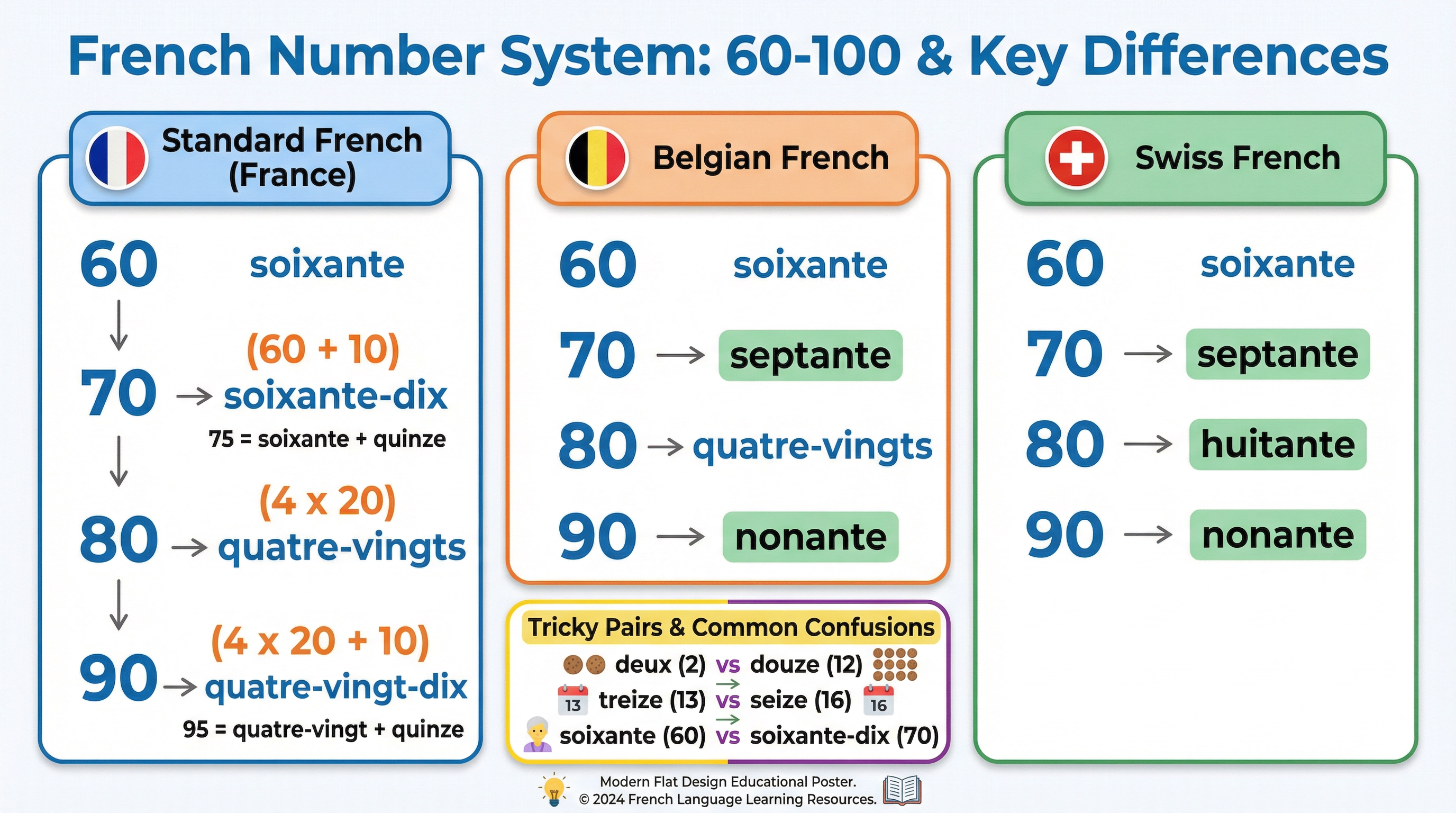
    French Number System: 60-100 & Key Differences.

    Ordinal Numbers

    What you need to know: Ordinal numbers (first, second, third) are crucial for dates and sequencing. The main rule is adding -ième to the cardinal number, with a few exceptions.

    Specific Knowledge:

    • First: premier (masculine) / première (feminine). This is the most common exception and is essential for dates (le premier mai).
    • Second: Can be deuxième or second(e). Deuxième is more common, especially when there are more than two items in a list.
    • Fifth: cinquième (note the u).
    • Ninth: neuvième (the f becomes a v).

    Telling the Time (L'Heure)

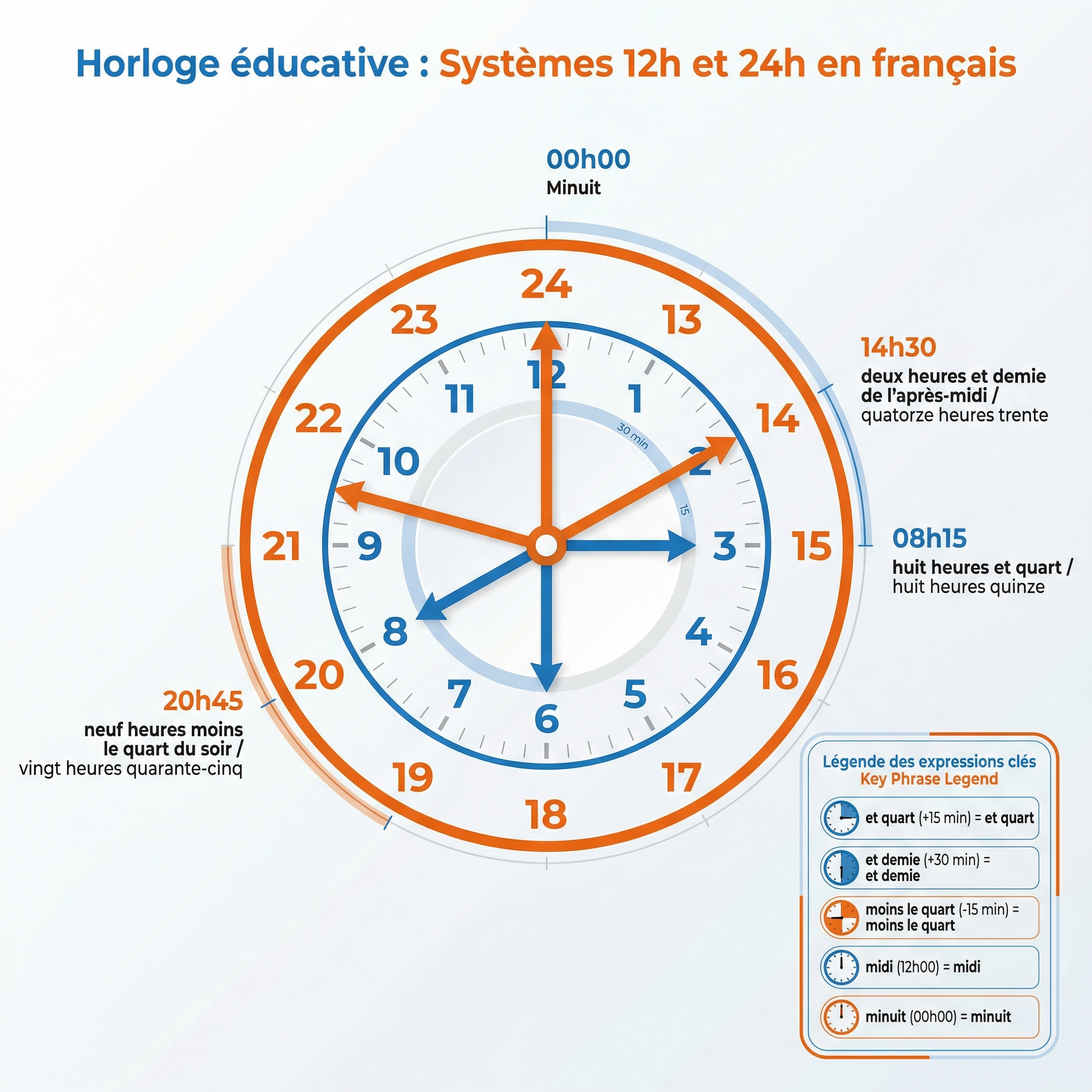
    The 24-Hour Clock

    What you need to know: The 24-hour clock (l'heure officielle) is standard in all written contexts: train timetables, school schedules, official appointments. Candidates must be fluent in this system.

    Key Structures:

    • Format: [Hour]h[Minute]. Example: 14h30.
    • Spoken Form: quatorze heures trente. The word heures is always plural (unless it's 1 o'clock) and minutes is often omitted.
    • Key Times: midi (12h00) and minuit (00h00). Examiners will penalize the use of douze heures for noon.

    The 12-Hour Clock & Common Phrases

    What you need to know: While less formal, the 12-hour clock is common in spoken French and uses specific phrases for quarter and half hours.

    Specific Knowledge:

    • ...et quart: quarter past (e.g., trois heures et quart - 3:15)
    • ...et demie: half past (e.g., trois heures et demie - 3:30). Note demie agrees with heure (feminine).
    • ...moins le quart: quarter to (e.g., quatre heures moins le quart - 3:45)

    Horloge éducative : Systèmes 12h et 24h en français.

    Expressing Dates (Les Dates)

    Structure and Prepositions

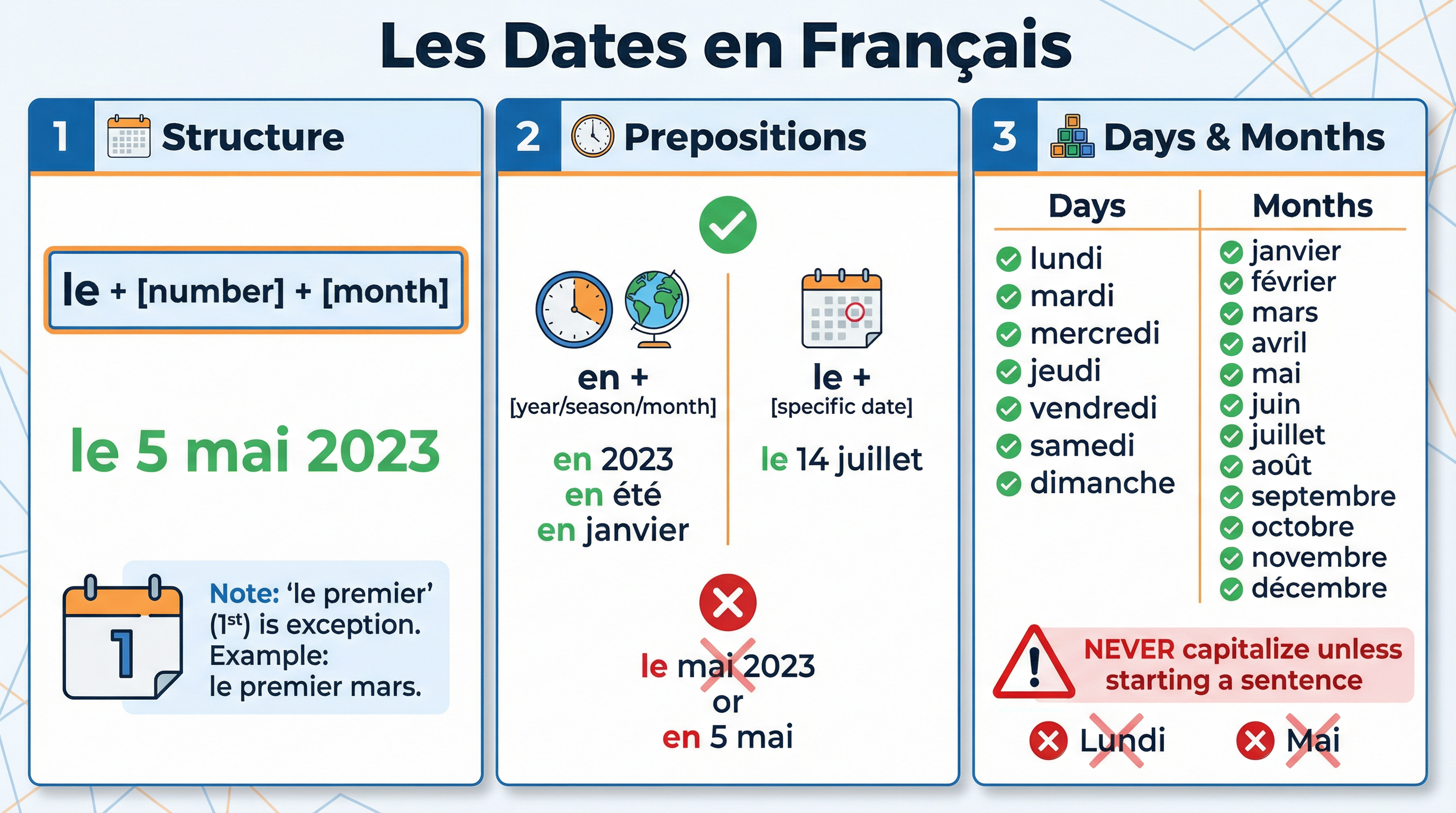
    What you need to know: The format for dates is rigid. Marks are consistently lost for incorrect structure and capitalization.

    Key Rules:

    • Format: le + [number] + [month] + [year]. Example: le 5 mai 2023. The le is mandatory.
    • Capitalization: Days of the week and months of the year are never capitalized in French unless they begin a sentence. This is a key marking point in AO4 (Writing).
    • Prepositions: Use en for months, seasons, and years (en mai, en hiver, en 2024). Use le for specific dates (le 14 juillet).

    Les Dates en Français: Structure, Prepositions & Rules.

    Worked Examples

    3 detailed examples with solutions and examiner commentary

    Practice Questions

    Test your understanding — click to reveal model answers

    Q1

    Translate into French: 'The meeting is on Tuesday, the 22nd of November.'

    3 marks
    standard

    Hint: Remember the structure for dates and the rule about capitalizing days of the week.

    Q2

    You hear the following announcement: Le train pour Lyon partira de la voie six à dix-sept heures cinquante. What time does the train leave?

    1 marks
    standard

    Hint: Convert the time from the 24-hour clock.

    Q3

    Write the following number in French words: 95

    1 marks
    hard

    Hint: Remember the 'four-twenty-ten' rule.

    Q4

    Your friend asks you what you did last weekend. Write a sentence in French saying: 'On Saturday, I went to the cinema at half past eight in the evening.'

    3 marks
    hard

    Hint: Use the 12-hour clock phrases and the passé composé.

    Q5

    You are reading a blog post. Je suis né en 1998. Mon frère est né trois ans avant moi. In what year was the brother born?

    1 marks
    standard

    Hint: 'Avant' means 'before'. You need to do a simple calculation.

    Key Terms

    Essential vocabulary to know

    More French Study Guides

    View all

    Prepositions

    AQA
    GCSE

    Mastering French prepositions is a game-changer for your AQA GCSE exam. This guide breaks down the essential rules for using words like 'à', 'de', and 'en' correctly, giving you the tools to boost your grade by demonstrating precision and a wider range of language, which is critical for hitting the top marks in both speaking and writing.

    Participating in conversations and discussions

    WJEC
    GCSE

    This guide focuses on the WJEC GCSE French Speaking exam (Unit 2), specifically the general conversation. It's designed to help you move beyond pre-learned answers, engage in spontaneous discussion, and use sophisticated language to secure top marks.

    Describing events and experiences

    WJEC
    GCSE

    Master the art of describing events and experiences in WJEC GCSE French. This guide will equip you with the essential grammar, vocabulary, and exam techniques to confidently narrate past events and achieve top marks.

    Global issues

    AQA
    GCSE

    This study guide for AQA GCSE French (Theme 2, Topic 3: Global Issues) provides a comprehensive, exam-focused resource to help students master the vocabulary and grammar needed to discuss environmental and social problems. It is designed to build confidence and secure top marks by focusing on examiner expectations, complex structures, and common pitfalls.

    Conjunctions

    AQA
    GCSE

    Unlock top marks in your AQA GCSE French exams by mastering conjunctions. This guide will transform your writing and speaking from simple to sophisticated, showing you how to use linking words to demonstrate the complexity and range of language that examiners reward.

    Identifying key information

    AQA
    GCSE

    Identifying key information in AQA GCSE French is the foundation skill that determines whether candidates earn marks for precision or lose them through vague responses. This study focuses on extracting specific details from authentic French sources, distinguishing timeframes, recognising negation, and navigating examiner-designed distractors. Mastering this skill unlocks success across 80% of the assessment objectives in Papers 1 and 3.