Participating in conversations and discussions

    WJEC
    GCSE
    French

    This guide focuses on the WJEC GCSE French Speaking exam (Unit 2), specifically the general conversation. It's designed to help you move beyond pre-learned answers, engage in spontaneous discussion, and use sophisticated language to secure top marks.

    4
    Min Read
    3
    Examples
    5
    Questions
    0
    Key Terms
    🎙 Podcast Episode
    Participating in conversations and discussions
    0:00-0:00

    Study Notes

    header_image.png

    Overview

    The WJEC GCSE French Speaking exam's general conversation is your opportunity to showcase your ability to communicate effectively and spontaneously in French. This section of the exam, which accounts for a significant portion of your overall speaking mark, assesses your ability to understand and respond to unseen questions on a variety of topics. Examiners are looking for candidates who can not only provide information but also express and justify opinions, narrate events across different time frames (past, present, and future), and interact authentically. Success in this part of the exam hinges on moving away from rote-learned monologues and towards genuine conversational skills. This guide will equip you with the structures, vocabulary, and techniques to navigate the conversation with confidence, demonstrating the full range of your linguistic abilities and securing the highest marks.

    participating_in_conversations_and_discussions_podcast.wav

    Key Skills for Top Marks

    Spontaneity and Interaction

    What it is: This is about having a natural, flowing conversation with the examiner. It means listening carefully to the question asked and responding directly to it, rather than reciting a prepared answer on a general topic.

    Why it matters: Marks are specifically awarded for 'Communication and Interaction'. A candidate who ignores the question and gives a pre-prepared speech will not score highly. Engaging with the examiner, even asking them a question back (e.g., "Et vous?"), demonstrates confidence and authentic conversational ability.

    Examiner Tip: Use 'repair strategies' if you don't understand. Saying "Pardon, pouvez-vous répéter?" is much better than guessing. It maintains the interaction and shows you are actively listening.

    Linguistic Structures and Vocabulary

    What it is: This involves using a wide range of vocabulary and, crucially, complex grammatical structures. This is what separates a good candidate from an excellent one.

    Why it matters: To access the top mark bands for 'Vocabulary and Structures', you must demonstrate ambition in your language. Over-reliance on simple phrases like "c'est" or "il y a" will limit your score.

    Specific Knowledge: Aim to include:

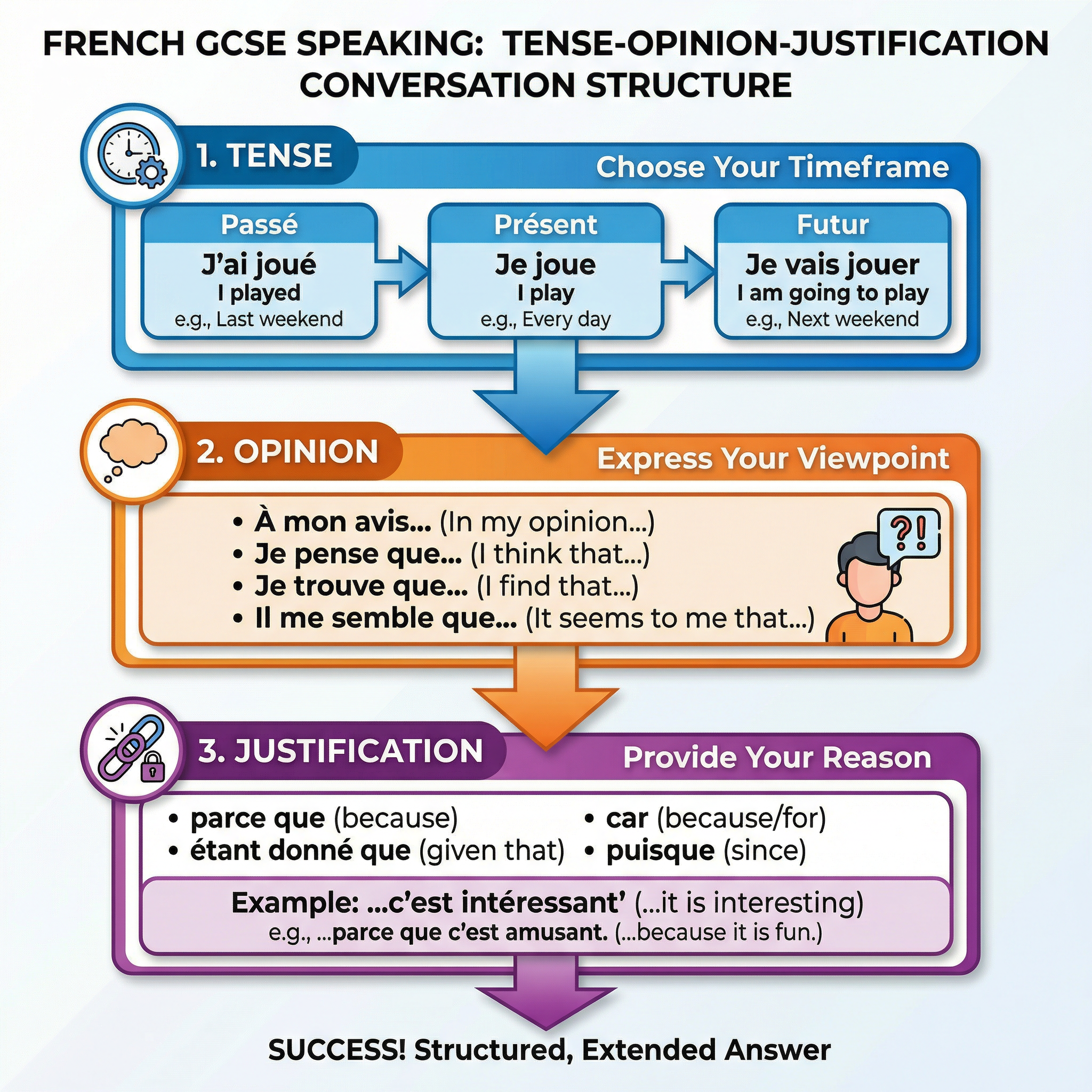
    • Multiple Tenses: Move seamlessly between the past (perfect and imperfect), present, and future/conditional.
    • Subjunctive Mood: Phrases like "il faut que je fasse..." (I must do...)
    • Complex Phrases: Structures like "avant de + infinitive" (before doing) and "après avoir + past participle" (after having done).
    • 'Si' Clauses: Conditional sentences, e.g., "Si j'avais le choix, je..." (If I had the choice, I would...)
    conversation_structure.png

    Pronunciation and Intonation

    What it is: The clarity and accuracy of your spoken French. This includes individual sounds, rhythm, and the rise and fall of your voice.

    Why it matters: The 'Phonetics' descriptor awards marks for pronunciation that is "generally authentic" and "intelligible throughout". Poor pronunciation can impede communication, costing you marks across all criteria.

    Key Areas to Focus On:

    • Silent Final Consonants: The final 't', 'd', 's', 'p', 'x', 'z' are usually silent (e.g., in 'petit', 'grand', 'français').
    • Liaison: Linking a normally silent final consonant to a following word that starts with a vowel (e.g., "les_amis", "vous_avez").
    • Nasal Vowels: Mastering the sounds in words like 'bon', 'vin', 'un', and 'en'.

    {{asset:pronunciation_guide.png

    Worked Examples

    3 detailed examples with solutions and examiner commentary

    Practice Questions

    Test your understanding — click to reveal model answers

    Q1

    Parle-moi d'un film que tu as vu récemment.

    5 marks
    standard

    Hint: Remember T.O.J! Use the perfect tense to describe the film, give your opinion on it, and explain why you felt that way.

    Q2

    Qu'est-ce que tu vas faire pendant les grandes vacances?

    5 marks
    standard

    Hint: This question requires the future tense. Start there, but try to bring in other tenses too. For example, compare it to what you did last year.

    Q3

    Est-ce que tu penses que les jeunes regardent trop la télévision?

    5 marks
    hard

    Hint: This is an abstract question. Give a balanced opinion using phrases like 'd'un côté' and 'd'un autre côté'.

    Q4

    Comment serait ta maison idéale?

    5 marks
    hard

    Hint: The word 'serait' is your clue! This question requires the conditional mood. Use 'je voudrais', 'il y aurait', etc.

    Q5

    Pourquoi est-il important d'apprendre une langue étrangère?

    5 marks
    standard

    Hint: Think of several reasons. Use phrases like 'Premièrement', 'Deuxièmement' or just link ideas with 'et aussi'.

    More French Study Guides

    View all

    Prepositions

    AQA
    GCSE

    Mastering French prepositions is a game-changer for your AQA GCSE exam. This guide breaks down the essential rules for using words like 'Ă ', 'de', and 'en' correctly, giving you the tools to boost your grade by demonstrating precision and a wider range of language, which is critical for hitting the top marks in both speaking and writing.

    Understanding numbers, times, and dates

    Edexcel
    GCSE

    Mastering numbers, times, and dates is non-negotiable for a top grade in GCSE French. This guide breaks down the essential rules, from the 24-hour clock to tricky number formations, giving you the precision needed to impress examiners across all four papers.

    Describing events and experiences

    WJEC
    GCSE

    Master the art of describing events and experiences in WJEC GCSE French. This guide will equip you with the essential grammar, vocabulary, and exam techniques to confidently narrate past events and achieve top marks.

    Global issues

    AQA
    GCSE

    This study guide for AQA GCSE French (Theme 2, Topic 3: Global Issues) provides a comprehensive, exam-focused resource to help students master the vocabulary and grammar needed to discuss environmental and social problems. It is designed to build confidence and secure top marks by focusing on examiner expectations, complex structures, and common pitfalls.

    Conjunctions

    AQA
    GCSE

    Unlock top marks in your AQA GCSE French exams by mastering conjunctions. This guide will transform your writing and speaking from simple to sophisticated, showing you how to use linking words to demonstrate the complexity and range of language that examiners reward.

    Identifying key information

    AQA
    GCSE

    Identifying key information in AQA GCSE French is the foundation skill that determines whether candidates earn marks for precision or lose them through vague responses. This study focuses on extracting specific details from authentic French sources, distinguishing timeframes, recognising negation, and navigating examiner-designed distractors. Mastering this skill unlocks success across 80% of the assessment objectives in Papers 1 and 3.