Study Notes
Overview
The Aztecs and the Spanish Conquest (1519–1535) is one of the most dramatic case studies of cultural collision, military strategy, and biological catastrophe in world history. This OCR B (SHP) World Depth Study examines how the Aztec Empire — a sophisticated, populous, and militarily powerful civilisation centred on the island city of Tenochtitlan — was conquered and dismantled by a small Spanish expedition led by Hernán Cortés, aided by tens of thousands of indigenous allies and the devastating power of European disease. Candidates are expected to demonstrate precise causal analysis, the ability to evaluate contemporary sources, and a nuanced understanding of why the conquest succeeded. Examiners reward responses that move beyond simple narrative to explain the interconnection of military, biological, diplomatic, and political factors. The period concludes with the formal establishment of New Spain as a Spanish viceroyalty in 1535, marking the complete transformation of Aztec society into a colonial structure.
Key Events and Developments
The Aztec Empire on the Eve of Conquest, c.1519
Date(s): By 1519
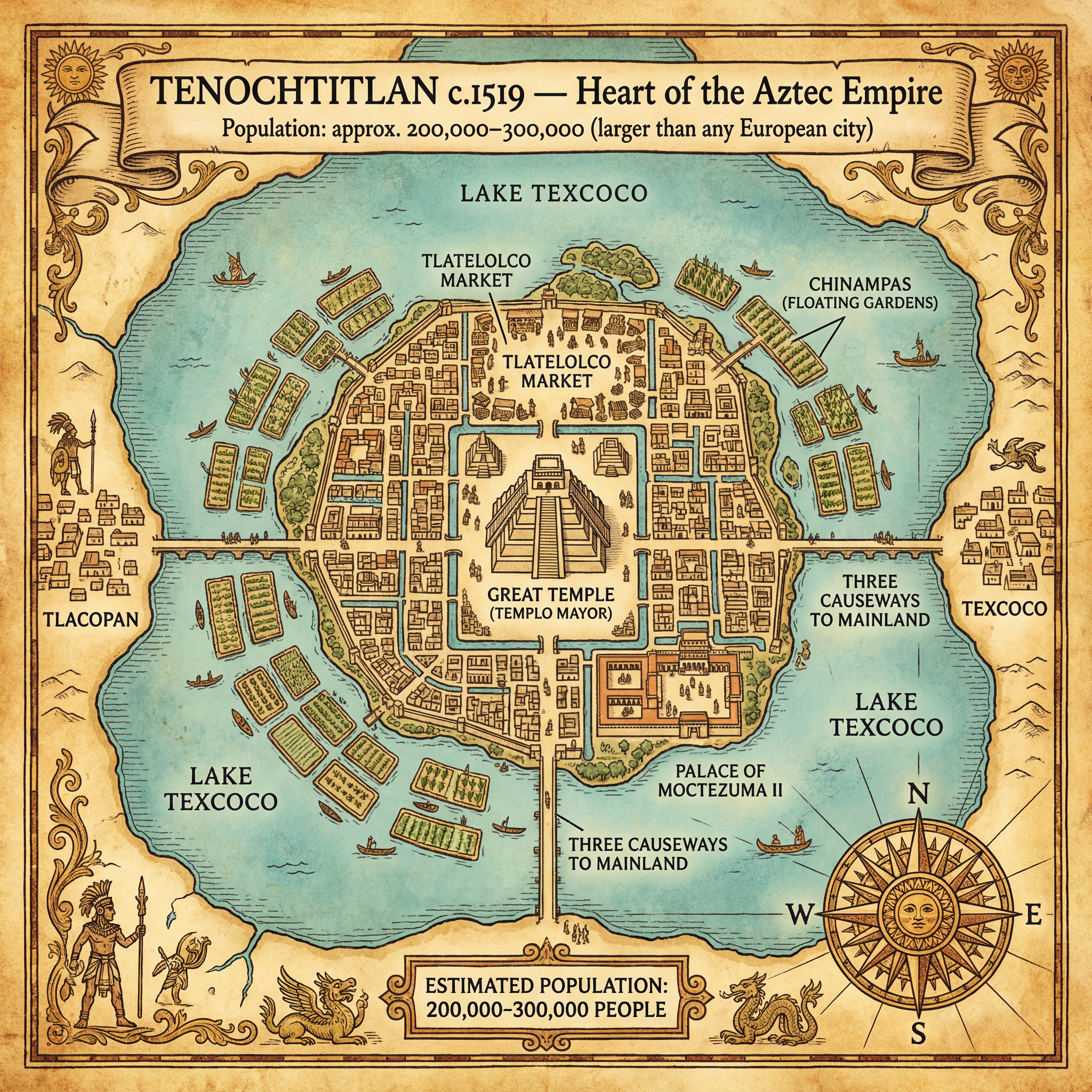
What happened: The Aztec Empire — formally the Triple Alliance of Tenochtitlan, Texcoco, and Tlacopan — dominated central Mexico. Its capital, Tenochtitlan, was built on an island in Lake Texcoco and connected to the mainland by three great causeways. The city's population of approximately 200,000–300,000 people made it larger than any contemporary European city, including London and Madrid. The city was sustained by chinampas (floating gardens), a sophisticated agricultural system that created artificial islands in the shallow lake. The empire was governed by a tlatoani (supreme ruler), Moctezuma II, who extracted tribute — goods, labour, and sacrificial victims — from dozens of subject peoples across the region.
Why it matters: Understanding the empire's strengths and vulnerabilities is essential for explaining the conquest. The tribute system created widespread resentment among subject peoples, which Cortés exploited. Examiners will credit candidates who explain that the empire's internal divisions were a precondition for the conquest's success.
Specific Knowledge: Population of Tenochtitlan: 200,000–300,000. Three causeways: Tlacopan, Iztapalapa, Tepeyac. The Tlatelolco market was described by Bernal Díaz del Castillo as larger than any market in Spain. The Templo Mayor (Great Temple) was the religious heart of the city, dedicated to Huitzilopochtli (sun god) and Tlaloc (rain god).
The Arrival of Cortés and the Tlaxcalan Alliance, 1519
Date(s): February–November 1519
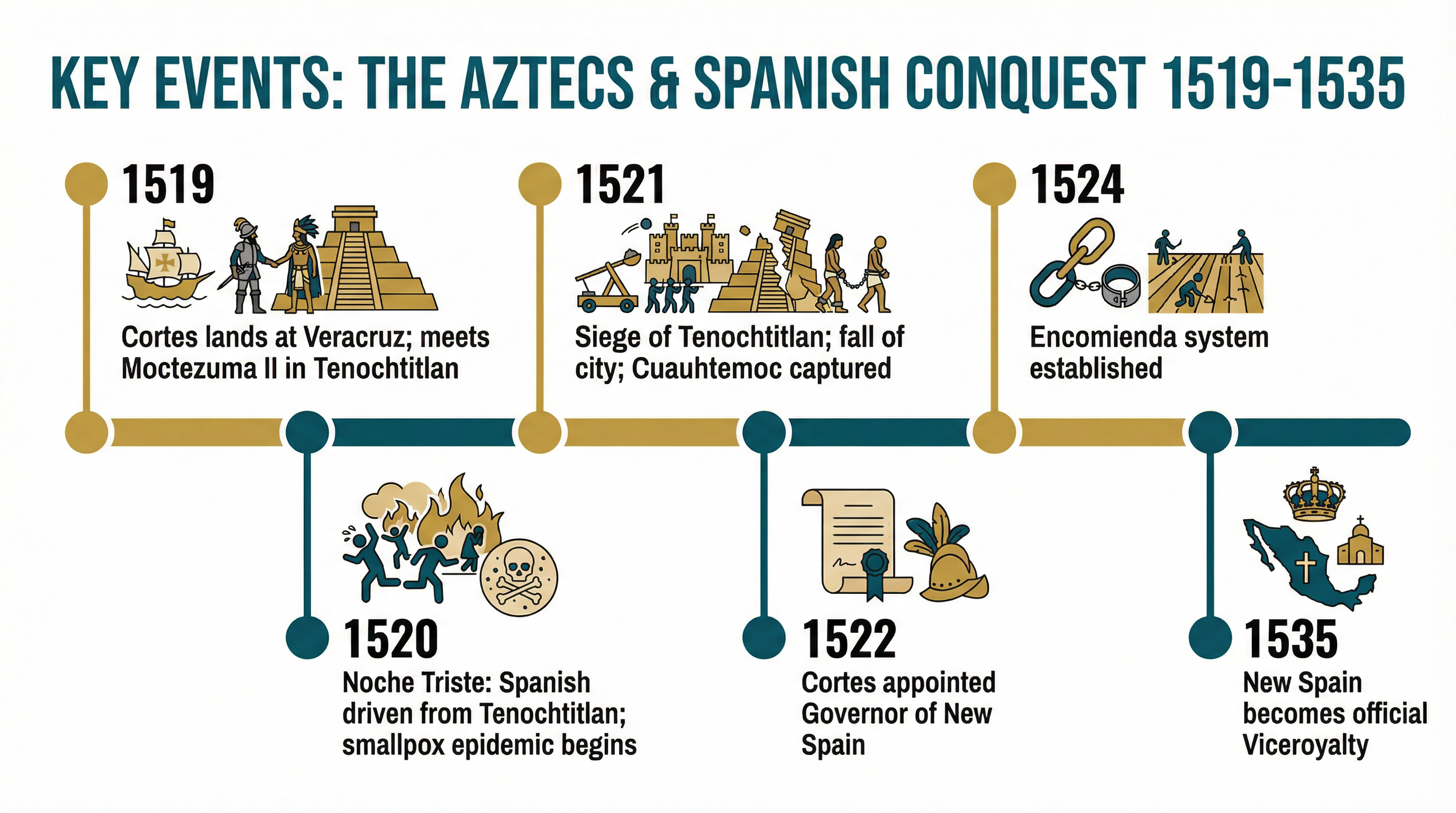
What happened: Hernán Cortés landed at Veracruz in February 1519 with approximately 500 soldiers, 16 horses, 14 cannons, and a small number of crossbowmen. He had defied the orders of Diego Velázquez, Governor of Cuba, to undertake this expedition — a fact that reveals his ambition and independence. Crucially, Cortés acquired La Malinche (Doña Marina), a Nahuatl-speaking indigenous woman who served as his interpreter and political advisor, enabling communication with Moctezuma and identification of potential allies. After initial combat with the Tlaxcalans — a people who had successfully resisted Aztec domination — Cortés negotiated an alliance. This was the pivotal diplomatic achievement of the conquest. By November 1519, when Cortés entered Tenochtitlan, his force had swelled to tens of thousands of indigenous warriors. Moctezuma received Cortés peacefully and was subsequently taken hostage.
Why it matters: The Tlaxcalan alliance is arguably the single most important factor in the conquest. Candidates who write that Cortés conquered the Aztecs with 500 soldiers will lose marks. Examiners specifically credit responses that identify the coalition nature of the conquest.
Specific Knowledge: Cortés's force: c.500 Spanish soldiers + 16 horses + 14 cannons. Tlaxcalan allied force: estimated 50,000–200,000 warriors. La Malinche was of Nahuatl-speaking origin, sold into slavery, and spoke both Nahuatl and Maya. Cortés entered Tenochtitlan on 8 November 1519.
The Noche Triste and the Smallpox Epidemic, 1520
Date(s): June–December 1520
What happened: In June 1520, while Cortés was absent dealing with a rival Spanish force sent by Velázquez, his lieutenant Pedro de Alvarado massacred Aztec nobles at the festival of Toxcatl. The city erupted in revolt. Moctezuma II was killed — sources dispute whether by the Spanish or by his own people. The Spanish were driven out of Tenochtitlan on the night of 30 June 1520, an event known as the Noche Triste (Night of Sorrows). Hundreds of Spanish soldiers drowned in Lake Texcoco, weighed down by looted gold. Simultaneously, smallpox — introduced to Mexico by the Spanish — began spreading through the indigenous population. The epidemic killed Emperor Cuitlahuac (Moctezuma's successor) just 80 days into his reign, along with an estimated one-third to one-half of Tenochtitlan's population.
Why it matters: The Noche Triste demonstrates that the conquest was not inevitable — the Aztecs came close to defeating the Spanish entirely. The smallpox epidemic is a critical causal factor: it did not merely kill people but destroyed the Aztec military command structure, created a leadership vacuum, and caused psychological despair. Candidates must explain the mechanism by which smallpox weakened Aztec resistance, not merely state that it killed people.
Specific Knowledge: Noche Triste: 30 June 1520. Cuitlahuac: died of smallpox after 80 days as emperor. Smallpox mortality: estimated 30–50% of Tenochtitlan's population. Cortés reportedly wept at the Noche Triste — this became known as the 'Tree of the Sad Night' (El Árbol de la Noche Triste).
The Siege and Fall of Tenochtitlan, 1521
Date(s): May–August 1521
What happened: Cortés regrouped at Tlaxcala, rebuilt his alliances, and planned a methodical siege. He had thirteen brigantines (flat-bottomed warships) constructed, transported overland in pieces, and assembled on Lake Texcoco. This gave the Spanish control of the lake, cutting off Tenochtitlan's supply lines and preventing escape or resupply. The siege began in May 1521 and lasted 75 days. The Spanish and their allies — numbering in the hundreds of thousands — systematically destroyed the city block by block. The last Aztec emperor, Cuauhtémoc, was captured on 13 August 1521 while attempting to escape by canoe. He was later tortured and executed by Cortés in 1525. Tenochtitlan was reduced to rubble; Mexico City was built on its ruins.
Why it matters: The siege demonstrates Cortés's strategic genius and the indispensable role of the brigantines — a detail that earns AO1 credit in exam answers. The fall of Tenochtitlan marks the end of the Aztec Empire as a political entity.
Specific Knowledge: 13 brigantines constructed and transported overland. Siege duration: 75 days (May–August 1521). Cuauhtémoc captured: 13 August 1521. Cuauhtémoc executed: 1525. Mexico City founded on the ruins of Tenochtitlan.
The Establishment of New Spain, 1522–1535
Date(s): 1522–1535
What happened: Following the conquest, Cortés was appointed Governor of New Spain in 1522. The Spanish Crown moved to institutionalise colonial control through the encomienda system — grants of indigenous labour to Spanish colonists (encomenderos), who were theoretically obliged to provide protection and Christian instruction in return. In practice, the system was a mechanism of brutal exploitation: indigenous people were forced to work in silver mines and on plantations under lethal conditions. Millions died from overwork, disease, and violence in the decades following the conquest. By 1535, New Spain was formally constituted as a viceroyalty, governed by a viceroy appointed by the Spanish Crown. The Aztec religion, political structures, and much of its culture were systematically suppressed and replaced with Spanish Catholic institutions.
Why it matters: The establishment of New Spain represents the long-term consequence of the conquest. Candidates must define the encomienda system precisely — as a labour system with a legal framework, not simply 'slavery' — and explain its consequences for indigenous populations.
Specific Knowledge: Cortés appointed Governor: 1522. First Viceroy of New Spain: Antonio de Mendoza, appointed 1535. Encomienda system: labour grants to encomenderos. Population collapse: central Mexican population fell from an estimated 25 million in 1519 to approximately 1 million by 1600.
Key Individuals
Hernán Cortés (1485–1547)
Role: Spanish conquistador and commander of the expedition to Mexico.
Key Actions: Defied Governor Velázquez's orders; secured the Tlaxcalan alliance; took Moctezuma II hostage; survived the Noche Triste; planned and executed the siege of Tenochtitlan using brigantines; appointed Governor of New Spain in 1522.
Impact: Cortés's leadership was a necessary but not sufficient cause of the conquest. His strategic intelligence, willingness to take extreme risks, and diplomatic skill in building indigenous alliances were decisive. However, candidates must avoid attributing the conquest solely to his genius — the Tlaxcalans, smallpox, and Aztec internal divisions were equally or more important.
Moctezuma II (r. 1502–1520)
Role: Tlatoani (supreme ruler) of the Aztec Empire at the time of the Spanish arrival.
Key Actions: Received Cortés peacefully in November 1519; was taken hostage by the Spanish; killed in June 1520 (circumstances disputed).
Impact: Moctezuma's decision to receive Cortés peacefully — possibly believing him to be the god Quetzalcoatl, though this interpretation is contested — gave the Spanish a critical foothold in the capital. His death created a leadership crisis.
La Malinche / Doña Marina (c.1500–c.1529)
Role: Indigenous Nahuatl-speaking interpreter and advisor to Cortés.
Key Actions: Translated between Cortés and Moctezuma; identified potential allies among subject peoples; provided intelligence on Aztec political structures.
Impact: Without La Malinche, the conquest would have been impossible. She is a complex historical figure — celebrated by some as a diplomatic genius, condemned by others as a traitor to her people. Her role demonstrates that the conquest was enabled by indigenous knowledge and participation.
Cuauhtémoc (r. 1520–1521)
Role: Last Aztec emperor, who led the defence of Tenochtitlan during the siege.
Key Actions: Succeeded Cuitlahuac; organised the defence of Tenochtitlan during the 75-day siege; captured on 13 August 1521; tortured and executed by Cortés in 1525.
Impact: Cuauhtémoc is remembered in Mexico as a national hero who fought to the end. His capture marked the definitive end of Aztec political independence.
Cuitlahuac (r. June–December 1520)
Role: Aztec emperor who succeeded Moctezuma II.
Key Actions: Led the Aztec forces that drove the Spanish out during the Noche Triste; died of smallpox after just 80 days as emperor.
Impact: Cuitlahuac's death from smallpox is a critical causal factor in the conquest. His brief reign demonstrates the devastating impact of epidemic disease on Aztec leadership at the most critical moment.
Second-Order Concepts
Causation
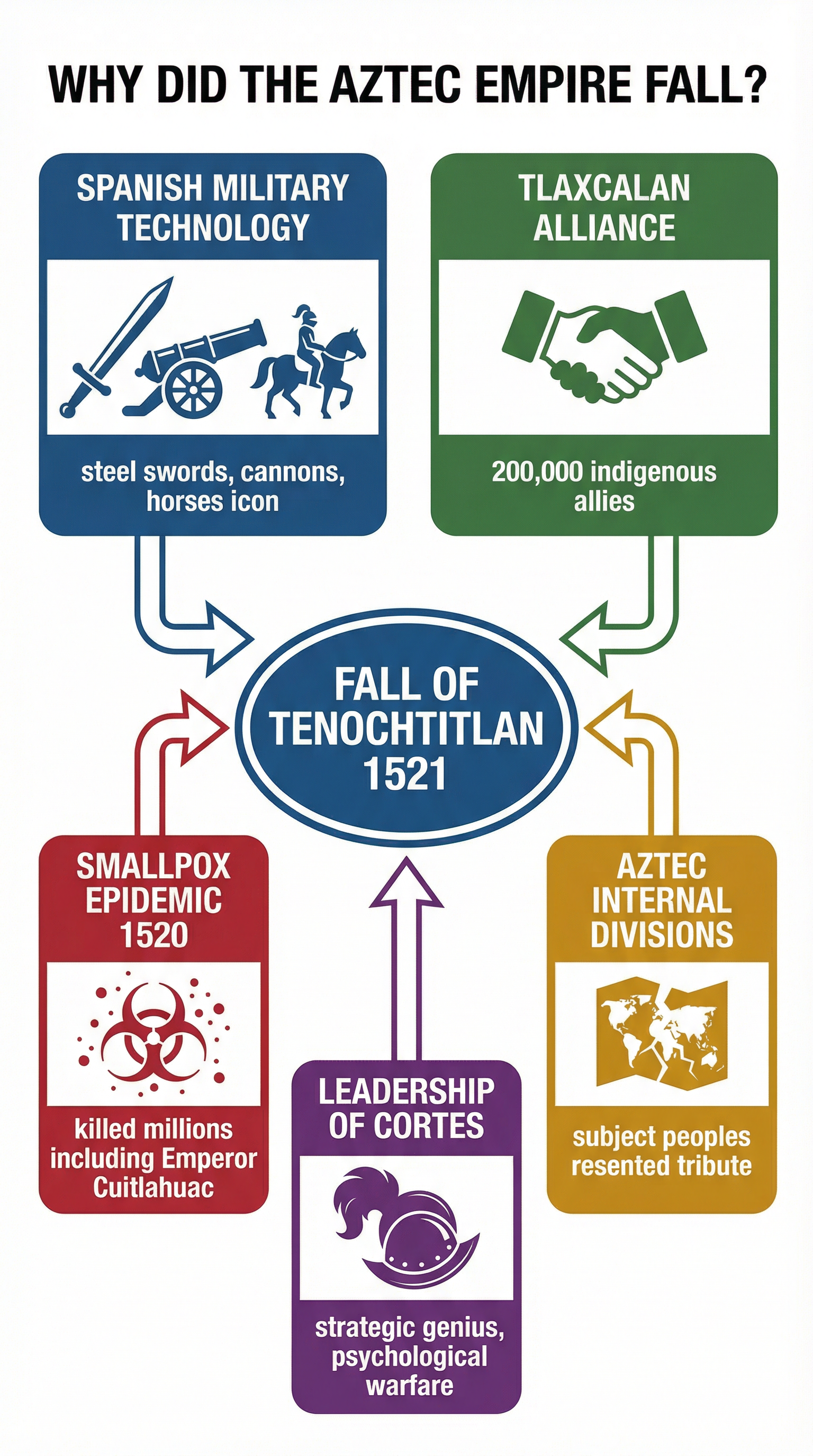
The fall of the Aztec Empire resulted from a convergence of short-term triggers and longer-term structural factors. The long-term causes include the internal divisions of the Aztec Empire — the resentment of subject peoples who paid tribute and provided sacrificial victims — and the technological gap between Spanish steel and gunpowder weapons and Aztec obsidian and wood weaponry. The medium-term cause was the arrival of smallpox in 1520, which devastated the population and killed the emperor. The short-term trigger was the siege of 1521, enabled by the brigantines and the Tlaxcalan alliance. Candidates should be able to explain how these causes interacted: for example, without the Tlaxcalan alliance (itself a product of Aztec internal divisions), the brigantines alone could not have won the siege.
Consequence
The immediate consequences of the conquest included the destruction of Tenochtitlan, the death of Cuauhtémoc, and the establishment of Spanish colonial rule. The long-term consequences were catastrophic for indigenous peoples: the encomienda system, forced labour in silver mines, and continued epidemic disease caused the central Mexican population to collapse from an estimated 25 million in 1519 to approximately 1 million by 1600 — one of the greatest demographic catastrophes in human history. The conquest also had global consequences, as silver from New Spain's mines fuelled the European economy and accelerated the development of global trade networks.
Change and Continuity
The conquest brought dramatic change: the Aztec political system was dismantled, the Templo Mayor was demolished and a Catholic cathedral built on its site, and the Nahuatl language was suppressed in favour of Spanish. However, elements of continuity persisted: indigenous agricultural practices (including chinampas) continued; many indigenous communities retained local governance structures under Spanish oversight; and Nahuatl survived as a spoken language. The encomienda system, while exploitative, was built on the existing Aztec tribute system — continuity in the mechanism of extraction, if not in who benefited.
Significance
The conquest of the Aztec Empire is historically significant for multiple reasons. It demonstrated the vulnerability of even sophisticated civilisations to biological warfare (unintentional in this case) and the power of coalition-building. It established the template for Spanish colonialism across the Americas. And it raises enduring questions about agency, resistance, and the role of indigenous peoples — not merely as victims but as active participants in the conquest, on both sides.
Source Skills
For this topic, candidates will encounter a range of source types: Spanish colonial accounts (such as Bernal Díaz del Castillo's True History of the Conquest of New Spain), Aztec pictorial manuscripts (codices), and administrative documents from the colonial period. When evaluating sources, candidates must apply the Content → Provenance → Usefulness → Limitations framework.
Content: What does the source explicitly show or state? What can you infer from it?
Provenance: Who created the source? When? For what purpose? A Spanish soldier's account will reflect Spanish perspectives and may glorify the conquest. An Aztec codex produced after the conquest may have been influenced by Spanish censorship or the trauma of defeat.
Usefulness: How does the content and provenance make it useful for the specific enquiry? Be precise — useful for what aspect of the topic?
Limitations: What does the source not tell us? What biases might affect its reliability? What is missing?
The Inference Formula (for 3-mark questions): 'I can infer [conclusion] from this source. The source suggests this by [specific detail from source].' Repeat for a second inference. Do not describe — infer.