Study Notes
Overview
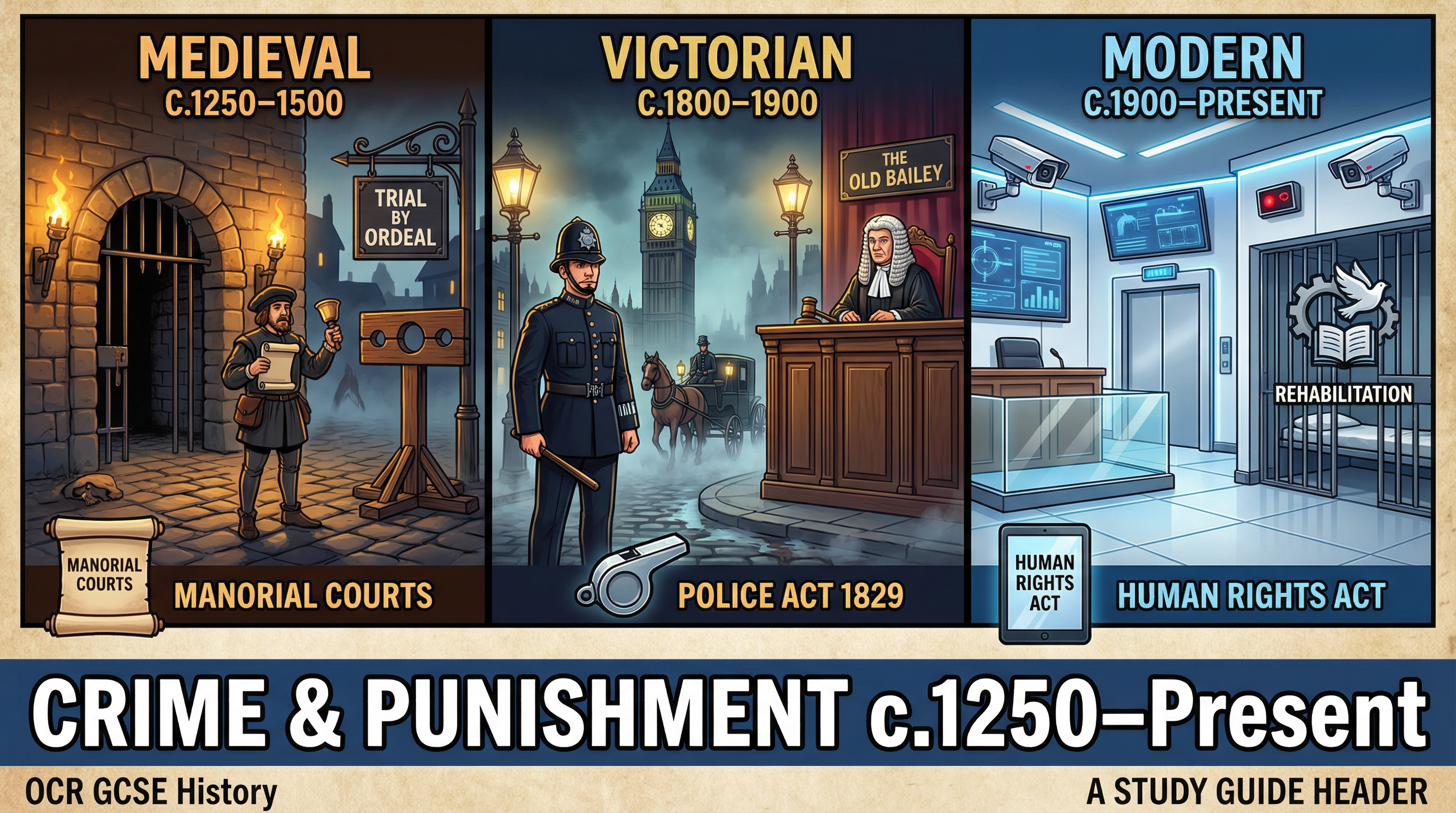
This thematic study, set by OCR B (Schools History Project), examines how crime has been defined, policed, and punished in Britain from approximately 1250 to the present day. It is not a narrative of individual events but an analytical investigation into patterns of change and continuity across more than seven centuries. Examiners expect candidates to deploy specific factual knowledge — named individuals, precise dates, and concrete examples — in the service of analytical argument. The study is structured around four Second Order Concepts: Change, Continuity, Causation, and Consequence. Candidates who merely describe what happened will be limited to Level 1 or Level 2. Those who explain why changes occurred, what drove continuity, and how significant developments were will access Level 3 and Level 4 marks. Throughout this guide, examiner commentary is provided to help candidates understand exactly what the mark scheme rewards.
Key Events and Developments
The Tithing and Hue and Cry Systems (c.1250)
Date(s): Operating throughout the medieval period, c.1000–1300s
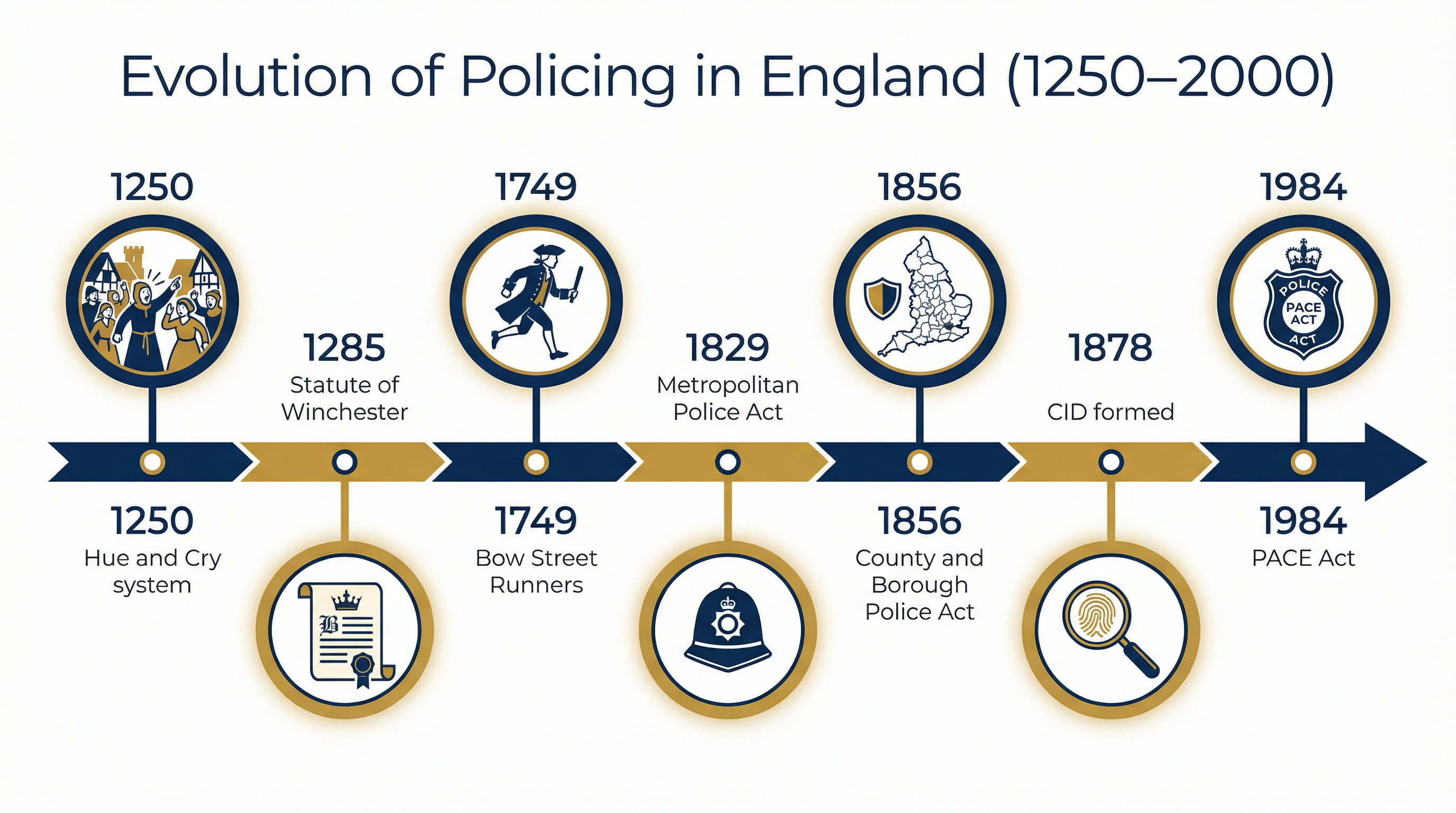
What happened: Medieval England had no professional police force. Law enforcement was entirely community-based. The Tithing system required every male over twelve to join a group of ten men (a tithing). If any member committed a crime, the rest were collectively responsible for bringing him to justice. Alongside this, the Hue and Cry system obliged all members of a community to pursue and apprehend any suspect when an alarm was raised by a victim or witness.
Why it matters: These systems illustrate the defining characteristic of medieval policing — it was unpaid, informal, and community-led. There was no state apparatus. This is a critical point of contrast with the Metropolitan Police established in 1829. Candidates must not conflate the two: the Hue and Cry is medieval and communal; the Met is Victorian and state-organised. Examiners award marks for this distinction.
Specific Knowledge: The Statute of Winchester (1285) formalised the Watchmen system, requiring towns to appoint unpaid volunteers to patrol at night. Parish Constables, introduced in the 16th century, were also unpaid and served for one year — a system that persisted until the 19th century.
The Bloody Code (c.1700–1823)
Date(s): Developed through the 17th and 18th centuries; peak c.1820 with over 220 capital offences; reformed from 1823 under Robert Peel
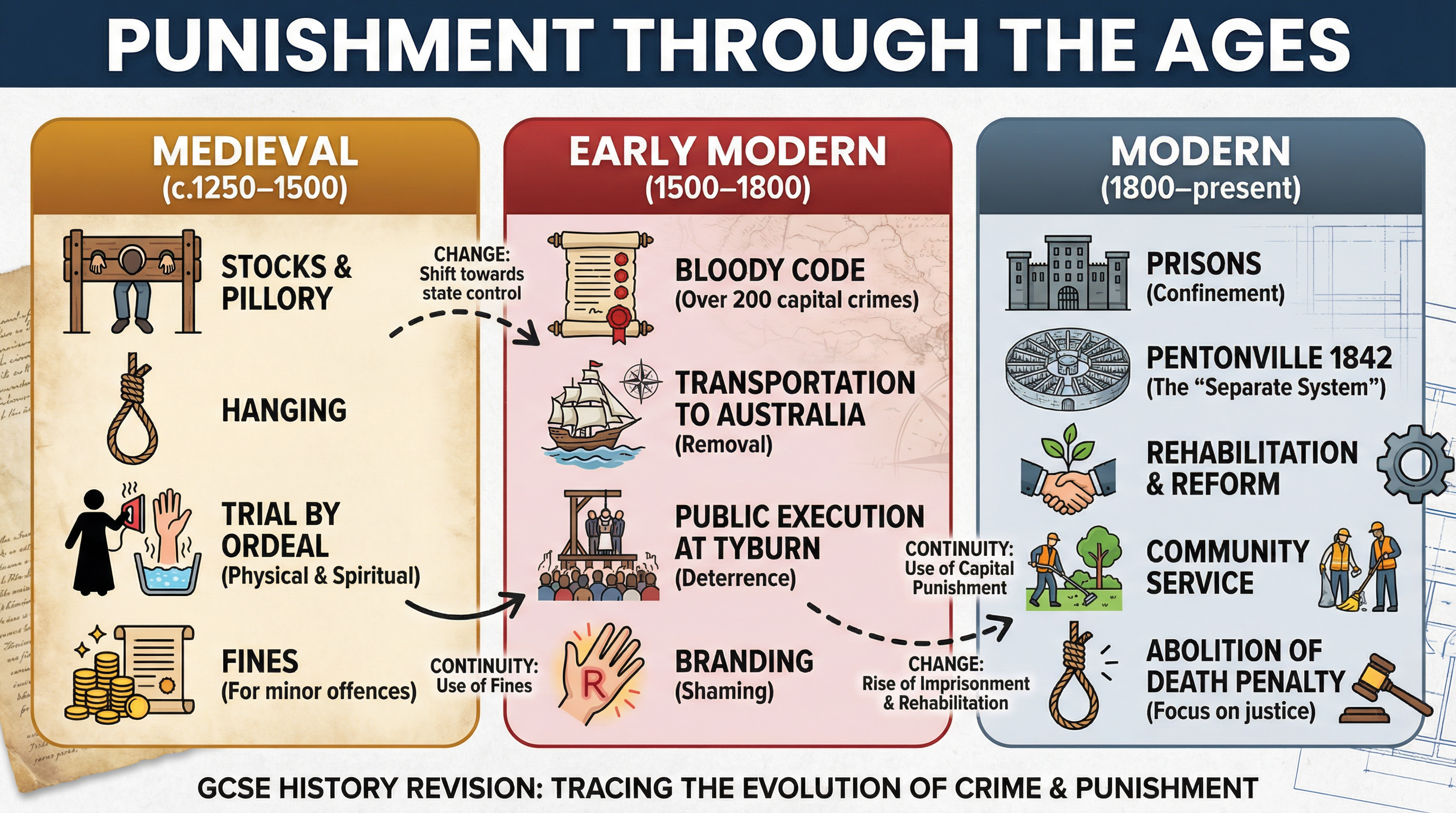
What happened: The Bloody Code was the collective name for a body of English law that made over 200 offences punishable by death. These included stealing goods worth more than 12 pence, cutting down a young tree in an orchard, and impersonating a Chelsea Pensioner. In practice, however, the Code was far less lethal than it appeared: juries frequently refused to convict knowing the penalty was death for minor crimes; judges used the legal loophole of 'benefit of clergy' to reduce sentences; and royal pardons were frequently granted.
Why it matters: The Bloody Code is a masterclass in the gap between law on paper and law in practice — a distinction that earns Level 3 marks. It also illustrates how deterrence was the dominant aim of punishment in this era, and how that approach ultimately failed. Robert Peel began repealing capital statutes from 1823, reflecting a shift towards a more rational, reforming approach to criminal justice.
Specific Knowledge: By 1820, over 220 offences carried the death penalty. Between 1770 and 1830, approximately 7,000 death sentences were passed in England and Wales, but only around 1,500 were actually carried out — roughly 21%. This statistic powerfully illustrates the Code's limited practical effectiveness.
Transportation (1718–1868)
Date(s): Transportation Act 1718 (to America); 1787 (first fleet to Australia); ended 1868
What happened: Transportation offered an alternative to execution. From 1718, convicted criminals could be sent to the American colonies. After American independence in 1776, Australia became the destination. The First Fleet arrived in Botany Bay in 1787. Between 1787 and 1868, approximately 160,000 convicts were transported to Australia.
Why it matters: Transportation demonstrates how economic and imperial factors shaped punishment. It was cheaper than building prisons, removed criminals from society, and helped populate Britain's colonies. It also reflects the growing reluctance to execute for minor crimes — a transitional punishment between the Bloody Code and the rise of imprisonment.
Specific Knowledge: Transportation was ended in 1868 partly due to opposition from Australian colonists who resented their land being used as a dumping ground for British criminals, and partly because Pentonville Prison (1842) offered a credible domestic alternative.
The Metropolitan Police Act (1829)
Date(s): 1829
What happened: Home Secretary Sir Robert Peel established the Metropolitan Police Force — the world's first professional, full-time, paid police force. Approximately 3,000 officers were recruited initially, based at Scotland Yard. Officers wore a distinctive blue uniform (deliberately different from the army's red) and carried a truncheon and a rattle. Their primary role was crime prevention through visible patrol, not detection.
Why it matters: 1829 is the single most important date in the history of policing. It represents the decisive shift from community-based, voluntary policing to a state-organised, professional institution. The County and Borough Police Act (1856) extended this model nationally, making it compulsory for all areas to establish a force. The CID (Criminal Investigation Department) was formed in 1878, professionalising detective work.
Specific Knowledge: Officers were nicknamed 'Peelers' or 'Bobbies' after Robert Peel. Initial public hostility was significant — many saw the new force as a threat to civil liberties. Peel's 'Nine Principles of Policing' emphasised that the police were the public and the public were the police — a philosophy of consent-based policing that remains influential today.
Pentonville Prison and the Prison System (1842–present)
Date(s): Pentonville opened 1842; Prison Act 1877 (nationalisation of prisons)
What happened: Pentonville Prison, opened in 1842, became the model for the Victorian prison system. It operated the 'Separate System' — prisoners were kept in solitary confinement, forbidden from communicating, and forced to wear masks when outside their cells. The theory was that isolation would induce reflection and moral reform. In practice, it caused widespread mental illness. By the late 19th century, the 'Silent System' (prisoners working together but in silence) became more common. The Prison Act of 1877 nationalised all prisons under central government control.
Why it matters: The rise of the prison as the primary form of punishment represents the most significant change in penal history. Before 1800, prisons held people awaiting trial or execution — they were not punishments in themselves. The Victorian era transformed imprisonment into the default response to serious crime, a position it retains today.
Specific Knowledge: By 1877, there were 113 local prisons in England and Wales. The 20th century saw a gradual shift from punishment towards rehabilitation: the death penalty was abolished for murder in 1965 (permanent 1969); community service orders were introduced in 1972; and the focus increasingly moved to education and skills training within prisons.
Key Individuals
Henry Fielding (1707–1754)
Role: Magistrate at Bow Street; novelist; social reformer
Key Actions: In 1749, Fielding established the Bow Street Runners — a small group of paid thief-takers based at Bow Street Magistrates' Court in London. This was one of the first organised, professional responses to crime in England.
Impact: The Bow Street Runners represent a crucial transitional moment between the old amateur, community-based system and the professional police force of 1829. They were limited in scope (London only, small numbers) but demonstrated that paid, organised law enforcement was both possible and effective. Examiners credit candidates who identify Fielding as a precursor to Peel rather than treating the two as equivalent.
Sir Robert Peel (1788–1850)
Role: Home Secretary 1822–1827 and 1828–1830; Prime Minister 1834–1835 and 1841–1846
Key Actions: Peel reformed the Bloody Code from 1823, reducing the number of capital offences. In 1829, he passed the Metropolitan Police Act, creating the world's first professional police force. His 'Nine Principles of Policing' established the philosophical foundation for modern British policing.
Impact: Peel is arguably the most significant individual in the history of British criminal justice. His reforms addressed both punishment (reducing capital statutes) and policing (creating a professional force). Examiners reward candidates who connect Peel's reforms to the broader context of 19th-century liberalism and the growth of London as an industrial city.
Elizabeth Fry (1780–1845)
Role: Quaker prison reformer
Key Actions: Fry visited Newgate Prison in 1813 and was appalled by conditions — women and children crowded together in squalor, with no education or meaningful occupation. She established a school within Newgate, introduced a classification system separating women from men, and campaigned publicly for prison reform. She gave evidence to a House of Commons committee in 1818.
Impact: Fry's work shifted public and political opinion towards the idea that prisons should reform as well as punish. Her emphasis on education and moral improvement directly influenced the design of Pentonville (1842) and the broader Victorian prison reform movement. She represents the growing influence of humanitarian and religious motivations in shaping punishment.
Second-Order Concepts
Causation
Changes in crime and punishment were driven by multiple overlapping causes. Social and economic factors were paramount: the rapid urbanisation of the 18th and 19th centuries created large, anonymous cities where the old community-based systems of policing simply could not function. London's population grew from approximately 600,000 in 1700 to over 2 million by 1850, making the Hue and Cry system entirely impractical. Religious factors shaped the definition of crime in the medieval and early modern periods: heresy and witchcraft were crimes because the Church defined them as such. As religious authority declined after the Reformation, these offences gradually disappeared from the statute book. Political factors drove key moments of reform: Peel's Metropolitan Police Act (1829) was a deliberate political decision, shaped by his Tory reforming instincts and the practical crisis of urban disorder.
Consequence
The consequences of key developments were often unintended. The Bloody Code was intended to deter crime through fear of death, but its consequence was jury reluctance to convict — actually undermining the justice system. Transportation was intended to punish and remove criminals, but its unintended consequence was the development of Australian colonial society. The Separate System at Pentonville was intended to reform prisoners through reflection, but its consequence was widespread mental illness and psychological breakdown.
Change and Continuity
The most significant change across the period is the shift from community-based, informal, unpaid systems to state-organised, professional, funded institutions — in both policing and punishment. In 1250, a victim relied on their neighbours to catch a criminal; by 1900, a professional police force, detective department, and national prison service existed. The most important continuity is the persistent aim of deterrence: from the public stocks of the medieval period to the public executions of the 18th century to the visible patrol of the Victorian police, the desire to discourage crime through the threat of consequences runs throughout the entire period. The aim of punishment has, however, shifted: from deterrence and retribution in the medieval period, through incapacitation (transportation) and rehabilitation (Victorian and modern prisons).
Significance
This topic is historically significant because it reveals how the relationship between the individual and the state has fundamentally changed over 750 years. In 1250, the state barely existed as a force in everyday life; criminal justice was local, personal, and communal. By 2000, the state monopolised the definition of crime, the apparatus of law enforcement, and the administration of punishment. This shift is one of the defining features of modernity.
Source Skills
OCR History B sources questions require candidates to evaluate usefulness — not simply describe content. The four-stage framework is: Content → Provenance → Usefulness → Limitations.
Content: What does the source actually tell us? Quote directly and explain what this reveals about the enquiry topic.
Provenance: Who created the source? When? Why? What was their purpose? A government report on prison conditions (e.g., a Parliamentary Select Committee report, 1818) has a different purpose from a reformer's pamphlet (e.g., Elizabeth Fry's writings). Both are useful, but for different reasons.
Usefulness: How does the content and provenance make the source useful for the specific enquiry? Be precise — useful for what, exactly?
Limitations: What does the source not tell us? What might be missing, exaggerated, or distorted by the author's purpose or position? A source is never 'biased and therefore useless' — examiners penalise this simplistic approach. Instead, explain what the bias or limitation means for how we use the source.