Study Notes
Overview
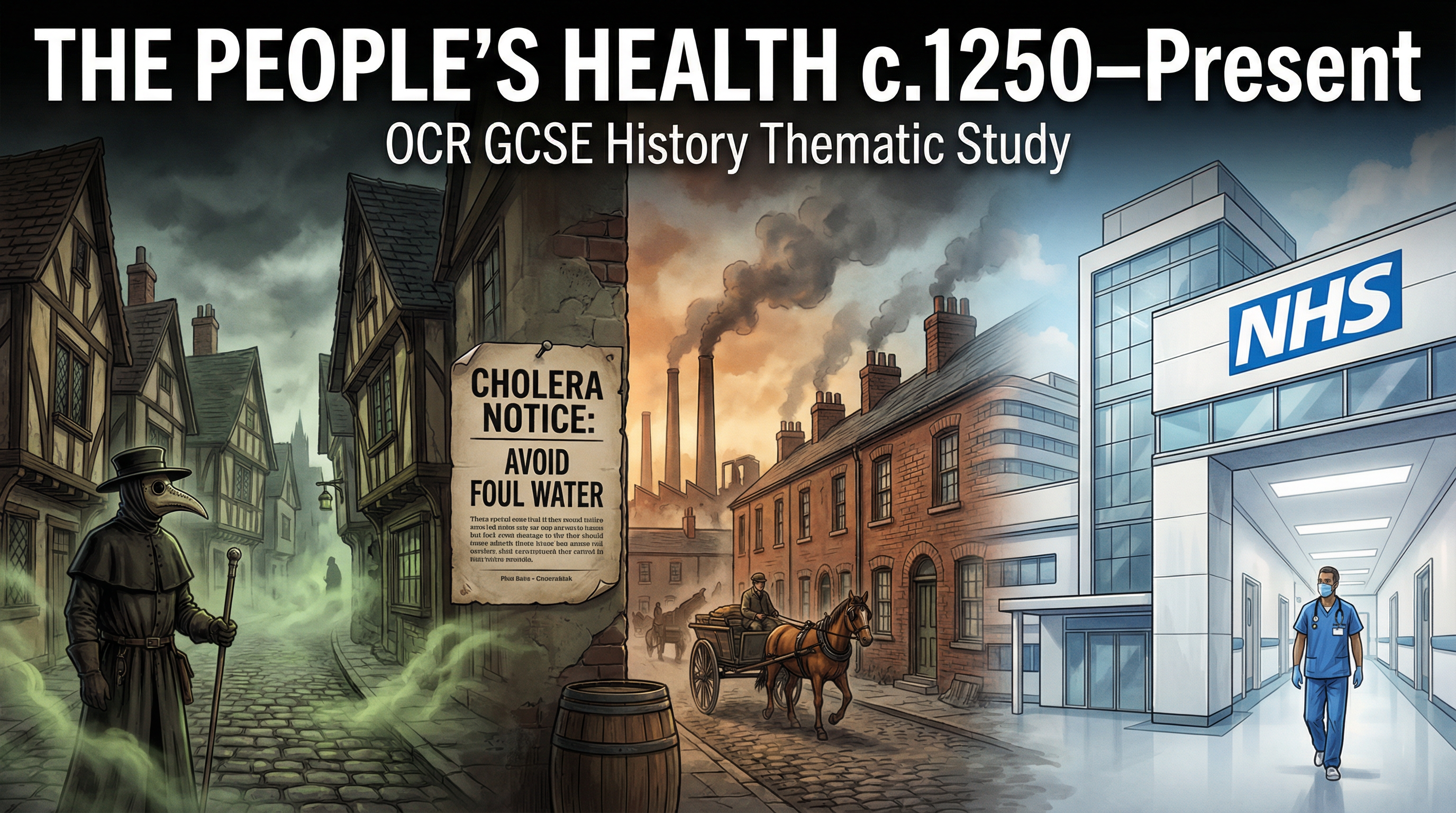
This thematic study charts the dramatic, often slow, and complex history of public health in Britain over nearly 800 years. Examiners expect candidates to understand the interplay of key factors—War, Science & Technology, Government, and Attitudes—and how they drove or hindered change. You will explore how living conditions, medical understanding, and the role of the state have evolved, from the filth of medieval towns and the devastation of the Black Death, through the industrial squalor of the 19th century, to the creation of the welfare state and the National Health Service. Success in this paper requires not just knowing the story, but being able to analyse why change happened, its consequences, and what remained the same over long periods. This guide is structured to help you build that analytical muscle, focusing on the specific events, individuals, and concepts you need to master.
Key Events & Developments
The Black Death
Date(s): 1348-1350
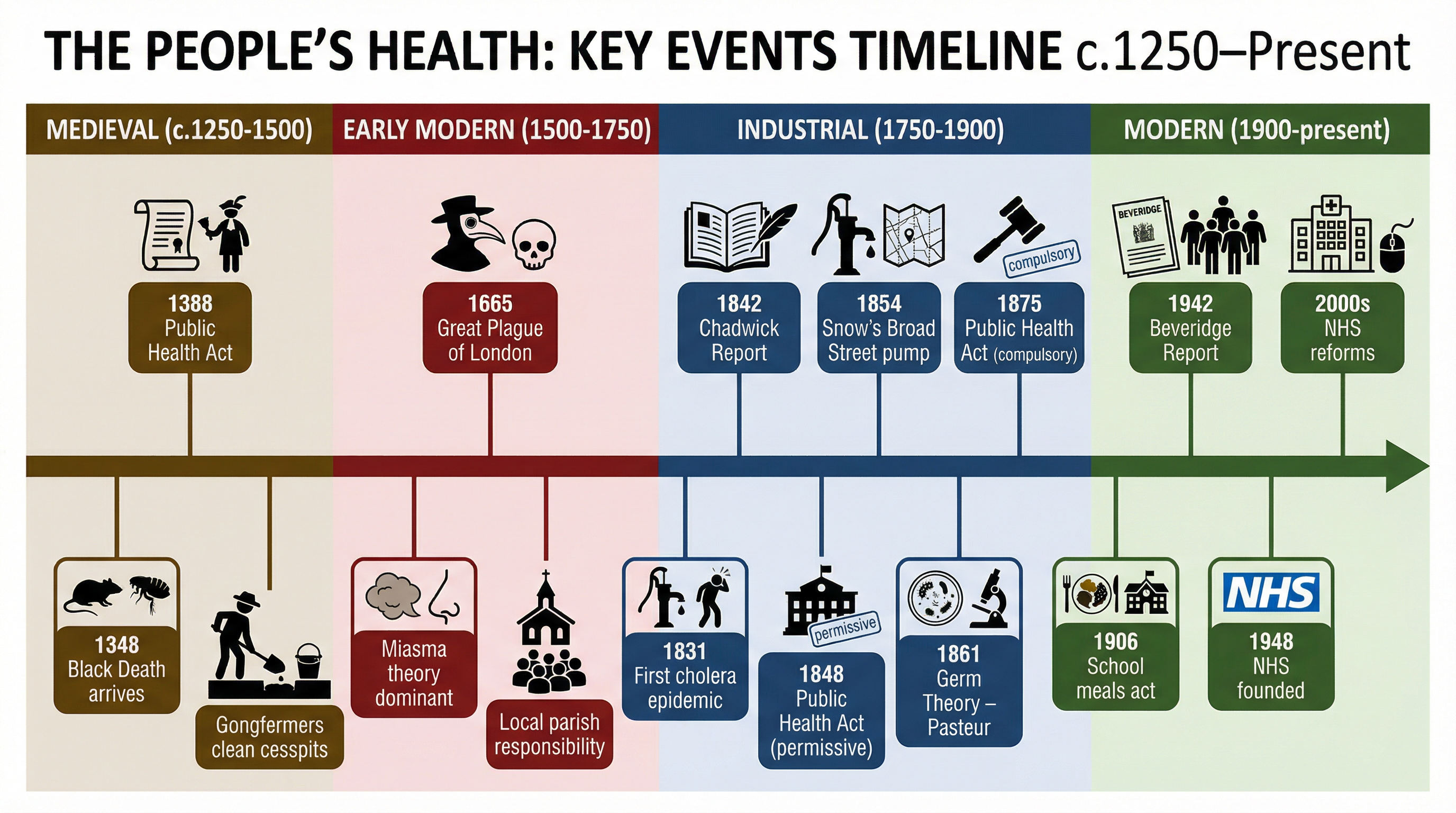
What happened: An epidemic of bubonic plague that swept across Europe, killing an estimated 40-60% of the population of England. It was spread by fleas on black rats that arrived on merchant ships.
Why it matters: It was a catastrophic event that shattered medieval society. In the short term, it led to peasant shortages, which increased their wages and weakened the feudal system. For public health, it revealed the complete inability of medieval medicine to cope with a major epidemic and prompted the first, limited government responses to public health, such as quarantines and attempts to clean towns.
Specific Knowledge: Arrived in England in 1348. Spread by Yersinia pestis bacterium. Symptoms included buboes (swellings), fever, and vomiting. Contemporary beliefs about causes: punishment from God, miasma, astrology.
The Great Plague of London
Date(s): 1665
What happened: The last major bubonic plague outbreak in Britain, largely confined to London. It killed an estimated 100,000 people, about a quarter of the city’s population.
Why it matters: It demonstrates both continuity and change. Continuity is seen in the dominant belief in miasma as the cause. Change is evident in the more organised local government response compared to the Black Death. Orders were issued for the sick to be quarantined, watchmen were appointed, and mass burial pits were dug. This shows a more hands-on approach from local authorities.
Specific Knowledge: Orders from the Lord Mayor of London. Use of red crosses on doors with the words 'Lord have mercy upon us'. Role of 'searchers' to identify plague victims. Bills of Mortality recorded deaths.
Chadwick's Report
Date(s): 1842
What happened: Edwin Chadwick, a civil servant, published his 'Report on the Sanitary Condition of the Labouring Population of Great Britain'. He used statistical evidence to prove a direct link between poor living conditions, disease, and a low life expectancy.
Why it matters: This was a landmark document. It provided the scientific and economic argument for government intervention. Chadwick argued that it was cheaper for the government to improve public health than to deal with a sick and unproductive workforce. It directly challenged the prevailing 'laissez-faire' attitude and laid the groundwork for the first Public Health Act.
Specific Knowledge: Titled 'Report on the Sanitary Condition of the Labouring Population'. Linked poverty and disease. Showed life expectancy in industrial cities like Manchester was as low as 17 years for labourers. Recommended the appointment of district medical officers.
The 1875 Public Health Act
Date(s): 1875
What happened: A compulsory Act of Parliament that forced local authorities to take responsibility for public health in their area. It consolidated previous laws and made them mandatory.
Why it matters: This Act is a turning point. It marks the end of the government's 'laissez-faire' attitude to public health. For the first time, all parts of the country were legally required to have a Medical Officer of Health and to provide clean water, proper drainage, and sewage systems. It laid the foundations for the sanitary standards of modern Britain.
Specific Knowledge: Compulsory (unlike the 1848 permissive Act). Forced councils to appoint Medical Officers and Sanitary Inspectors. Required councils to maintain sewers and provide clean water.
The Beveridge Report & the NHS
Date(s): 1942 (Report), 1948 (NHS founded)
What happened: During WW2, William Beveridge published a report outlining a vision for a comprehensive welfare state. This led to the Labour government, under Clement Attlee, creating the National Health Service (NHS) in 1948.
Why it matters: The creation of the NHS was the most significant development in the history of British public health. It established the principle of universal healthcare, free at the point of use, funded by general taxation. It aimed to slay Beveridge's 'Five Giants': Want, Disease, Ignorance, Squalor, and Idleness. It represented the complete rejection of laissez-faire and the acceptance of the state's ultimate responsibility for the nation's health.
Specific Knowledge: Beveridge Report (1942). Five Giants. NHS founded 5th July 1948. Minister for Health: Aneurin 'Nye' Bevan. Principle: free healthcare 'from the cradle to the grave'.
Key Individuals
Edwin Chadwick (1800-1890)
Role: Social reformer and civil servant.
Key Actions: Authored the 1842 'Sanitary Report'. Used extensive statistical evidence to link poor sanitation to disease and poverty.
Impact: His work provided the crucial evidence and economic argument that persuaded the government to move away from laissez-faire and pass the 1848 Public Health Act. He was a key architect of the public health movement.
John Snow (1813-1858)
Role: Physician and anaesthetist.
Key Actions: During the 1854 cholera epidemic in Soho, London, he mapped the locations of deaths and traced the outbreak to a single contaminated water pump on Broad Street. He had the pump handle removed, and the outbreak ceased.
Impact: Snow's work was a major breakthrough. It provided the first clear, scientific proof that cholera was a waterborne disease, not airborne as suggested by miasma theory. Although his ideas were not immediately accepted, he is now considered a father of modern epidemiology.
Louis Pasteur (1822-1895)
Role: French chemist and microbiologist.
Key Actions: Developed 'Germ Theory' in 1861, proving that decay and disease were caused by living microorganisms (germs), not spontaneous generation. He also developed the process of pasteurisation.
Impact: Germ Theory revolutionised medical understanding. It provided the scientific proof for the work of Snow and others, and explained why sanitation was so important. It destroyed the old miasma theory and paved the way for antiseptic surgery and vaccinations.
Aneurin 'Nye' Bevan (1897-1960)
Role: Labour politician, Minister for Health (1945-1951).
Key Actions: As Minister for Health, he was the chief architect of the National Health Service. He overcame fierce opposition from doctors and the Conservative party to establish a universal, comprehensive, and free healthcare system.
Impact: Bevan is the father of the NHS. His determination and political skill ensured that the vision of the Beveridge Report became a reality, fundamentally changing the lives and health of every person in Britain.
Second-Order Concepts
Causation
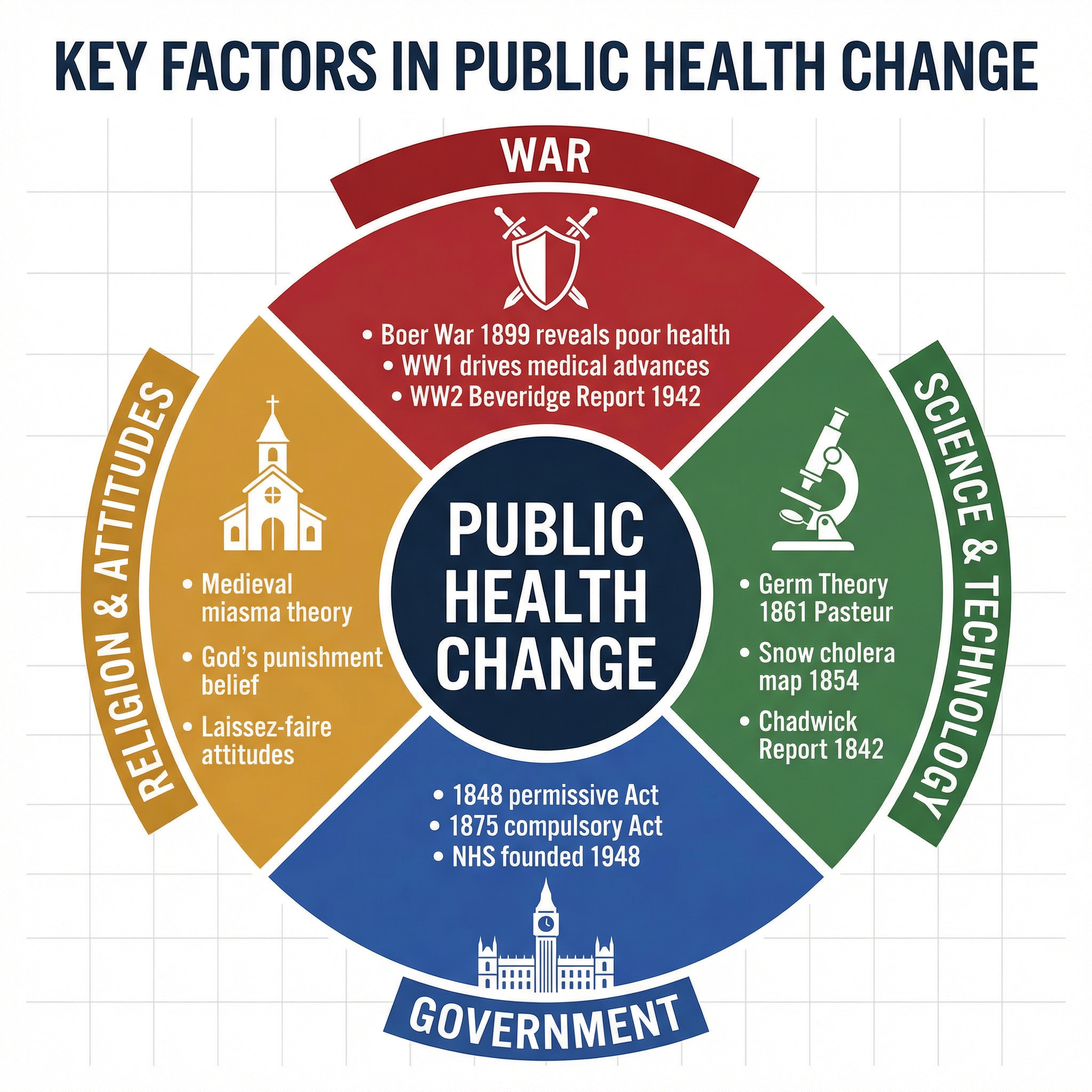
Public health changes were rarely caused by a single factor. For example, the 1875 Public Health Act was caused by a combination of factors: scientific proof (Snow, Pasteur), government reports (Chadwick), political pressure (extension of the vote to working men who demanded better conditions), and repeated cholera epidemics creating a sense of crisis.
Consequence
The consequences of public health measures were profound. The provision of clean water and sewers after 1875 led to a dramatic fall in deaths from diseases like typhoid and cholera. The creation of the NHS in 1948 led to a significant increase in life expectancy and a reduction in infant mortality.
Change & Continuity
While there has been massive change, some things have remained constant. The belief in miasma was a major continuity from the medieval period to the mid-19th century. The gap in health outcomes between rich and poor, while narrowed, remains a continuity even today. Change is most evident in the shift from individual/local responsibility to national government responsibility for health.
Significance
The establishment of the NHS in 1948 is arguably the most significant event in this entire thematic study. It marked the culmination of a century of struggle and a fundamental shift in the relationship between the state and the citizen.
Source Skills
When analysing sources on this topic, apply the Content-Provenance-Limitations-Judgement framework. A photograph of a Victorian slum is useful for showing the conditions (Content), but its usefulness is enhanced by knowing who took it and why (Provenance - was it a reformer trying to shock the public?). Its usefulness might be limited because it only shows one street and may not be representative (Limitations). Your final judgement should weigh these points to assess its overall utility for a specific enquiry."