Study Notes
Overview
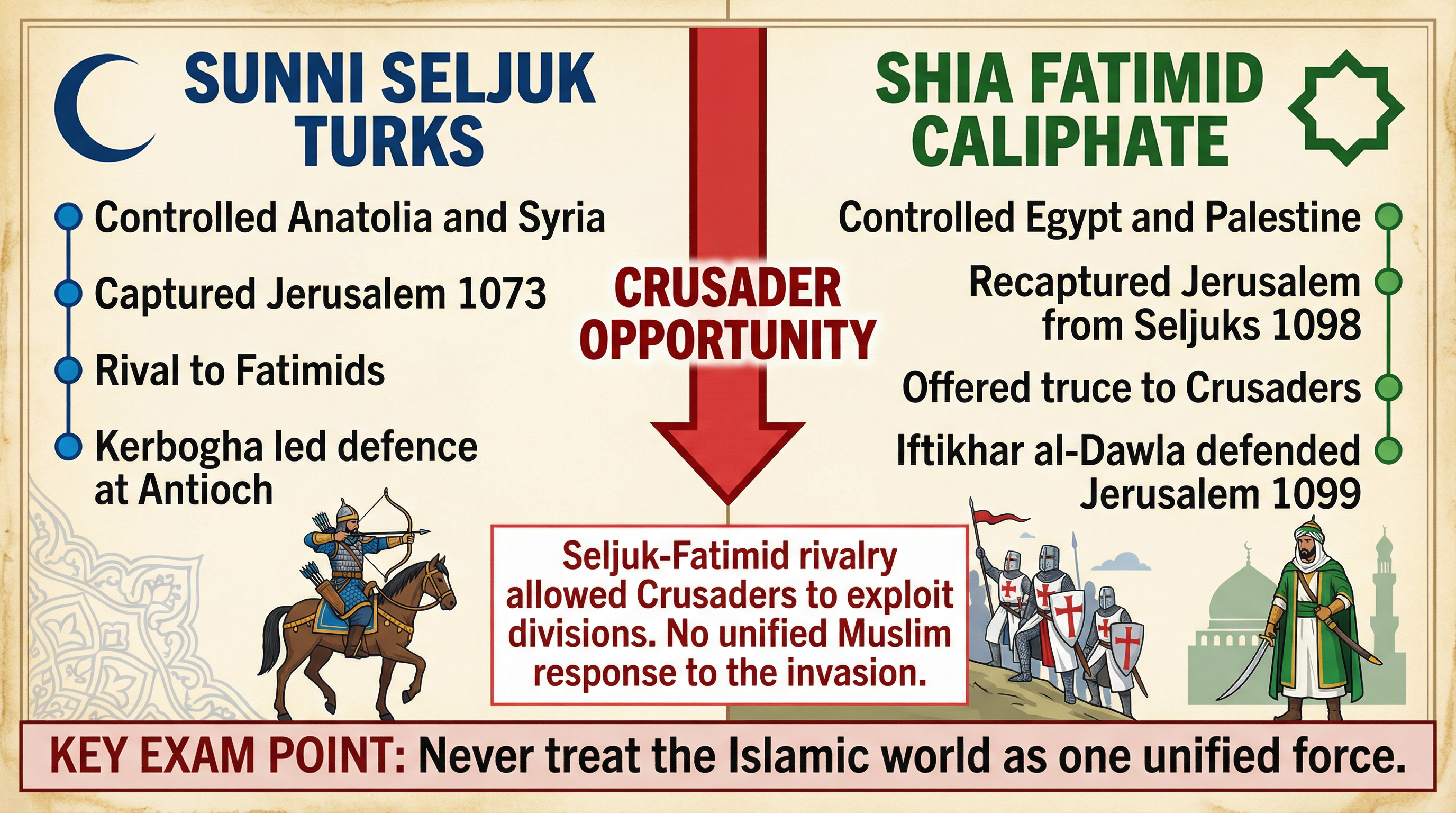
This OCR B (SHP) World Depth Study focuses on the First Crusade, a pivotal event in medieval history. Candidates are expected to move beyond a simple narrative of events and engage with the complex interplay of religious zeal, political ambition, and military strategy. The historical context is crucial: the fragmentation of the Near East, with the Sunni Seljuk Turks and the Shia Fatimid Caliphate locked in rivalry, created a window of opportunity for the Latin West. Examiners will reward responses that analyse the distinct motivations of Pope Urban II, Emperor Alexios I, and the Crusader princes, and evaluate differing historical interpretations. A key skill is the ability to deconstruct primary sources, considering their provenance and purpose to judge their utility. This guide will equip you with the detailed knowledge and analytical frameworks required to excel.
Key Events & Developments
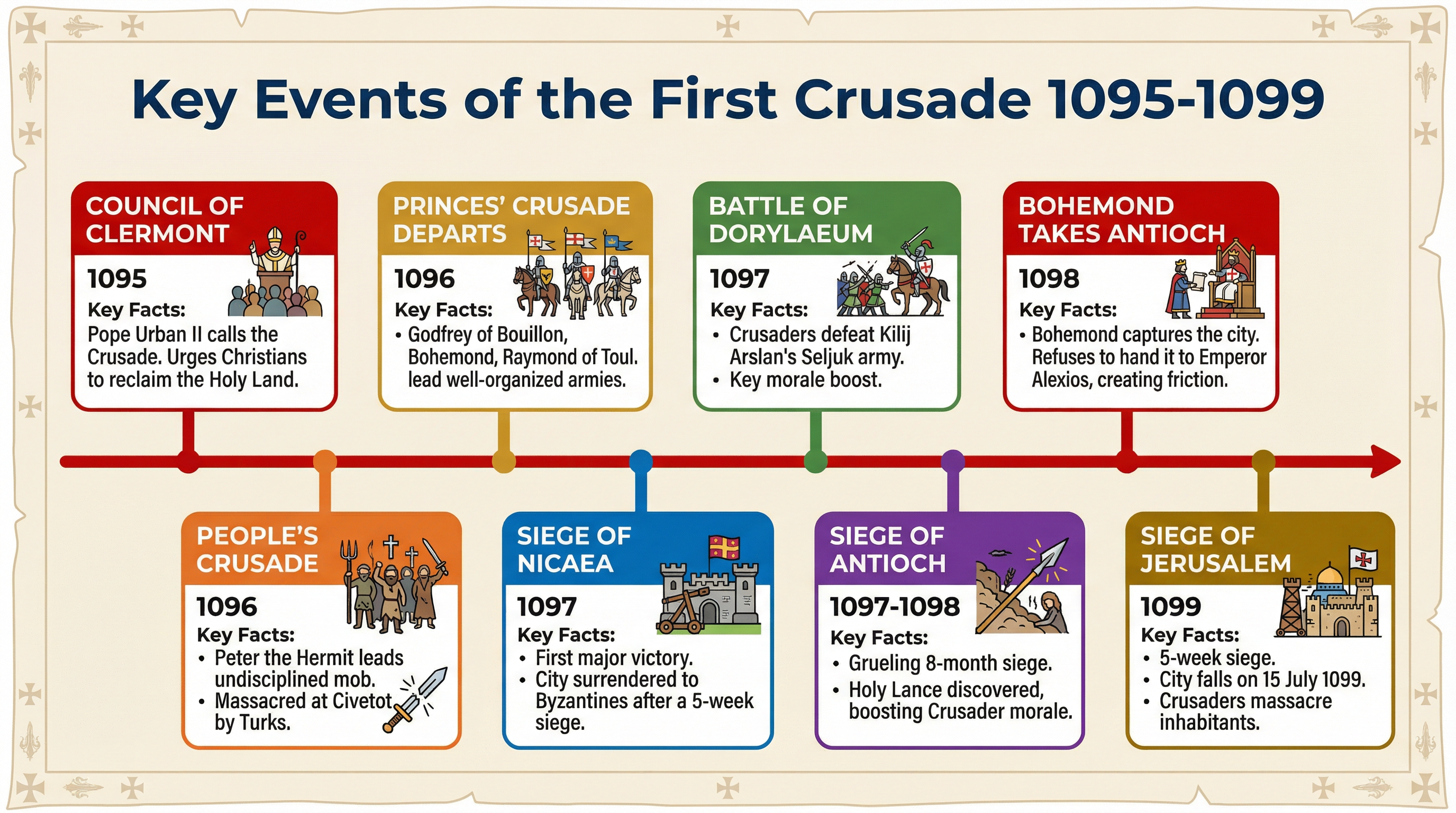
The Call to Arms: Council of Clermont
Date(s): November 1095
What happened: Pope Urban II delivered a powerful sermon calling on the knights of Christendom to embark on an armed pilgrimage to reclaim Jerusalem from Seljuk control. He offered a spiritual reward: the remission of all sins for those who undertook the journey.
Why it matters: This was the catalyst for the entire Crusade. It successfully mobilised thousands of warriors by blending religious piety with the opportunity for glory and land. For the exam, this event is central to any analysis of causation and motivation.
Specific Knowledge: Pope Urban II, Council of Clermont, November 1095, "Deus vult!" (God wills it!), Remission of Sins (plenary indulgence).
The People's Crusade vs. The Princes' Crusade
Date(s): 1096
What happened: Two distinct waves departed. The first, the People's Crusade, was an undisciplined and ill-equipped mass led by Peter the Hermit, which was quickly destroyed by the Turks at Civetot. The second, the Princes' Crusade, was a professional military force led by major European nobles.
Why it matters: A common mistake is to conflate these two. Examiners expect candidates to differentiate them clearly. The failure of the People's Crusade highlights the necessity of military discipline and logistics, which the Princes' Crusade possessed.
Specific Knowledge: Peter the Hermit, Civetot (October 1096), Godfrey of Bouillon, Bohemond of Taranto, Raymond of Toulouse.
The Siege of Antioch
Date(s): October 1097 - June 1098
What happened: An eight-month siege of a strategically vital city. The Crusaders suffered immense hardship but eventually took the city through treachery. They were then immediately besieged themselves by a relief army under Kerbogha, which they defeated against the odds after the supposed discovery of the Holy Lance.
Why it matters: This was the Crusade's greatest test. It demonstrates both Crusader resilience and the crucial role of morale (the Holy Lance). Critically, Bohemond's refusal to return the city to Emperor Alexios I highlights the theme of personal ambition versus the stated goals of the Crusade.
Specific Knowledge: Bohemond of Taranto, Kerbogha of Mosul, Holy Lance, Peter Bartholomew, Principality of Antioch.
The Capture of Jerusalem
Date(s): 7 June - 15 July 1099
What happened: After a five-week siege, the Crusaders breached the walls and captured the city, followed by a brutal massacre of the inhabitants. The Crusade's ultimate objective was achieved.
Why it matters: This was the culmination of the campaign. Analysis of its success must include the disunity of its defenders (the Fatimids had only recently taken it from the Seljuks) and the crucial arrival of Genoese ships with supplies and timber for siege engines.
Specific Knowledge: Iftikhar al-Dawla (Fatimid governor), Genoese fleet, siege towers, 15 July 1099.
Key Individuals
Pope Urban II
Role: Head of the Catholic Church
Key Actions: Called the First Crusade at the Council of Clermont in 1095.
Impact: His speech ignited the crusading movement. His motives were complex: to assert papal authority over secular rulers, heal the schism with the Eastern Church, and channel the violence of European knights outwards.
Emperor Alexios I Komnenos
Role: Byzantine Emperor
Key Actions: Appealed to the West for military aid against the Seljuk Turks.
Impact: His appeal was the trigger for Urban's call. However, he expected a small force of mercenaries, not a mass pilgrimage. His relationship with the Crusader leaders was fraught with tension, particularly over their refusal to return conquered lands like Antioch.
Bohemond of Taranto
Role: Norman prince from Southern Italy, a leader of the Princes' Crusade.
Key Actions: Masterminded the capture of Antioch and kept it for himself, creating the first Crusader State.
Impact: Bohemond is the prime example of a Crusader motivated by personal ambition and territorial gain. His actions at Antioch are crucial evidence for challenging interpretations that focus solely on religious zeal.
Godfrey of Bouillon
Role: Duke of Lower Lorraine, a leader of the Princes' Crusade.
Key Actions: Played a key role in the Siege of Jerusalem. Became the first ruler of the Crusader Kingdom of Jerusalem, taking the title 'Advocate of the Holy Sepulchre'.
Impact: Often portrayed as a more pious leader than Bohemond, Godfrey represents the ideal of the righteous warrior. His leadership was crucial in the final stages of the Crusade.
Second-Order Concepts
Causation
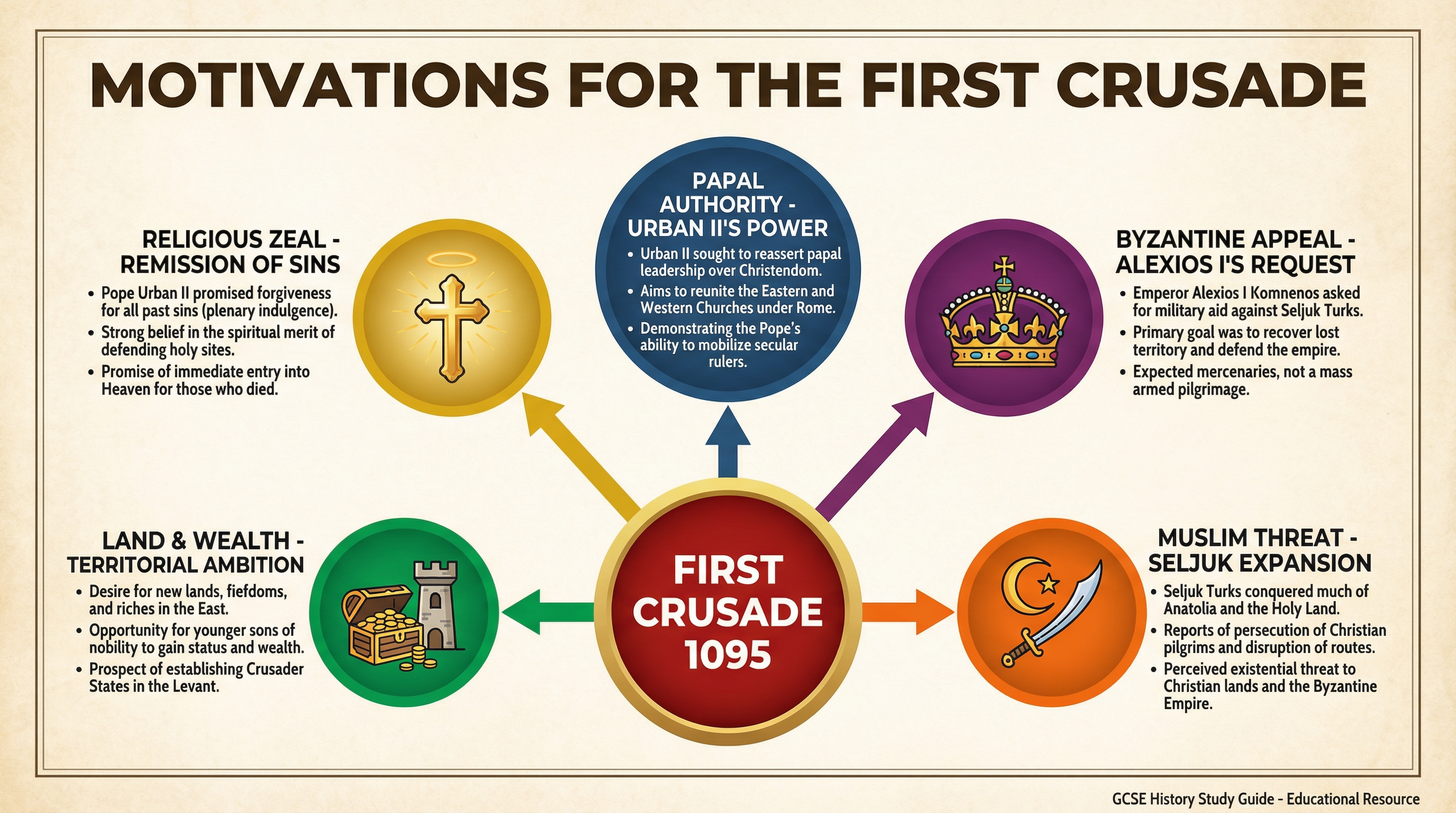
The causes of the First Crusade are a classic exam topic. You must categorise them. Long-term causes include the tradition of Christian pilgrimage, the concept of holy war, and the Investiture Controversy driving the Papacy to assert its authority. Medium-term causes include the expansion of the Seljuk Turks after the Battle of Manzikert (1071) and the resulting threat to the Byzantine Empire. The short-term trigger was Alexios I's appeal for help and Pope Urban II's speech at Clermont in 1095.
Consequence
The immediate consequence was the capture of Jerusalem and the establishment of four Crusader States: the Kingdom of Jerusalem, the Principality of Antioch, the County of Edessa, and the County of Tripoli. This dramatically altered the political map of the Near East. Long-term, it created a legacy of conflict between Christianity and Islam, intensified the split between the Catholic and Orthodox churches, and boosted the power and prestige of the Papacy.
Change & Continuity
Change: The Crusade represented a major change in Western European expansion, directing its military energy towards the Holy Land. It created a new form of piety – the armed pilgrimage. Continuity: The Crusade continued existing trends, such as the Papacy's efforts to control secular rulers and the land-hunger of European knights.
Significance
The First Crusade is significant because it was, against all expectations, a success. It demonstrated the power of the Papacy to mobilise vast armies and projected Western military power into the heart of the Islamic world. Its success created a precedent that would fuel the crusading movement for the next two centuries.
Source Skills
For this topic, you will encounter sources from different perspectives. When evaluating a source, use the Content-Provenance-Purpose (CPP) model.
- Content: What does the source say? What is its message? (e.g., A Christian chronicler describes a miracle; a Muslim writer describes Crusader brutality).
- Provenance: Who wrote it, when, and where? (e.g., Was it an eyewitness like the anonymous author of the Gesta Francorum? Or a later historian like Ibn al-Qalanisi writing in Damascus?)
- Purpose: Why was it created? (e.g., To glorify the Crusaders? To justify a political claim? To document a tragedy for a Muslim audience?).
Your judgement on a source's utility must be based on how its provenance and purpose affect the reliability and usefulness of its content for a specific enquiry. For example, a biased source can still be very useful for understanding the attitudes and beliefs of the person who created it.