Study Notes
Overview
This study explores the dramatic period between 1065 and 1087, focusing on the causes, events, and consequences of the Norman Conquest. It was a period defined by a brutal struggle for the English crown, the systematic subjugation of a conquered people, and the imposition of a new political, social, and religious order. For your OCR exam, a simple narrative is insufficient. Examiners expect candidates to analyse the mechanics of Norman control, such as the castle-building programme and the Feudal System, and to evaluate the nature of English resistance, from open rebellion to sullen compliance. You must deploy second-order historical concepts like causation, consequence, and change with precision, using specific, detailed knowledge to support your arguments. This guide will equip you to understand not just what happened, but why it mattered, and how historians have interpreted these seismic events.
Key Events & Developments
The Succession Crisis, 1065-1066
Date(s): 1065 - January 1066
What happened: The ageing and childless King Edward the Confessor was in failing health. This created a power vacuum with three main claimants to the English throne: Harold Godwinson, the most powerful Earl in England; William, Duke of Normandy, who claimed Edward had promised him the throne; and Harald Hardrada, King of Norway, whose claim was based on a previous Viking agreement. Harold Godwinson was crowned king the day after Edward's death on January 6th, 1066, a move that made conflict with the other claimants inevitable.
Why it matters: This is the critical short-term cause of the Norman Conquest. Without the succession crisis, William would have had no legitimate pretext to invade. For the exam, you must be able to explain the strengths and weaknesses of each claimant's case.
Specific Knowledge: Edward the Confessor died January 5th 1066. Harold Godwinson was crowned January 6th 1066. William of Normandy's claim was based on an alleged promise from Edward in 1051 and Harold's own oath of fealty sworn in 1064.
The Battles of 1066: Stamford Bridge & Hastings
Date(s): September - October 1066
What happened: First, Harald Hardrada invaded the north of England. Harold Godwinson marched his army north and defeated the Viking invaders at the Battle of Stamford Bridge on September 25th, 1066. Just three days later, William of Normandy landed his invasion force at Pevensey Bay in the south. Godwinson had to force-march his exhausted army over 200 miles south to confront the new threat. On October 14th, 1066, the two armies met at the Battle of Hastings. The battle lasted all day, but the Norman use of cavalry and archers, combined with the breaking of the English shield wall, led to a decisive Norman victory. Harold Godwinson was killed.
Why it matters: Hastings was the single most important event of the conquest. It eliminated the reigning king and shattered the Anglo-Saxon military leadership, opening the way for William to seize London and the crown. Candidates must not conflate Stamford Bridge and Hastings; credit is given for understanding the logistical challenge Godwinson faced fighting two major battles in three weeks.
Specific Knowledge: Battle of Stamford Bridge: September 25, 1066. William's landing at Pevensey: September 28, 1066. Battle of Hastings: October 14, 1066. Key turning point: The feigned retreat tactic used by the Normans.
The Harrying of the North, 1069-1070
Date(s): Winter 1069 - 1070
What happened: In response to a major rebellion in the north of England, supported by the Danes and the Scottish king, William unleashed a campaign of savage destruction. His armies systematically burned crops, destroyed villages, and slaughtered livestock across Yorkshire and the north-east. The aim was to make the region incapable of supporting future rebellions.
Why it matters: This event is crucial for understanding the brutality of Norman control. It demonstrates the lengths William would go to in order to crush resistance. High-level answers will link the Harrying to its long-term economic consequences, evidenced by the Domesday Book, which recorded huge areas of Yorkshire as 'waste' (terra vasta) in 1086.
Specific Knowledge: The rebellion was led by Edgar the Aetheling. The chronicler Orderic Vitalis claimed 100,000 people died of starvation. In the Domesday Book (1086), 60% of Yorkshire was recorded as waste.
The Feudal System & Castles
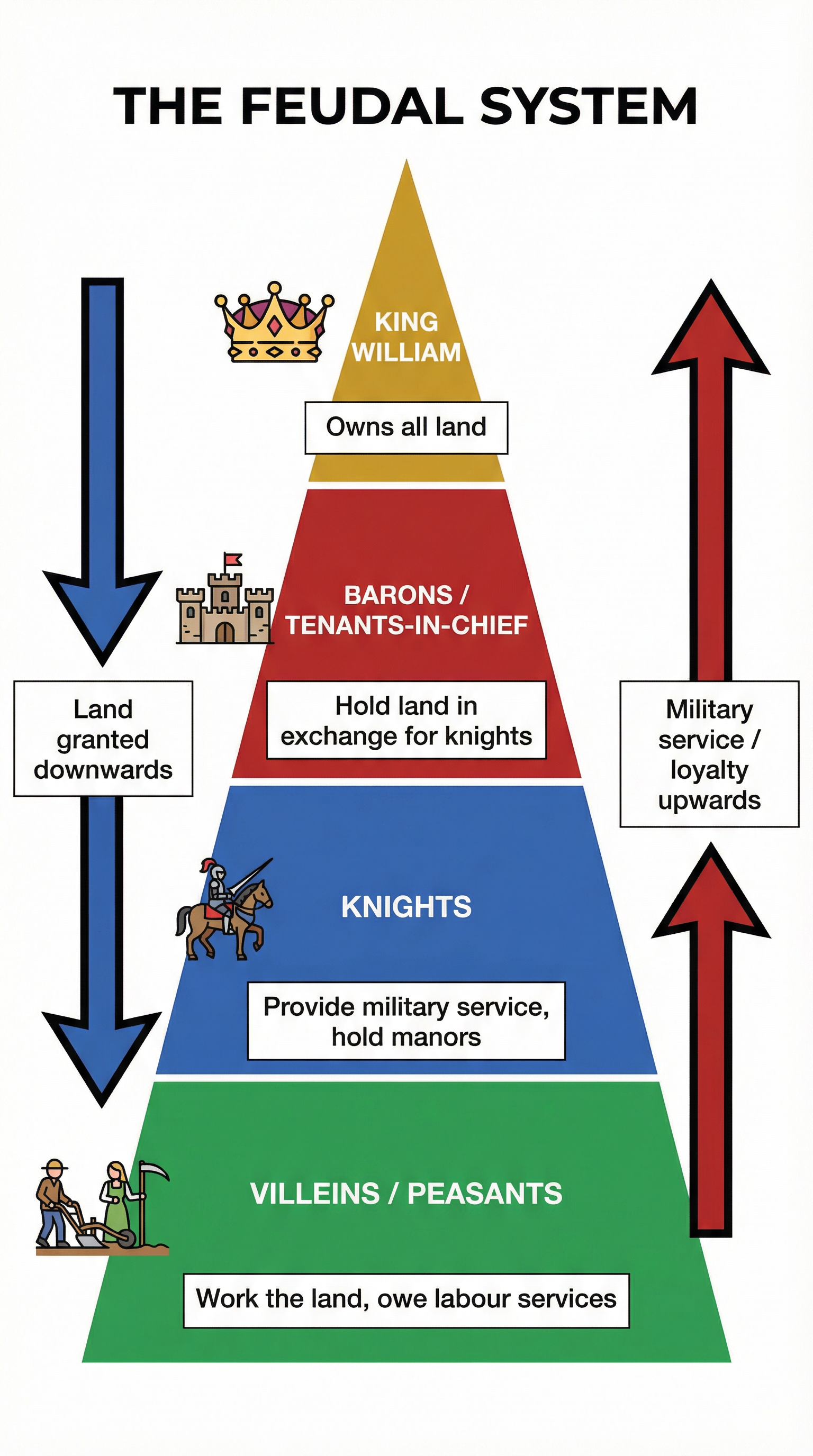
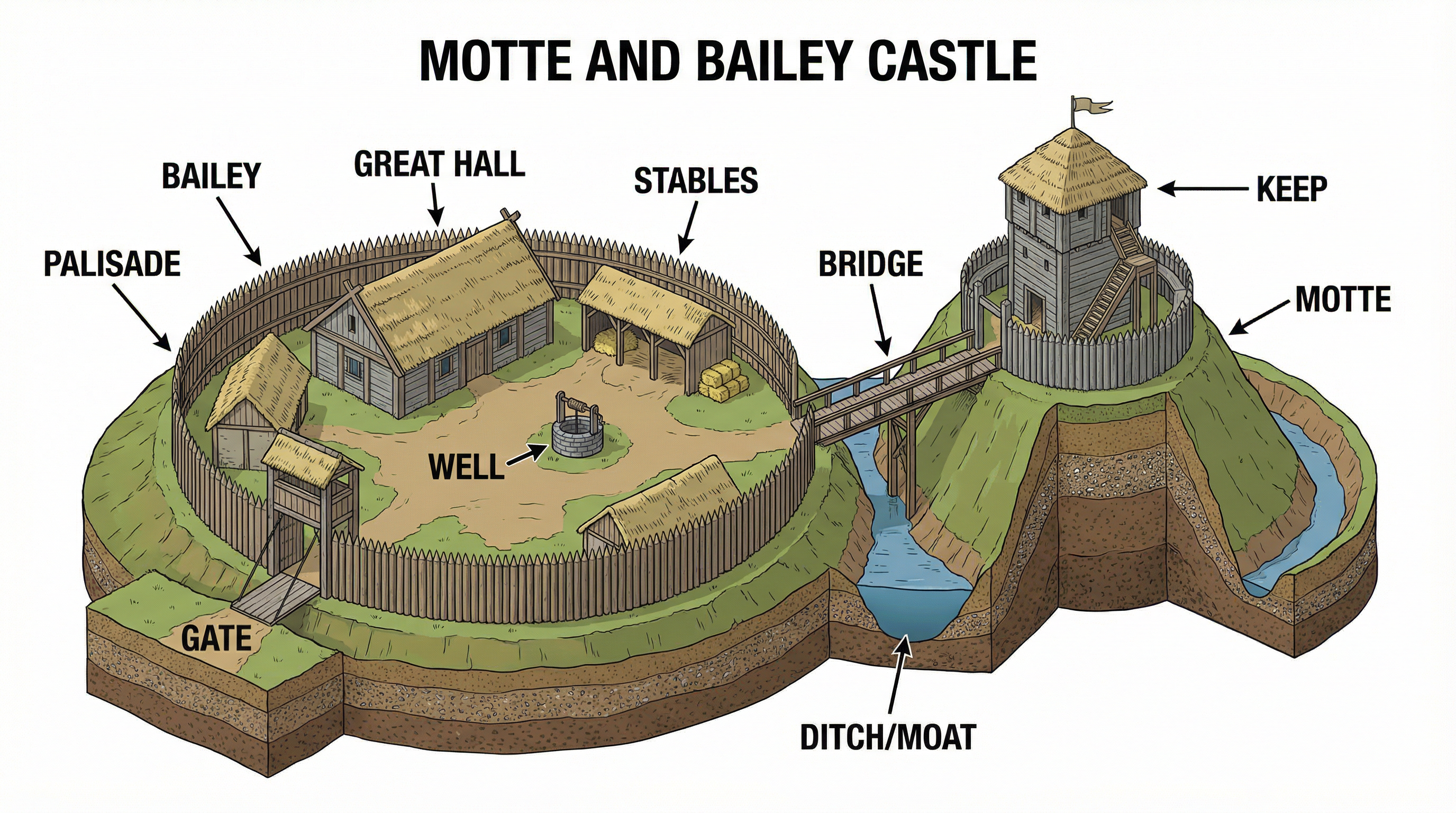
What happened: To consolidate his rule, William imposed a new system of land ownership. He declared all land in England belonged to him and granted large estates to his most loyal Norman barons (tenants-in-chief) in return for providing knights for military service. This system cascaded down through society. Alongside this, he initiated a massive castle-building programme. Initially, these were motte-and-bailey castles, quick to build from earth and timber, which served as bases for controlling the surrounding area.
Why it matters: These were the two primary instruments of Norman control. The Feudal System replaced the entire Anglo-Saxon aristocracy with a Norman one, ensuring loyalty to the king. Castles were physical symbols of Norman power, dominating the landscape and intimidating the local population. Marks are awarded for explaining this link between castles and the suppression of rebellion.
Specific Knowledge: By 1087, only 2 major Anglo-Saxon landowners remained. Around 500 motte-and-bailey castles were built. Key examples include the castle at Exeter, built after the 1068 revolt, and the Tower of London (started c. 1078).
The Domesday Book, 1086
Date(s): Commissioned 1085, completed 1086
What happened: William ordered a comprehensive survey of his new kingdom to establish who owned what land, how much it was worth, and what taxes it owed. Commissioners were sent out across England to gather information under oath from local juries of Normans and Anglo-Saxons.
Why it matters: The Domesday Book is an unparalleled historical source. For the exam, it provides concrete evidence of the wholesale transfer of land from Anglo-Saxon to Norman hands. It also provides the starkest evidence for the long-term impact of the Harrying of the North. It was a colossal administrative achievement and a final, definitive statement of William's power over England.
Specific Knowledge: The survey covered all of England except London, Winchester, and parts of the north. It revealed that by 1086, less than 5% of land was held by Anglo-Saxons.
Key Individuals
William the Conqueror
Role: Duke of Normandy, then King of England (1066-1087)
Key Actions: Invaded England in 1066, won the Battle of Hastings, brutally suppressed English rebellions (e.g., the Harrying of the North), imposed the Feudal System, commissioned the Domesday Book.
Impact: Transformed England's ruling class, social structure, church, and architecture. His reign established a powerful, centralised monarchy that laid the foundations for the medieval English state.
Harold Godwinson
Role: Earl of Wessex, then King of England (January - October 1066)
Key Actions: Secured his election as king, defeated Harald Hardrada at Stamford Bridge, fought and died at the Battle of Hastings.
Impact: The last Anglo-Saxon king of England. His short, dramatic reign represents the final, doomed stand of the Anglo-Saxon polity against overwhelming pressures.
Lanfranc, Archbishop of Canterbury
Role: Archbishop of Canterbury (from 1070)
Key Actions: A key advisor to William, he reformed the English Church, replacing Anglo-Saxon bishops with Normans, enforcing clerical celibacy, and overseeing the rebuilding of major cathedrals in the Norman Romanesque style.
Impact: He Normanised the English Church, bringing it into line with the continental European church and making it another pillar of Norman control.
Hereward the Wake
Role: Anglo-Saxon rebel
Key Actions: Led a famous resistance movement against the Normans based in the Isle of Ely between 1070-1071.
Impact: Became a legendary figure of English resistance. His campaign highlights the difficulties the Normans faced in subduing all parts of the kingdom and the importance of geography (the Fens) in resisting Norman military tactics.
Second-Order Concepts
Causation
Long-term causes: Edward the Confessor's childlessness; William of Normandy's growing ambition and power; the historic links between England and Scandinavia. Short-term cause/trigger: Edward's death in January 1066 and Harold Godwinson's immediate coronation.
Consequence
Immediate: Decimation of the Anglo-Saxon aristocracy; widespread confiscation of land; a major programme of castle building. Long-term: The creation of a new Anglo-Norman society and culture; the strengthening of the English monarchy; a shift in England's political and cultural focus from Scandinavia towards France and continental Europe; the English language was profoundly changed by the introduction of Norman French.
Change & Continuity
Change: A complete change in the land-owning elite. A new language of power (Norman French). A new style of architecture (Romanesque). A new military system (feudalism and knights). Continuity: The basic structures of local government (shires and hundreds) were kept. The majority of the population remained Anglo-Saxon peasants, working the land as they had before, albeit for new lords. Some Anglo-Saxon laws were retained.
Significance
The Norman Conquest is arguably the single most significant event in English history. It was not merely a change of king, but a revolutionary transformation of the country's ruling class, social structure, language, and culture. It ended the Anglo-Saxon period and set England on a new historical trajectory.
Source Skills
When approaching OCR sources on this topic, you will often encounter excerpts from the Anglo-Saxon Chronicle, William of Poitiers, or Orderic Vitalis, as well as the Bayeux Tapestry. Always apply the Content-Provenance-Limitations-Judgement framework. For example, when analysing the Bayeux Tapestry, its content is a detailed visual narrative of the conquest. Its provenance is crucial: it was likely commissioned by Bishop Odo, William's half-brother, around 1077, meaning it presents a Norman perspective. Its usefulness is immense for understanding the Norman view of events and for details of military equipment, but its limitation is its clear pro-Norman bias. Your final judgement must weigh these factors to assess its utility for a specific enquiry.