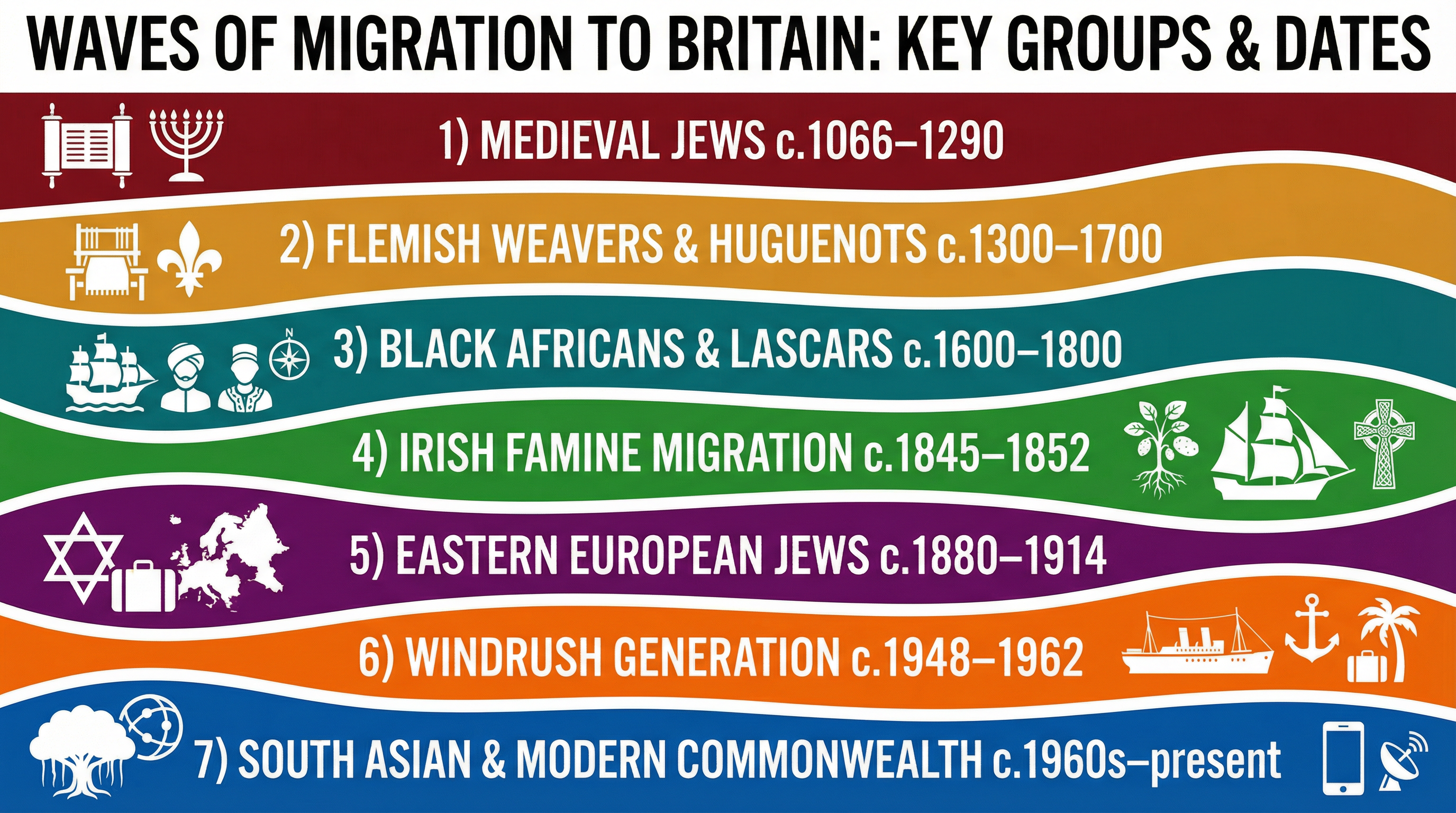
Study Notes
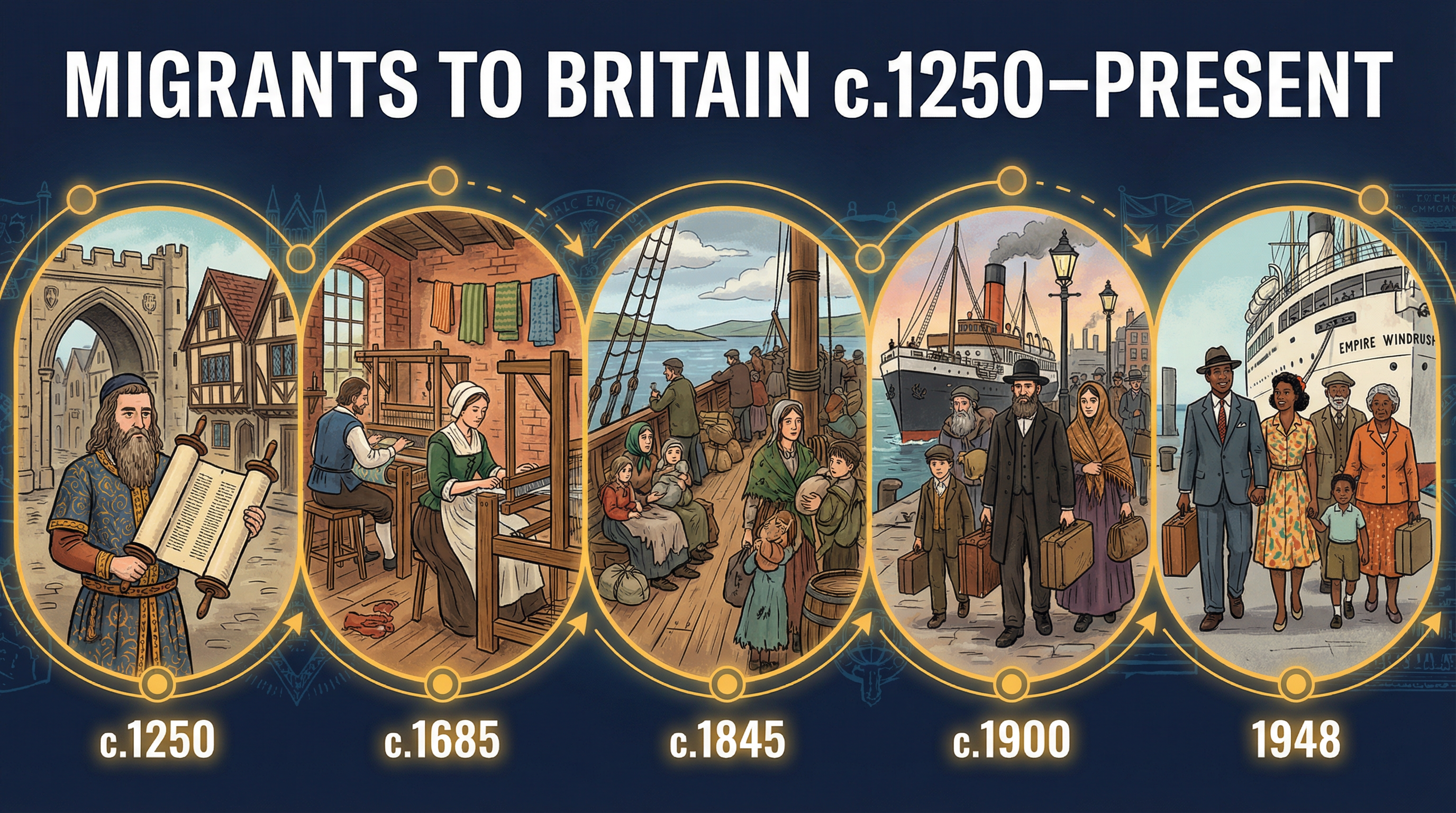
Overview
This thematic study for OCR A (Explaining the Modern World) charts the long and complex story of migrants to Britain. It requires candidates to move beyond a simple narrative of arrivals and instead analyse the forces that have driven migration (push and pull factors), the varied experiences of migrant groups upon arrival, and their profound impact on British society. Examiners are looking for a sophisticated understanding of change and continuity over this vast 800-year period. A successful candidate will be able to draw thematic comparisons between, for example, the economic role of medieval Jews and post-war Commonwealth citizens, or the hostile reception faced by both Irish famine migrants and the Windrush generation. The key to this paper is balancing precise, factual knowledge (AO1) with the analytical skills needed to evaluate sources and construct arguments (AO2 & AO3). This guide will break down the key events, concepts, and skills you need to excel.
Key Events & Developments
The Jews in Medieval England (c.1066-1290)
Date(s): c.1066 - 1290
What happened: Following the Norman Conquest, William I invited Jewish merchants and financiers from Rouen to England. As they were not bound by the Christian laws on usury (lending money for interest), they played a vital role in the economy, financing the construction of many cathedrals and abbeys. Legally, they were considered the personal property of the King, which afforded them protection but also made them vulnerable to royal exploitation through arbitrary taxes (tallages).
Why it matters: This period establishes a key theme: migrants being invited for economic reasons but facing social and religious hostility. The Jews' financial success bred resentment, and religious anti-semitism was widespread, leading to periodic violence (pogroms), such as the massacre at York in 1190. This culminated in the Edict of Expulsion in 1290 by Edward I, the first national expulsion of a migrant group, setting a precedent for state-level action.
Specific Knowledge: William the Conqueror, Edict of Expulsion (1290), tallages, usury, Clifford's Tower (York massacre).
Huguenot Weavers in London (c.1680-1750)
Date(s): Primarily 1680s, following the Revocation of the Edict of Nantes in 1685.
What happened: Huguenots were French Protestants who fled persecution under the Catholic King Louis XIV. Around 50,000 came to England, a significant number of whom were highly skilled artisans, especially in silk weaving. They settled in areas like Spitalfields in London and Canterbury.
Why it matters: The Huguenots are often cited as a successful example of integration. Their skills revitalised the English textile industry, bringing new techniques and designs that made Spitalfields silk a luxury product. This demonstrates the positive economic impact of migration. While there was some initial resentment from local weavers, their shared Protestantism and valuable skills helped them assimilate relatively smoothly compared to other groups.
Specific Knowledge: Louis XIV, Revocation of the Edict of Nantes (1685), Spitalfields, silk weaving.
Irish Famine Migration (c.1845-1852)
Date(s): 1845-1852
What happened: The Great Famine in Ireland, caused by potato blight, was a catastrophic push factor that led to the death of one million people and the emigration of another million. Hundreds of thousands came to mainland Britain, seeking work in the industrial cities like Liverpool, Manchester, and Glasgow.
What happened: They provided a huge source of cheap labour for Britain's factories, docks, and infrastructure projects (becoming known as 'navvies' for building canals and railways). However, they faced extreme poverty and lived in overcrowded, unsanitary conditions. Crucially, they also experienced intense anti-Catholic and anti-Irish prejudice, often depicted in hostile media cartoons as ape-like and subhuman.
Why it matters: This wave highlights the complex interplay of economic need and social hostility. While Irish labour was essential to the Industrial Revolution, the migrants themselves were often marginalised and discriminated against. This period shows a clear continuity of migrant groups filling low-wage jobs while facing a hostile reception from the native population.
Specific Knowledge: The Great Famine, potato blight, 'navvies', anti-Catholicism, Punch magazine cartoons.
The 1905 Aliens Act
Date(s): 1905
What happened: From the 1880s, Britain saw a large influx of Eastern European Jews fleeing pogroms in the Russian Empire. They settled in poor, inner-city areas like the East End of London. Their arrival, combined with existing social tensions, led to a moral panic about the impact of immigration.
Why it matters: The Conservative government passed the Aliens Act, the first piece of legislation in peacetime to control who could enter the country. It specified that immigrants could be refused entry if they were 'undesirable' (e.g., likely to become a public charge). While its immediate impact was limited, it was a huge symbolic turning point. It marked the end of Britain's 'open door' policy and established the principle that the state had the right to control its borders.
Specific Knowledge: Pogroms, East End of London, 'undesirable' immigrants, Balfour's Conservative government.
The Windrush Generation and Commonwealth Migration (1948-1962)
Date(s): 1948 onwards
What happened: After WWII, Britain faced severe labour shortages. The British Nationality Act 1948 granted all Commonwealth citizens the right to move to and work in the UK. The arrival of the ship HMT Empire Windrush in 1948, carrying nearly 500 workers from the Caribbean, is a symbolic start to this era. Hundreds of thousands more followed from the Caribbean, India, and Pakistan, invited to work in the newly formed NHS, public transport, and textile factories.
Why it matters: This was a period of government-sponsored immigration driven by economic need. However, social reality was different. Migrants faced the 'Colour Bar' – widespread racial discrimination in housing ('No Blacks, No Dogs, No Irish'), employment, and social life. Tensions erupted into violence, such as the Notting Hill Riots in 1958. This led to a shift in policy, from encouragement to restriction, with the 1962 Commonwealth Immigrants Act, which began to limit the rights of Commonwealth citizens to migrate.
Specific Knowledge: British Nationality Act 1948, HMT Empire Windrush, 'Colour Bar', Notting Hill Riots (1958), Commonwealth Immigrants Act 1962.
Key Individuals
William the Conqueror (1066-1087)
Role: King of England
Key Actions: Invited Jewish financiers from Normandy to England after the conquest.
Impact: Established the first significant Jewish community in England, primarily for economic reasons. His policy set the stage for the complex relationship between the Crown, the economy, and the Jewish population for the next 200 years.
Edward I (1272-1307)
Role: King of England
Key Actions: Issued the Edict of Expulsion in 1290, forcing all Jews to leave England.
Impact: Ended the medieval Jewish presence in England. This was the first state-sponsored expulsion of a migrant group in British history, a significant act of state power that reflected and solidified widespread anti-semitism.
Enoch Powell (1912-1998)
Role: Conservative MP
Key Actions: Delivered the infamous 'Rivers of Blood' speech in 1968, in which he warned of the dangers of Commonwealth immigration and predicted civil strife.
Impact: Powell's speech was highly inflammatory and brought the issue of race and immigration to the forefront of public debate. While he was sacked from the Shadow Cabinet, polls showed he had significant public support. He gave a voice to anti-immigrant sentiment and created a political climate that made it harder to pass anti-discrimination laws.
Second-Order Concepts
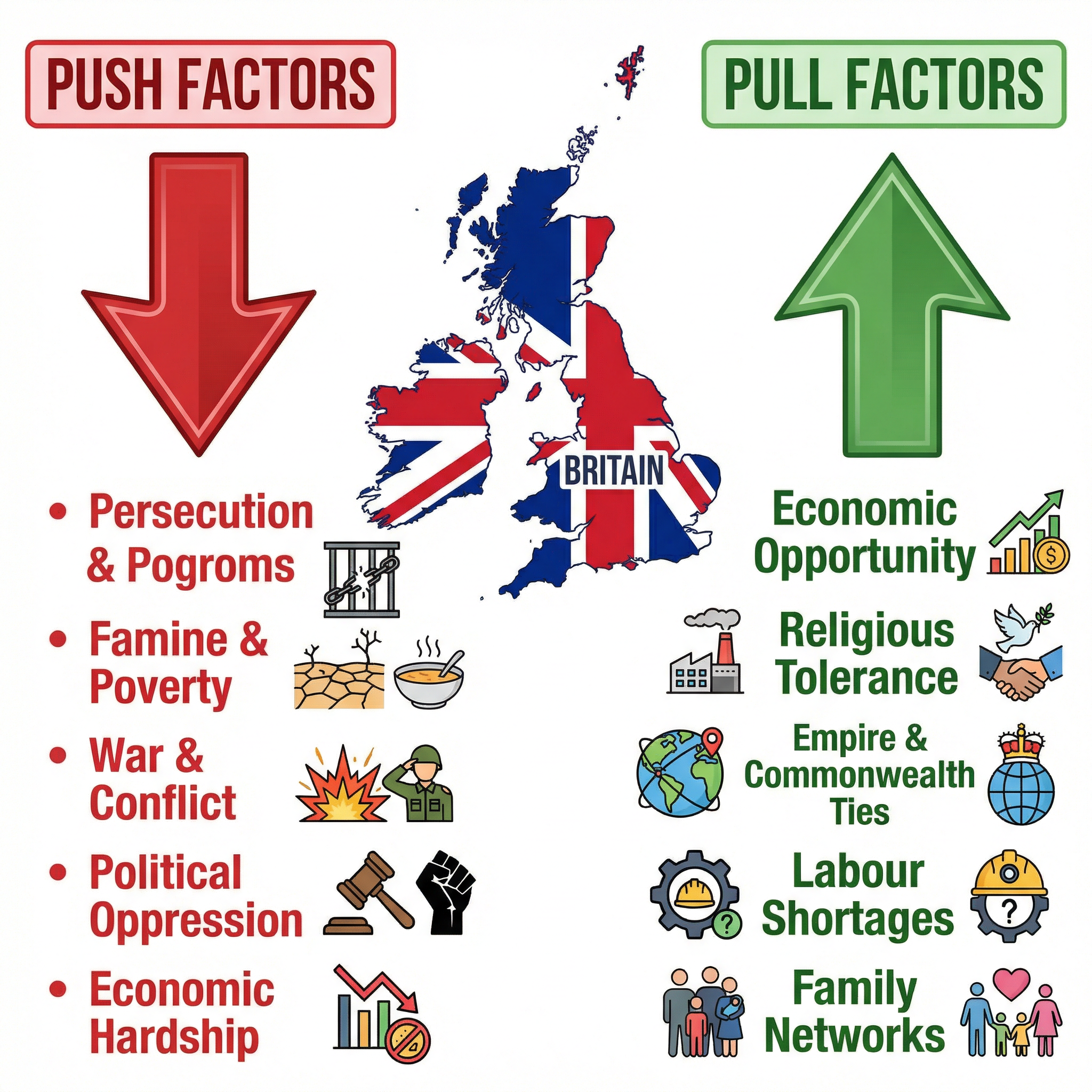
Causation
Migration is never caused by a single factor. Examiners expect you to analyse a combination of 'push' factors (reasons to leave a country) and 'pull' factors (reasons to come to Britain). For example, the push factor of the Irish Famine (poverty, starvation) combined with the pull factor of industrial jobs in Britain. Long-term causes like ongoing persecution (Huguenots, Jews) can be turned into immediate migration by short-term trigger events like the Revocation of the Edict of Nantes or a specific pogrom.
Consequence
The consequences of migration are widespread, affecting the economy, society, and culture. For the exam, you must analyse both positive and negative consequences. For example, a positive economic consequence was the Huguenots' contribution to the silk industry. A negative social consequence was the racial tension and riots of the 1950s. You should also consider the impact on the migrants themselves – their experiences of work, housing, and reception.
Change & Continuity
This is the most important concept for this thematic study.
Change: The ethnic and religious diversity of migrants has changed significantly, from mainly European groups to people from across the Commonwealth. Government policy has also changed dramatically, from the 'open door' of the 19th century to the restrictive legislation of the 20th and 21st centuries.
Continuity: There are striking continuities. Migrants have consistently been a source of labour for the British economy. There is also a depressing continuity in the hostile reception many groups have faced, from the anti-semitism faced by medieval Jews to the racism experienced by the Windrush generation.
Significance
Why does this all matter? The significance of migration to Britain is immense. It has shaped the country's economic development, social fabric, and cultural identity. Key events have long-term significance. The 1905 Aliens Act is significant because it established the principle of immigration control. The arrival of the Windrush is significant because it marks the beginning of modern, multicultural Britain.
Source Skills
For this topic, you will be given sources to evaluate. Use the Content-Provenance-Limitations-Judgement model.
- Content: What does the source say or show? What is its argument or message? Pick out specific details.
- Provenance: Who made it? When? Why? What type of source is it? This is crucial. A government report has a different purpose to a political cartoon. The purpose of the author/creator is key to understanding potential bias.
- Limitations (and Usefulness): Based on its content and provenance, what are the source's limitations? A biased source is NOT useless. Its bias is useful for showing the attitudes of the time. What does the source not tell you? You must use your own knowledge (AO1) here to identify what is missing.
- Judgement: Make an overall judgement. How useful is the source for the specific enquiry in the question? Compare it to other sources if the question asks for it.