Study Notes
Overview
This OCR World Depth Study investigates the profound impact of the Nazi dictatorship on the German people. Examiners expect candidates to move beyond simple descriptions and analyse the complex relationship between state power and popular consent. The study covers the consolidation of Hitler's power, the mechanisms of control (both terror and persuasion), the changing lives of social groups like women, youth, and workers, and the radicalisation of policy during the Second World War, culminating in the Holocaust. High-level responses must demonstrate a clear understanding of change over time, contrasting the pre-war period (1933-1939) with the war years (1939-1945). Credit is awarded for precise factual knowledge and the ability to evaluate historical sources and interpretations critically. Success in this topic hinges on understanding not just what happened, but why it happened and how the regime was able to embed itself so deeply into German society.
Key Events & Developments
The Consolidation of Power (1933-1934)
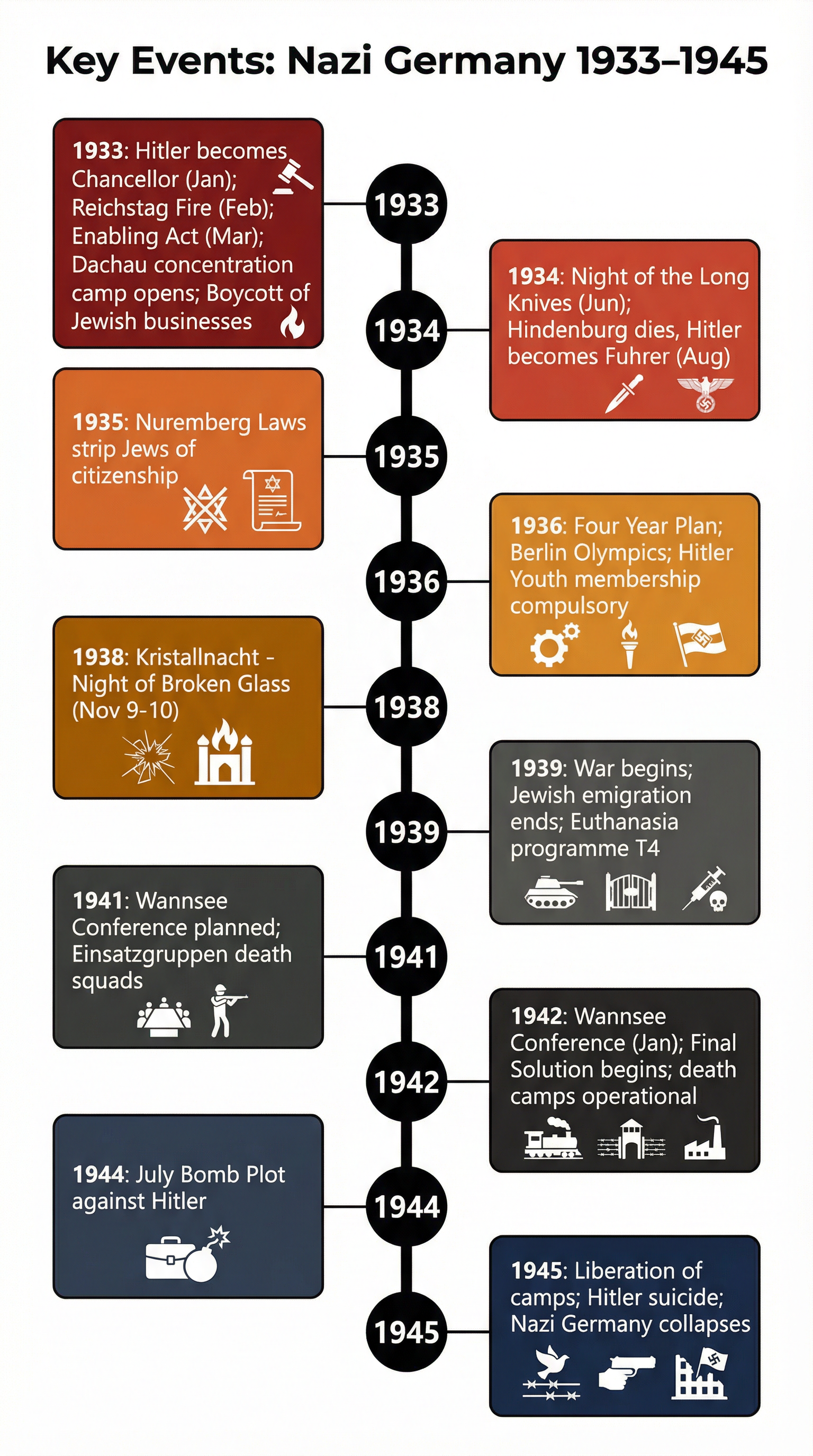
Date(s): January 1933 - August 1934
What happened: A rapid sequence of events allowed Hitler to dismantle democracy and establish a dictatorship. This began with his appointment as Chancellor (Jan 1933), followed by the Reichstag Fire (Feb 1933), which was used as a pretext to pass the 'Decree for the Protection of People and State', suspending civil liberties. The Enabling Act (March 1933) gave Hitler the power to pass laws without the Reichstag's consent for four years. The Night of the Long Knives (June 1934) eliminated internal opposition from the SA and secured the army's loyalty. When President Hindenburg died (August 1934), Hitler merged the offices of Chancellor and President to become the Führer.
Why it matters: This sequence is fundamental to causation questions. Candidates must explain how each step logically led to the next, removing checks and balances and concentrating all state power in Hitler's hands. It demonstrates the fragility of democracy and the use of legal means to achieve dictatorial ends.
Specific Knowledge: Reichstag Fire Decree, Enabling Act, Night of the Long Knives, death of Hindenburg.
The Police State: Mechanisms of Control
Date(s): 1933-1945
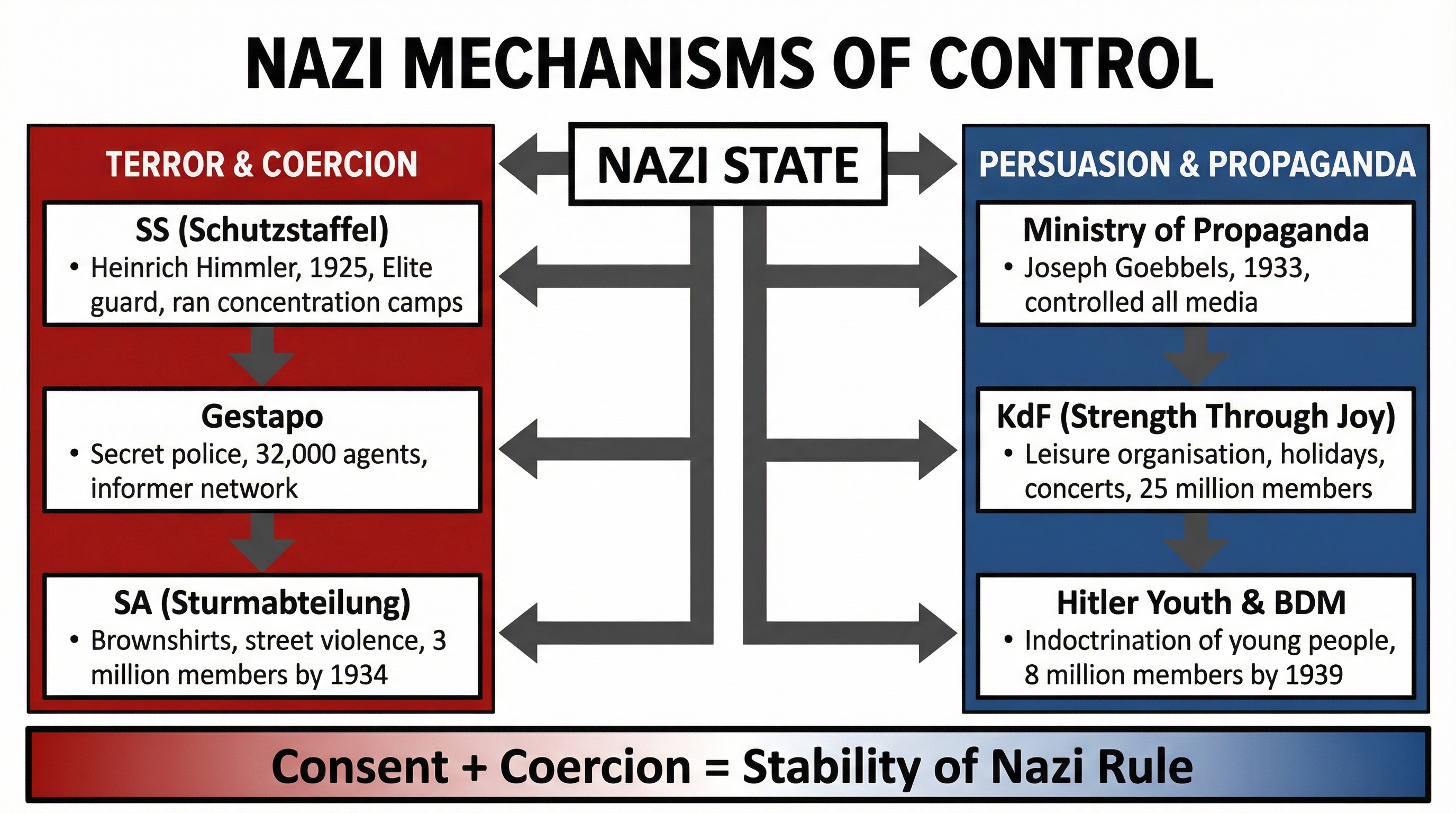
What happened: The regime maintained control through a dual system of terror and persuasion. The terror apparatus was led by the SS (Schutzstaffel) under Heinrich Himmler, which controlled the concentration camp system and, after 1936, the Gestapo (Secret State Police). The Gestapo, though relatively small, was highly effective due to a vast network of informers. This created a climate of fear and suspicion. Alongside this was a sophisticated propaganda machine run by Joseph Goebbels, which controlled all media and promoted the cult of the Führer. Organisations like the KdF (Strength Through Joy) provided leisure opportunities, generating popular consent.
Why it matters: This is the core of the topic. High-level responses must analyse the relationship between terror and consent. Was the regime popular because people were terrified, or because they genuinely supported its policies? The answer is a complex mix of both, and candidates must be able to argue this balance.
Specific Knowledge: SS, Gestapo, Heinrich Himmler, Joseph Goebbels, KdF, Reich Chamber of Culture.
The Escalation of Persecution against the Jews
Date(s): 1933-1945
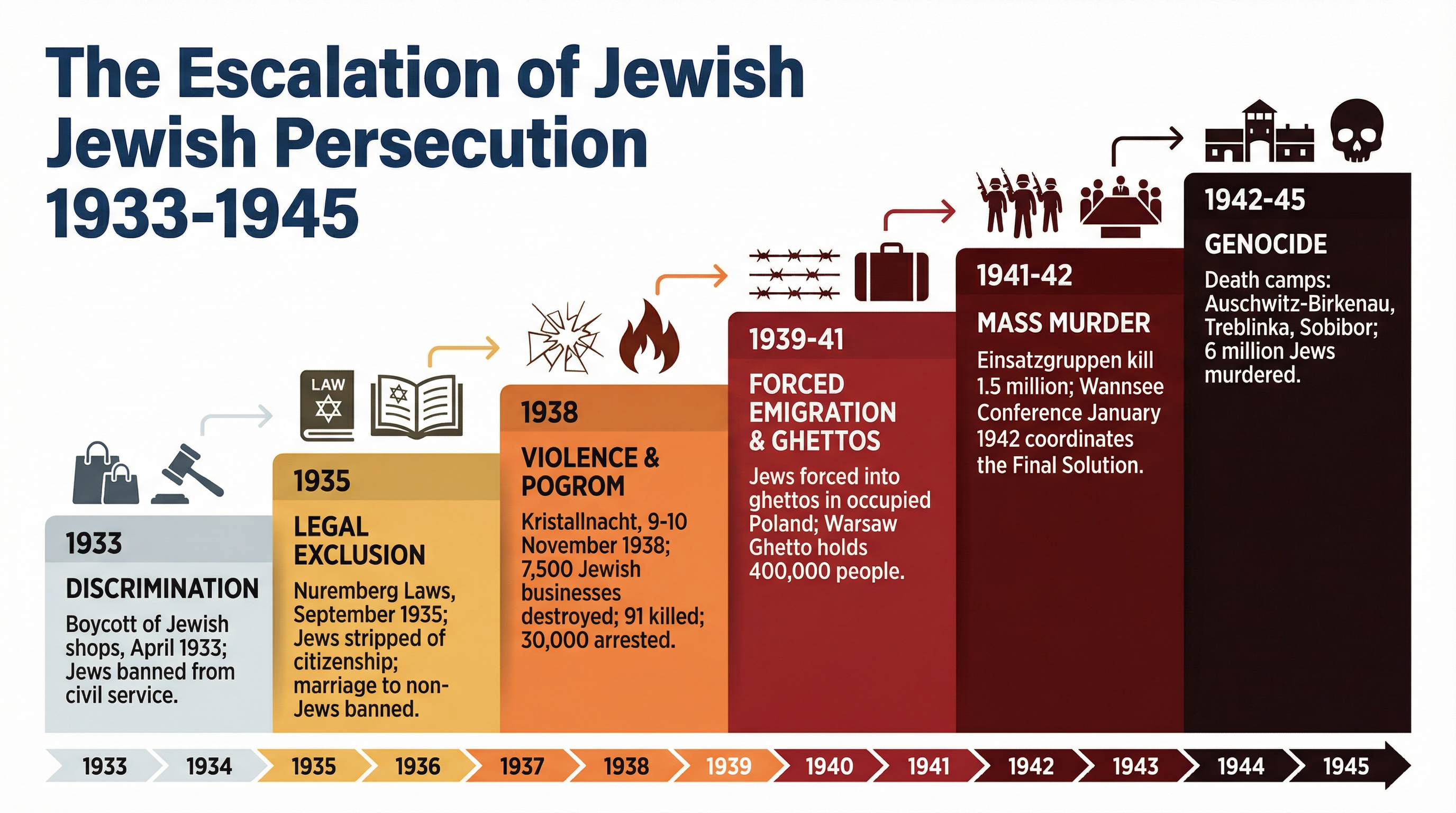
What happened: The persecution of Germany's Jewish population occurred in escalating stages. It began with discrimination and legal exclusion, such as the 1933 boycott of Jewish businesses and the 1935 Nuremberg Laws which stripped Jews of their citizenship. The violence intensified with the Kristallnacht pogrom in November 1938. With the start of the war, policy radicalised, moving to ghettoisation and, from 1941, systematic mass murder by the Einsatzgruppen. The 'Final Solution to the Jewish Question' was coordinated at the Wannsee Conference in January 1942, leading to the establishment of death camps and the murder of six million Jews.
Why it matters: This demonstrates the concept of change over time and the radicalising effect of war. Candidates must be able to distinguish between the different phases of persecution and explain how the regime's aims evolved from exclusion to extermination.
Specific Knowledge: Nuremberg Laws (1935), Kristallnacht (1938), Wannsee Conference (1942), Einsatzgruppen, The Final Solution, Auschwitz-Birkenau.
Key Individuals
Adolf Hitler
Role: Führer and Chancellor of Germany
Key Actions: Architect of the Nazi state and its ideology. Made all key strategic decisions, from the consolidation of power in 1933-34 to the initiation of the war and the Holocaust.
Impact: His leadership was central to the regime's character. The 'Führerprinzip' (leader principle) meant his will was the ultimate law. The cult of personality built around him was a key element of propaganda.
Heinrich Himmler
Role: Reichsführer-SS, Chief of German Police
Key Actions: As head of the SS, Himmler was one of the most powerful men in Nazi Germany. He controlled the entire police state apparatus, including the Gestapo, the concentration camp system, and the Waffen-SS. He was the main architect of the Holocaust.
Impact: Himmler was the embodiment of the Nazi terror state. His bureaucratic efficiency and fanatical ideological commitment were instrumental in carrying out the regime's most horrific crimes.
Joseph Goebbels
Role: Minister for Public Enlightenment and Propaganda
Key Actions: Controlled every aspect of German media and culture, from newspapers and radio to film and art. He orchestrated the Nuremberg Rallies and the cult of the Führer. He was a master of manipulating public opinion.
Impact: Goebbels was crucial in generating consent and maintaining morale. His propaganda machine was vital for persuading the German people to accept the regime's policies and to continue fighting the war.
Second-Order Concepts
Causation
Why did the Nazis succeed in staying in power? Long-term causes include the legacy of the Treaty of Versailles and the weakness of the Weimar Republic. Medium-term causes include the impact of the Great Depression. Short-term triggers include the Reichstag Fire and the political intrigues that led to Hitler's appointment as Chancellor. The combination of terror and propaganda was the key causal factor in maintaining power.
Consequence
The consequences of Nazi rule were catastrophic. For Germany, it led to total war, physical destruction, national division, and the deaths of millions. For Europe, it led to the Second World War and the Holocaust, the systematic murder of six million Jews and millions of other victims. The long-term consequences include the ongoing struggle to deal with the legacy of genocide and the creation of the state of Israel.
Change & Continuity
A key theme is the change over time. The regime of 1933, focused on economic recovery and consolidating power, was very different from the regime of 1943, engaged in total war and industrialised genocide. However, there was continuity in the core ideology of racial purity and aggressive nationalism. Candidates must differentiate between the pre-war and wartime periods.
Significance
The Nazi regime is historically significant as a case study in the collapse of democracy, the mechanics of a modern totalitarian state, and the perpetration of genocide. It raises fundamental questions about human nature, obedience, and resistance that remain relevant today. For examiners, its significance lies in its impact on Germany and the world, and its role as a defining event of the 20th century.
Source Skills
When approaching OCR sources on this topic, focus on provenance. Who created this source, when, and for what purpose? A speech by Goebbels is useful not for its factual accuracy, but for what it reveals about Nazi propaganda methods. A private diary entry from a Jewish citizen is useful for its insight into the lived experience of persecution, but may not see the bigger political picture. The key is to use the source's nature to inform your evaluation. Never, ever dismiss a source as 'biased and therefore useless'. Instead, explain how the bias is useful to a historian.