Study Notes
Overview
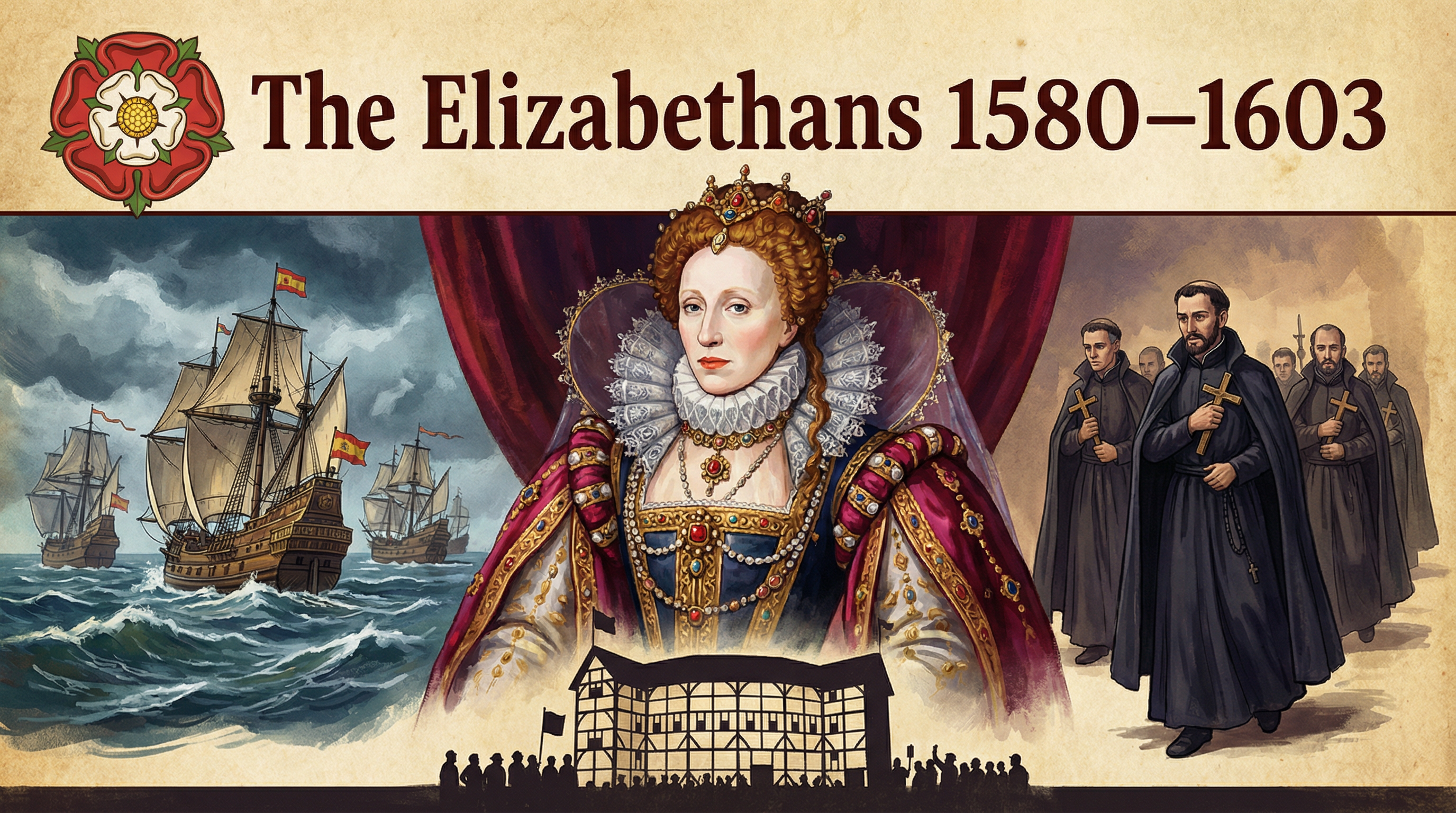
This OCR B (SHP) Depth Study examines the final two decades of Elizabeth I's reign, a period of intense crisis and change often obscured by the 'Golden Age' myth. Candidates are expected to move beyond narrative and develop analytical arguments on the nature of the Catholic and Puritan threats, the causes and consequences of social and economic problems like poverty, and the role of culture, particularly the theatre, in Elizabethan society. Examiners award high marks for the ability to deploy precise factual knowledge (AO1) to support arguments, and to critically evaluate historical interpretations (AO4) by testing their claims against this contextual knowledge. This guide will break down the key events, individuals, and concepts you need to master to achieve a top-level response.
Key Events & Developments
The Jesuit Mission
Date(s): 1580-1581
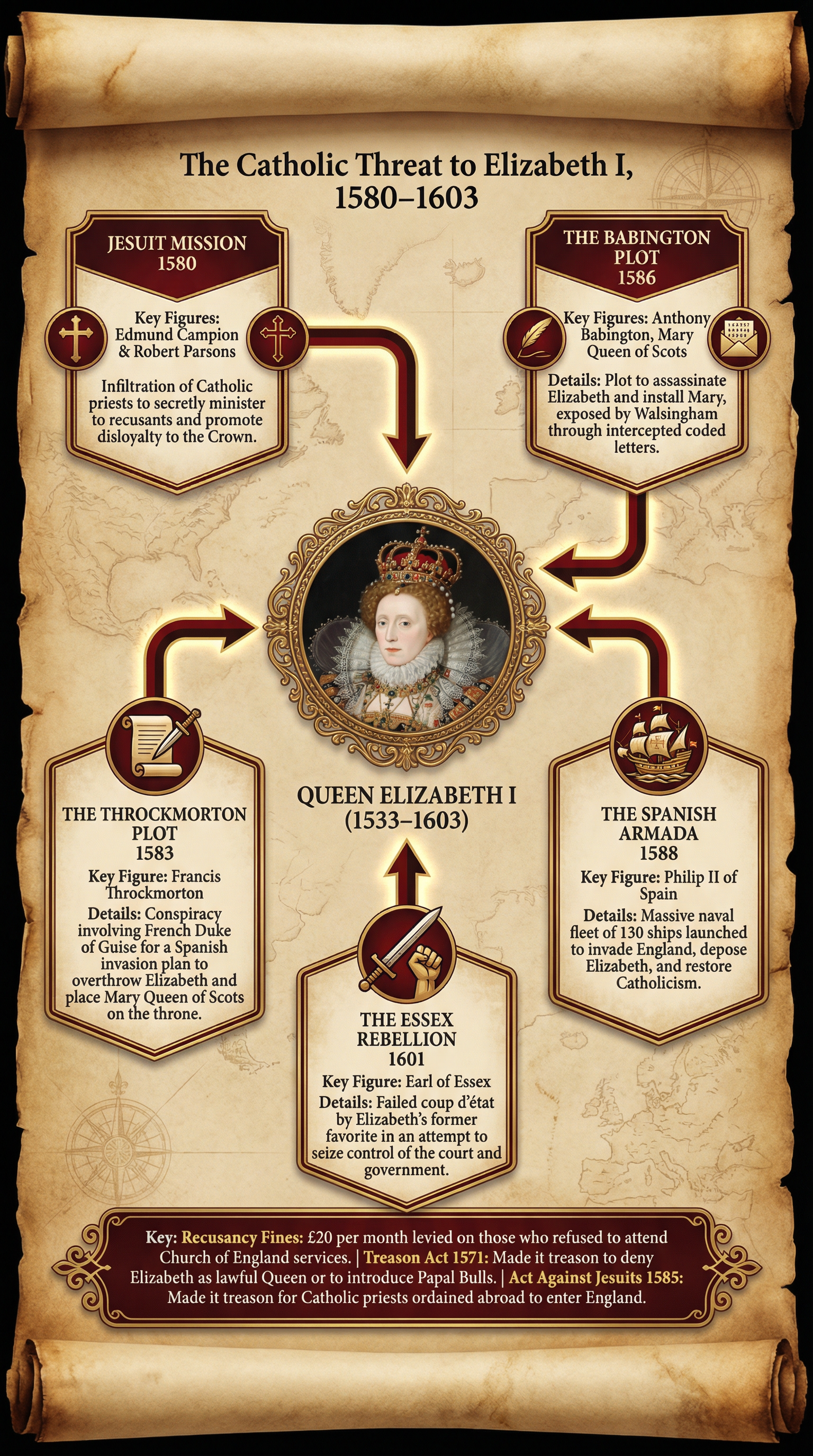
What happened: The arrival of highly trained, secret Catholic missionary priests, most notably Edmund Campion and Robert Parsons. Their mission was to minister to England's secret Catholic community (recusants) and strengthen their faith.
Why it matters: The government viewed this as a direct political and religious threat, believing the Jesuits were actively encouraging rebellion against Queen Elizabeth. This triggered a severe government crackdown, marking a significant escalation in the persecution of Catholics. For the exam, this event serves as a crucial turning point, demonstrating the shift from passive containment to active suppression of Catholicism.
Specific Knowledge: Edmund Campion (executed for treason, 1581), Robert Parsons, Recusancy fines increased to £20 per month by the 1581 'Act to Retain the Queen's Majesty's Subjects in their Due Obedience'.
The Babington Plot & Execution of Mary, Queen of Scots
Date(s): 1586-1587
What happened: A plot, led by Sir Anthony Babington, to assassinate Queen Elizabeth and place her Catholic cousin, Mary, Queen of Scots, on the throne. The plot was discovered by Elizabeth's spymaster, Sir Francis Walsingham, who intercepted coded letters between Babington and Mary that proved her complicity.
Why it matters: This was the final straw that led to Mary's execution. It provides a clear example of the internal Catholic threat and the effectiveness of Walsingham's spy network. Crucially, Mary's execution had major international consequences, as it was a key trigger for Philip II of Spain launching the Armada.
Specific Knowledge: Sir Anthony Babington, Sir Francis Walsingham, Mary, Queen of Scots (executed Fotheringhay Castle, February 1587), coded letters.
The Spanish Armada
Date(s): 1588
What happened: A massive fleet of 130 Spanish ships, led by the Duke of Medina Sidonia, sailed to invade England, overthrow Elizabeth, and restore Catholicism. The invasion failed due to a combination of English naval tactics (including the use of fireships at the Battle of Gravelines), superior English ship design (smaller, faster galleons), and severe weather.
Why it matters: The defeat of the Armada was a huge propaganda victory for Elizabeth, seemingly proving God was on the side of Protestant England. It boosted national pride and secured the English Reformation. For exam questions on the Spanish threat, candidates must analyse the multiple reasons for the Armada's failure, not just the weather.
Specific Knowledge: Philip II of Spain, Duke of Medina Sidonia, Battle of Gravelines, fireships, role of the 'Protestant Wind'.
The Poverty Crisis & Poor Laws
Date(s): 1590s, specifically 1594-1597 (bad harvests)
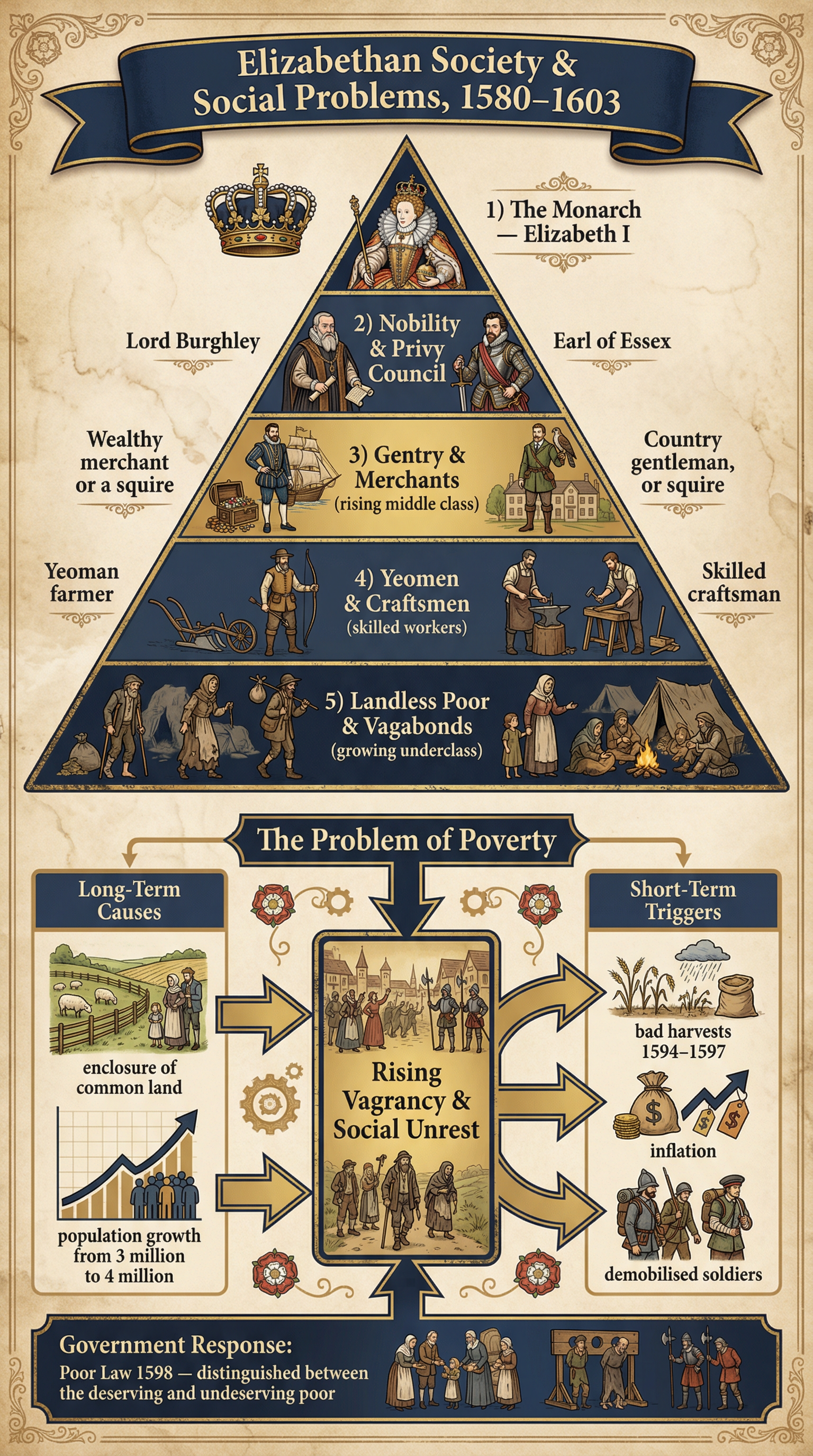
What happened: A severe economic and social crisis caused by long-term factors (population growth, enclosure, inflation) and short-term triggers (a series of disastrously bad harvests). This led to soaring food prices, starvation, and a dramatic increase in the number of homeless and unemployed people (vagabonds).
Why it matters: The crisis posed a major threat to social order, a key concern for the Elizabethan government. The response was the landmark Elizabethan Poor Law (consolidated in 1598 and 1601), which created a national system for poor relief, funded by a local tax (the poor rate). It crucially distinguished between the 'deserving' poor (who received help) and the 'undeserving' or 'idle' poor (who were punished). This is a vital example of the expansion of state power and social control.
Specific Knowledge: Enclosure, population growth (from c.3m to c.4m), inflation (price revolution), Poor Law (1598/1601), deserving vs. undeserving poor, poor rate.
The Rise of the Theatre
Date(s): c.1580-1603
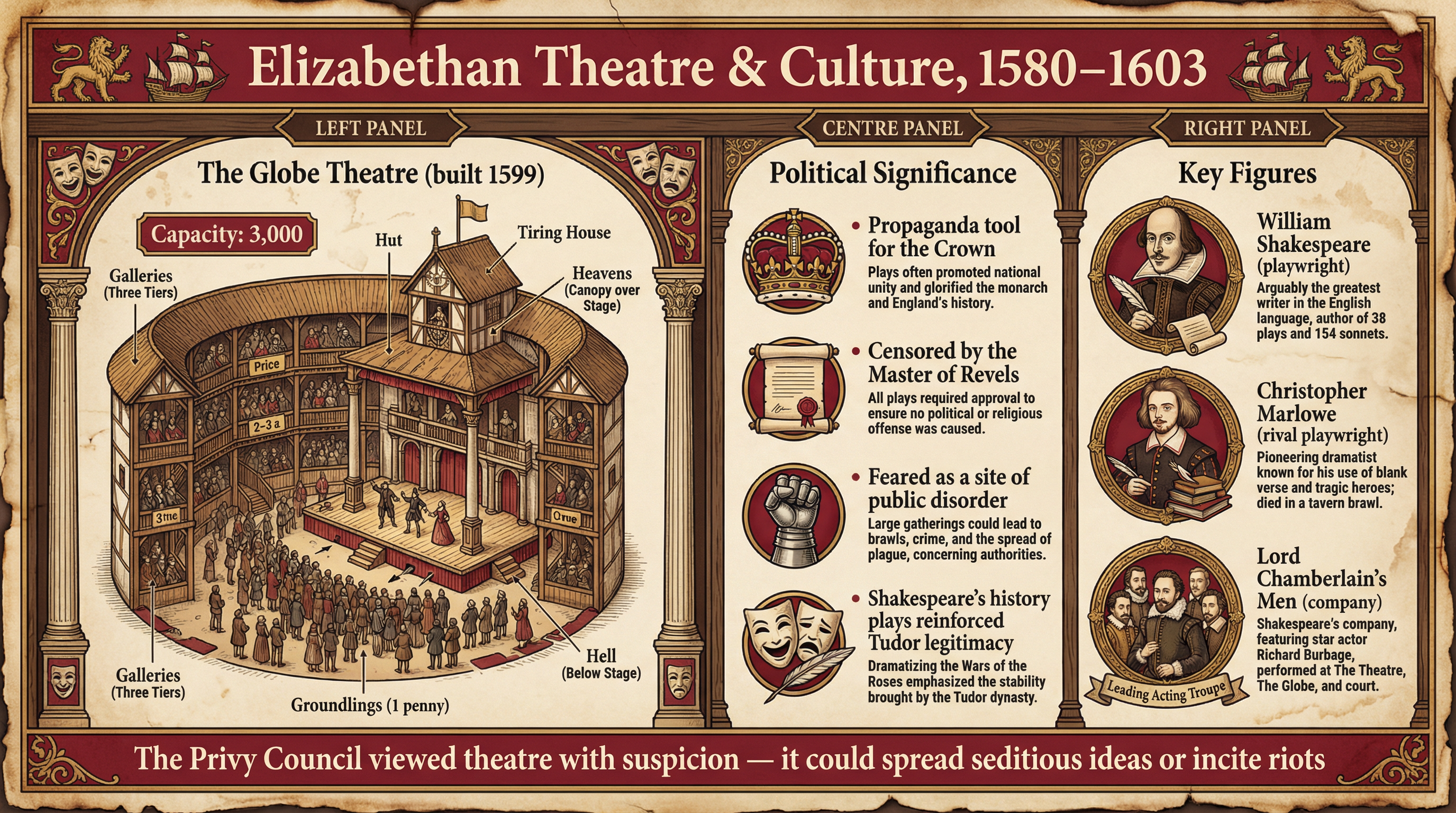
What happened: The emergence of the first permanent, purpose-built public theatres in London, such as The Rose and The Globe (1599). Playwrights like William Shakespeare and Christopher Marlowe created a new, popular form of entertainment.
Why it matters: The theatre was more than just entertainment. The government saw it as a potential source of public disorder, crime, and plague, and therefore subjected it to censorship under the Master of Revels. It was also a powerful propaganda tool. Shakespeare's history plays, for example, often glorified the Tudor dynasty and warned against the dangers of civil war, reinforcing the government's message of obedience and order.
Specific Knowledge: The Globe, William Shakespeare, Christopher Marlowe, Lord Chamberlain's Men, Master of Revels (censorship role), groundlings.
Key Individuals
Queen Elizabeth I
Role: Monarch of England and Ireland.
Key Actions: Presided over the government's response to the Catholic and Spanish threats. Signed Mary, Queen of Scots' death warrant. Oversaw the implementation of the Poor Laws. Used her image and speeches (e.g., at Tilbury in 1588) as powerful propaganda.
Impact: Her strong leadership and survival against numerous threats created the 'Gloriana' myth. However, her indecisiveness (e.g., over Mary's execution) and reliance on a small group of ageing councillors created political tensions towards the end of her reign.
Sir Francis Walsingham
Role: Elizabeth's Principal Secretary and 'spymaster'.
Key Actions: Developed and ran a vast network of spies and informers across England and Europe. Uncovered the Throckmorton and Babington plots. Gathered the intelligence that proved Mary, Queen of Scots' guilt.
Impact: Walsingham was instrumental in protecting Elizabeth and the state from Catholic plots. His methods demonstrate the ruthless efficiency of the Elizabethan government in dealing with perceived threats. High-level answers will credit Walsingham for his crucial role in state security.
Robert Devereux, Earl of Essex
Role: Nobleman, military commander, and Elizabeth's final favourite.
Key Actions: Gained prominence in the 1590s after the death of older councillors. Led a costly and unsuccessful campaign in Ireland (1599). Defied the Queen, returned to England, and launched a failed rebellion (the Essex Rebellion) in 1601.
Impact: Essex's rise and fall illustrate the factional tensions within the late Elizabethan court. His rebellion, though a failure, exposed the political instability of the final years of Elizabeth's reign as nobles competed for power and patronage.
Second-Order Concepts
Causation
Examiners look for a sophisticated understanding of causation. For the poverty crisis, you must distinguish between long-term causes (population growth, enclosure) and short-term triggers (harvest failures). For the Armada, you must link the long-term religious and political rivalry with Spain to the short-term trigger of Mary, Queen of Scots' execution.
Consequence
The consequences of events are critical. The consequence of the Jesuit Mission was not a Catholic uprising, but a harsh government crackdown. The consequence of the Babington Plot was not the overthrow of Elizabeth, but the execution of Mary, which in turn led to the Armada. Tracing these chains of consequence is a key historical skill.
Change & Continuity
What changed in this period? The threat from Catholicism became more direct and organised, leading to harsher laws. The state took on a new level of responsibility for the poor. What stayed the same? The fundamental structure of society, with the monarch at the top, remained. The belief in the 'Great Chain of Being' continued to dominate social thinking.
Significance
Why do these events matter? The defeat of the Armada was significant because it helped forge a sense of English national identity tied to Protestantism. The Poor Laws were significant because they were the first national, state-sponsored system of welfare in England, laying the foundations for future social policy.
Source Skills
For OCR, the key source skill is AO4: evaluating interpretations. When you get a 'How convincing?' question, your task is to test the claims in the source against your own knowledge. Do not waste time on the source's origin (provenance). Structure your answer by taking claims from the source one by one and either supporting or challenging them with specific facts, names, and dates. For example, if a source claims 'The Catholic threat was entirely imaginary', you would challenge this by citing the specific details of the Throckmorton and Babington plots.