Study Notes
Overview
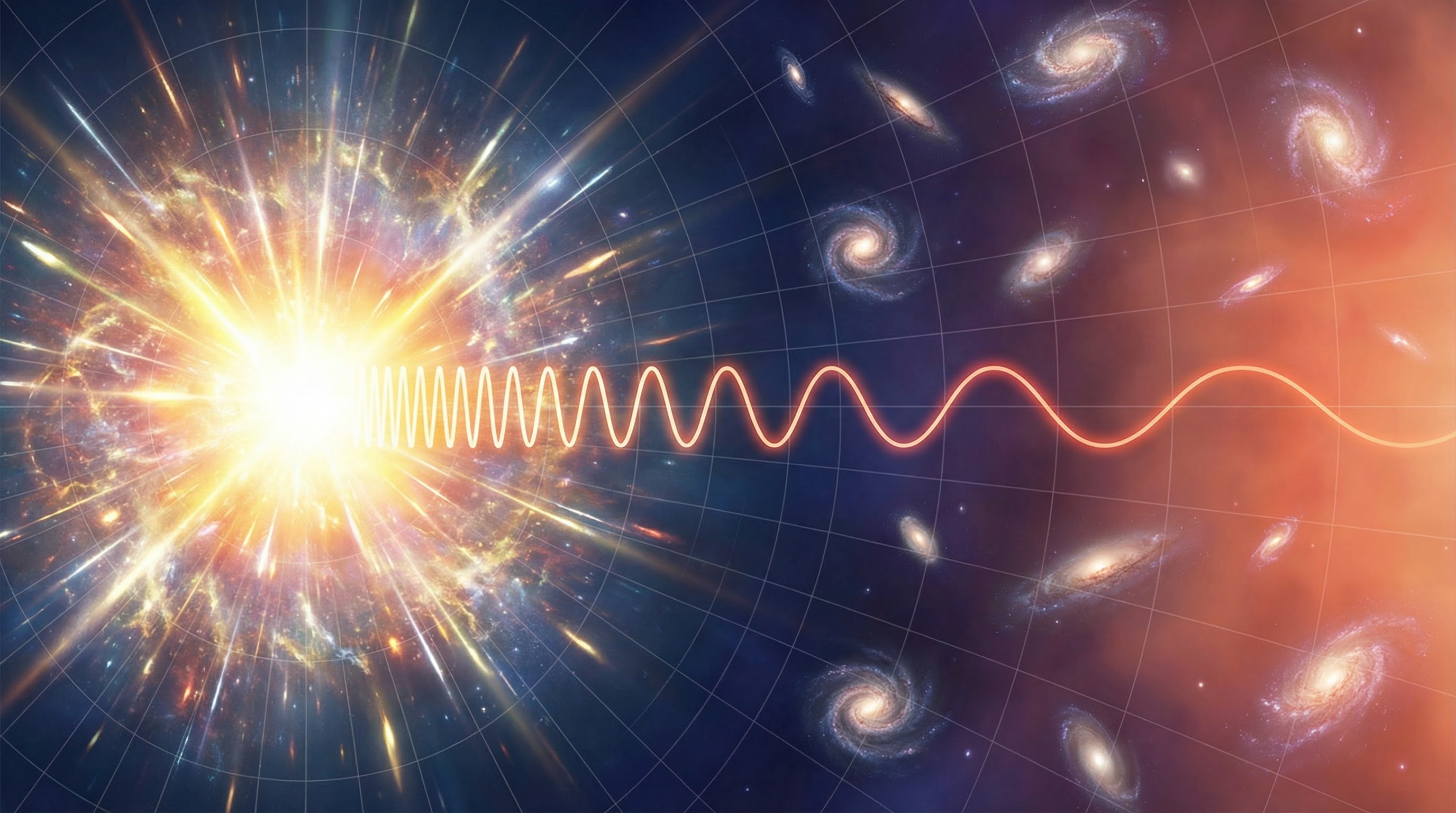
The Cosmic Microwave Background Radiation (CMBR) represents one of the most significant discoveries in modern physics and provides the definitive evidence that our universe began with a Big Bang approximately 13.8 billion years ago. This topic sits at the heart of cosmology and is a favourite for OCR examiners because it tests your ability to connect observational evidence with theoretical models. You will encounter questions asking you to describe what the CMBR is, explain its origin, and articulate why it supports the Big Bang theory while contradicting the Steady State model. Typical exam questions range from 2-mark recall items to 6-mark extended response questions requiring you to compare competing cosmological theories. Understanding the mechanism by which gamma rays were redshifted into microwaves is essential for Higher Tier candidates, and you must be able to use precise scientific terminology to earn full credit.
Key Concepts
Concept 1: What is the Cosmic Microwave Background Radiation?
The Cosmic Microwave Background Radiation is a faint, uniform glow of microwave radiation that permeates the entire universe. It is detected with almost identical intensity from every direction in space, at a temperature of approximately 2.7 Kelvin (about -270°C). This uniformity is critical because it indicates that the early universe was itself remarkably uniform. The CMBR is not associated with any particular star, galaxy, or object; rather, it fills all of space. You can think of it as the 'afterglow' or 'echo' of the Big Bang, a fossil remnant of the universe's infancy. The discovery of the CMBR in 1965 by Arno Penzias and Robert Wilson provided the first direct observational confirmation of the Big Bang theory and earned them the Nobel Prize in Physics.
Example: Imagine you are in a large, dark room with a heater that was switched off hours ago. Even though the heater is no longer running, you can still feel a faint warmth in the air. The CMBR is similar: it is the residual 'warmth' left over from the incredibly hot early universe, now cooled to just 2.7 K.
Concept 2: The Origin of the CMBR – From Gamma Rays to Microwaves
The CMBR originated approximately 380,000 years after the Big Bang, during an event known as recombination or photon decoupling. In the first moments after the Big Bang, the universe was an extraordinarily hot, dense plasma of subatomic particles and high-energy electromagnetic radiation, specifically gamma rays. The temperature was so extreme that atoms could not form; electrons and nuclei existed separately. As the universe expanded, it cooled. Eventually, the temperature dropped enough for electrons to combine with nuclei to form the first neutral atoms, primarily hydrogen. At this moment, the gamma radiation that had been trapped within the plasma was suddenly free to travel through space. This is the radiation we now detect as the CMBR.
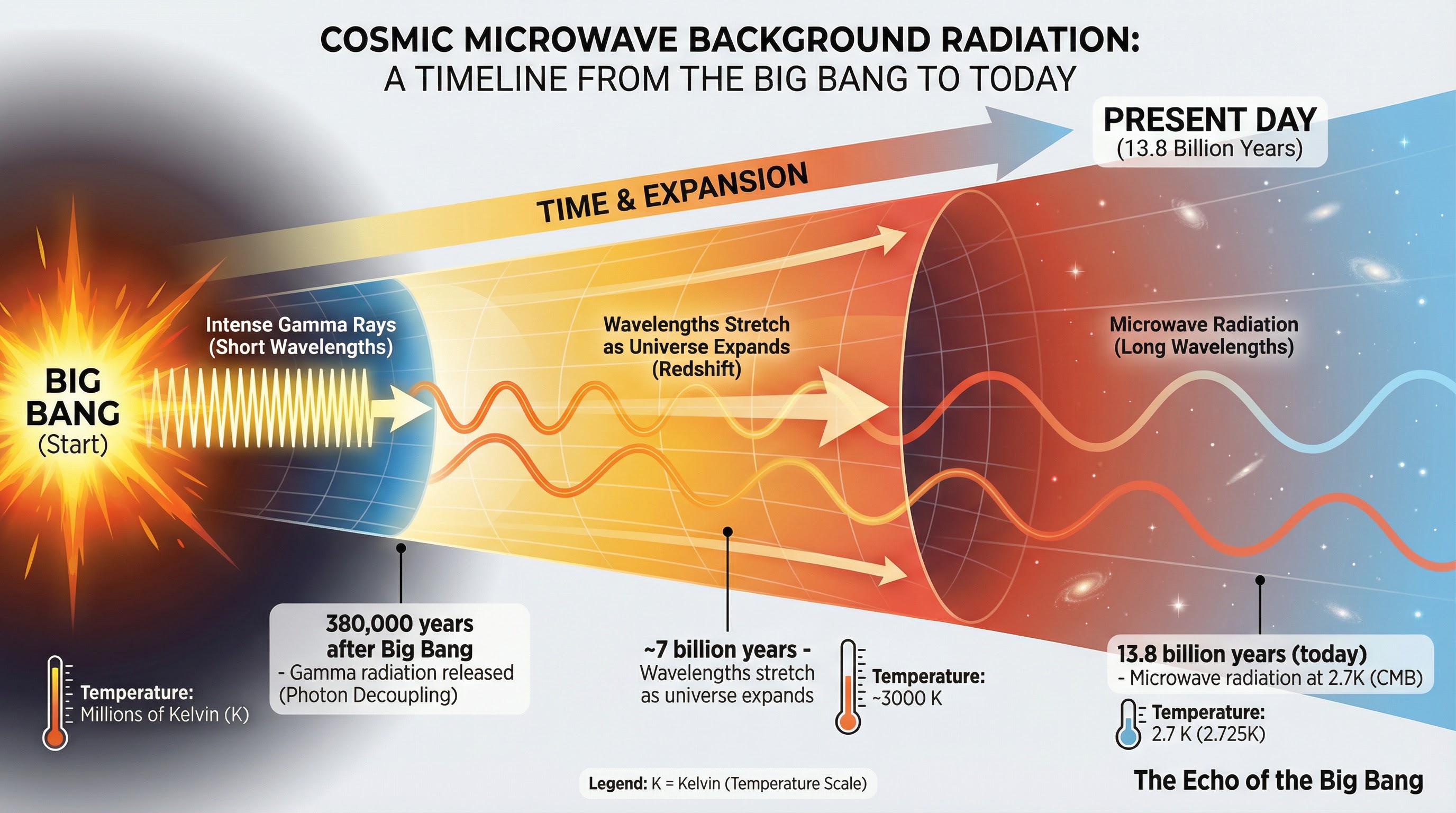
The crucial question is: why do we detect this radiation as microwaves rather than gamma rays? The answer lies in the expansion of the universe. As space itself has expanded over the past 13.8 billion years, the wavelength of the radiation travelling through it has been stretched. This stretching of wavelength is known as cosmological redshift. The high-energy, short-wavelength gamma rays have been elongated into low-energy, long-wavelength microwaves. This is a key point for Higher Tier candidates: you must be able to state that 'the wavelength of the radiation increased as the universe expanded'.
Example: Think of drawing a wave on a rubber band and then stretching the rubber band. The wave's peaks become further apart, just as the wavelength of the CMBR has been stretched by the expansion of space.
Concept 3: Uniformity and What It Tells Us
One of the most remarkable features of the CMBR is its uniformity. No matter where astronomers point their radio telescopes, they detect the same faint microwave signal at the same temperature (2.7 K). This uniformity is evidence that the early universe was itself highly uniform and that all regions of space have expanded from a single, common origin point. If the universe had always existed in a steady state, or if different regions had different origins, we would not expect to see such uniformity.
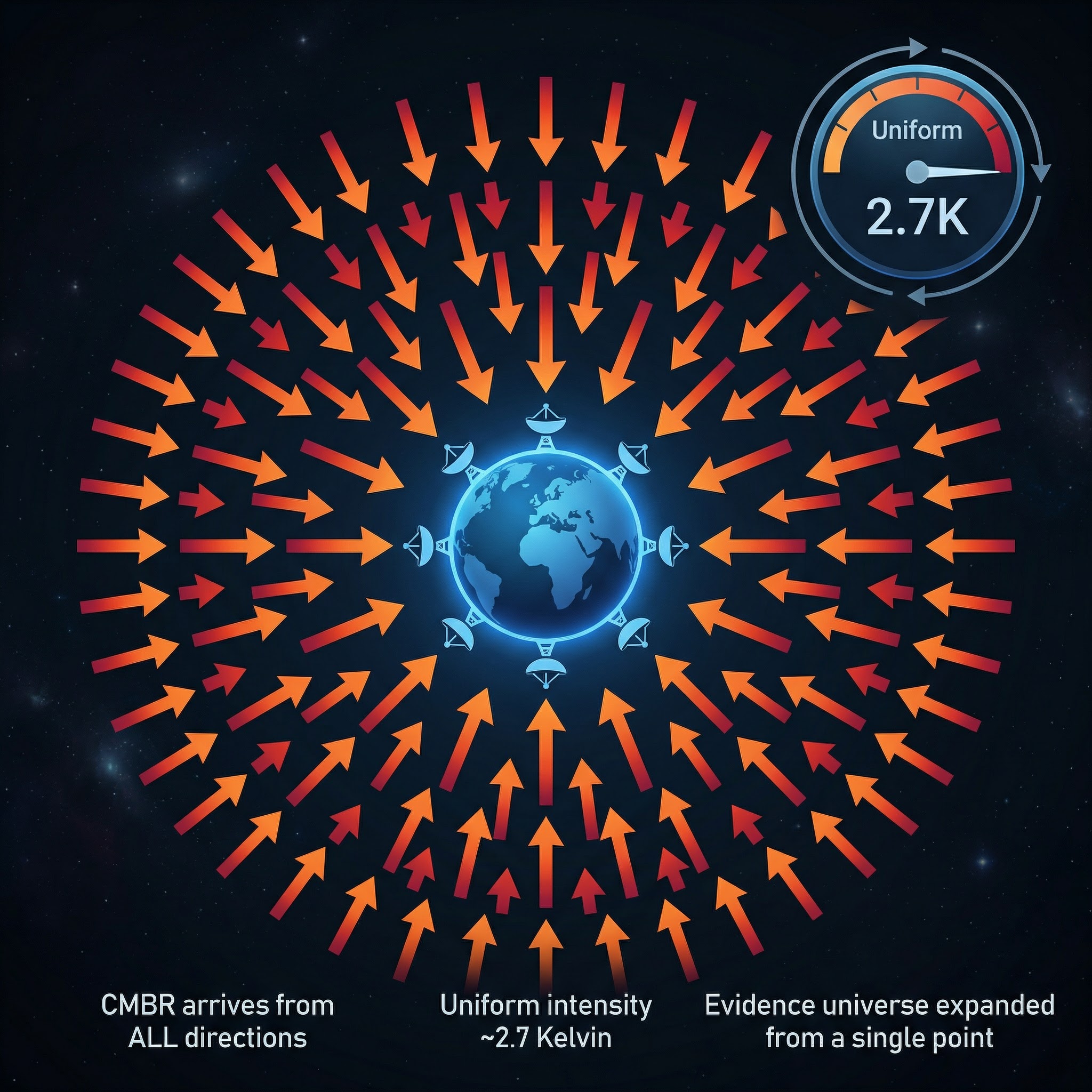
The uniformity of the CMBR also addresses a common misconception: students sometimes think that because the radiation arrives from all directions, Earth must be at the centre of the universe. This is incorrect. The radiation is uniform because every point in the universe is expanding away from every other point. An observer anywhere in the universe would detect the same uniform CMBR.
Example: Imagine baking a raisin cake. As the cake rises in the oven, every raisin moves away from every other raisin. No single raisin is at the 'centre' of the expansion. Similarly, the universe expands uniformly, and the CMBR is detected uniformly from all locations.
Concept 4: CMBR as Evidence for the Big Bang vs. Steady State
Before the discovery of the CMBR, the Steady State theory was a competing model for the universe. This theory proposed that the universe had no beginning and has always looked roughly the same, with new matter continuously being created to maintain a constant density as the universe expands. The Steady State model could not explain the existence of the CMBR. If the universe had always existed in a steady state, there would be no reason for a uniform background of microwave radiation to exist.
The Big Bang theory, on the other hand, predicted the existence of the CMBR. According to this model, the universe began in an extremely hot, dense state and has been expanding and cooling ever since. The CMBR is the cooled remnant of the intense radiation from that early hot phase. The discovery of the CMBR in 1965 was the decisive evidence that led the scientific community to accept the Big Bang theory and reject the Steady State model.
Example: If you ask two people to explain why a room is warm, one might say the heater was on earlier (Big Bang), and the other might say the room has always been this temperature (Steady State). Finding evidence of a heater that was recently on (the CMBR) supports the first explanation and contradicts the second.
Mathematical/Scientific Relationships
There are no specific formulas you need to memorise for this topic, but you should understand the relationship between wavelength, frequency, and energy:
- Wavelength (λ): The distance between successive peaks of a wave. Measured in metres (m). Gamma rays have very short wavelengths (~10⁻¹² m), while microwaves have much longer wavelengths (~10⁻³ m).
- Frequency (f): The number of wave peaks passing a point per second. Measured in Hertz (Hz). Higher frequency means shorter wavelength.
- Energy (E): Higher frequency (shorter wavelength) radiation has higher energy. Gamma rays are high-energy; microwaves are low-energy.
The key relationship is:
**As the universe expands, wavelength increases, frequency decreases, and energy decreases.**This is why the original high-energy gamma radiation is now detected as low-energy microwave radiation.
Practical Applications
While there is no required practical specifically on the CMBR for GCSE, understanding this topic connects to broader themes in physics:
- Radio Astronomy: The CMBR is detected using radio telescopes, which are sensitive to microwave radiation. This links to the electromagnetic spectrum and the use of different wavelengths to observe the universe.
- Cosmology and the History of the Universe: The CMBR provides a 'snapshot' of the universe when it was just 380,000 years old, allowing scientists to study conditions in the early universe.
- Redshift: The concept of cosmological redshift is also observed in the light from distant galaxies. As galaxies move away from us due to the expansion of the universe, their light is redshifted (wavelength increases). This is separate evidence for the Big Bang.
Exam Technique and Command Words
OCR examiners use specific command words, and your response must match the command word to earn full marks. Here's how to approach questions on the CMBR:
State/Give (1 mark): Provide a brief, factual answer. For example, 'State one piece of evidence for the Big Bang theory.' Answer: 'Cosmic Microwave Background Radiation' or 'CMBR'. Do not write just 'background radiation' as this is too vague.
Describe (2-3 marks): Say what the CMBR is or what it is like. For example, 'Describe the Cosmic Microwave Background Radiation.' Answer: 'The CMBR is a faint, uniform glow of microwave radiation detected from all directions in space at a temperature of approximately 2.7 K.'
Explain (3-4 marks): Say how or why something happens. Use 'because' to link cause and effect. For example, 'Explain how the CMBR provides evidence for the Big Bang.' Answer: 'The CMBR originated as high-energy gamma radiation shortly after the Big Bang. As the universe expanded, the wavelength of this radiation was stretched, causing it to become microwave radiation. The uniform detection of this radiation from all directions supports the idea that the universe expanded from a single, hot, dense point.'
Compare (4-6 marks): Identify similarities and differences. For example, 'Compare the Big Bang and Steady State theories in terms of their explanation for the CMBR.' Answer: 'The Big Bang theory predicts the existence of the CMBR as the cooled remnant of radiation from the early hot universe. The Steady State theory, which suggests the universe has always existed in a constant state, cannot explain the CMBR. The discovery of the CMBR supports the Big Bang and contradicts the Steady State model.'
Common Pitfalls to Avoid
-
Saying the Big Bang 'created microwaves': This is incorrect. The Big Bang produced gamma rays, which were later redshifted into microwaves over billions of years.
-
Confusing CMBR with redshift of galaxies: These are two separate pieces of evidence for the Big Bang. Redshift of galaxies shows the universe is expanding; CMBR shows it started from a hot, dense state.
-
Thinking Earth is the centre of the universe: The CMBR arrives uniformly from all directions, but this does not mean Earth is at the centre. The universe expands uniformly from all points.
-
Using vague terminology: Always write 'Cosmic Microwave Background Radiation' or 'CMBR', not just 'background radiation'.
-
Forgetting to mention wavelength stretching: For Higher Tier, you must explain that the expansion of the universe stretched the wavelength of the radiation.