Study Notes
Overview
The topic of Planets sits within OCR's 'Beyond Earth' module and represents a fascinating intersection of observational astronomy, physics principles, and the history of science. Candidates are expected to demonstrate knowledge of the Solar System's structure, explain how gravity acts as the centripetal force maintaining stable orbits, and evaluate how scientific models evolve in response to new evidence. This topic typically accounts for approximately 5-8% of your total Physics exam marks and appears in questions ranging from simple recall (1-2 marks) to extended response items worth 6 marks. At Foundation Tier, the focus is on describing planetary order and comparing historical models, while Higher Tier candidates must also apply circular motion concepts to explain the relationship between orbital radius, velocity, and gravitational force. Examiners particularly value candidates who can distinguish between speed and velocity, cite specific evidence such as Galileo's telescopic observations, and structure extended responses with clear cause-and-effect reasoning.
Key Concepts
Concept 1: Structure of the Solar System
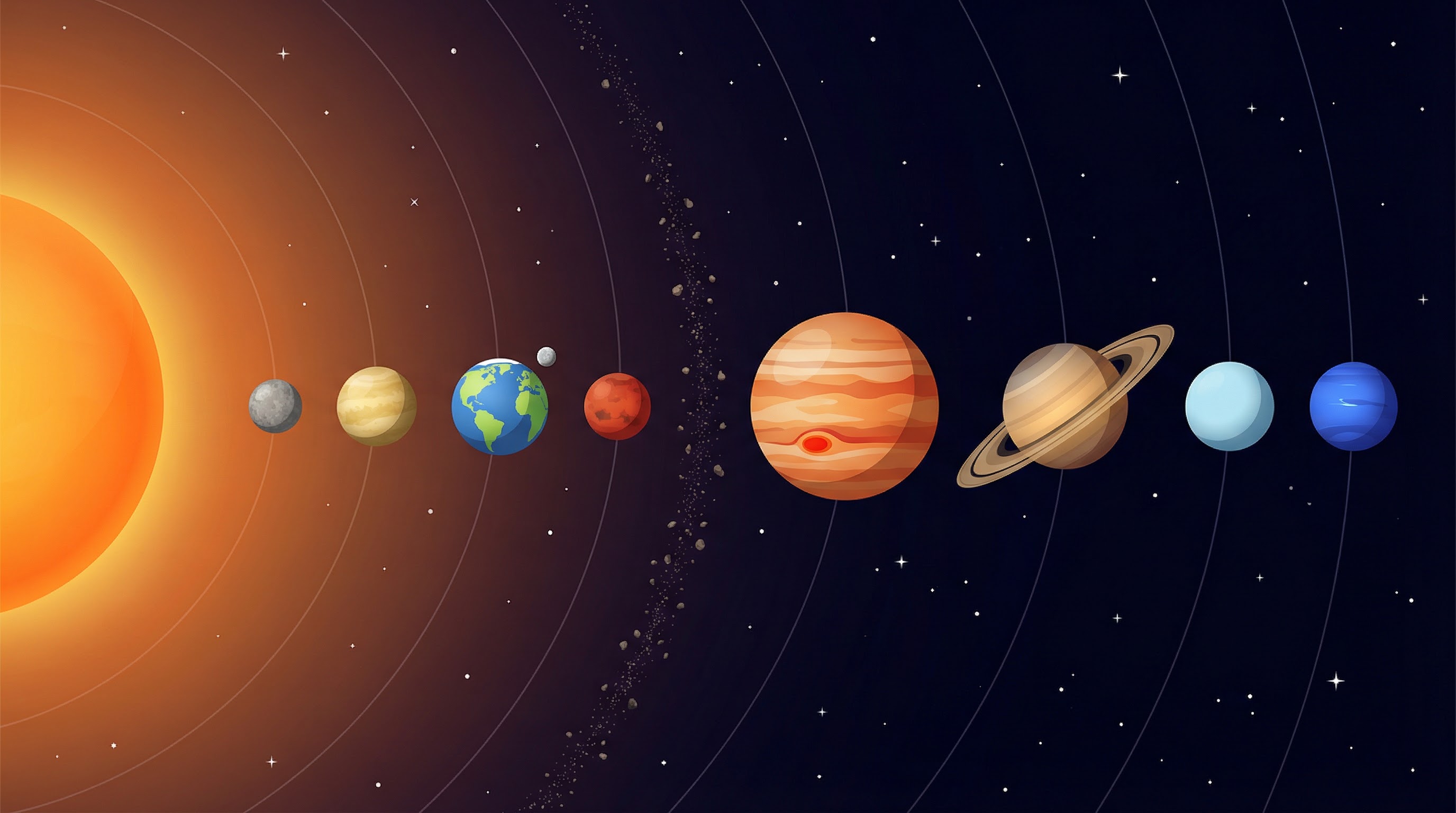
Our Solar System consists of eight planets orbiting the Sun in a predictable order. The inner four planets—Mercury, Venus, Earth, and Mars—are relatively small, rocky bodies with solid surfaces. Between Mars and Jupiter lies the asteroid belt, a region containing thousands of rocky fragments that never coalesced into a planet due to Jupiter's immense gravitational influence. Beyond the asteroid belt are the four outer planets—Jupiter, Saturn, Uranus, and Neptune—which are much larger and composed primarily of gases and liquids. These gas giants lack solid surfaces and possess extensive systems of moons and rings. The order of planets from the Sun is crucial exam knowledge and can be remembered using the mnemonic: My Very Easy Method Just Speeds Up Naming (Mercury, Venus, Earth, Mars, Jupiter, Saturn, Uranus, Neptune). Examiners frequently test this in 1-mark questions, and candidates must write full planet names rather than abbreviations to secure credit.
Example: A typical exam question might state: "Name the largest planet in our Solar System." The answer is Jupiter. Another common variant: "State which planet lies between Earth and Jupiter." The answer is Mars. These are straightforward recall questions where knowing the order and basic characteristics earns easy marks.
Concept 2: Gravitational Force and Orbital Motion
Planets remain in stable orbits around the Sun because of gravitational attraction, which acts as the centripetal force. This force always points directly toward the centre of the orbit (toward the Sun) and acts perpendicular to the instantaneous velocity of the planet. The key to understanding orbital motion is recognising that even though a planet may travel at constant speed, its velocity is continuously changing because velocity is a vector quantity possessing both magnitude and direction. As the planet moves along its circular path, the direction of motion changes at every instant, meaning the velocity vector is constantly changing even if the speed remains the same. This is a Higher Tier concept that examiners test extensively, and candidates who fail to mention direction when discussing velocity will lose marks.
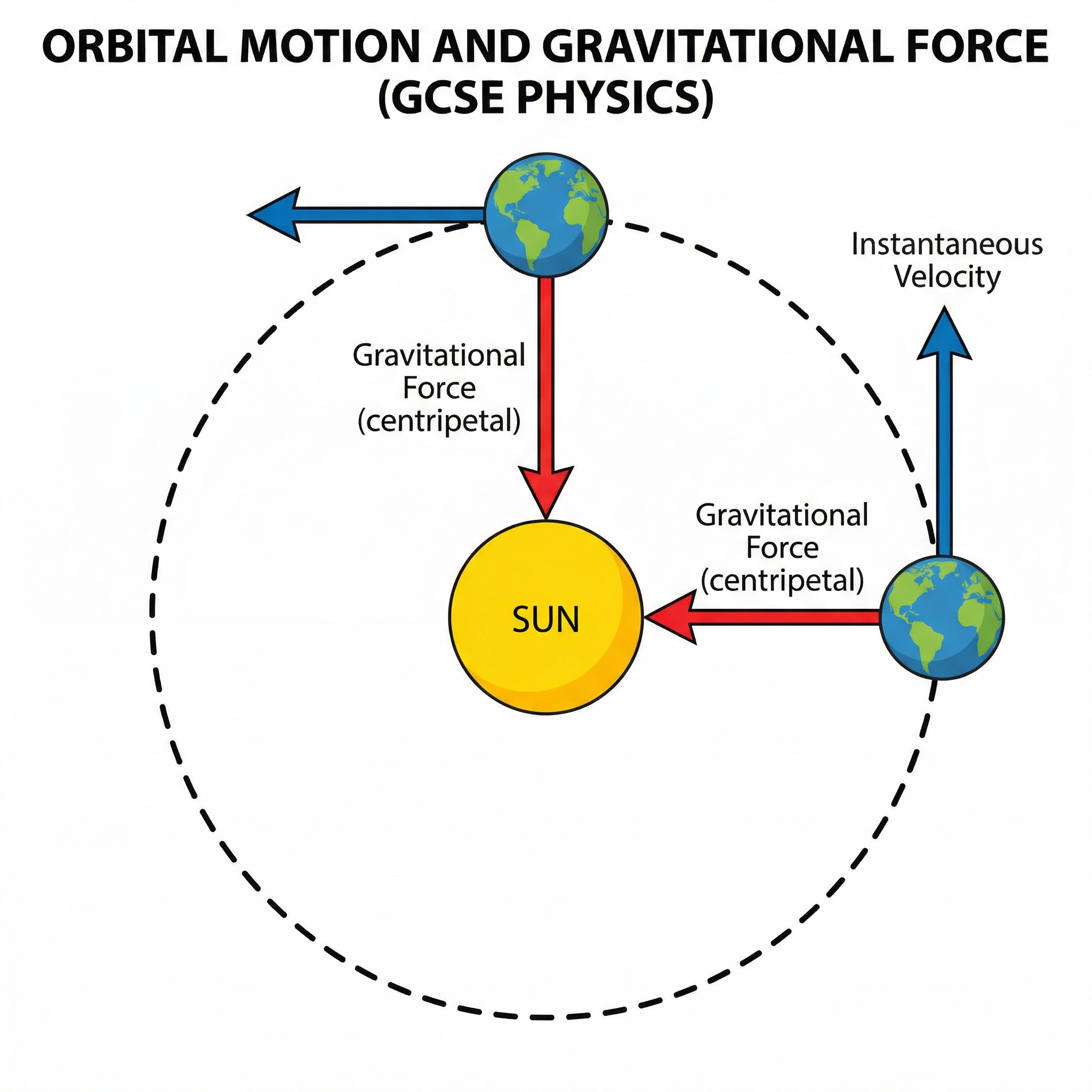
Example: Consider Earth orbiting the Sun. The gravitational force between Earth and the Sun provides the centripetal force needed to keep Earth in its orbit. At any point on the orbit, Earth's velocity is tangent to the circular path, while the gravitational force points directly toward the Sun. As Earth moves, the direction of the velocity vector changes continuously, so even if Earth's orbital speed is constant, its velocity is not.
Concept 3: Geocentric vs. Heliocentric Models
For over a millennium, the dominant model of the Solar System was the geocentric model, which placed Earth at the centre with the Sun, Moon, and planets orbiting around it. This model, refined by the Greek astronomer Ptolemy, aligned with everyday observations: the Sun appears to rise and set, and we do not feel Earth moving. However, this model required increasingly complex explanations to account for the observed motion of planets, particularly their apparent retrograde motion.
The heliocentric model, proposed by Nicolaus Copernicus in the 16th century and later championed by Galileo Galilei, placed the Sun at the centre of the Solar System with planets, including Earth, orbiting around it. This model simplified explanations of planetary motion and aligned better with accumulating observational data. The critical turning point came in the early 1600s when Galileo used a telescope to observe four moons orbiting Jupiter. This observation provided direct evidence that not all celestial bodies orbit Earth, undermining the geocentric model and supporting the heliocentric view. In exam questions asking for evidence supporting the heliocentric model, citing Galileo's observations of Jupiter's moons is worth at least one mark.
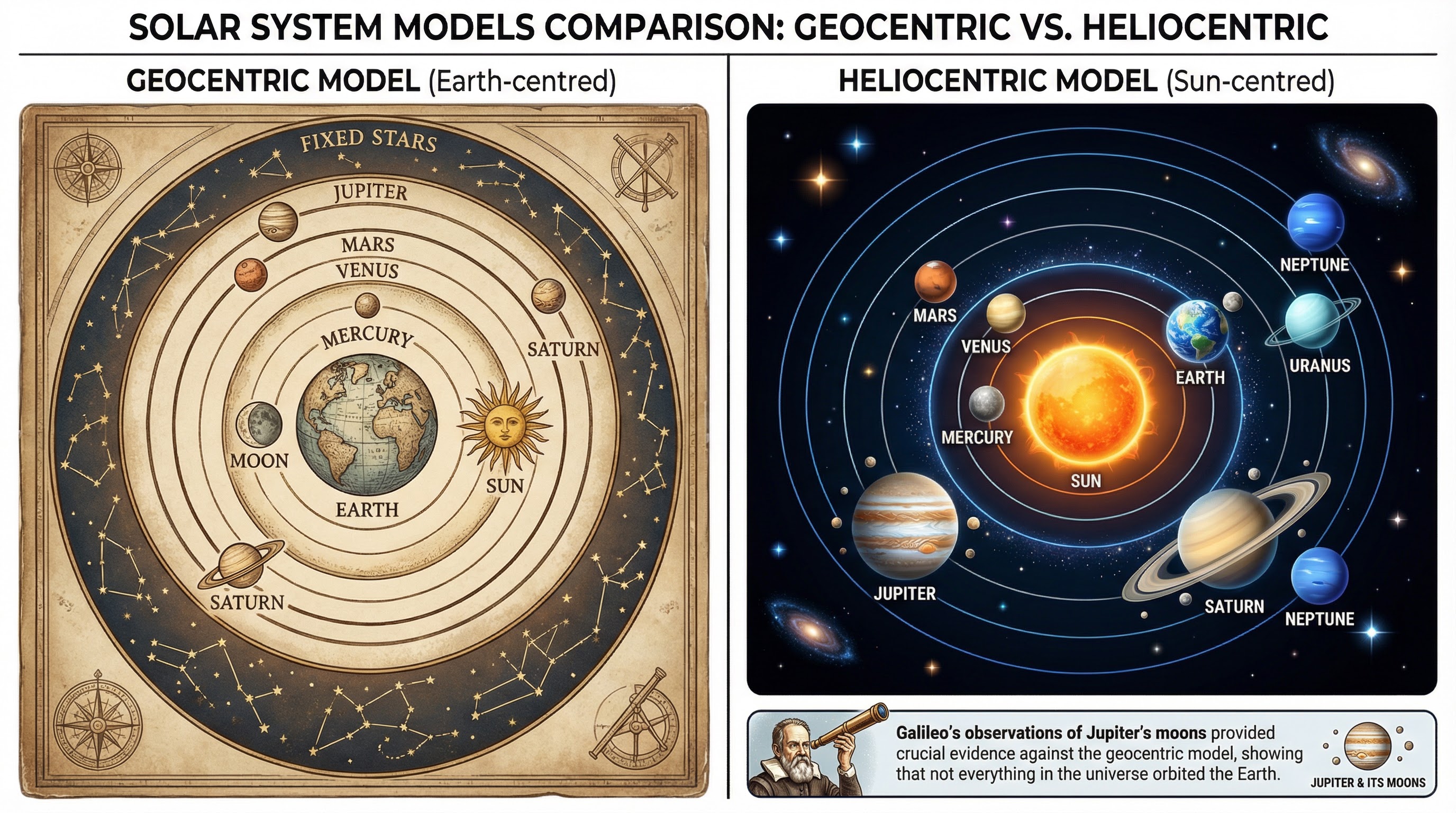
Important Distinction: Candidates must be precise in stating that the heliocentric model places the Sun at the centre of the Solar System, not the Universe. Confusing these two is a common error that costs marks.
Mathematical/Scientific Relationships
While OCR GCSE Physics does not require candidates to perform complex orbital calculations, understanding the qualitative relationships is essential, particularly at Higher Tier:
-
Gravitational Force as Centripetal Force: The gravitational force (F) between two masses (such as the Sun and a planet) provides the centripetal force needed for circular motion. This force is always directed toward the centre of the orbit.
-
Velocity in Circular Motion: For an object moving in a circle at constant speed, the velocity is constantly changing because the direction is changing. Velocity is a vector, so any change in direction constitutes a change in velocity, even if speed (the magnitude) remains constant.
-
Orbital Radius and Velocity: At Higher Tier, candidates should understand that planets closer to the Sun orbit faster than those further away. This is because the gravitational force is stronger closer to the Sun, requiring a higher orbital velocity to maintain a stable orbit. This relationship is qualitative at GCSE level—no formula is required, but the conceptual understanding is tested.
Key Formula (Higher Tier Awareness): While not explicitly required for calculation, awareness that centripetal force is related to mass, velocity, and radius helps conceptual understanding: F = mv²/r. Examiners do not expect candidates to recall or use this formula, but understanding that force, velocity, and radius are interconnected is valuable.
Practical Applications
Understanding planetary motion and gravitational forces has numerous real-world applications:
-
Satellite Orbits: Artificial satellites, including GPS satellites and the International Space Station, orbit Earth using the same gravitational principles that govern planetary orbits. Engineers must calculate precise velocities and altitudes to maintain stable orbits.
-
Space Exploration: Missions to other planets require detailed understanding of orbital mechanics to plan trajectories, perform gravitational assists (using a planet's gravity to alter a spacecraft's speed and direction), and achieve orbit insertion.
-
Exoplanet Detection: Astronomers use knowledge of orbital motion to detect planets around distant stars by observing the slight wobble in a star's position caused by an orbiting planet's gravitational pull.
While this topic does not include a required practical, candidates may be asked to interpret data from historical observations (such as Galileo's sketches of Jupiter's moons) or analyse diagrams showing orbital paths and force vectors.
Listen to the Podcast
Listen to this 10-minute educational podcast for a comprehensive audio review of all key concepts, exam tips, and a quick-fire recall quiz to test your knowledge!
Exam Technique Deep Dive
This topic appears across multiple question types in OCR GCSE Physics exams. Mastering the content is only half the battle—knowing how to approach different question styles is equally important.
For 1-2 Mark Questions: These typically test recall of basic facts. Examples include naming planets in order, identifying the largest planet, or stating what force keeps planets in orbit. The key is precision: write full names, use correct terminology (e.g., "gravitational force" rather than just "gravity"), and ensure your answer directly addresses the question.
For 3-4 Mark Questions: These often require explanation or description. You might be asked to describe the geocentric model, explain why velocity changes in circular motion, or describe evidence supporting the heliocentric model. Structure your answer clearly: define key terms, state the main point, and provide supporting detail or evidence. Use linking words like "because," "therefore," and "this means that" to show cause-and-effect reasoning.
For 6 Mark Extended Response Questions: These assess your ability to construct a coherent, detailed argument. A common question type asks candidates to compare the geocentric and heliocentric models and explain how scientific evidence led to the change. To earn full marks:
- Describe the geocentric model (Earth at centre, other bodies orbit Earth)
- Describe the heliocentric model (Sun at centre, planets including Earth orbit Sun)
- Cite specific evidence (Galileo's observations of Jupiter's moons)
- Explain why this evidence supported the heliocentric model
- Use scientific terminology throughout
- Structure your answer in clear paragraphs
Examiners award marks for quality of written communication in extended response questions, so clear structure and correct spelling of scientific terms matter.
Drawing Diagrams: For questions involving orbital motion, always draw a clear diagram showing the planet, the Sun, the orbital path (as a circle or ellipse), and labelled arrows for gravitational force (pointing toward the Sun) and velocity (tangent to the orbit). Even if your written explanation is incomplete, a correct diagram can earn marks.