Study Notes
Overview
Welcome to the study of Galaxies, a cornerstone of the OCR GCSE Physics 'Beyond Earth' (P8) module. This topic takes you on a journey from our local cosmic neighbourhood, the Solar System, to the edge of the observable Universe. You will explore the hierarchical structure of the cosmos and delve into one of the most profound discoveries in scientific history: the expansion of the Universe. Understanding this topic is not just about memorising facts; it's about connecting observational evidence, specifically red-shift, to a cohesive theory of our origins—the Big Bang. Examiners will expect you to be precise with your definitions, confident in your explanation of red-shift, and able to structure a logical argument for the Big Bang theory, often in longer, 6-mark questions. This guide will equip you with the key concepts, exam techniques, and memory aids to secure every available mark.
Key Concepts
Concept 1: The Structure of the Universe
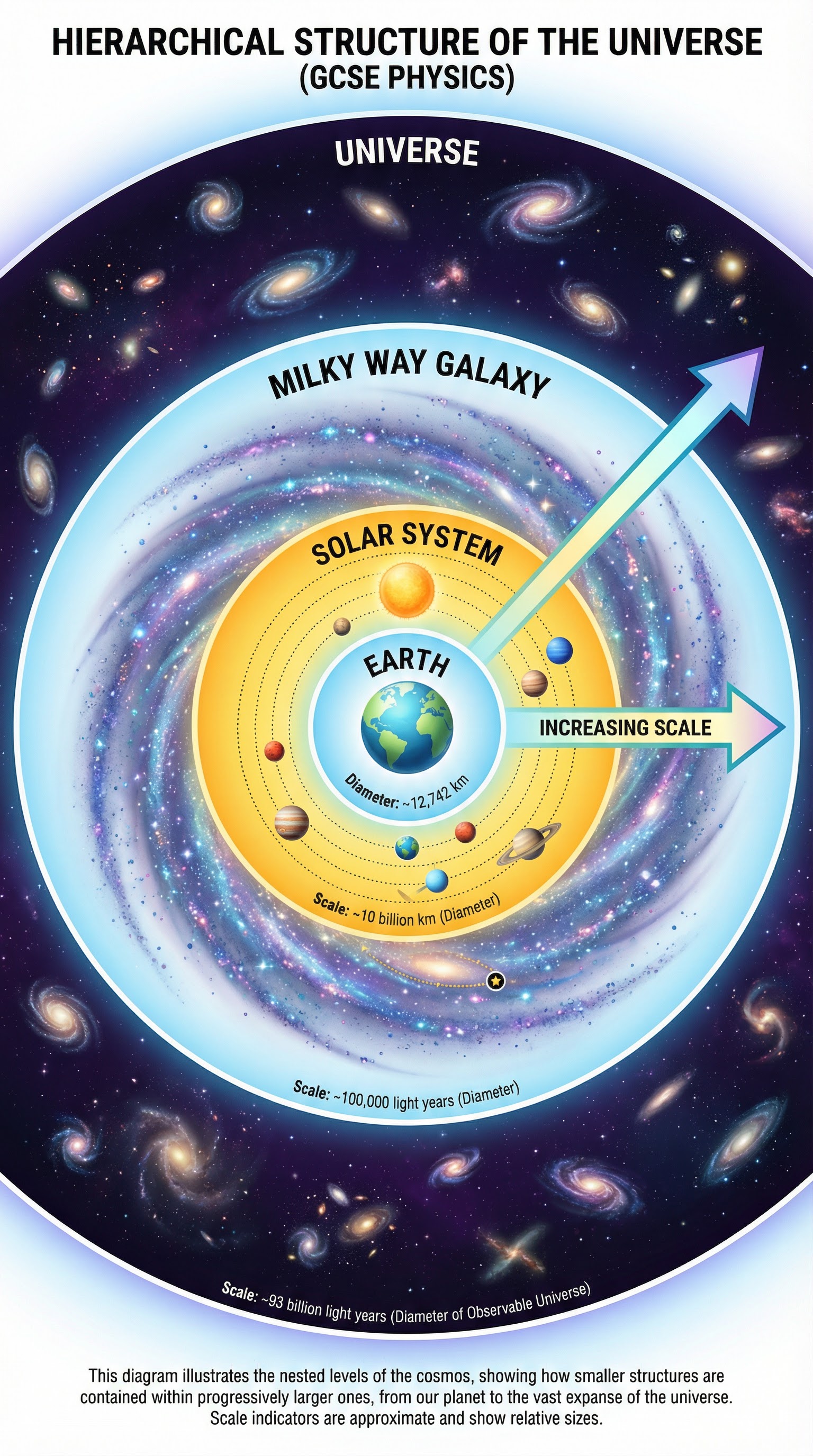
The Universe is organised in a clear hierarchy. Getting this order correct is a frequent source of easy marks in the exam. Imagine a set of Russian dolls, with each one fitting inside the next.
- Planets: Celestial bodies orbiting a star (e.g., Earth).
- Stars: Massive, luminous spheres of plasma held together by their own gravity (e.g., the Sun).
- Solar Systems: A star and the celestial bodies that orbit it, including planets, moons, and asteroids.
- Galaxies: A vast collection of billions of stars, along with gas, dust, and dark matter, all held together by gravity. Our home galaxy is the Milky Way.
- The Universe: All of space and time and their contents, including all galaxies, stars, and planets.
It is a common mistake to confuse the order, for instance, by stating that a galaxy is inside a solar system. Credit is given for correctly identifying the Milky Way as our galaxy.
Concept 2: Red-Shift and the Expanding Universe
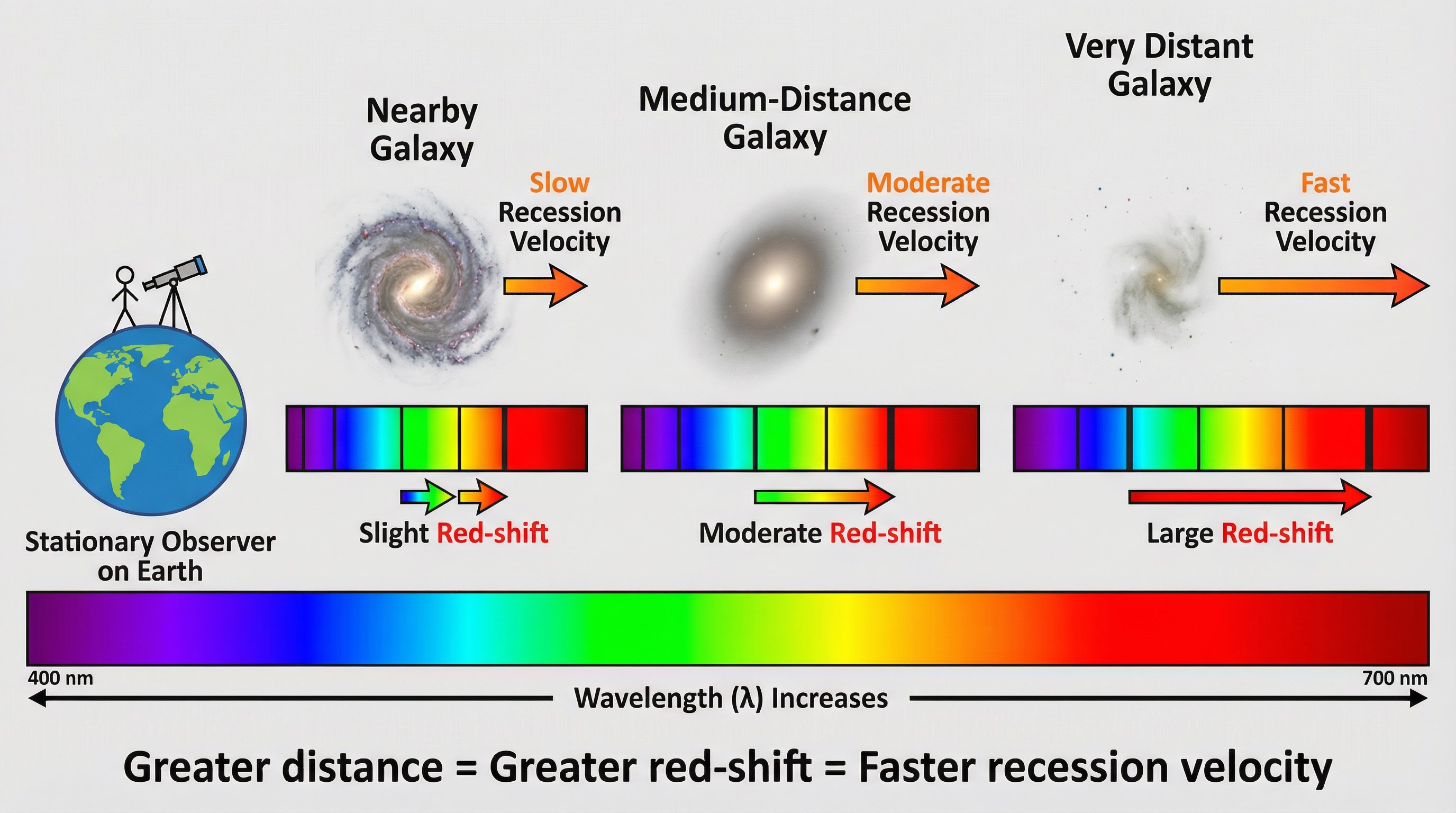
This is the core of the topic and the primary piece of evidence for the Big Bang. When we observe light from distant galaxies, we find that the light is 'stretched'. The wavelength of the observed light is longer than it should be, shifting it towards the red end of the electromagnetic spectrum. This phenomenon is called red-shift.
Why does this happen? Red-shift is a direct consequence of the Doppler effect for light. As a galaxy moves away from us, the light waves it emits are stretched out, increasing their wavelength. The faster the galaxy is moving away, the more the light is red-shifted.
In the 1920s, astronomer Edwin Hubble made a groundbreaking observation: the light from almost all galaxies is red-shifted, meaning they are all moving away from us. More importantly, he discovered a crucial relationship:
The more distant a galaxy is, the greater its red-shift, and therefore the faster it is moving away from us.
This observation leads to a staggering conclusion: the very fabric of space is expanding. It's not that galaxies are flying through a static space; rather, space itself is stretching, carrying the galaxies along with it. Think of dots on the surface of an inflating balloon—as the balloon expands, every dot moves away from every other dot.
Concept 3: The Big Bang Theory
The evidence from red-shift is the foundation of the Big Bang theory. If the Universe is expanding, it logically follows that in the past, it must have been smaller, hotter, and denser. By winding the cosmic clock backwards, we arrive at a point approximately 13.8 billion years ago when the entire Universe was concentrated into a single, infinitesimally small point of infinite density and temperature. This point exploded in an event we call the Big Bang, and the Universe has been expanding and cooling ever since.
For a top-level answer in your exam, especially in a 6-mark question, you must connect these ideas explicitly:
- Observation: Light from distant galaxies is red-shifted.
- Interpretation: This shows that these galaxies are moving away from us.
- Relationship: The more distant the galaxy, the faster it is receding.
- Conclusion: This provides evidence that the Universe is expanding.
- Theory: An expanding Universe implies it originated from a single, hot, dense point—the Big Bang.
Another key piece of evidence is the Cosmic Microwave Background Radiation (CMBR). This is faint microwave radiation detected from all directions in space. Scientists interpret this as the leftover heat—the afterglow—from the initial Big Bang explosion. Mentioning both red-shift and CMBR is essential for accessing the top mark bands in extended-response questions.
Mathematical/Scientific Relationships
While you are not required to perform complex calculations with red-shift at GCSE level, you must understand the conceptual relationship:
Recession Velocity ∝ DistanceThis means the speed at which a galaxy is moving away from us (its recession velocity) is directly proportional to its distance from us. This is known as Hubble's Law. You should be able to interpret graphs that show this relationship—a straight line through the origin, with recession velocity on the y-axis and distance on the x-axis.
Practical Applications
While there are no required practicals for this specific topic, the principles of spectroscopy are fundamental. Astronomers use instruments called spectrometers to split the light from distant stars and galaxies into a spectrum. By analysing the absorption lines within this spectrum and comparing them to known spectra from elements here on Earth, they can determine the magnitude of the red-shift and thus calculate the galaxy's recession velocity. This is a powerful application of the physics of light that allows us to probe the history and fate of the entire Universe from our vantage point on Earth.