Study Notes
Overview
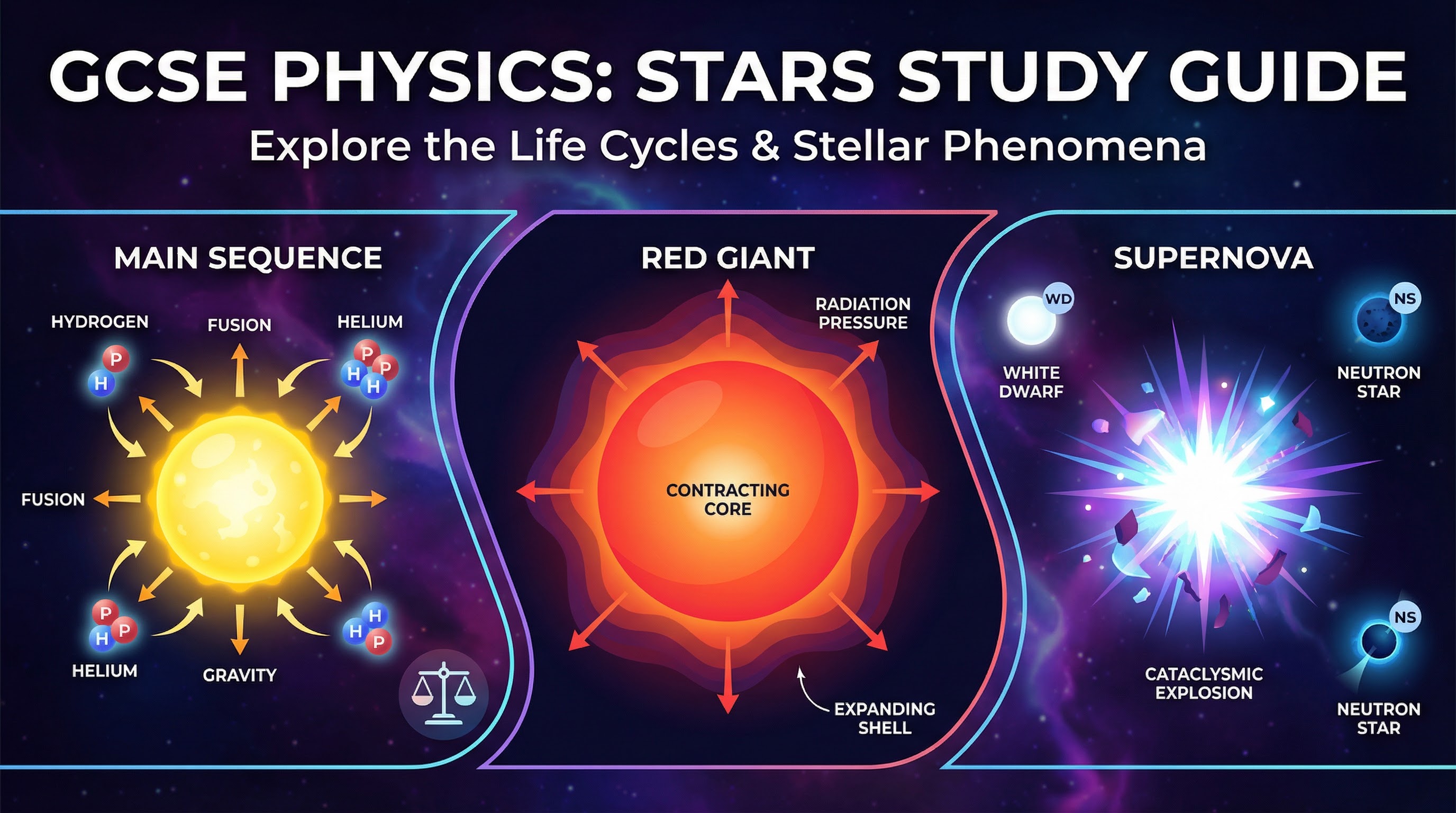
Welcome to the study of stars, a topic that sits at the heart of physics, combining concepts of forces, energy, and the very matter we are made of. For your OCR GCSE exam, understanding the life cycle of stars is not just about memorizing stages; it is about explaining the physics that drives them. Examiners will expect you to detail the journey of a star from its birth in a nebula to its ultimate fate as a white dwarf, neutron star, or black hole. This topic, specification point 8.6, frequently appears in exams, often as high-mark extended response questions. It provides a fantastic opportunity to demonstrate a deep understanding of physics by linking the microscopic world of nuclear fusion to the macroscopic scale of the cosmos. Prepare to explain the delicate balance of forces that keep a star stable and the dramatic events that occur when that balance is lost.
Key Concepts
Concept 1: The Birth of a Star and the Main Sequence
Stars are born from massive, cold clouds of gas (mostly hydrogen) and dust called nebulae. Gravity slowly pulls these materials together into a dense, hot ball known as a protostar. As the protostar contracts, its temperature and pressure increase dramatically. When the core becomes hot and dense enough (around 15 million °C), nuclear fusion begins. This is the point a star is truly born and enters the main sequence phase, where it will spend around 90% of its life.
During the main sequence, the star is in a state of hydrostatic equilibrium. This is a critical concept that earns marks. It means the inward pull of gravity is perfectly balanced by the outward push of radiation pressure from the energy released during fusion. Candidates must be able to name both forces and describe their directions accurately.
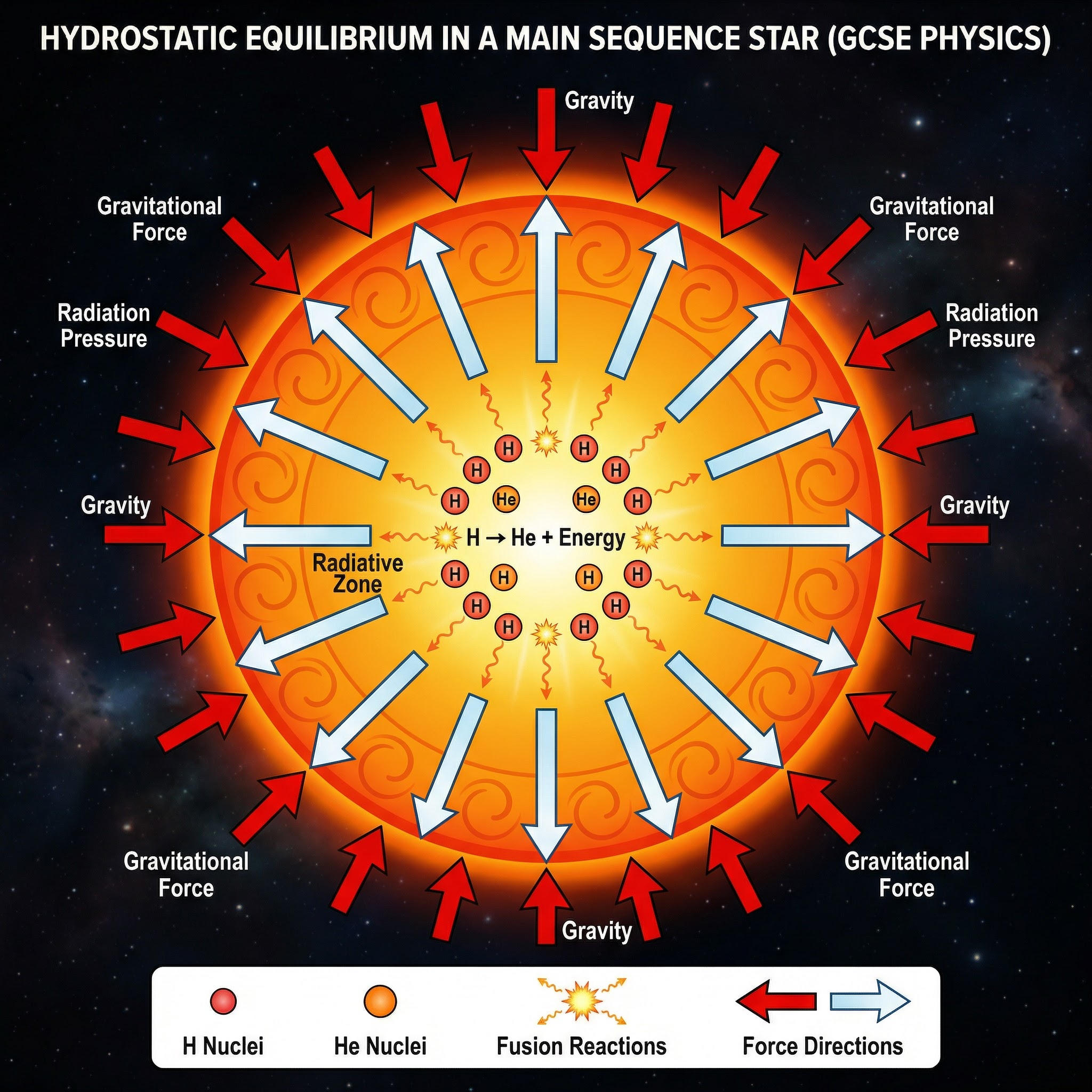
Example: Our Sun is a main sequence star. In its core, hydrogen nuclei are fused into helium nuclei, releasing a vast amount of energy that pushes outwards, preventing the Sun from collapsing under its own immense gravity.
Concept 2: Stellar Evolution - The Role of Mass
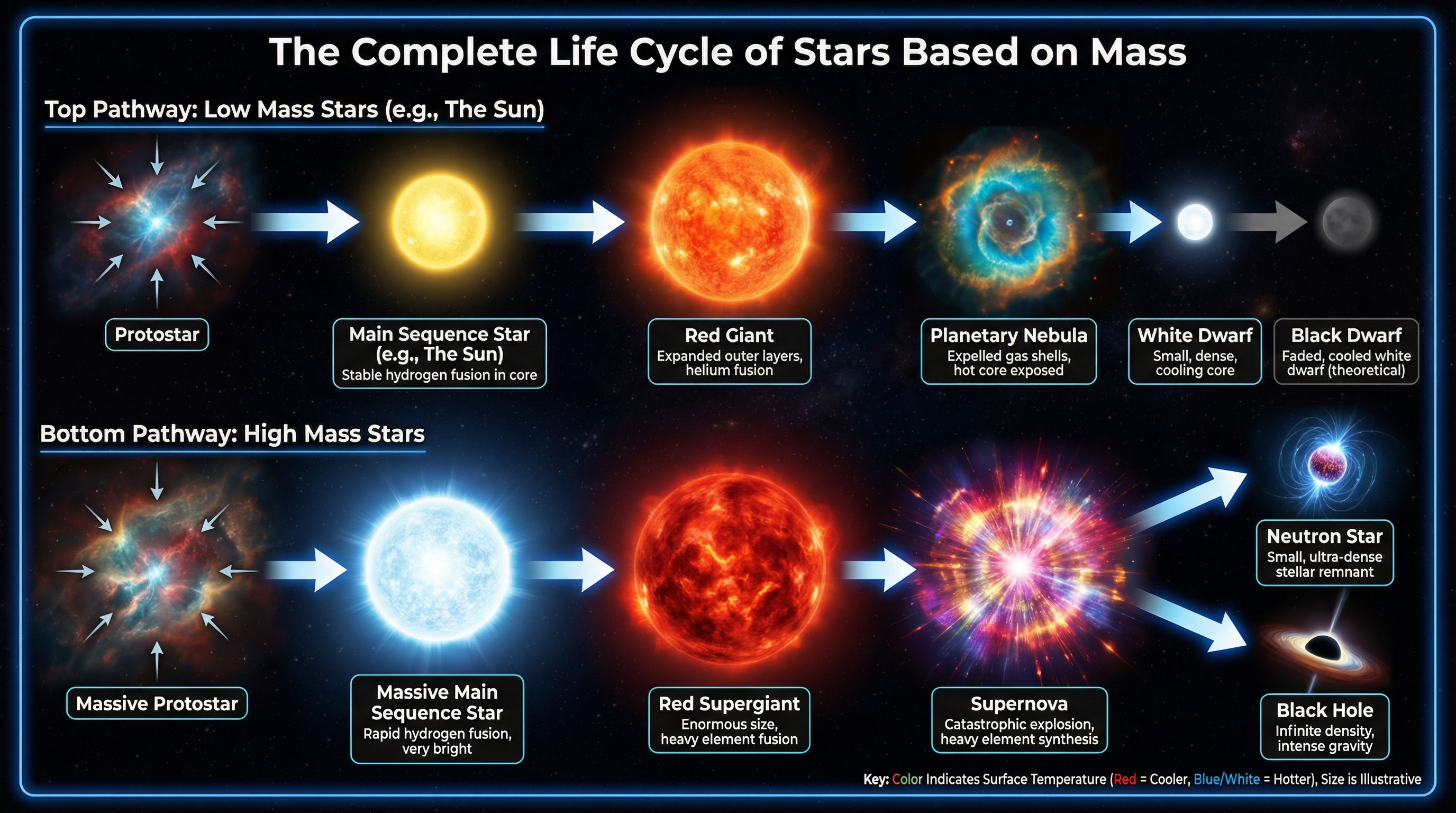
The life path of a star after the main sequence is determined entirely by its initial mass. Examiners require candidates to describe two distinct pathways: one for low-mass stars (like the Sun) and one for high-mass stars.
Low-Mass Star Life Cycle:
- Red Giant: When a low-mass star exhausts its hydrogen fuel, fusion in the core ceases. Gravity causes the core to contract and heat up. This new heat causes the outer layers of the star to expand and cool, forming a red giant. The star is red because its surface is cooler, and a giant because it has expanded enormously.
- Helium Fusion: The core becomes hot enough to start fusing helium into heavier elements like carbon and oxygen.
- Planetary Nebula: Eventually, the star becomes unstable and ejects its outer layers of gas into space, creating a beautiful structure called a planetary nebula.
- White Dwarf: The hot, dense, solid core left behind is a white dwarf. It no longer undergoes fusion and simply cools down over billions of years.
- Black Dwarf: A theoretical final stage where the white dwarf has cooled completely and no longer emits light.
High-Mass Star Life Cycle:
- Red Supergiant: High-mass stars (over 8 times the mass of our Sun) evolve into red supergiants. Their cores are hot enough to fuse elements all the way up to iron through a process called nucleosynthesis.
- The Iron Problem: Fusing iron does not release energy; it requires it. When the core turns to iron, fusion stops abruptly.
- Supernova: With no outward radiation pressure, the core collapses catastrophically under gravity in a fraction of a second. The outer layers crash down onto the core and rebound in a gigantic explosion called a supernova. This event is so bright it can outshine an entire galaxy.
- Origin of Heavy Elements: The extreme energy of a supernova is responsible for creating all elements heavier than iron, such as gold, silver, and uranium. This is a key marking point.
- The Remnant: After the supernova, the remnant core will become either a neutron star (if the original star was 8-20 times the Sun's mass) or a black hole (if over 20 times the Sun's mass).
Mathematical/Scientific Relationships
While complex calculations are not required at GCSE, understanding the principles is vital.
- Einstein's Mass-Energy Equivalence: E = mc²
- E: Energy released
- m: Mass converted into energy
- c: The speed of light (a very large number, 3 x 10⁸ m/s)
- Relevance: This formula explains how a tiny amount of mass lost during nuclear fusion can be converted into a tremendous amount of energy, powering the star. You do not need to calculate with it, but you should understand the principle. This is a "Must memorise" concept.
Practical Applications
While there are no required practicals for this specific topic, the study of stars has profound practical implications:
- Element Creation: Every element in your body heavier than hydrogen was forged inside a star or a supernova. The calcium in your bones, the iron in your blood – it's all stardust. This is a powerful real-world connection.
- Navigation: For centuries, sailors have used stars like Polaris (the North Star) for navigation.
- Telescopes & Spectroscopy: The development of telescopes and the technique of spectroscopy (analysing the light from stars) allows astronomers to determine a star's temperature, composition, and motion. This is how we have gathered all this evidence about stellar evolution. The absorption spectra from a star provide evidence for the elements present within it."