Study Notes
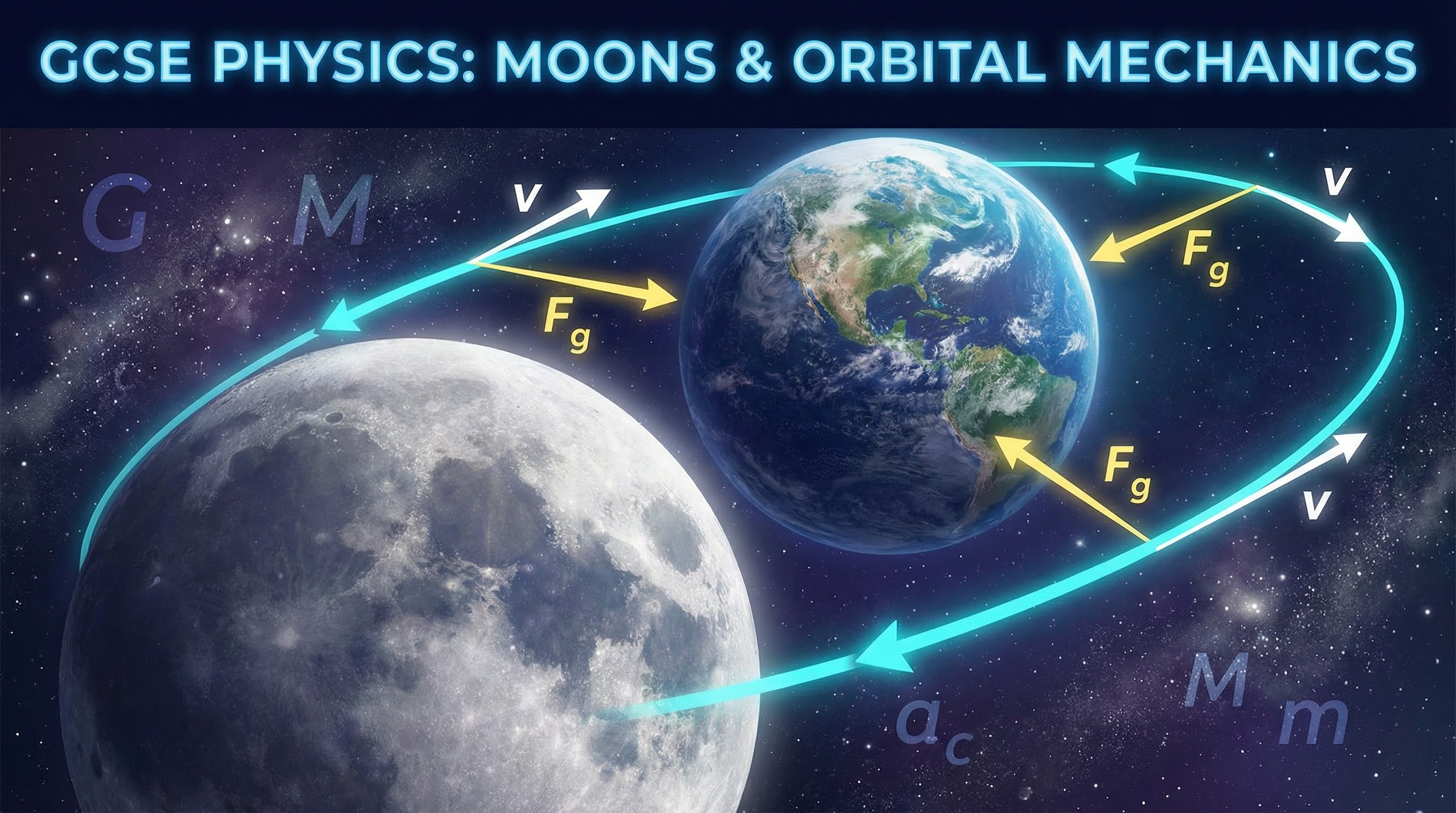
Overview
Moons are natural satellites that orbit planets, held in place by gravitational attraction. This topic sits within OCR's P8 Solar System unit and requires candidates to apply Newton's laws to circular motion, distinguishing carefully between scalar speed and vector velocity. At Foundation Tier, you must be able to define a moon and describe qualitatively why it remains in orbit. At Higher Tier, you are expected to explain quantitatively the relationship between orbital radius, speed, and period using the equation v = 2πr/T, and to recognise that gravitational force provides the centripetal force necessary for circular motion. Exam questions typically award 3-6 marks and test your ability to explain acceleration in circular orbits, calculate orbital speeds, and predict how changes in radius affect orbital dynamics. This topic connects directly to forces (P5), motion (P6), and gravity (P8.1), making it a prime candidate for synoptic assessment.
Key Concepts
Concept 1: Definition of a Moon
A moon is defined as a natural satellite that orbits a planet. The term "natural" distinguishes moons from artificial satellites such as communications satellites or the International Space Station. The Moon orbiting Earth is the most familiar example, but candidates should be aware that other planets possess moons too: Jupiter has at least 79, Saturn has 82, and even Mars has two small moons, Phobos and Deimos. In your exam, if asked to define a moon, the mark scheme awards one mark for stating "natural satellite" and one mark for "orbits a planet." Do not add unnecessary detail; precision and brevity earn marks.
Example: State what is meant by a moon. Answer: A moon is a natural satellite that orbits a planet. (2 marks)
Concept 2: Circular Motion and Velocity as a Vector
When a moon orbits a planet in a circular path, it travels at constant speed but its velocity is continuously changing. This distinction is critical and frequently tested. Speed is a scalar quantity, meaning it has magnitude only. Velocity is a vector quantity, meaning it has both magnitude and direction. Because the moon's direction of motion is constantly changing as it moves around the circle, its velocity is changing even if its speed remains constant. This is the foundation for understanding why a moon in orbit is accelerating.
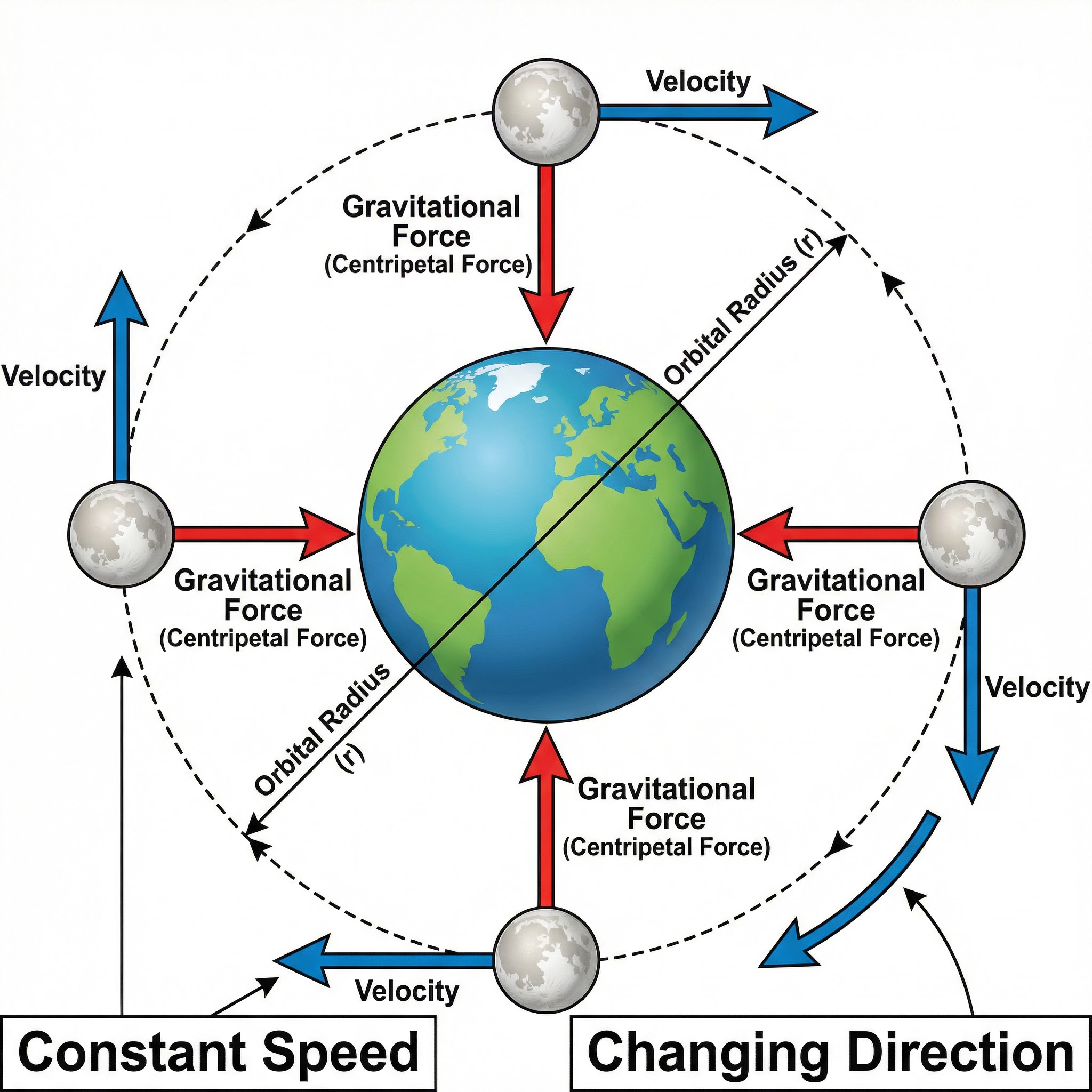
Imagine swinging a ball on a string in a horizontal circle. The ball moves at a steady speed, but at every instant, its velocity vector points tangentially to the circle. As the ball moves, this tangent direction changes, so the velocity vector changes. According to Newton's Second Law, if velocity is changing, there must be acceleration, and therefore there must be a resultant force acting on the object. In the case of the ball, the force is the tension in the string. In the case of a moon, the force is gravity.
Example: A student says, "The Moon is not accelerating because it moves at constant speed." Explain why this statement is incorrect. Answer: The Moon is accelerating because velocity is a vector, and although speed is constant, the direction is continuously changing, so velocity is changing. Acceleration is the rate of change of velocity, so there must be acceleration. (3 marks)
Concept 3: Centripetal Force and Gravitational Force
The force that acts toward the centre of a circular path is called the centripetal force. The word "centripetal" means "centre-seeking." It is crucial to understand that centripetal force is not a new or separate type of force; it is simply the name given to the resultant force that causes circular motion. For a moon orbiting a planet, the centripetal force is provided entirely by the gravitational force between the moon and the planet.
Gravitational force acts along the line joining the centres of the two masses, pulling the moon toward the planet's centre. This inward force continuously changes the direction of the moon's velocity, causing it to follow a curved path rather than moving off in a straight line as Newton's First Law would predict in the absence of a force. Candidates often make the error of inventing a separate "centripetal force" in addition to gravity. This loses marks. Always state clearly: "Gravitational force provides the centripetal force."
Example: Describe the force that keeps a moon in orbit around a planet. Answer: The gravitational force between the moon and the planet acts toward the planet's centre and provides the centripetal force required for circular motion. (2 marks)
Concept 4: Orbital Radius, Speed, and Period Relationship
At Higher Tier, candidates must understand and apply the quantitative relationship between a moon's orbital speed (v), orbital radius (r), and orbital period (T). The equation is:
v = 2πr / TWhere:
- v = orbital speed in metres per second (m/s)
- r = orbital radius in metres (m), measured from the centre of the planet to the centre of the moon
- T = orbital period in seconds (s), the time taken to complete one full orbit
This equation derives from the fact that the moon travels a distance equal to the circumference of its circular orbit (2πr) in time T, so speed = distance/time. The equation reveals an important inverse relationship: if the orbital radius decreases, the orbital speed must increase to maintain a stable orbit. Conversely, moons farther from their planet orbit more slowly and take longer to complete one orbit.
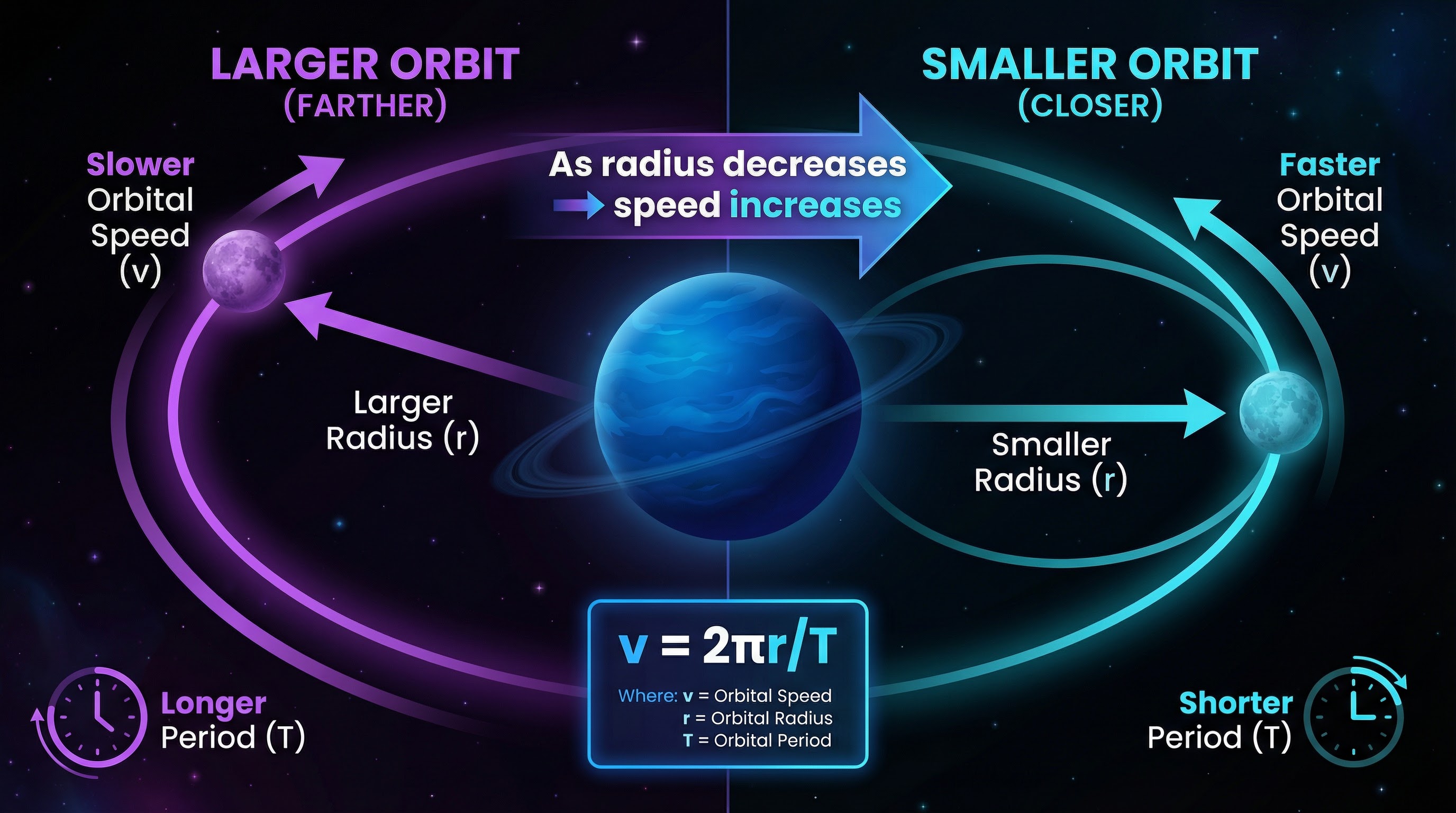
Example: The International Space Station orbits Earth at a radius of 6.77 × 10⁶ m with a period of 5400 s. Calculate its orbital speed. Answer: v = 2πr/T = (2 × π × 6.77 × 10⁶) / 5400 = 7880 m/s (or 7.88 km/s). (3 marks for correct substitution, calculation, and unit)
Candidates must be vigilant about unit conversions. If the period is given in hours, days, or years, convert to seconds before substituting. If radius is given in kilometres, convert to metres. Failure to convert units is one of the most common reasons for losing marks in calculation questions.
Concept 5: Why the Moon Doesn't Fall to Earth
A frequent misconception is that the Moon does not experience gravity because it does not fall to Earth. This is incorrect. The Moon is continuously falling toward Earth due to gravitational attraction, but because it also has a large tangential velocity, it "misses" Earth and continues in orbit. This is sometimes described as the Moon being in a state of continuous freefall. If the Moon's tangential velocity were suddenly removed, it would fall directly toward Earth. If the gravitational force were suddenly removed, the Moon would move off in a straight line tangent to its orbit, in accordance with Newton's First Law.
This concept can be illustrated by imagining a cannon on a very high mountain firing a cannonball horizontally. If fired slowly, the ball falls to Earth nearby. If fired faster, it lands farther away. If fired fast enough, the curvature of its fall matches the curvature of the Earth, and it enters orbit, continuously falling but never hitting the ground. This thought experiment, originally proposed by Isaac Newton, elegantly demonstrates orbital mechanics.
Example: Explain why the Moon does not fall to Earth even though gravitational force acts on it. Answer: The Moon is falling toward Earth due to gravity, but it also has a large tangential velocity. Because of this velocity, it continuously moves forward as it falls, so it follows a curved path around Earth and remains in orbit rather than hitting the surface. (3 marks)
Mathematical/Scientific Relationships
Orbital Speed Formula
v = 2πr / T
- v: orbital speed (m/s)
- r: orbital radius from planet's centre (m)
- T: orbital period (s)
- Status: Must memorise (not provided on formula sheet)
This formula is essential for Higher Tier candidates. You must be able to rearrange it to find r or T if given the other variables. For example:
- To find radius: r = vT / 2π
- To find period: T = 2πr / vAlways show your working clearly, substitute values with units, and give your final answer to an appropriate number of significant figures (usually 2 or 3).
Inverse Relationship Between Radius and Speed
For a stable orbit, as r decreases, v increases. This is not a formula to memorise but a qualitative relationship to understand and apply in prediction questions. Examiners often ask, "What happens to the orbital speed if the radius is reduced?" The correct answer is that speed increases.
Gravitational Force as Centripetal Force
While the full equation F = mv²/r is not required at GCSE, candidates should understand conceptually that the gravitational force provides the centripetal force. At Higher Tier, you may be asked to explain this relationship in words: "The gravitational force between the moon and planet acts toward the centre and provides the centripetal force required to maintain circular motion."
Practical Applications
Artificial Satellites and the International Space Station
The principles governing natural moons apply equally to artificial satellites. The International Space Station (ISS) orbits Earth at an altitude of approximately 400 km, giving an orbital radius of about 6770 km from Earth's centre. Its orbital period is roughly 90 minutes, meaning astronauts aboard experience 16 sunrises and sunsets every 24 hours. The ISS must travel at approximately 7.8 km/s to maintain this orbit. If its speed were reduced, it would fall into a lower orbit and eventually re-enter the atmosphere. If its speed were increased, it would move into a higher orbit.
Geostationary Satellites
Geostationary satellites orbit Earth with a period of exactly 24 hours, matching Earth's rotation. This means they remain above the same point on the equator, making them ideal for communications and weather monitoring. To achieve this, they must orbit at a specific radius of approximately 42,000 km from Earth's centre (about 36,000 km above the surface). This is a direct application of the relationship v = 2πr/T: for a fixed period (24 hours), there is only one radius that satisfies the equation.
Planetary Moons in the Solar System
Jupiter's moon Io orbits very close to the planet and completes an orbit in just 1.77 days, travelling at about 17 km/s. In contrast, Callisto, another of Jupiter's moons, orbits much farther out and takes 16.7 days to complete one orbit, moving at only 8 km/s. This perfectly demonstrates the inverse relationship between orbital radius and speed.
Listen to the 10-minute podcast: This audio guide covers all key concepts, exam tips, common mistakes, and includes a quick-fire recall quiz. Perfect for revision on the go!
Worked Examples
Worked Example 1: Defining and Explaining Orbital Motion
Question: A moon orbits a planet in a circular path at constant speed.
(a) State what is meant by a moon. (1 mark)
(b) Explain why the moon is accelerating even though its speed is constant. (3 marks)
Solution:
(a) A moon is a natural satellite that orbits a planet. ✓ (1 mark)
(b) The moon is accelerating because velocity is a vector quantity, which has both magnitude and direction. ✓ Although the speed (magnitude) is constant, the direction of the moon's motion is continuously changing as it moves in a circle. ✓ Since velocity is changing, there must be acceleration. ✓ (3 marks)
Examiner Commentary: Part (a) earns the mark for including both "natural satellite" and "orbits a planet." Part (b) earns full marks by explicitly stating that velocity is a vector, explaining that direction changes in circular motion, and linking this to acceleration. A common error is to say "the moon is accelerating because there is a force acting on it" without explaining why the force causes acceleration. Always link cause and effect using "because."
Worked Example 2: Identifying the Centripetal Force
Question: Describe the force that keeps a moon in a stable circular orbit around a planet. (2 marks)
Solution:
The gravitational force between the moon and the planet ✓ acts toward the centre of the planet and provides the centripetal force required for circular motion. ✓ (2 marks)
Examiner Commentary: This answer earns both marks by naming the force (gravitational force) and explaining its role (provides centripetal force). Common errors include inventing a separate "centripetal force" or failing to mention that the force acts toward the centre. To secure full marks, always state clearly that gravity provides the centripetal force.
Worked Example 3: Calculating Orbital Speed
Question: Earth's Moon orbits at a radius of 3.84 × 10⁸ m from Earth's centre. The orbital period is 27.3 days. Calculate the Moon's orbital speed. (4 marks)
Solution:
Step 1: Convert period to seconds.
T = 27.3 days × 24 hours/day × 3600 s/hour = 2.36 × 10⁶ s ✓
Step 2: Write the formula.
v = 2πr / T ✓
Step 3: Substitute values.
v = (2 × π × 3.84 × 10⁸) / (2.36 × 10⁶) ✓
Step 4: Calculate and give answer with unit.
v = 1020 m/s (or 1.02 km/s) ✓
(4 marks)
Examiner Commentary: This answer earns full marks by converting the period to seconds (1 mark), correctly stating the formula (1 mark), substituting values correctly (1 mark), and calculating the final answer with the correct unit (1 mark). The most common error is failing to convert days to seconds, which results in an incorrect answer and loss of marks. Always check units before substituting.
Worked Example 4: Predicting Changes in Orbital Speed
Question: A satellite is moved from a high orbit to a lower orbit closer to Earth. Explain what happens to its orbital speed. (2 marks)
Solution:
The orbital speed increases. ✓ This is because for a stable orbit, as the radius decreases, the speed must increase to provide the greater centripetal force required at smaller radii. ✓ (2 marks)
Examiner Commentary: The first mark is awarded for stating that speed increases. The second mark is awarded for explaining why, using the relationship between radius and speed. Candidates who simply state "speed increases" without explanation earn only 1 mark. To earn full marks, always justify your answer.
Memory Hooks
1. VVD: Velocity is a Vector, Direction matters
Hook: VVD
Explanation: This acronym reminds you that Velocity is a Vector, and changing Direction means changing velocity, which means there is acceleration. Use this in any question asking why an object in circular motion is accelerating.
Type: acronym
2. "Gravity Gives Circular Pull"
Hook: Gravity Gives Circular Pull (GGCP)
Explanation: This phrase reminds you that Gravity provides the Centripetal force (the inward Pull) that keeps a moon in a Circular orbit. Never invent a separate centripetal force; gravity IS the centripetal force.
Type: acronym
3. "Closer means Faster"
Hook: Closer means Faster
Explanation: This simple rhyme helps you remember the inverse relationship: smaller orbital radius means faster orbital speed. Think of the ISS (close to Earth, fast orbit, 90 minutes) versus the Moon (far from Earth, slow orbit, 27 days).
Type: rhyme
4. The Falling Moon Story
Hook: The Moon is always falling toward Earth but keeps missing it.
Explanation: This memorable visual image helps you understand that gravity is constantly acting on the Moon, pulling it toward Earth, but because the Moon is also moving sideways very fast, it continuously "falls around" Earth rather than falling into it. This is orbital motion: falling and missing at the same time.
Type: story
5. "2 Pies Are Tasty" for 2πr/T
Hook: 2 Pies Are Tasty
Explanation: This mnemonic helps you remember the formula v = 2πr/T. "2 Pies" = 2πr, "Are" = /, "Tasty" = T. So v = 2πr / T.
Type: rhyme
6. "Speed Stays, Velocity Varies"
Hook: Speed Stays, Velocity Varies
Explanation: In circular motion at constant speed, the Speed Stays constant but Velocity Varies because direction changes. This alliteration makes it easy to remember the key distinction.
Type: rhyme
Exam Technique
Time per mark: Approximately 1 minute per mark. A 4-mark calculation should take about 4-5 minutes, including checking your answer.
Question approach:
- Read carefully: Identify the command word (state, describe, explain, calculate) and the number of marks available.
- Underline key information: Circle numerical values and their units. Note what you are asked to find.
- Plan your answer: For explanations, decide which concepts you need to mention (e.g., velocity as a vector, centripetal force). For calculations, write down the formula first.
- Show all working: Even if you make an arithmetic error, you can still earn method marks if your approach is correct.
- Check units: Convert all quantities to standard SI units (metres, seconds, kilograms) before substituting into formulas.
- Use scientific language: Use terms like "gravitational force," "centripetal force," "velocity is a vector," and "acceleration" precisely.
Answer structure:
- 1-2 marks: A brief factual statement or a single calculation step. Example: "A moon is a natural satellite that orbits a planet."
- 3-4 marks: A detailed explanation with multiple linked points, or a multi-step calculation with clear working. Use "because" to link cause and effect.
- 5-6 marks: A comprehensive explanation covering multiple concepts, or a complex calculation involving unit conversion, rearrangement, and substitution. Structure your answer in clear steps.
Common pitfalls:
- Confusing speed and velocity: Always state "velocity is a vector" when explaining acceleration in circular motion.
- Inventing extra forces: Do not add a separate "centripetal force" to gravity. Gravity provides the centripetal force.
- Forgetting unit conversions: Convert days/hours to seconds, kilometres to metres, before calculating.
- Not showing working: In calculations, always write the formula, substitute values, and show each step. You can earn method marks even if your final answer is wrong.
- Mixing up orbital period and rotational period: The Moon's orbital period (time to orbit Earth) is 27.3 days. Its rotational period (time to spin once) is also 27.3 days, which is why we always see the same face. Be clear which you are referring to.
Command word strategies:
- State/Give: Provide a brief factual answer, typically one sentence or a short phrase. Example: "State what provides the centripetal force for a moon's orbit." Answer: "Gravitational force."
- Describe: Say what happens or what something is like, using correct scientific terminology. Example: "Describe the motion of a moon in orbit." Answer: "The moon moves in a circular path at constant speed, with its velocity continuously changing direction."
- Explain: Say HOW or WHY something happens. Use "because" to link cause and effect. Example: "Explain why a moon in orbit is accelerating." Answer: "The moon is accelerating because velocity is a vector, and although speed is constant, direction is changing, so velocity is changing."
- Calculate: Show all working, write the formula, substitute values with units, and give your final answer with the correct unit. Always check your answer makes sense (e.g., orbital speeds are typically thousands of m/s).
- Compare: Identify both similarities and differences. Use comparative language like "both," "whereas," "in contrast." Example: "Compare the orbital speeds of two moons at different radii." Answer: "Both moons travel in circular orbits, but the moon closer to the planet has a higher orbital speed, whereas the moon farther away has a lower orbital speed."
- Evaluate: Consider evidence for and against, weigh up different factors, and make a reasoned judgement. This command word is rare in this topic but may appear in synoptic questions.
Key Definitions
1. Moon
Definition: A natural satellite that orbits a planet.
Context: This definition appears in 1-mark "state" or "define" questions. Ensure you include both "natural satellite" and "orbits a planet" to secure the mark.
2. Natural Satellite
Definition: An astronomical body that orbits a planet or other larger body and is not human-made.
Context: This term distinguishes moons from artificial satellites. Examiners may ask you to explain the difference between natural and artificial satellites.
3. Velocity
Definition: A vector quantity that describes the speed of an object in a particular direction.
Context: Understanding that velocity is a vector (has both magnitude and direction) is essential for explaining why an object in circular motion is accelerating even at constant speed.
4. Acceleration
Definition: The rate of change of velocity. Measured in metres per second squared (m/s²).
Context: In circular motion, acceleration occurs because the direction of velocity changes, even if speed is constant. Always link acceleration to changing velocity, not just changing speed.
5. Centripetal Force
Definition: The resultant force acting toward the centre of a circular path that causes an object to move in a circle.
Context: Centripetal force is not a separate type of force. For a moon, the centripetal force is provided by gravitational force. Examiners test whether you understand this distinction.
6. Gravitational Force
Definition: The attractive force between two masses. For a moon and planet, this force acts along the line joining their centres.
Context: Gravitational force provides the centripetal force for orbital motion. This concept links Topic 8.3 (Moons) with Topic 8.1 (Gravity).
7. Orbital Radius (r)
Definition: The distance from the centre of the planet to the centre of the orbiting moon or satellite, measured in metres.
Context: Used in the equation v = 2πr/T. Be careful: orbital radius is measured from the planet's centre, not its surface. If given altitude above surface, add the planet's radius.
8. Orbital Period (T)
Definition: The time taken for a moon or satellite to complete one full orbit around a planet, measured in seconds.
Context: Used in the equation v = 2πr/T. Always convert from days or hours to seconds before substituting into the formula.
9. Orbital Speed (v)
Definition: The distance travelled per unit time by a moon or satellite in its orbit, measured in metres per second (m/s).
Context: Calculated using v = 2πr/T. Orbital speed is constant in a circular orbit, but velocity is not constant because direction changes.
Mermaid Diagrams
Diagram 1: Concept Map of Orbital Motion
mermaid
graph TD
A[Moon in Circular Orbit] --> B[Constant Speed]
A --> C[Changing Velocity]
C --> D[Velocity is a Vector]
D --> E[Direction Changes]
E --> F[Acceleration Occurs]
F --> G[Requires Resultant Force]
G --> H[Gravitational Force]
H --> I[Provides Centripetal Force]
I --> J[Acts Toward Centre]
J --> A
Caption: This concept map shows the logical flow of ideas in orbital motion. A moon moves at constant speed but changing velocity (because velocity is a vector and direction changes). Changing velocity means acceleration, which requires a force. That force is gravity, which provides the centripetal force acting toward the centre, maintaining the circular orbit.
Diagram 2: Decision Tree for Orbital Motion Questions
mermaid
graph TD
Start[Orbital Motion Question] --> Q1{Asked to define moon?}
Q1 -->|Yes| A1[State: Natural satellite that orbits a planet]
Q1 -->|No| Q2{Asked why moon accelerates?}
Q2 -->|Yes| A2[Explain: Velocity is a vector, direction changes, so velocity changes, causing acceleration]
Q2 -->|No| Q3{Asked what provides force?}
Q3 -->|Yes| A3[State: Gravitational force provides centripetal force]
Q3 -->|No| Q4{Asked to calculate speed?}
Q4 -->|Yes| A4[Use v = 2πr/T, convert units, show working]
Q4 -->|No| Q5{Asked about radius vs speed?}
Q5 -->|Yes| A5[State: Smaller radius means faster speed]
Caption: Use this decision tree to quickly identify which concept or formula to apply based on the question type. This helps you structure your answer and ensure you include all the key points examiners are looking for.
Practice Questions
Question 1: Foundation Tier
Question: Mars has two moons, Phobos and Deimos. State what is meant by a moon. (1 mark)
Marks: 1
Difficulty: foundation
Hint: Think about what type of object a moon is and what it does.
Model Answer: A moon is a natural satellite that orbits a planet.
Mark Scheme Breakdown:
- 1 mark: Correct definition including "natural satellite" and "orbits a planet"
Common Wrong Answers:
- "A moon is a rock in space" — too vague, does not mention orbiting a planet
- "A moon orbits Earth" — incorrect, moons orbit planets in general, not just Earth
Question 2: Higher Tier
Question: A student observes that the Moon moves in a circular orbit around Earth at constant speed. The student concludes that the Moon is not accelerating. Explain why the student's conclusion is incorrect. (3 marks)
Marks: 3
Difficulty: standard
Hint: Think about the difference between speed and velocity, and what acceleration actually means.
Model Answer: The student's conclusion is incorrect because velocity is a vector quantity, which has both magnitude and direction. Although the Moon's speed (magnitude) is constant, its direction is continuously changing as it moves in a circle. Since velocity is changing, the Moon must be accelerating.
Mark Scheme Breakdown:
- 1 mark: State that velocity is a vector
- 1 mark: Explain that direction is changing in circular motion
- 1 mark: Link changing velocity to acceleration
Common Wrong Answers:
- "The Moon is accelerating because there is a force acting on it" — this is true but does not explain WHY the student is wrong about acceleration
- "Speed and velocity are different" — too vague, must explain that velocity includes direction
Question 3: Higher Tier Calculation
Question: A satellite orbits Earth at a radius of 7.0 × 10⁶ m. Its orbital period is 6000 s. Calculate the satellite's orbital speed. (3 marks)
Marks: 3
Difficulty: standard
Hint: Use the formula v = 2πr/T. Check that all units are in metres and seconds.
Model Answer:
v = 2πr / T
v = (2 × π × 7.0 × 10⁶) / 6000
v = 7330 m/s (or 7.3 km/s)
Mark Scheme Breakdown:
- 1 mark: Correct formula stated or implied
- 1 mark: Correct substitution of values
- 1 mark: Correct answer with unit
Common Wrong Answers:
- Forgetting to multiply by 2π, giving v = r/T
- Incorrect unit conversion or missing unit in final answer
- Arithmetic errors in calculation
Question 4: Synoptic Higher Tier
Question: Jupiter's moon Io orbits at a radius of 4.2 × 10⁸ m with a period of 1.77 days. Europa, another moon of Jupiter, orbits at a larger radius of 6.7 × 10⁸ m. Predict whether Europa's orbital speed is greater than, less than, or equal to Io's orbital speed. Explain your answer. (3 marks)
Marks: 3
Difficulty: challenging
Hint: Think about the relationship between orbital radius and orbital speed. Do you need to calculate, or can you predict qualitatively?
Model Answer: Europa's orbital speed is less than Io's orbital speed. This is because for a stable orbit, as the orbital radius increases, the orbital speed decreases. Europa orbits at a larger radius than Io, so it must travel more slowly.
Mark Scheme Breakdown:
- 1 mark: State that Europa's speed is less than Io's speed
- 1 mark: Explain that larger radius means slower speed
- 1 mark: Apply this reasoning to the specific case of Europa and Io
Common Wrong Answers:
- "Europa's speed is greater because it has to travel a longer distance" — incorrect reasoning; although the distance is greater, the period is also longer, and the relationship is inverse
- Attempting to calculate both speeds without being asked to do so — wastes time, and if you make an error, you lose marks
Question 5: Explaining Centripetal Force
Question: Describe the force that keeps a moon in a stable circular orbit around a planet, and explain the role this force plays in the moon's motion. (4 marks)
Marks: 4
Difficulty: standard
Hint: Name the force, describe its direction, and explain what it does to the moon's velocity.
Model Answer: The force is the gravitational force (or gravity) between the moon and the planet. This force acts toward the centre of the planet. It provides the centripetal force required to keep the moon moving in a circular path. The force continuously changes the direction of the moon's velocity, causing it to accelerate toward the centre and follow a curved orbit rather than moving in a straight line.
Mark Scheme Breakdown:
- 1 mark: Name the force (gravitational force)
- 1 mark: State that it acts toward the centre
- 1 mark: State that it provides the centripetal force
- 1 mark: Explain that it changes the direction of velocity, causing circular motion
Common Wrong Answers:
- "There is a centripetal force and a gravitational force" — incorrect, these are not two separate forces; gravity provides the centripetal force
- "The force keeps the moon from falling" — misleading; the moon is falling, but it keeps missing the planet due to its tangential velocity
Question 6: Unit Conversion Challenge
Question: Earth's Moon has an orbital period of 27.3 days and orbits at a radius of 3.84 × 10⁸ m. Calculate the Moon's orbital speed in km/s. (4 marks)
Marks: 4
Difficulty: challenging
Hint: Convert the period from days to seconds first. Then use v = 2πr/T. Finally, convert your answer from m/s to km/s.
Model Answer:
Step 1: Convert period to seconds.
T = 27.3 days × 24 hours/day × 3600 s/hour = 2.36 × 10⁶ s
Step 2: Calculate speed.
v = 2πr / T = (2 × π × 3.84 × 10⁸) / (2.36 × 10⁶) = 1022 m/s
Step 3: Convert to km/s.
v = 1022 / 1000 = 1.02 km/s
Mark Scheme Breakdown:
- 1 mark: Correct conversion of period to seconds
- 1 mark: Correct use of formula v = 2πr/T
- 1 mark: Correct calculation in m/s
- 1 mark: Correct conversion to km/s as requested
Common Wrong Answers:
- Forgetting to convert days to seconds, leading to a wildly incorrect answer
- Forgetting to convert final answer to km/s as requested in the question
- Arithmetic errors in multi-step conversions
Quick Summary
- A moon is a natural satellite that orbits a planet.
- In circular motion, speed is constant but velocity is changing because direction changes.
- Velocity is a vector, so changing direction means changing velocity, which means there is acceleration.
- Gravitational force provides the centripetal force that keeps a moon in orbit.
- The centripetal force is not a separate force; it is the name for the resultant force acting toward the centre.
- The formula for orbital speed is v = 2πr / T (must memorise, not on formula sheet).
- Smaller orbital radius means faster orbital speed; larger radius means slower speed.
- Always convert units to metres and seconds before substituting into formulas.
- Use the word "because" to link cause and effect in explanation questions.
- The Moon is continuously falling toward Earth but keeps missing due to its tangential velocity.
Retrieval Cues
Retrieval Cue 1
Prompt: Without looking at your notes, write down the definition of a moon that would earn you full marks in an exam.
Difficulty: foundation
Expected Answer Points:
- Natural satellite
- Orbits a planet
Retrieval Cue 2
Prompt: Cover this page and explain in your own words why an object moving in a circle at constant speed is accelerating.
Difficulty: foundation
Expected Answer Points:
- Velocity is a vector
- Direction is changing
- Changing velocity means acceleration
Retrieval Cue 3
Prompt: Without looking, write down the formula for orbital speed and define each symbol.
Difficulty: foundation
Expected Answer Points:
- v = 2πr / T
- v = orbital speed (m/s)
- r = orbital radius (m)
- T = orbital period (s)
Retrieval Cue 4
Prompt: Close your notes and describe what provides the centripetal force for a moon orbiting a planet, and explain why this is not a separate force.
Difficulty: standard
Expected Answer Points:
- Gravitational force provides the centripetal force
- Centripetal force is the name for the resultant force toward the centre
- Not a separate physical force
Retrieval Cue 5
Prompt: Without referring to your notes, explain what happens to a moon's orbital speed if its orbital radius decreases, and justify your answer.
Difficulty: standard
Expected Answer Points:
- Orbital speed increases
- Inverse relationship between radius and speed
- Smaller radius requires faster speed for stable orbit
Retrieval Cue 6
Prompt: Cover this guide and explain why the Moon does not fall to Earth even though gravity acts on it.
Difficulty: challenging
Expected Answer Points:
- Gravity does act on the Moon
- The Moon is falling toward Earth
- The Moon also has tangential velocity
- It continuously falls but keeps missing Earth
- This is what an orbit is: continuous freefall
Synoptic Links
Link 1: Forces (P5)
Related Topic: Newton's First Law and Resultant Forces
Connection: Newton's First Law states that an object continues in a straight line at constant velocity unless acted upon by a resultant force. A moon in orbit would move in a straight line if not for the gravitational force acting as the centripetal force, continuously changing its direction.
Exam Relevance: Examiners may ask you to apply Newton's First Law to explain why a moon requires a force to maintain circular motion, or to predict what would happen if gravitational force were suddenly removed (the moon would move off in a straight line tangent to its orbit).
Link 2: Gravity (P8.1)
Related Topic: Gravitational Force and Weight
Connection: Gravitational force acts between any two masses and decreases with distance. For a moon orbiting a planet, this force provides the centripetal force. The strength of gravitational force depends on the masses of the moon and planet and the distance between their centres.
Exam Relevance: Synoptic questions may ask you to explain how gravitational force varies with distance and how this affects orbital motion. For example, a moon farther from the planet experiences weaker gravitational force and therefore requires a slower speed to maintain orbit.
Link 3: Motion (P6)
Related Topic: Velocity, Acceleration, and Equations of Motion
Connection: Understanding velocity as a vector quantity is essential for both linear motion (P6) and circular motion (P8.3). Acceleration is defined as the rate of change of velocity, which applies whether velocity changes in magnitude (speeding up or slowing down) or direction (circular motion).
Exam Relevance: Examiners test whether you can distinguish between speed and velocity, and whether you understand that acceleration can occur even at constant speed if direction changes. This concept appears in both motion and orbital mechanics questions.
Link 4: Energy (P1)
Related Topic: Kinetic Energy and Gravitational Potential Energy
Connection: A moon in orbit has both kinetic energy (due to its motion) and gravitational potential energy (due to its position in the planet's gravitational field). If a moon moves to a lower orbit, it loses gravitational potential energy and gains kinetic energy, so it speeds up.
Exam Relevance: Higher Tier synoptic questions may ask you to explain energy transfers when a satellite changes orbit. For example, if a satellite is moved to a lower orbit, it speeds up (gains kinetic energy) because it loses gravitational potential energy.
Elaboration Questions
Question 1
Why does the gravitational force provide exactly the right amount of centripetal force for a moon to stay in a stable orbit, rather than spiralling inward or flying away?
Question 2
If you were an astronaut in orbit around Earth, you would feel weightless. Does this mean gravity is not acting on you? Explain your reasoning.
Question 3
The International Space Station orbits at about 400 km altitude and takes 90 minutes per orbit. The Moon orbits at about 384,000 km and takes 27.3 days per orbit. Why is there such a huge difference in orbital period for what seems like a modest difference in distance?
Question 4
Imagine you could suddenly stop the Moon's tangential velocity so it was stationary in space. What would happen next, and why?
Question 5
How would you explain the concept of "falling around the Earth" to someone who has never studied physics, using only everyday language and analogies?
Question 6
If Earth's mass suddenly doubled, what would happen to the Moon's orbit? Would it stay in the same orbit, move closer, or move farther away? Justify your answer using physics principles.