Study Notes
Overview
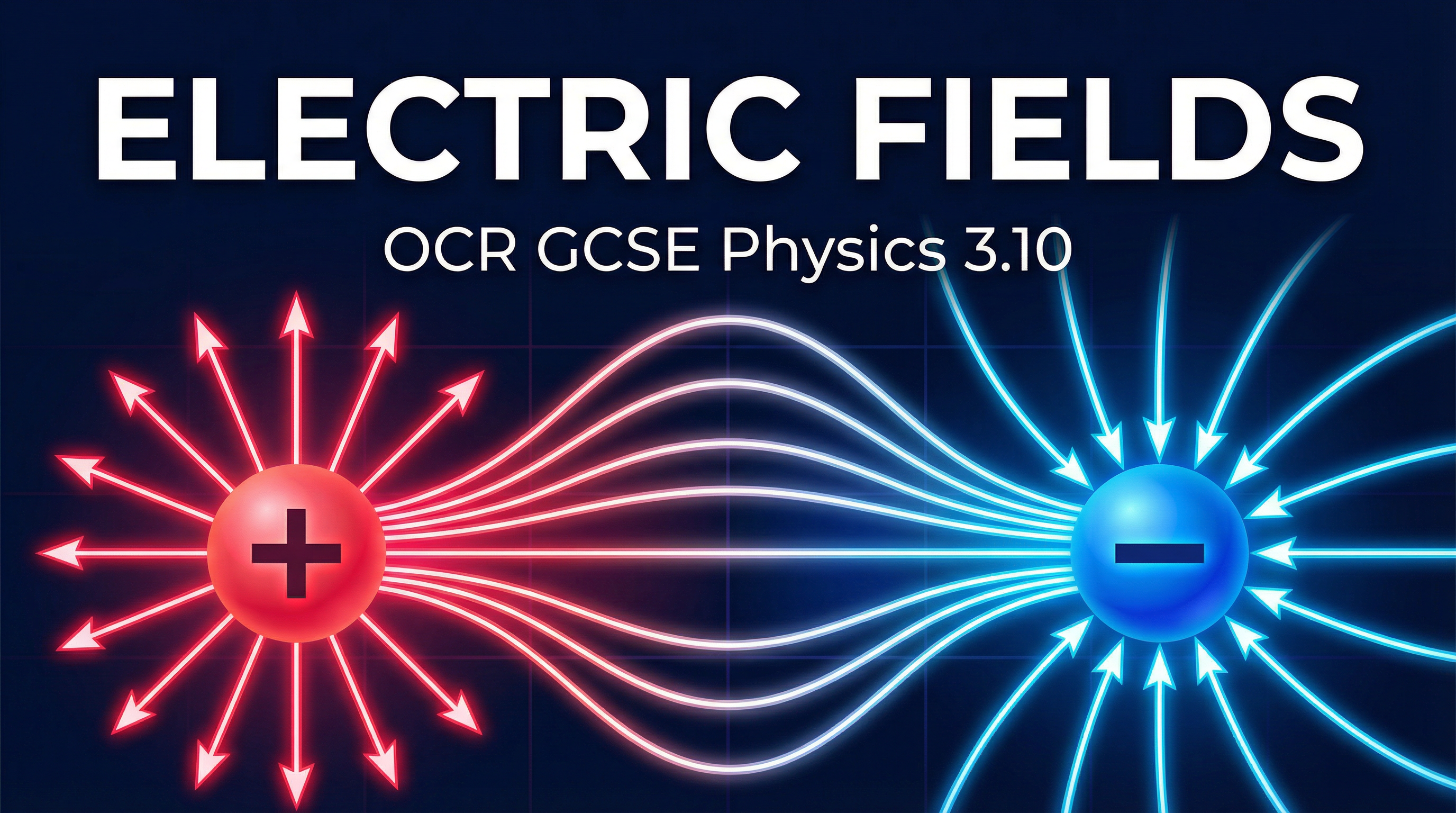
Welcome to the study of Electric Fields, a fundamental concept in physics that explains the non-contact force between charged objects. For your OCR GCSE exam, this topic is all about understanding how objects become charged and how to visually represent the invisible fields they create. It is a highly visual topic, meaning that well-drawn diagrams are a reliable source of marks. Examiners will test your ability to recall key definitions, apply rules for drawing field lines, and, for Higher Tier candidates, explain the dramatic phenomenon of sparking. This topic links directly to static electricity in everyday life, from getting a shock from a car door to the awesome power of a lightning strike. A solid grasp of electric fields also lays the groundwork for understanding more advanced concepts in electromagnetism at A-Level.
Key Concepts
Concept 1: Static Charge by Friction
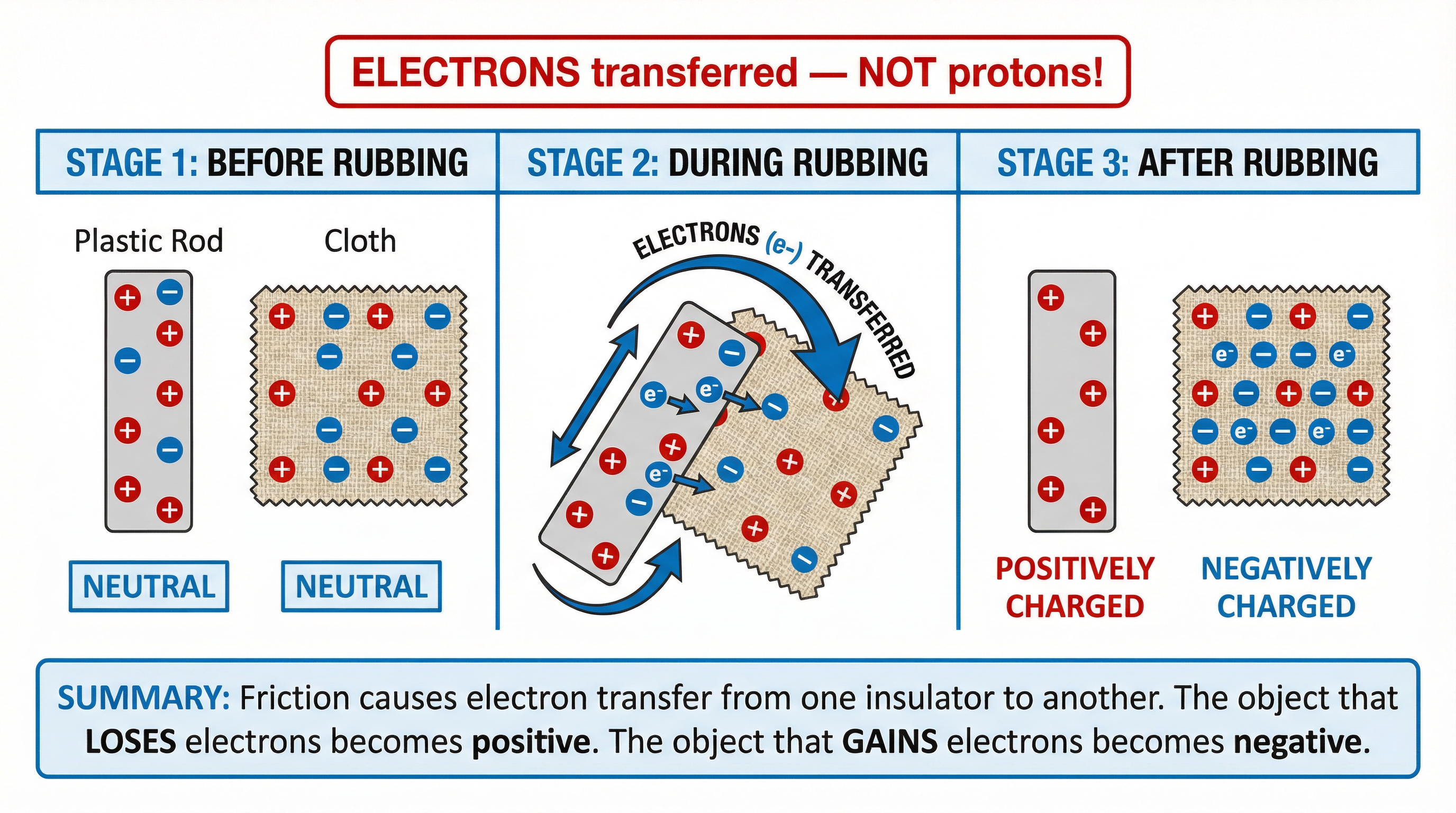
When two electrically insulating materials are rubbed together, a phenomenon known as charging by friction occurs. This is not magic; it is the physical transfer of tiny, negatively charged particles called electrons. The key to understanding this is knowing which particles move and which do not.
Atoms contain positive protons (fixed in the nucleus) and negative electrons (orbiting the nucleus). Protons are locked in place and do not move during this process. Only the electrons are mobile. Friction provides the energy needed to strip electrons from the surface of one material and transfer them to the surface of the other.
The material that loses electrons is left with a surplus of positive charges, so it becomes positively charged. The material that gains electrons now has an excess of negative charges, so it becomes negatively charged. This is a crucial point that is frequently misunderstood. Credit is only given for answers that explicitly state that electrons are transferred. Mentioning the movement of protons is a common mistake that will cost you marks every time.
Concept 2: Electric Fields and Field Lines
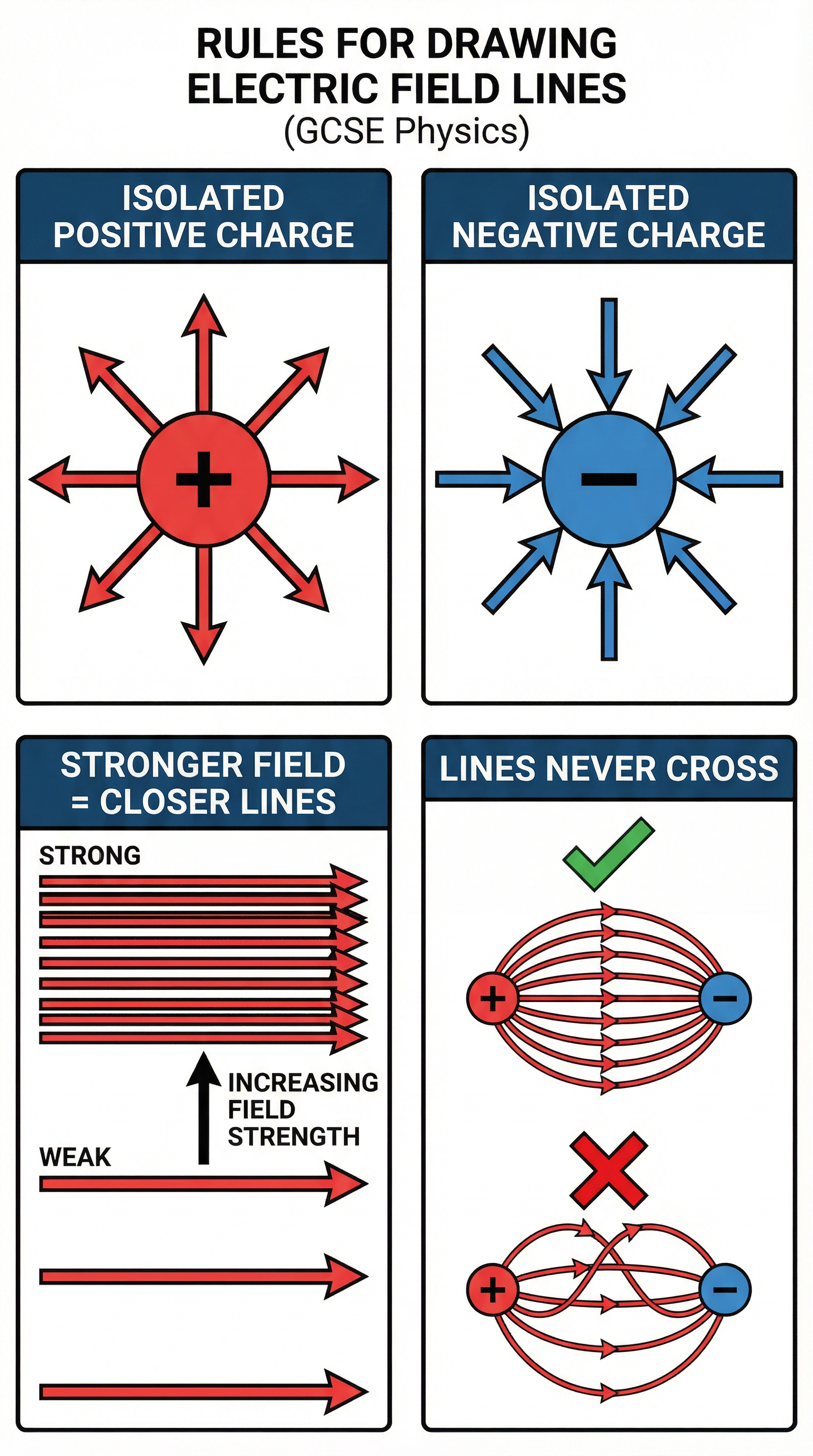
An electric field is defined as a region of space around a charged object where another charged object will experience an electrostatic force. We cannot see these fields, so we use a model called electric field lines (or lines of force) to represent them. These lines are not just random squiggles; they follow a strict set of rules that you must memorise and apply precisely in the exam.
The Golden Rules of Field Lines:
Rule 1 — Direction: Field lines always show the direction of the force on a positive test charge. Therefore, they always point away from positive charges and towards negative charges.
Rule 2 — Perpendicular Surface: The lines must start and end at the surface of the charged object, and they must leave or arrive perpendicular (at right angles) to that surface.
Rule 3 — No Crossing: Field lines can never, ever cross. If they did, it would imply a force acting in two different directions at the same point simultaneously, which is physically impossible.
Rule 4 — Density Equals Strength: The spacing of the field lines indicates the strength of the field. Where the lines are close together, the field is strong. Where they are far apart, the field is weak. This is the key piece of evidence you must cite when asked to describe field strength from a diagram.
Candidates are often asked to draw the field pattern for an isolated charge or between two charges. Marks are awarded for correctly applying these rules: arrows pointing the right way, lines touching the surface, and lines never crossing.
Concept 3: Sparking and Ionisation (Higher Tier Only)
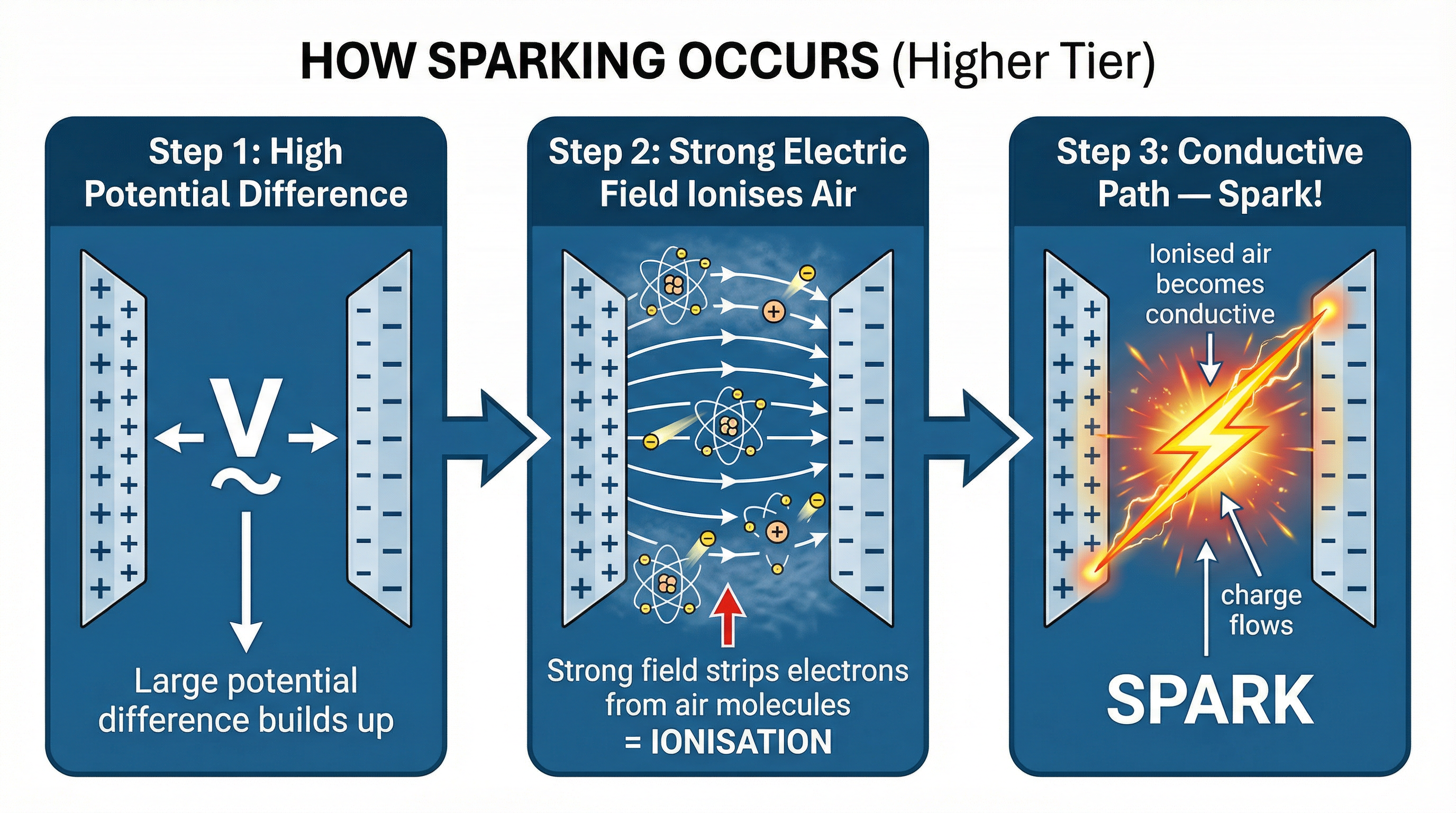
Sparking is a dramatic example of an electric field in action. It occurs when an electric field becomes so strong that it can make a normally insulating material, like air, behave like a conductor. Understanding this mechanism is essential for Higher Tier candidates.
A very large potential difference (voltage) between two points creates a very strong electric field in the space between them. This strong field exerts a powerful force on the electrons in the air molecules. If the field is strong enough, it can strip the outer electrons away from the air molecules. This process is called ionisation.
The air is now a mixture of positive ions (the molecules that lost electrons) and free negative electrons. This sea of charged particles is an excellent electrical conductor. A massive flow of charge can now surge through this conductive path, and we see this sudden discharge as a spark or, on a grander scale, a lightning bolt.
To earn full marks on a question about sparking, candidates must use the key terminology: potential difference, strong electric field, ionisation, and conductive path. These are the four pillars of a complete Higher Tier answer.
Mathematical and Scientific Relationships
At GCSE level, the treatment of electric fields is largely qualitative, meaning there are no complex formulas to memorise for calculating field strength. The key relationship is conceptual: field strength decreases as you move further from the charge. This is visually represented by the field lines spreading out and becoming less densely packed with increasing distance.
The one quantitative relationship you should be aware of is the definition of potential difference. Potential difference (V) is measured in Volts and represents the work done per unit charge. In the context of sparking, a large potential difference (high voltage) is the trigger for creating a strong enough field to ionise air. This formula is given on the OCR formula sheet: V = W/Q (Potential Difference = Work Done / Charge).
Practical Applications
Electric fields are not just an abstract concept; they have numerous real-world applications that make the physics tangible and memorable.
Photocopiers and laser printers use static electricity to attract powdered ink (toner) to a charged drum, which then transfers the pattern onto paper. Electrostatic precipitators are used in factory chimneys to clean emissions: smoke particles are given a charge and are then attracted to oppositely charged plates, removing them from the exhaust gases before they pollute the atmosphere. In car manufacturing, paint spraying exploits electric fields to ensure an even coat: the car body and paint droplets are given opposite charges, so the paint is actively attracted to the car body, even wrapping around edges and reducing waste. In medicine, a defibrillator uses a strong electric field to pass a current through a patient's heart to restore a normal rhythm.