Study Notes
Overview
Welcome to the definitive guide for OCR GCSE Physics Topic 5.1: Energy Stores. This topic forms the bedrock of your understanding of energy, a concept that weaves through nearly every other area of physics, from forces and motion to electricity and waves. In the exam, you will be assessed on your ability to precisely identify the eight distinct energy stores, describe how energy is transferred between them using one of the four pathways, and apply mathematical formulae to calculate changes in kinetic and gravitational potential energy. Examiners are looking for candidates who can think like a physicist, analysing the world in terms of 'systems' and the energy they contain. A common question style involves presenting a real-world scenario (like a falling object, a boiling kettle, or a moving vehicle) and asking you to provide a step-by-step description of the energy transformations occurring. Mastering the specific vocabulary and sentence structures outlined in this guide is not just helpful—it is essential for achieving full marks.
Key Concepts
Concept 1: The 'Systems' Approach
In OCR Physics, a system is defined as an object or a group of objects. When we talk about energy, we are talking about the energy stored within a system or transferred between systems. This is a crucial starting point. Instead of vaguely saying 'a car has energy', a physicist says 'the moving car is a system, and it has energy in its kinetic store'.
Example: A swinging pendulum. The system is the pendulum bob and the Earth. At the top of its swing, energy is primarily in the gravitational potential store. As it swings downwards, energy is transferred to the kinetic store. At the bottom, the kinetic store is at its maximum. This constant transfer happens within the defined system.
Concept 2: The Eight Energy Stores
Candidates must be able to name and identify all eight energy stores. Credit is awarded for using the precise terminology.
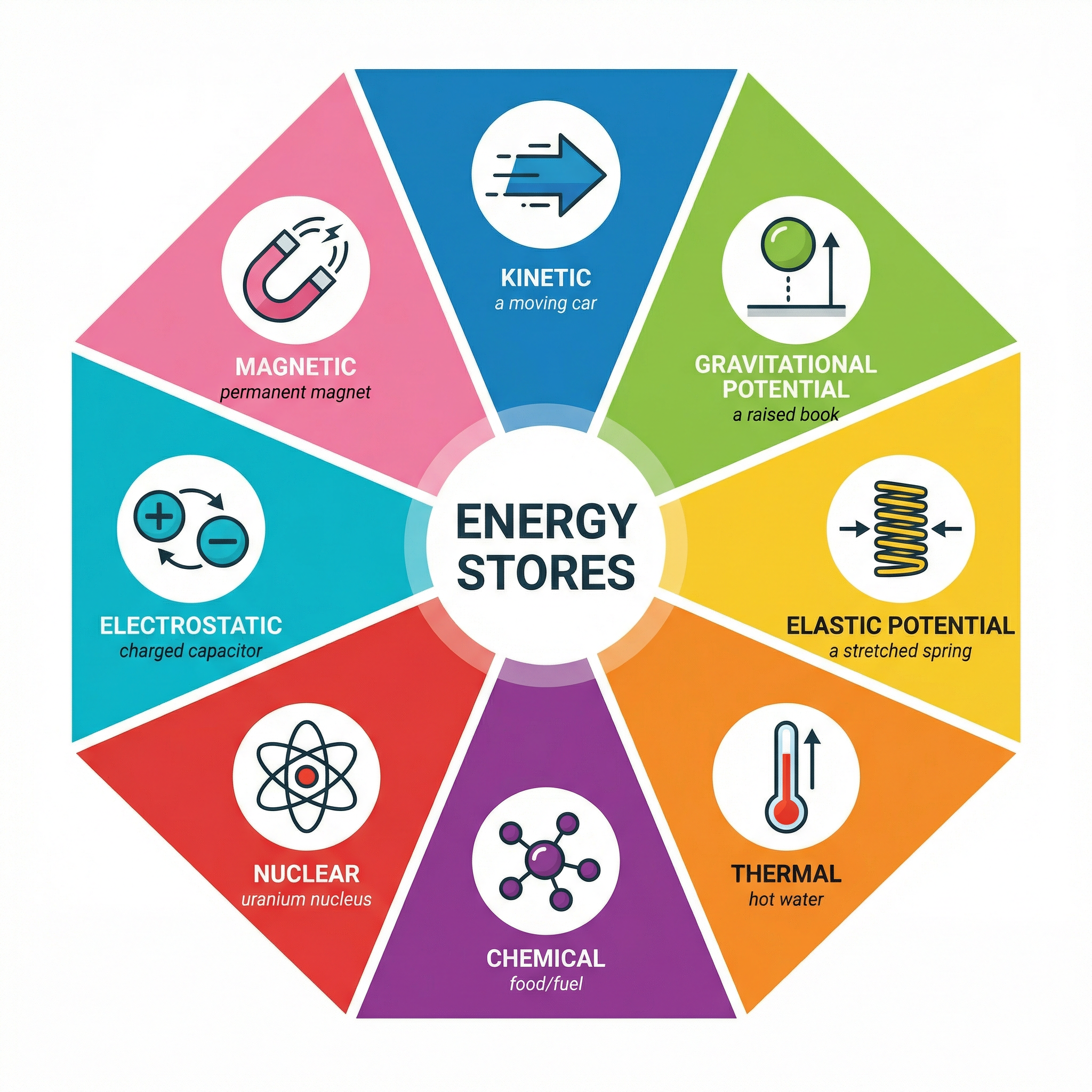
- Kinetic Store (Ek): Energy stored in a moving object. The faster an object moves or the greater its mass, the more energy is in its kinetic store.
- Gravitational Potential Store (Ep): Energy stored in an object due to its position in a gravitational field. The higher it is, the more GPE it has.
- Elastic Potential Store (Ee): Energy stored when an object is stretched or compressed (e.g., a spring, a rubber band).
- Thermal Store: Energy stored due to the temperature of an object, related to the kinetic energy of its particles.
- Chemical Store: Energy stored in the bonds between atoms, released during chemical reactions (e.g., in food, fuel, batteries).
- Nuclear Store: Energy stored in the nucleus of an atom, released during nuclear reactions (fission or fusion).
- Electrostatic Store: Energy stored when electric charges are separated (e.g., in a capacitor, or a thundercloud).
- Magnetic Store: Energy stored in a magnetic field (e.g., around a magnet or an electromagnet).
Concept 3: The Four Energy Transfer Pathways
Energy moves from one store to another via one of four pathways. You must be able to name these and apply them correctly.
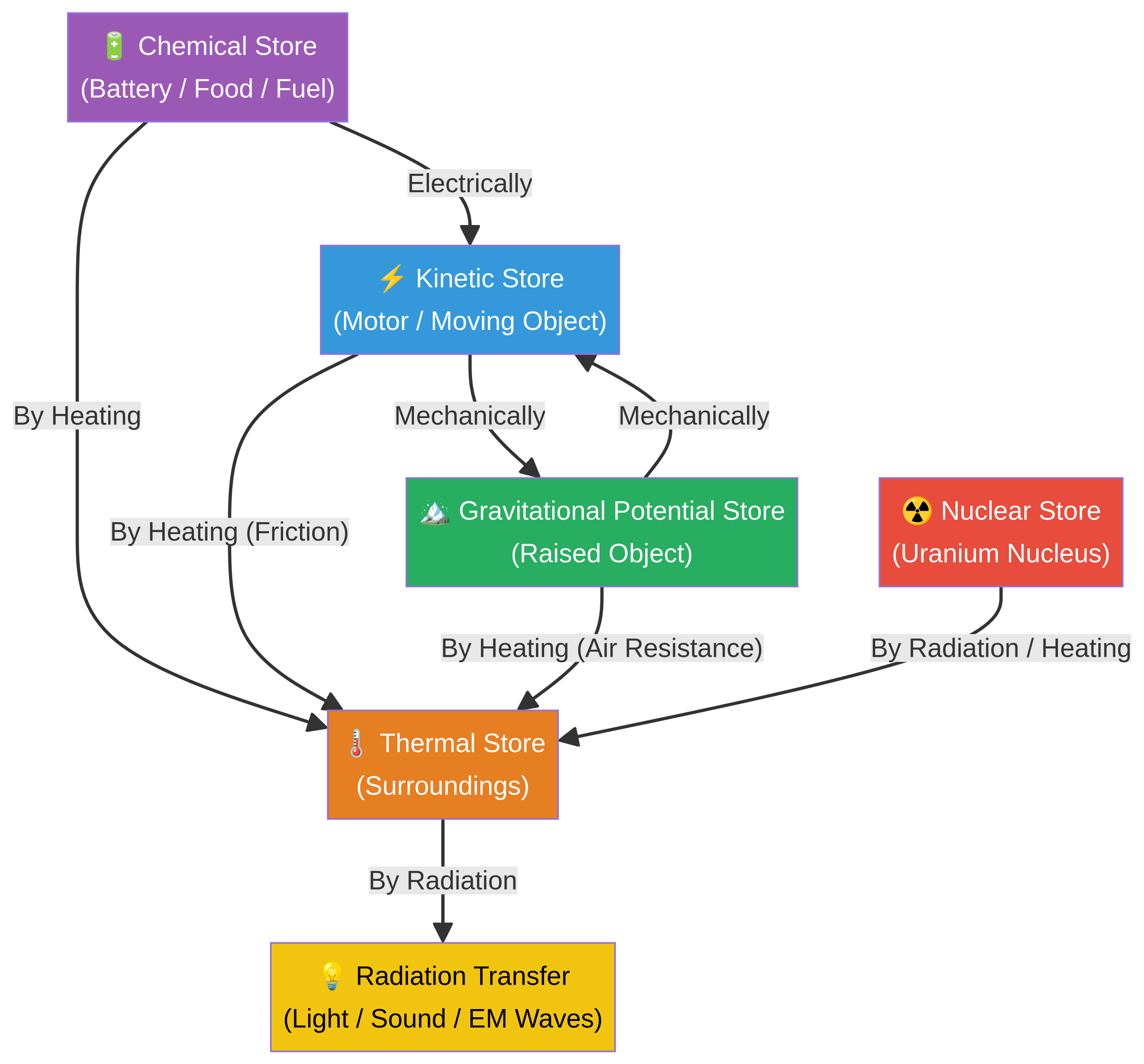
- Mechanical Transfer: When a force does work and moves an object (e.g., pushing a box, lifting a weight).
- Electrical Transfer: When charge moves through a potential difference (i.e., in an electrical circuit).
- Heating: Energy transfer from a hotter object to a cooler object.
- Radiation: Energy transferred as a wave, such as light, infrared, or sound (e.g., the sun heating the Earth).
Concept 4: The Law of Conservation of Energy
This is one of the most important laws in all of physics. It states that energy can never be created or destroyed, only transferred from one store to another. In a 'closed system' (one where no energy can enter or leave), the total amount of energy is constant. This principle is the key to solving many higher-level problems.
Concept 5: Dissipation and 'Wasted' Energy
In real-world systems, energy transfers are rarely 100% efficient. Some energy is always transferred to a less useful store. This is called dissipation. Crucially, this energy is NOT 'lost' or 'used up'. The correct OCR-approved phrase is that the energy is 'transferred to the thermal store of the surroundings'. For example, when a light bulb is on, some energy is usefully transferred by radiation as light, but much is also dissipated, transferred by heating to the thermal store of the bulb and the air around it.
Mathematical/Scientific Relationships
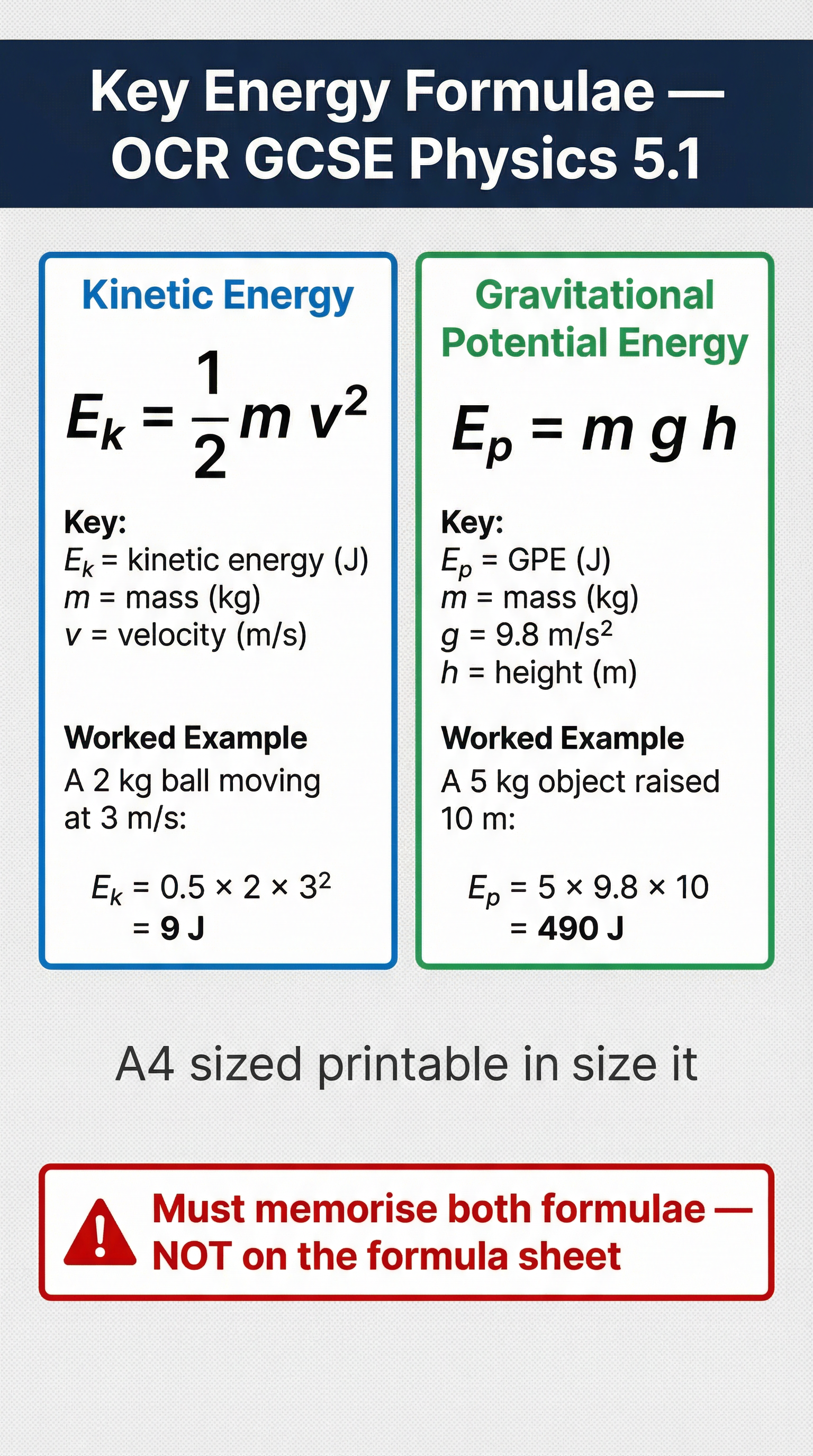
There are two key formulae for this topic that you must memorise. They are not provided on the OCR formula sheet.
-
Kinetic Energy (Ek)
- Formula: Ek = ½ × m × v²
- Ek: Kinetic Energy, measured in Joules (J)
- m: mass, measured in kilograms (kg)
- v: velocity (or speed), measured in metres per second (m/s)
- Key Point: Notice the velocity is squared (v²). This means velocity has a much bigger impact on kinetic energy than mass does. Doubling the mass doubles the Ek, but doubling the velocity quadruples the Ek.
-
Gravitational Potential Energy (Ep)
- Formula: Ep = m × g × h
- Ep: Gravitational Potential Energy, measured in Joules (J)
- m: mass, measured in kilograms (kg)
- g: gravitational field strength, measured in Newtons per kilogram (N/kg). On Earth, this is approximately 9.8 N/kg.
- h: height, measured in metres (m)
Higher Tier Link: GPE lost = KE gainedFor a falling object where air resistance is negligible, the energy from the gravitational potential store is transferred to the kinetic store. This allows us to equate the two formulae:
m × g × h = ½ × m × v²
Notice that mass (m) is on both sides, so it can be cancelled out. This shows that the final speed of a falling object (without air resistance) does not depend on its mass!
Practical Applications
- Roller Coasters: A classic example of GPE being converted to KE at the bottom of a drop, and back to GPE as it goes up the next hill. The initial GPE at the top of the first lift hill determines the maximum possible KE (and therefore speed) of the ride.
- Vehicle Safety: Car crumple zones are designed to increase the time taken for a car to stop in a crash. This reduces the rate of energy transfer from the car's kinetic store, lowering the forces involved and protecting the occupants.
- Power Generation: In a hydroelectric power station, the GPE of water stored in a high reservoir is converted to KE as it flows down pipes. This KE is then used to turn turbines (a mechanical transfer), which turn generators to produce an electrical transfer.
- Bungee Jumping: A perfect example of interplay between GPE, KE, and Elastic Potential Energy. As the jumper falls, GPE is converted to KE. As the bungee cord starts to stretch, KE is converted to Elastic Potential Energy in the cord.