Study Notes
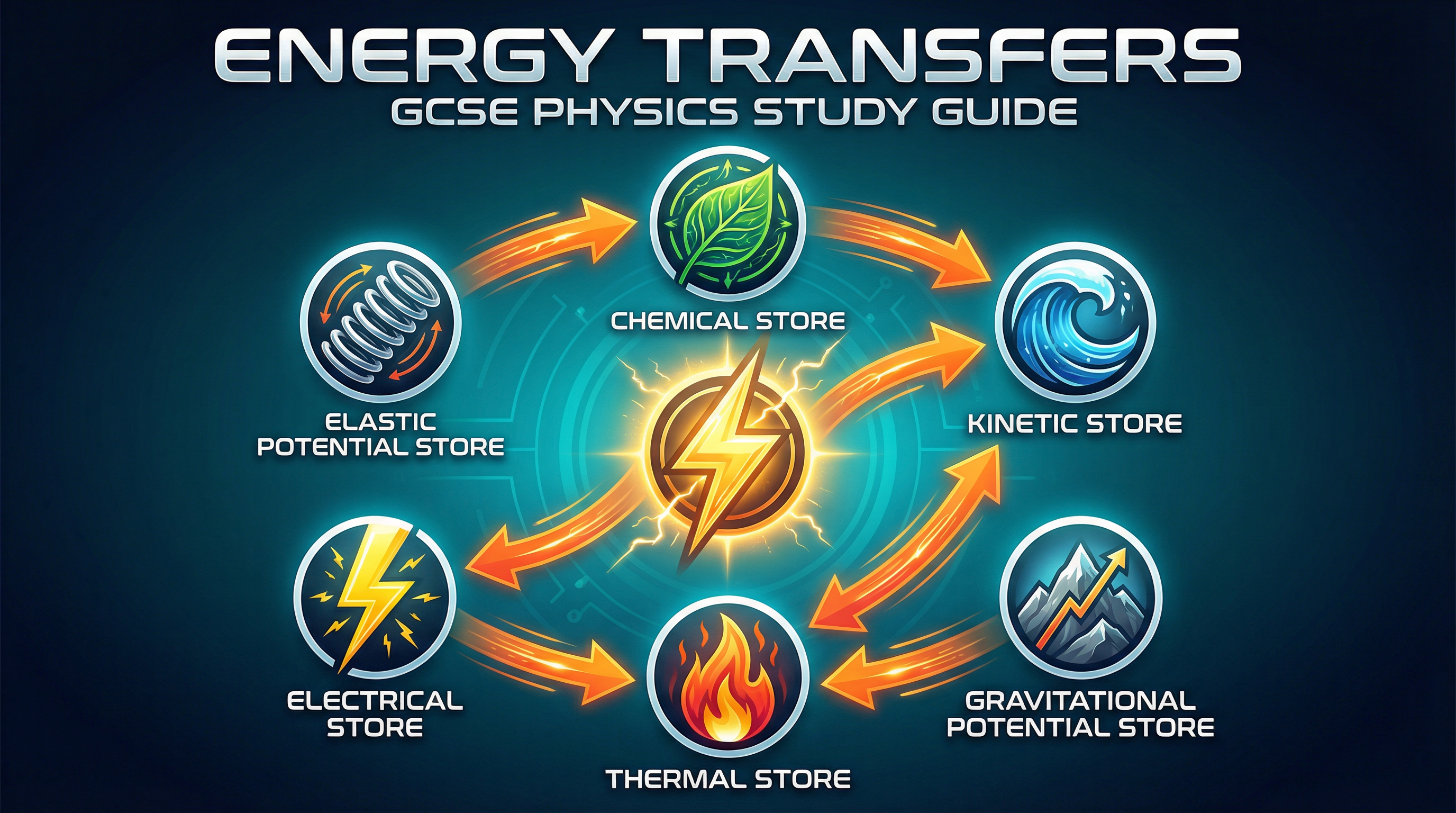
Overview
Welcome to the definitive guide for OCR GCSE Physics topic 5.2: Energy Transfers. This fundamental concept underpins almost every area of physics, making it a critical topic to master for exam success. In this guide, we will explore the core principle that energy is never created or destroyed, only transferred from one store to another. You will become fluent in the 'stores and pathways' model used by examiners, learning to precisely describe energy shifts in various scenarios. We will delve into the quantitative side, tackling the key equations for Power, Efficiency, and the different energy stores. A significant focus will be placed on thermal energy, exploring how conduction, convection, and radiation are managed in practical applications like home insulation. Examiners frequently test this topic using a mix of short-answer calculations and longer, 6-mark 'Level of Response' questions that require structured, detailed explanations. By mastering the content and exam technique in this guide, you will be well-equipped to confidently answer any question on Energy Transfers.
Key Concepts
The Principle of Conservation of Energy
This is the single most important rule in this topic: Energy cannot be created or destroyed, only transferred from one store to another. In any process, the total amount of energy in a closed system remains constant. A closed system is defined as a system where no energy can enter or leave. When you analyse an energy transfer, the total energy you start with must equal the total energy you end with, even if it has moved between different stores or been dissipated to the surroundings. Forgetting this principle is a major source of lost marks.
Energy Stores
Think of energy stores as different 'accounts' where energy can be held. You must be able to name and describe the eight key energy stores:
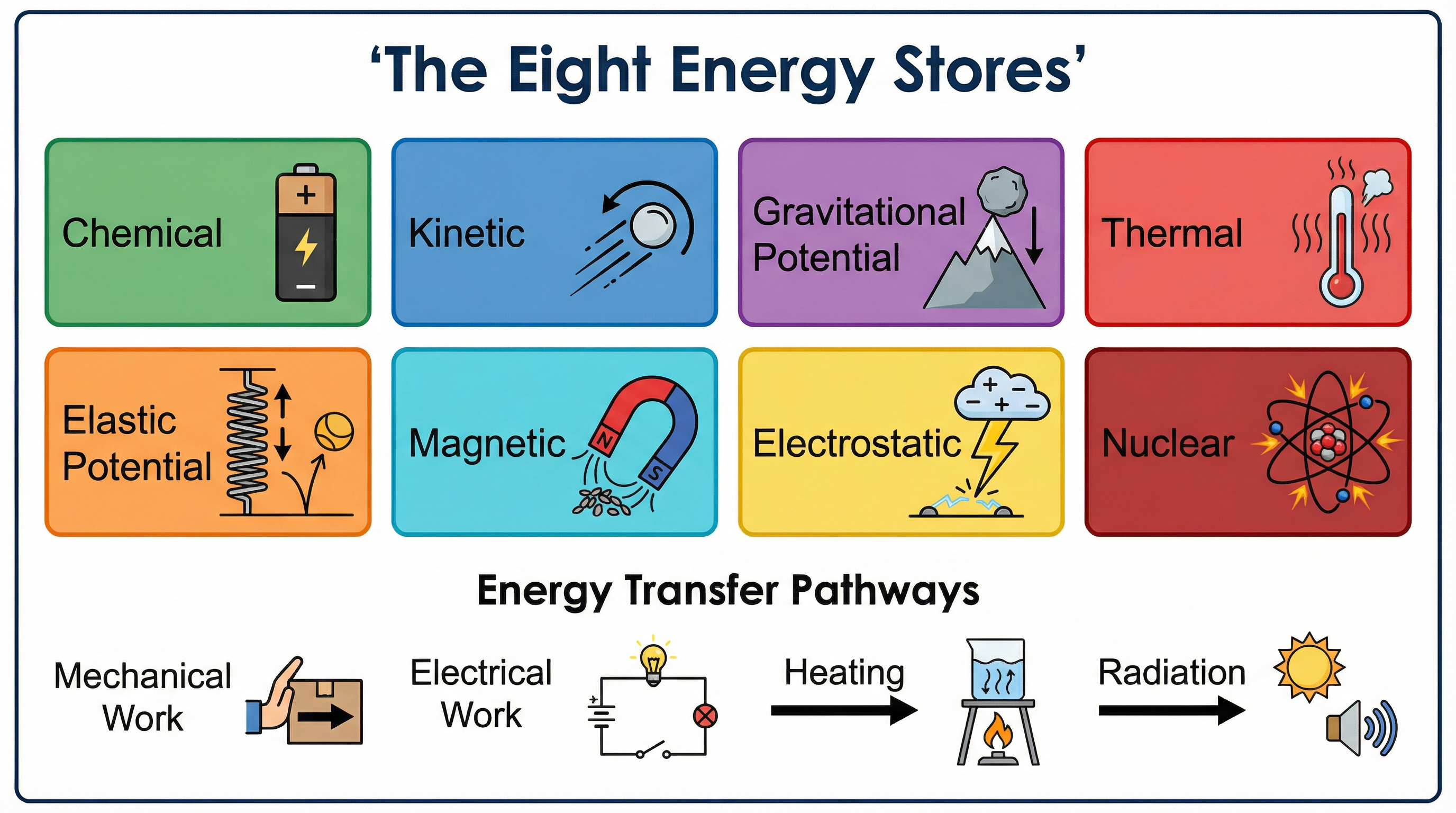
- Chemical Store: Energy stored in the bonds between atoms. Found in food, fuels (like petrol and gas), and batteries.
- Kinetic Store: The energy of a moving object. The faster an object moves and the greater its mass, the more energy is in its kinetic store.
- Gravitational Potential Store (GPE): Energy an object has due to its position in a gravitational field. The higher it is, the more GPE it has.
- Elastic Potential Store: Energy stored when an object is stretched or compressed. Examples include a stretched elastic band or a compressed spring.
- Thermal Store: The total kinetic and potential energy of the particles within an object. The hotter an object is, the more energy is in its thermal store.
- Magnetic Store: Energy stored when repelling poles have been pushed closer together or attracting poles have been pulled further apart.
- Electrostatic Store: Energy stored when repelling charges have been moved closer together or attracting charges have been pulled further apart.
- Nuclear Store: Energy stored in the nucleus of an atom, released during nuclear reactions.
Energy Transfer Pathways
Energy moves from one store to another via one of four pathways:
- Mechanical Work: A force moving an object through a distance (e.g., pushing a box transfers energy from your chemical store to the box's kinetic store).
- Electrical Work: Charges moving due to a potential difference (e.g., a current flowing in a circuit).
- Heating: Energy transferred from a hotter object to a colder object (via conduction, convection, or radiation).
- Radiation: Energy transferred as a wave, such as light or sound (e.g., the Sun heating the Earth).
Wasted and Useful Energy (Dissipation)
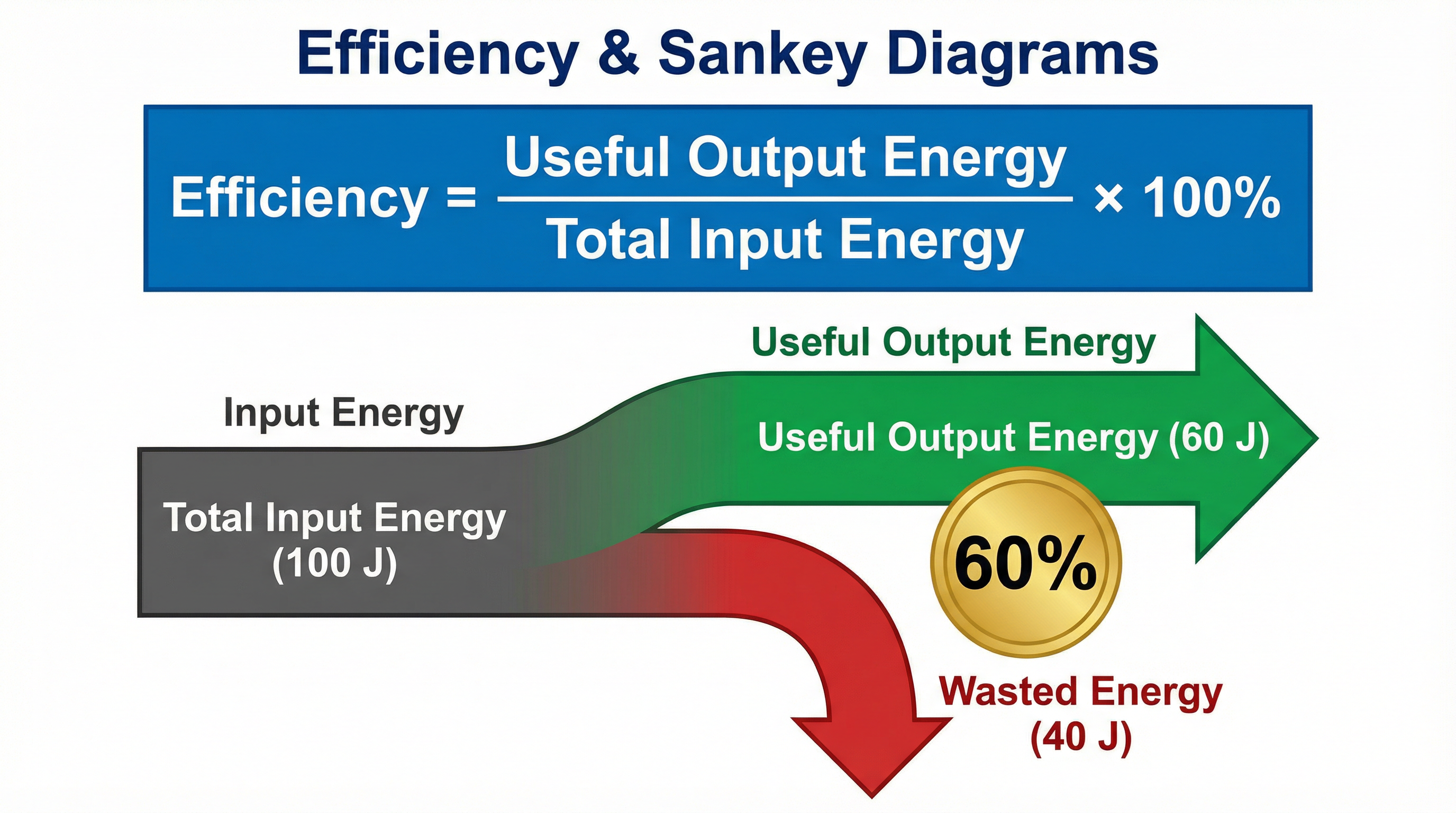
In most energy transfers, not all the energy goes where you want it to. The energy that is transferred to the intended store for the desired purpose is useful energy. The rest is often described as wasted energy. This 'wasted' energy is not destroyed; it is dissipated, meaning it spreads out into the surroundings, increasing the thermal store of the environment. For example, in a light bulb, the useful transfer is to light, but a lot of energy is dissipated as heat to the air. This dissipated energy is no longer easy to use for a specific purpose.
Mathematical/Scientific Relationships
Credit is always given for showing your working, including writing the formula, substituting values, and giving the correct units.
| Formula | Symbol Equation | Units | Status on Formula Sheet | Notes |
|---|---|---|---|---|
| Efficiency | - | % or decimal | Must memorise | Efficiency = (Useful output / Total input) x 100%. Can also be calculated using power. |
| Power | P = E / t | Power (W), Energy (J), Time (s) | Given | Power is the rate of energy transfer. Remember to convert time to seconds. |
| Kinetic Energy | Ek = ½mv² | Energy (J), Mass (kg), Speed (m/s) | Given | The kinetic energy store depends on mass and the square of the speed. |
| Gravitational Potential Energy | Ep = mgh | Energy (J), Mass (kg), g (N/kg), Height (m) | Given | The GPE store depends on mass, height, and gravitational field strength (g = 9.8 N/kg on Earth). |
| Elastic Potential Energy | Ee = ½ke² | Energy (J), k (N/m), e (m) | Given | The elastic potential store depends on the spring constant (k) and the square of the extension (e). |
Practical Applications
Energy Transfers in the Home: Insulation
Reducing unwanted energy transfers is a key application of this topic, particularly in the context of home insulation. The goal is to reduce the rate of energy transfer from the warm thermal store of the house to the cooler thermal store of the surroundings. This is achieved by tackling conduction, convection, and radiation.
- Loft Insulation: Thick layers of fibreglass wool are laid in the loft. The wool traps pockets of air. Air is a poor conductor (an insulator), so this reduces energy transfer by conduction. By preventing the air from moving, it also stops convection currents from forming, further reducing heat loss through the roof.
- Cavity Wall Insulation: Most modern houses have a gap (a cavity) between the inner and outer walls. This gap is filled with foam or insulating beads. This works just like loft insulation: it traps air to reduce both conduction and convection.
- Double Glazing: Two panes of glass with a vacuum or a noble gas (like Argon) trapped between them. The vacuum prevents any transfer by conduction or convection. The gas is a much poorer conductor than glass, so it significantly reduces the rate of energy transfer.
- Draught-Proofing: Strips of foam and plastic around doors and windows stop cold air from entering and warm air from leaving, preventing energy transfer via convection currents.
Required Practical: Investigating Thermal Insulators
OCR may ask questions about an experiment to compare the effectiveness of different thermal insulators.
- Apparatus: Several identical beakers, a kettle, a thermometer, a stopwatch, insulating materials (e.g., bubble wrap, cotton wool, foil), a top-pan balance.
- Method:
- Wrap each beaker in a different insulating material. Leave one beaker unwrapped as a control.
- Use the kettle to boil water. Carefully measure an equal volume of hot water into each beaker (e.g., 200 ml).
- Measure the starting temperature of the water in each beaker. It should be the same for all.
- Start the stopwatch. Record the temperature of the water in each beaker every 2 minutes for a total of 20 minutes.
- Results: The beaker that shows the smallest temperature drop over the 20 minutes is the one with the most effective insulator.
- Common Errors: Not using the same volume of water, not using the same starting temperature, not using beakers of the same size and material. These are control variables that must be kept constant for a fair test.
Podcast Study Session
For an in-depth audio walkthrough of this topic, including exam tips and a quick-fire quiz, listen to our dedicated podcast episode.