Study Notes
Overview
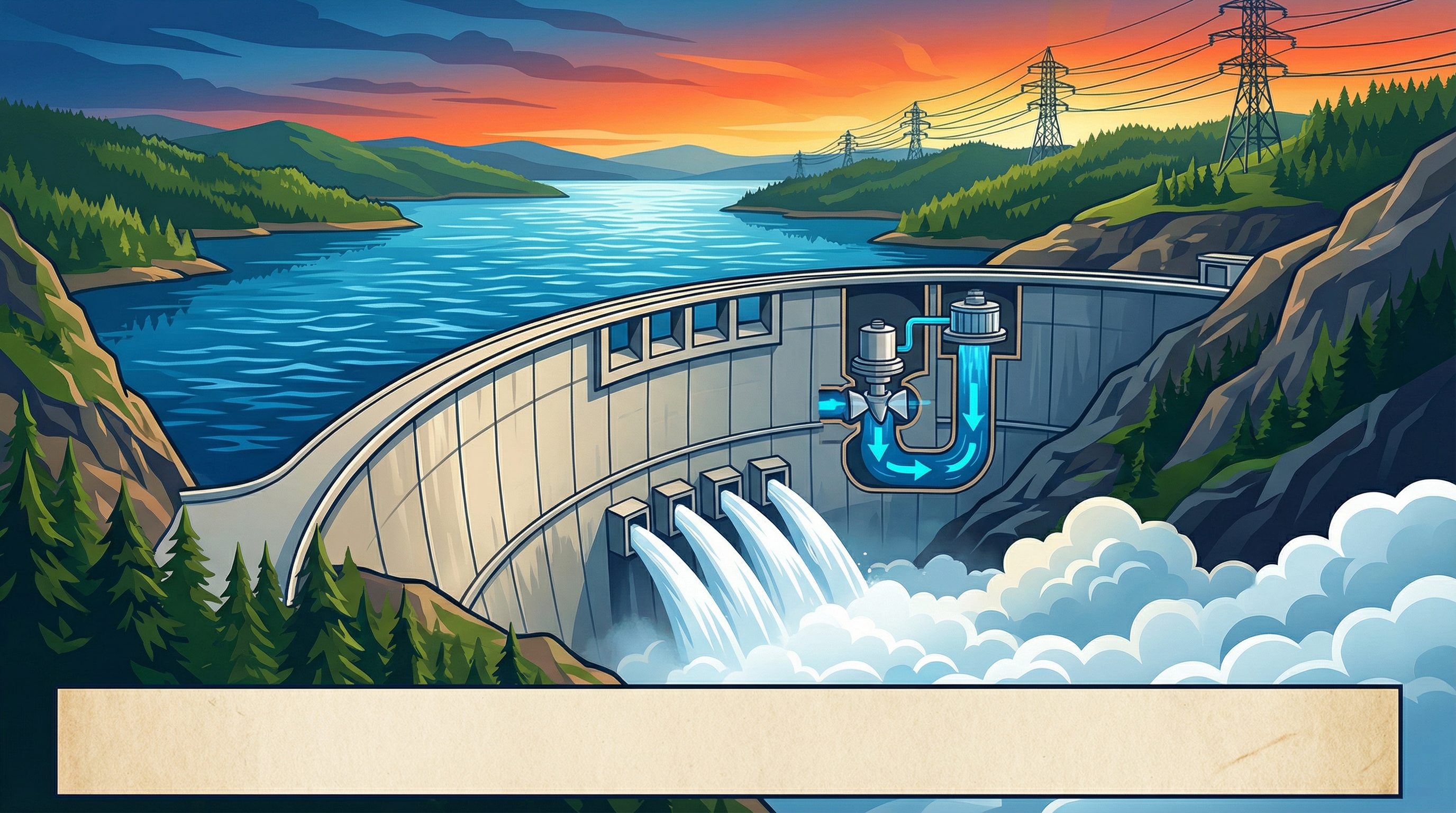
Hydroelectric power is a cornerstone of renewable energy generation and a recurring topic in OCR GCSE Physics exams. This guide will deconstruct the core principles, from the fundamental energy transfers that convert the potential energy of stored water into electricity, to the calculations required to quantify this process. We will explore the strategic importance of pumped storage systems in balancing the National Grid and evaluate the significant environmental and economic factors involved. A firm grasp of this topic is crucial, as it frequently appears in structured questions requiring both descriptive explanations and mathematical problem-solving, linking directly to broader concepts of energy, power, and efficiency.
Key Concepts
Concept 1: The Energy Transfer Pathway
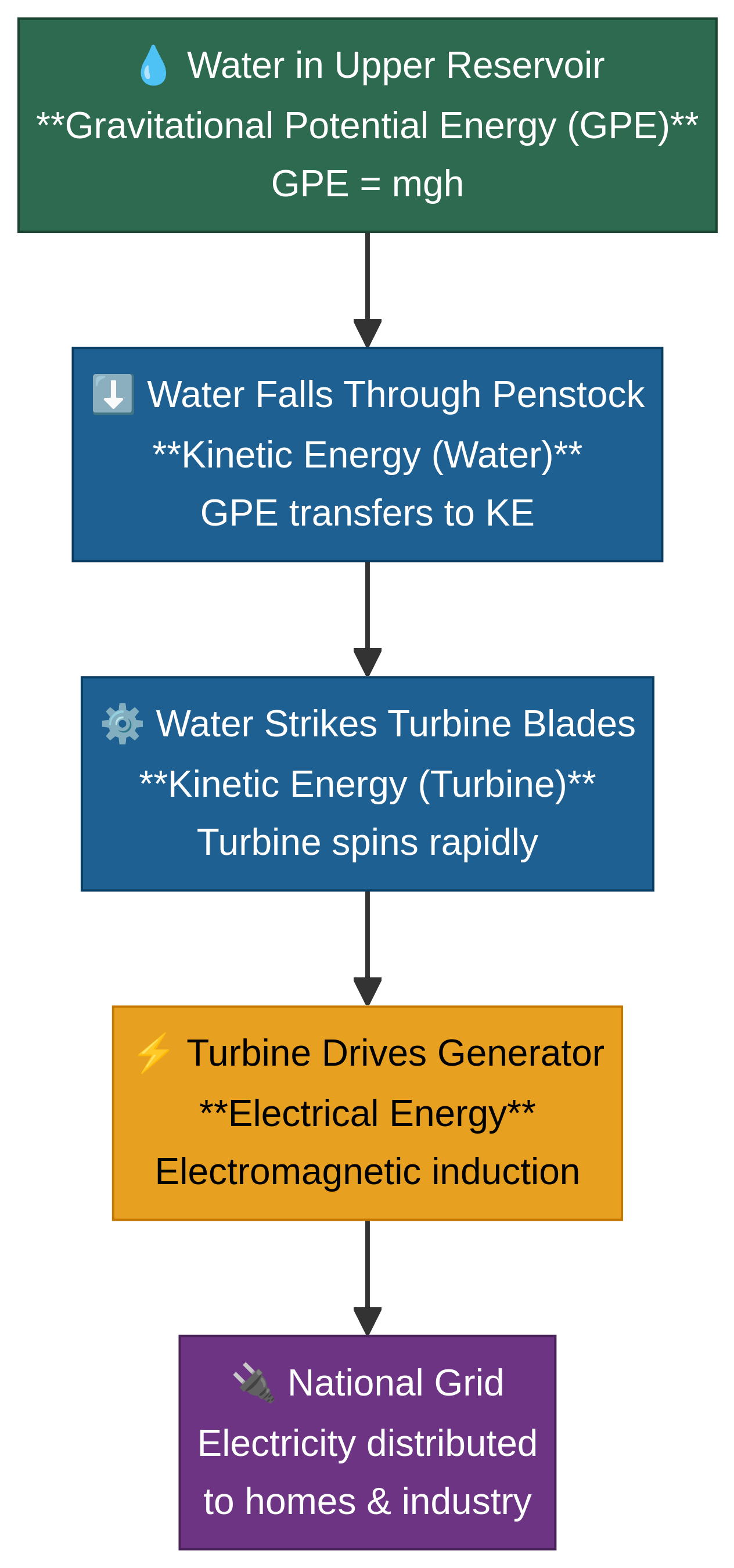
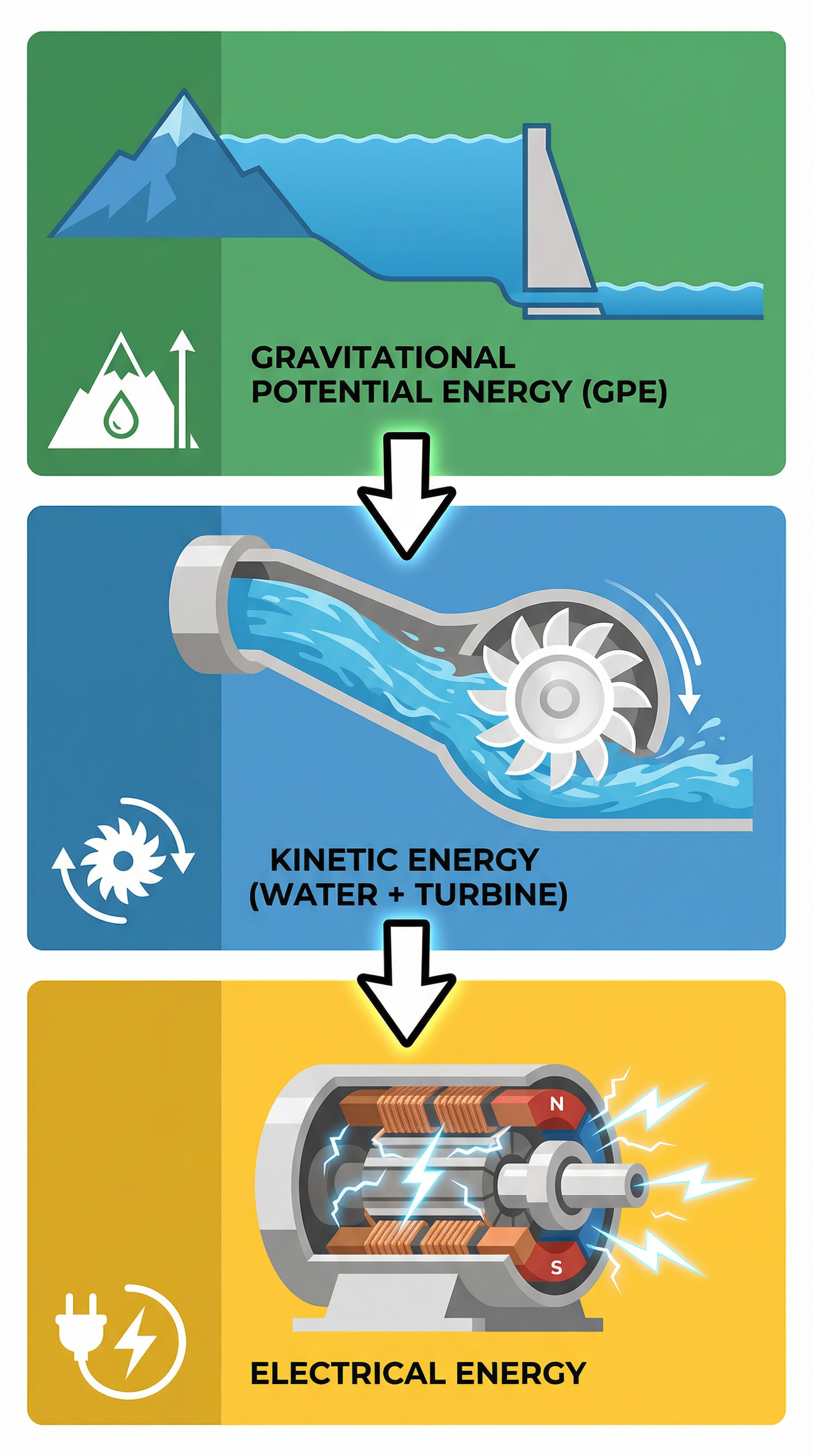
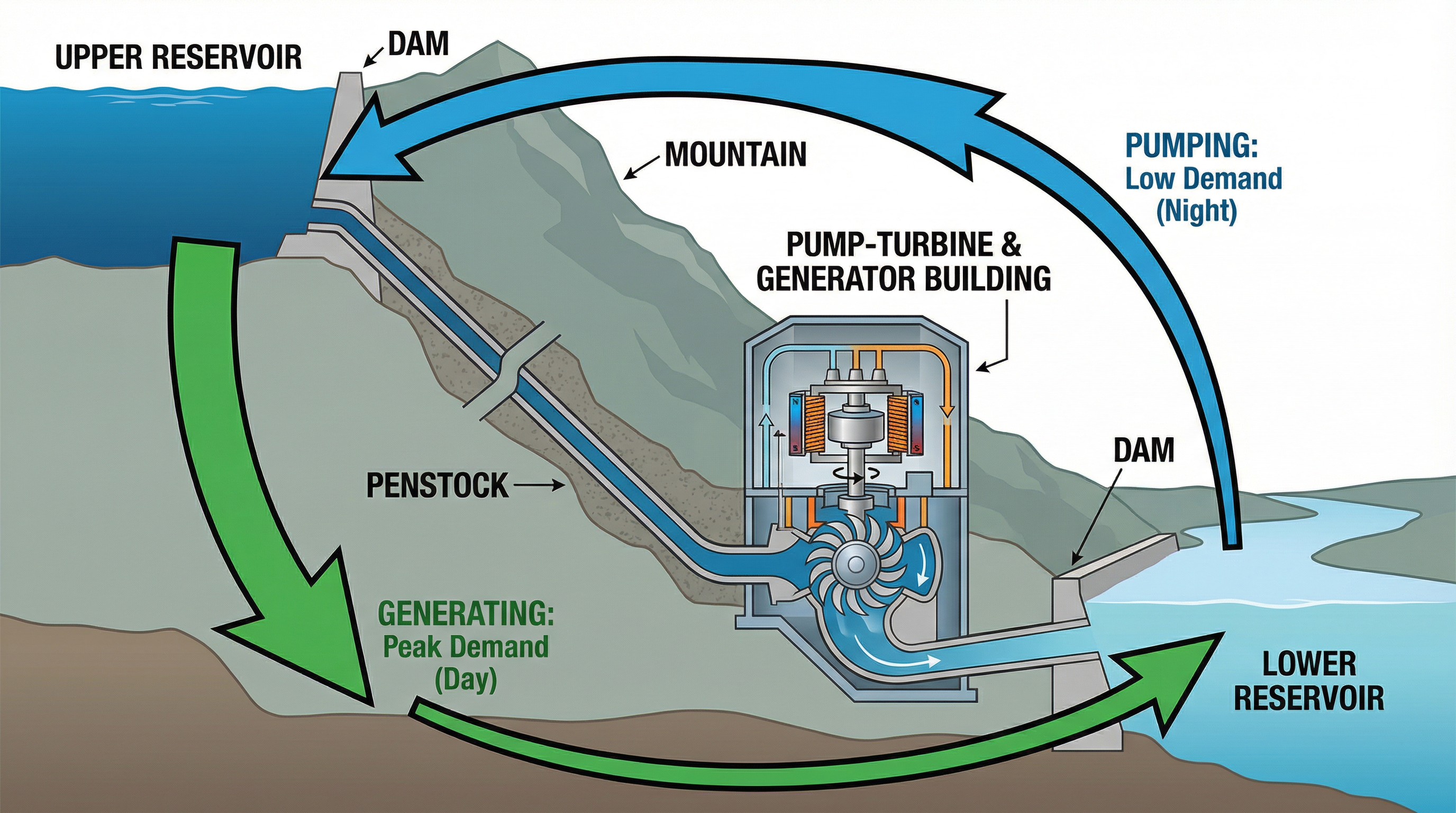
The entire process of hydroelectric generation is an application of the principle of conservation of energy, where energy is transferred from one store to another. Examiners award significant credit for a precise description of this pathway. It begins with the water held in a high-level reservoir. Due to its height (h) and mass (m), this water possesses a large store of Gravitational Potential Energy (GPE). When the sluice gates of the dam are opened, this water flows downwards through large pipes called penstocks. As it loses height, its GPE is transferred into Kinetic Energy (KE) – the energy of motion. This rapidly moving water then strikes the blades of a turbine, causing it to spin at high speed. It is critical to note that this is a further energy transfer: the kinetic energy of the water is transferred to the Kinetic Energy of the turbine. Finally, the spinning turbine is coupled to a generator. Inside the generator, the rotational kinetic energy is used to turn a coil of wire inside a magnetic field, which induces an electric current. This is the final transfer to Electrical Energy, which is then stepped up in voltage and transmitted to the National Grid.
Concept 2: Pumped Storage Hydroelectricity
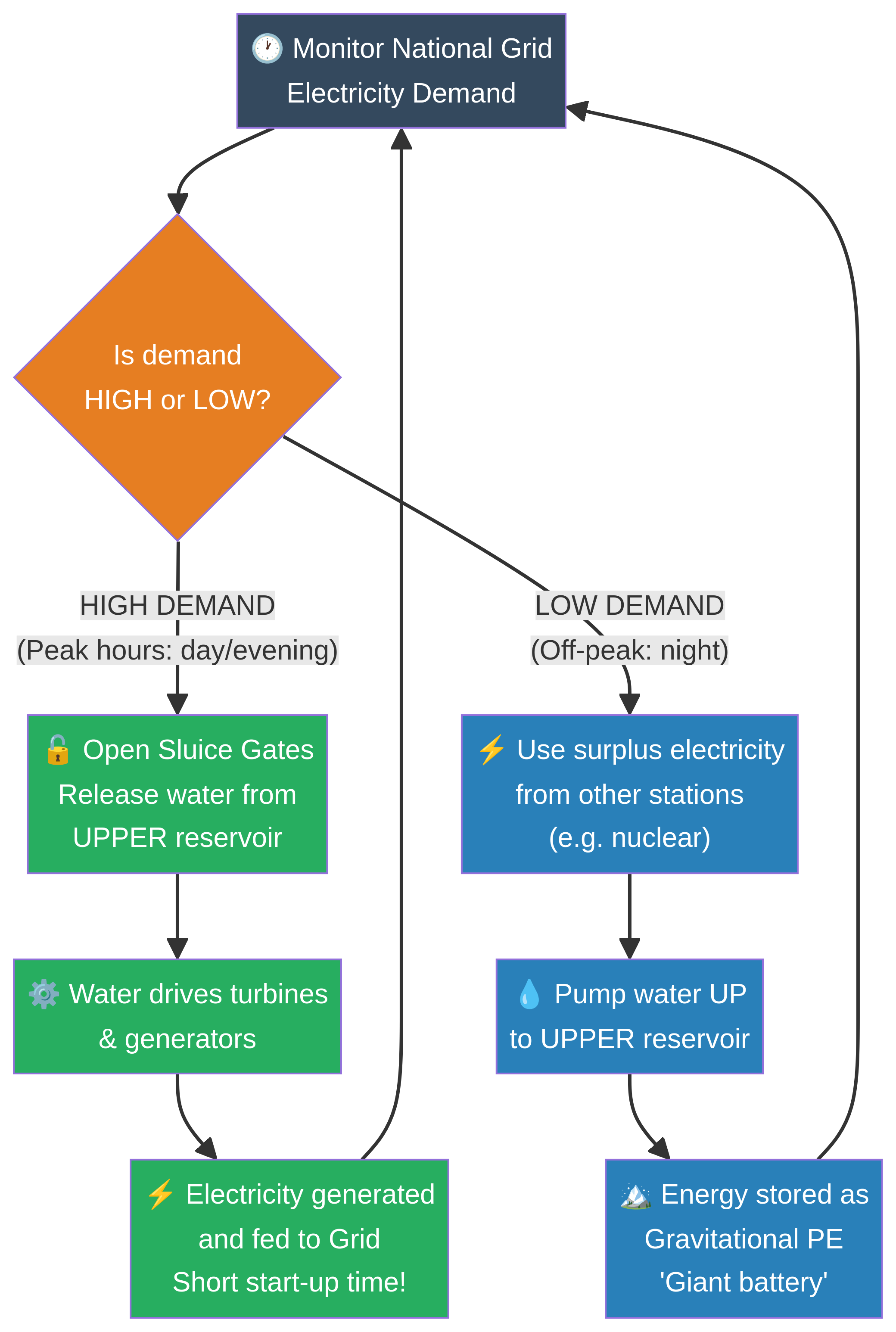
Pumped storage is a specialised form of hydroelectricity designed to manage fluctuations in national electricity demand. It acts like a giant, rechargeable battery for the grid. The system consists of two reservoirs, one at a high altitude and one at a low altitude. During periods of low electricity demand (typically at night), when there is a surplus of power from other stations (like nuclear or wind) that are difficult to switch off, the system uses this cheap, excess electricity to pump water from the lower reservoir up to the higher reservoir. This process transfers electrical energy back into a store of gravitational potential energy. Then, during periods of high electricity demand (e.g., during evening peaks), the water is released from the upper reservoir to flow back down through the turbines, generating electricity very quickly to meet the surge in demand. This ability to start generating power in seconds – known as a short start-up time – is a key advantage, making pumped storage vital for grid stability.
Concept 3: Environmental and Economic Evaluation
Candidates are often required to evaluate the use of hydroelectric power, which means considering both the advantages and disadvantages. Economically, the main drawback is the extremely high initial capital cost required to build the dam, reservoirs, and power station. However, once built, the running costs are very low because there are no fuel costs – the water is free. Environmentally, hydroelectric power is a clean, renewable source that produces no greenhouse gases during operation. However, the construction of a dam has significant negative impacts. It involves flooding vast areas of land, which destroys natural habitats and can displace entire communities. The rotting of submerged vegetation can also release large quantities of methane, a potent greenhouse gas. Furthermore, the dam itself acts as a barrier, disrupting fish migration patterns and the natural flow of the river ecosystem.
Mathematical/Scientific Relationships
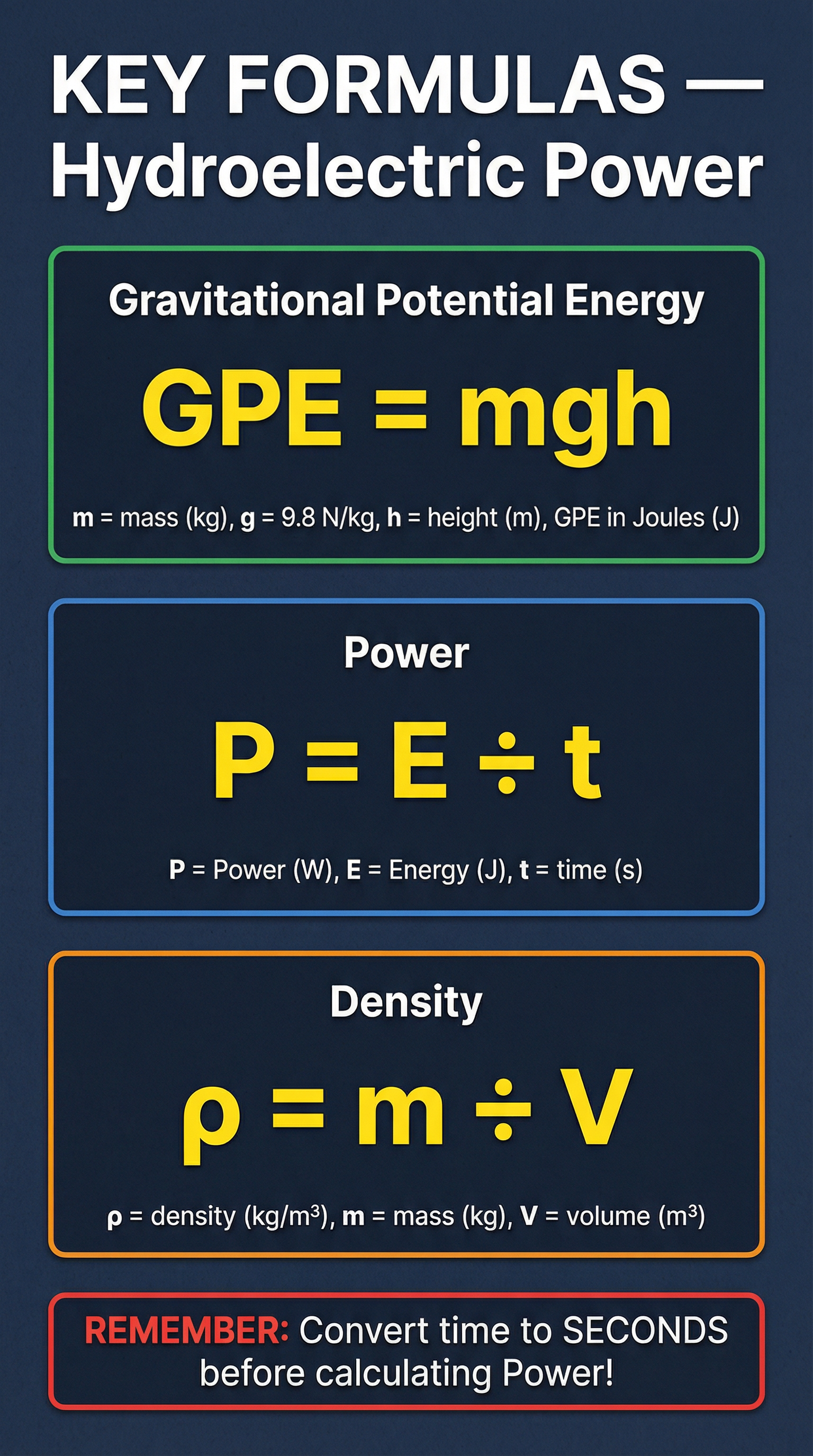
Candidates must be confident in using three key formulas for this topic. These are essential for calculation questions, which form a significant part of the assessment.
-
Gravitational Potential Energy (GPE): This is the energy stored in the water due to its height.
- Formula:
GPE = m × g × h - Symbols:
GPE= Gravitational Potential Energy (in Joules, J)m= mass of the water (in kilograms, kg)g= gravitational field strength (on Earth, this is 9.8 N/kg)h= vertical height difference (in metres, m)
- Status: Given on the formula sheet.
- Formula:
-
Power (P): This is the rate at which energy is transferred.
- Formula:
P = E / t - Symbols:
P= Power (in Watts, W)E= Energy transferred (in Joules, J) – in this context, this is the GPE.t= time taken (in seconds, s)
- Status: Must memorise.
- Formula:
-
Density (ρ): This formula is needed if the question provides the volume of water instead of its mass.
- Formula:
ρ = m / V(often rearranged tom = ρ × V) - Symbols:
ρ= density (for water, this is 1000 kg/m³)m= mass (in kilograms, kg)V= volume (in cubic metres, m³)
- Status: Must memorise.
- Formula:
Practical Applications
While there isn't a specific required practical for hydroelectric power, the principles are applied in large-scale civil engineering projects across the world. The Dinorwig Power Station in Snowdonia, Wales, is a classic example of a pumped storage system, often cited in textbooks. It can provide a massive 1.7 GW of power to the grid in just 16 seconds, demonstrating the rapid response capability that is so valuable for balancing energy supply and demand. Understanding how these real-world systems operate provides excellent context for answering AO3 (application of knowledge) style exam questions.