Internal energy

    OCR
    GCSE
    Physics

    This guide provides a comprehensive, exam-focused breakdown of Internal Energy for OCR GCSE Physics (6.3). It covers the core concepts of kinetic and potential energy stores, changes of state, and the crucial calculations for specific heat capacity and specific latent heat, ensuring you have the knowledge to secure top marks.

    6
    Min Read
    3
    Examples
    5
    Questions
    6
    Key Terms
    🎙 Podcast Episode
    Internal energy
    13:38
    0:00-13:38

    Study Notes

    Header image for OCR GCSE Physics: Internal Energy (6.3)

    Overview

    Internal energy is a fundamental concept in thermodynamics and the particle model of matter. For your OCR GCSE Physics exam, it is defined with mark-winning precision as the total kinetic and potential energy of all the particles that make up a system. Understanding this topic is crucial as it forms the bedrock for explaining how energy transfer affects substances, leading to either a temperature change or a change of state. Examiners frequently test this through multi-step calculations and graph interpretation, so a solid grasp is essential for success. This guide will break down the two key energy stores, explain the mathematical relationships you need, and show you how to apply them to exam-style questions, connecting directly to the assessment objectives (AO1, AO2, and AO3) to maximise your marks.

    Internal Energy Revision Podcast

    Key Concepts

    Concept 1: Internal Energy as Kinetic + Potential Energy

    At the heart of this topic is the core definition. Internal energy isn’t just about how hot something is; it’s the sum of two distinct energy stores within the particles of a substance.

    • Kinetic Energy Store: This is the energy particles have due to their random motion. In solids, this is vibrational energy. In liquids and gases, it includes translational (moving from place to place) and rotational energy. Temperature is a measure of the average kinetic energy of the particles. When you heat a substance and its temperature rises, you are increasing the kinetic energy store of its particles.

    • Potential Energy Store: This is the energy stored due to the forces between particles (intermolecular forces). It relates to the particles' positions relative to each other. To change a substance's state (e.g., melting a solid to a liquid), you must overcome these forces and move the particles further apart. This requires energy, which is transferred to the potential energy store.
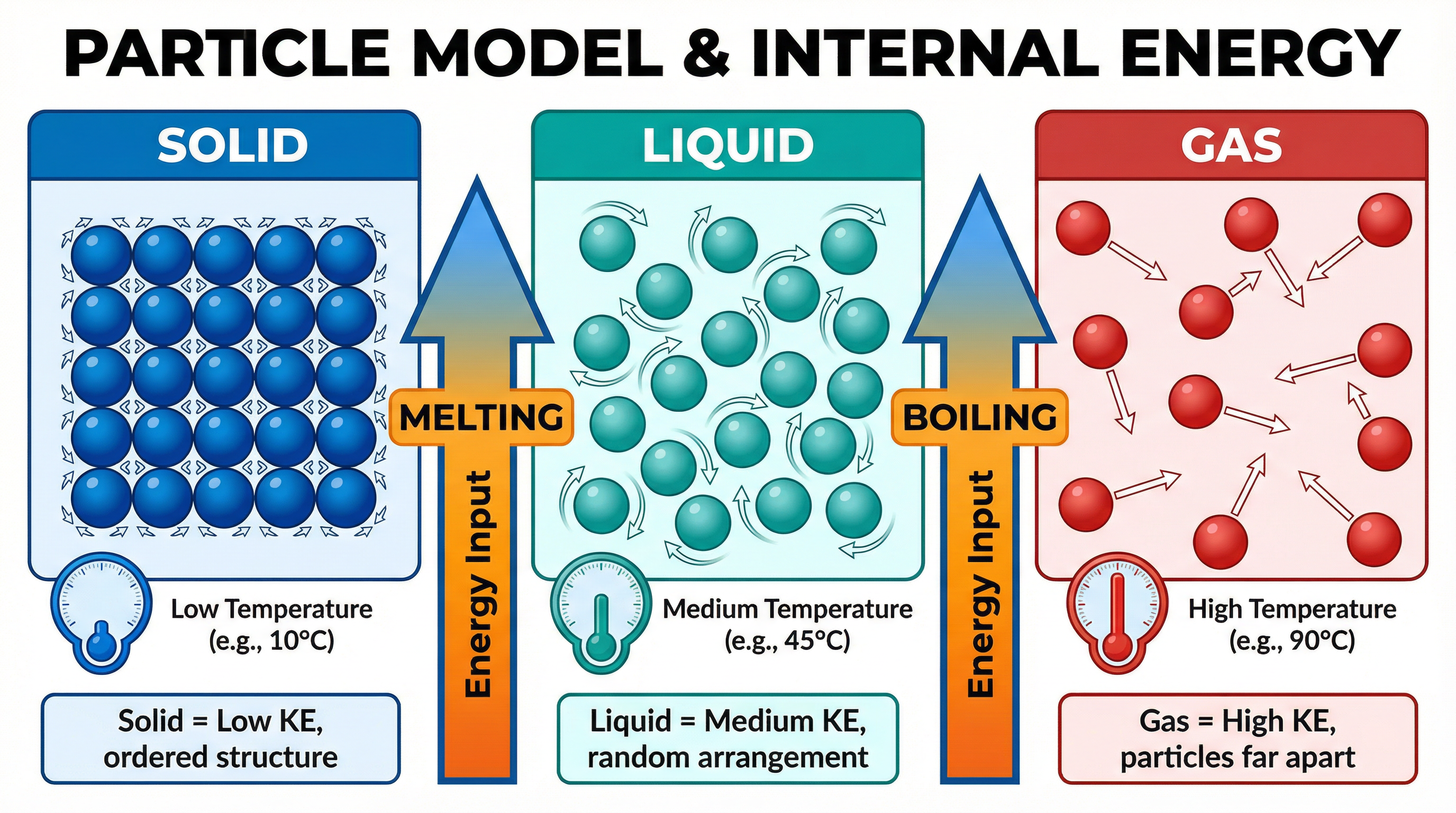
    The particle model of solids, liquids, and gases, showing changes in kinetic and potential energy.

    Concept 2: Changes of State and Latent Heat

    A change of state is a physical process where a substance changes from one state (solid, liquid, gas) to another. During a change of state, the temperature of the substance does not change. This is a critical point that candidates often misunderstand.

    When a solid melts or a liquid boils, the energy being supplied is used to break the intermolecular bonds holding the particles together, not to increase their speed. This energy increases the potential energy store of the particles. The energy required for this process is called latent heat. 'Latent' means hidden, because the energy transfer doesn't cause a visible temperature change.

    • Specific Latent Heat of Fusion (Lf): The energy required to change 1kg of a substance from solid to liquid with no change in temperature.
    • Specific Latent Heat of Vaporisation (Lv): The energy required to change 1kg of a substance from liquid to gas with no change in temperature.
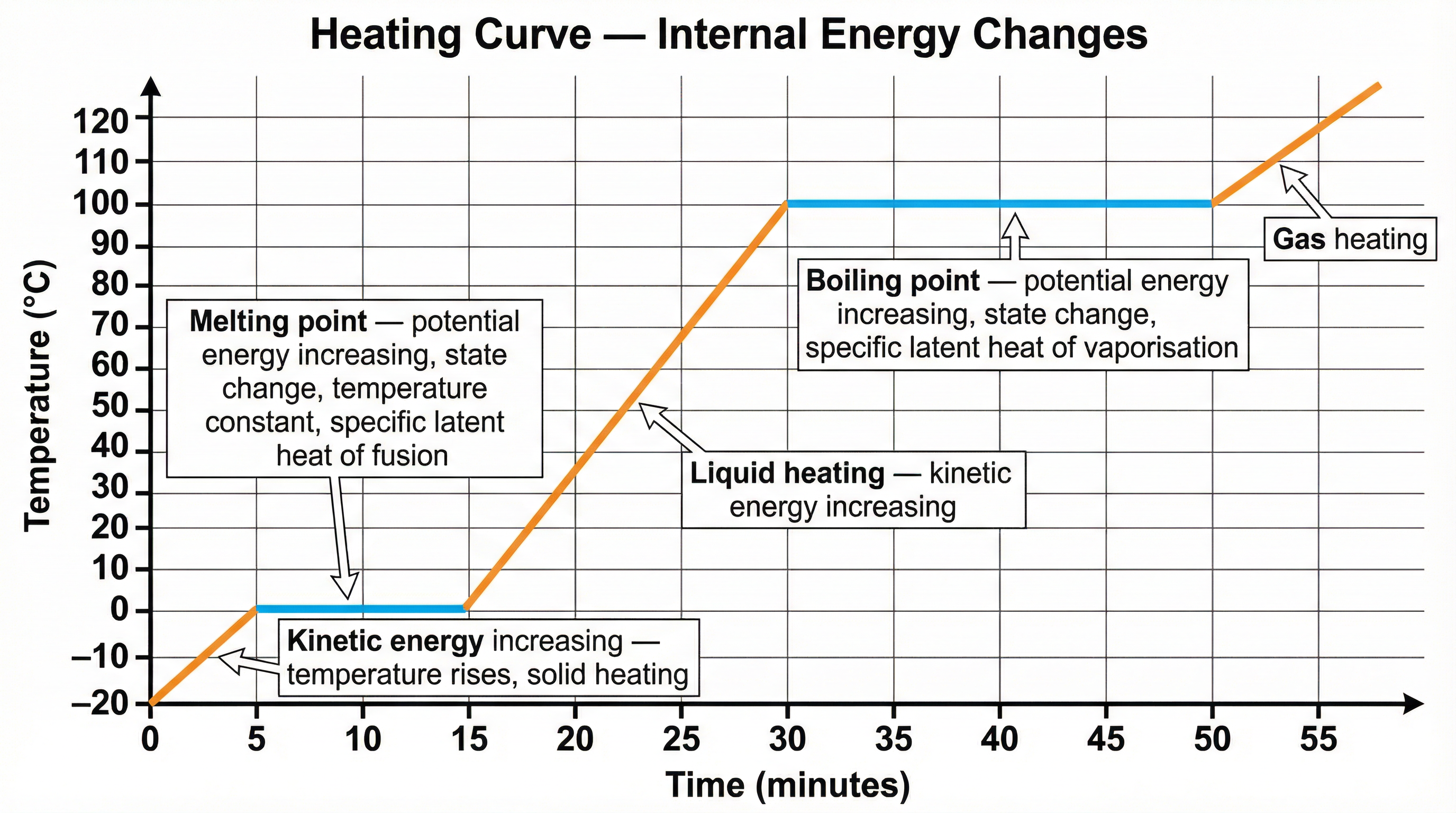
    A typical heating curve, illustrating the relationship between temperature, time, and changes of state.

    Mathematical/Scientific Relationships

    Two key equations govern this topic. You must know when and how to use each one.

    1. Specific Heat Capacity (for temperature changes)

      • Formula: ΔE = m × c × Δθ
      • Given on formula sheet?: Yes
      • What it means:
        • ΔE (or Q) = Change in thermal energy (Joules, J)
        • m = mass (kilograms, kg) — Examiner Tip: Watch out for mass given in grams! You MUST convert it.
        • c = specific heat capacity (Joules per kilogram per degree Celsius, J/kg°C)
        • Δθ = temperature change (degrees Celsius, °C)
      • When to use it: Use this equation when a substance is being heated or cooled and its temperature is changing. Do NOT use it for a change of state.
    2. Specific Latent Heat (for changes of state)

      • Formula: E = m × L
      • Given on formula sheet?: Yes
      • What it means:
        • E (or Q) = Energy for a change of state (Joules, J)
        • m = mass (kilograms, kg)
        • L = specific latent heat (Joules per kilogram, J/kg). This will be either Lf for fusion or Lv for vaporisation.
      • When to use it: Use this equation ONLY when a substance is melting, freezing, boiling, or condensing at a constant temperature.

    Practical Applications

    This topic has many real-world applications, from engineering to everyday life.

    • Cooling Systems: Refrigerators and air conditioners work by exploiting changes of state. A special fluid (refrigerant) is vaporised (boiled) inside the unit. This process absorbs a large amount of thermal energy from the inside of the fridge (due to the high specific latent heat of vaporisation), making it cold. The gas is then pumped outside, compressed, and condensed back into a liquid, releasing the absorbed heat into the surroundings.

    • Climate Regulation: Large bodies of water, like oceans, have a very high specific heat capacity. This means they can absorb a huge amount of energy from the sun without a large temperature increase. They act as a thermal buffer, keeping coastal areas cooler in summer and warmer in winter than inland areas.

    • Required Practical: Investigating Specific Heat Capacity

      • Apparatus: 1kg block of material (e.g., aluminium), thermometer, heater, ammeter, voltmeter, power pack, stopwatch, insulation.
      • Method: Measure the mass of the block. Insert the heater and thermometer into the holes in the block. Wrap the block in insulation to reduce heat loss to the surroundings. Measure the initial temperature. Connect the heater to the power pack with the ammeter in series and voltmeter in parallel. Turn on the power and start the stopwatch. Record the voltage and current. After a set time (e.g., 10 minutes), turn off the power and record the final temperature. Calculate the energy supplied by the heater using E = P × t = V × I × t. Calculate the temperature change Δθ. Calculate the specific heat capacity using c = ΔE / (m × Δθ).
      • Common Errors: Heat loss to the surroundings is the biggest source of error, leading to a calculated value of c that is higher than the true value. Not waiting for the temperature to distribute evenly through the block before taking the final reading is another error.

    Visual Resources

    2 diagrams and illustrations

    The particle model of solids, liquids, and gases, showing changes in kinetic and potential energy.
    The particle model of solids, liquids, and gases, showing changes in kinetic and potential energy.
    A typical heating curve, illustrating the relationship between temperature, time, and changes of state.
    A typical heating curve, illustrating the relationship between temperature, time, and changes of state.

    Interactive Diagrams

    2 interactive diagrams to visualise key concepts

    Heat AddedKE of particles increasesHeat Added at Melting PointTemperature is CONSTANTHeat AddedKE of particles increasesHeat Added at Boiling PointTemperature is CONSTANTHeat AddedStart: Solid below melting pointTemperature RisesState Change: MeltingTemperature RisesState Change: BoilingEnd: Gas above boiling point

    Flowchart showing the energy changes when heating a substance from a solid to a gas. Note the distinction between processes that increase Kinetic Energy (temperature rise) and those that increase Potential Energy (state change).

    Energy InputInternal EnergyNoYesKinetic Energy StorePotential Energy StoreHeatingIs substance at melting/boiling point?TemperatureState

    Concept map illustrating how energy input is directed. If the substance is not at a transition point, energy increases the kinetic store (raising temperature). If it is at a transition point, energy increases the potential store (changing state).

    Worked Examples

    3 detailed examples with solutions and examiner commentary

    Practice Questions

    Test your understanding — click to reveal model answers

    Q1

    Define 'internal energy'. (2 marks)

    2 marks
    foundation

    Hint: Remember it's the sum of two types of energy store.

    Q2

    A student heats 250 g of water from 15 °C to 95 °C. The specific heat capacity of water is 4200 J/kg°C. Calculate the energy transferred to the water. (4 marks)

    4 marks
    standard

    Hint: Don't forget to convert the mass to the standard unit!

    Q3

    Explain why the temperature of a kettle of boiling water does not increase even though the kettle is still being heated. (3 marks)

    3 marks
    standard

    Hint: Think about where the energy is going if not into the kinetic energy store.

    Q4

    The specific latent heat of fusion for ice is 334,000 J/kg. How much energy is needed to melt 600 g of ice at 0 °C? (3 marks)

    3 marks
    standard

    Hint: Select the correct formula and remember your unit conversions.

    Q5

    A heating graph for a substance is shown. Compare the energy required for melting to the energy required for boiling for this substance. Explain your answer. (4 marks)

    4 marks
    challenging

    Hint: The rate of heating is constant, so the time taken is proportional to the energy supplied. Compare the lengths of the two flat sections.

    Explore this topic further

    View Topic PageAll Physics Topics

    Key Terms

    Essential vocabulary to know

    More Physics Study Guides

    View all

    Refraction

    OCR
    GCSE

    This guide explains light refraction for OCR GCSE Physics (4.6), covering why light bends, how to draw ray diagrams, and the secrets to exam success. Master the concepts of optical density and total internal reflection to secure top marks.

    Isotopes

    OCR
    GCSE

    This guide provides a comprehensive overview of isotopes for OCR GCSE Physics (7.2), focusing on core definitions, calculations, and exam technique. It's designed to help you secure maximum marks by mastering the difference between isotopes and ions, understanding nuclear notation, and avoiding common pitfalls.

    Galaxies

    OCR
    GCSE

    Unlock top marks in your OCR GCSE Physics exam by mastering Galaxies (Topic 8.7). This guide breaks down the vastness of space into bite-sized, exam-focused chunks, from the structure of our Milky Way to the mind-bending evidence for the Big Bang.

    Planets

    OCR
    GCSE

    This topic covers the structure of our Solar System, the role of gravitational forces in maintaining planetary orbits, and the historical shift from geocentric to heliocentric models. Understanding these concepts is essential for securing marks in both Foundation and Higher Tier questions, particularly those testing orbital mechanics and the nature of scientific progress.

    Stars

    OCR
    GCSE

    Explore the dramatic life and death of stars, from stable main sequence suns to explosive supernovae. This guide for OCR GCSE Physics (8.6) provides everything candidates need to master stellar evolution, secure top marks, and understand our cosmic origins."

    The Solar System

    OCR
    GCSE

    This guide covers OCR GCSE Physics Topic 8.1, The Solar System. It explores the shift from geocentric to heliocentric models, the physics of orbital motion, and the complete life cycles of stars. Mastering this topic is crucial for tackling high-mark questions on stellar evolution and gravitational forces.