Study Notes

Overview
Momentum sits at the heart of OCR GCSE Physics Topic 4.5 and is one of the most reliably examined areas of the Forces unit. At its core, momentum describes how much 'motion' an object possesses, combining both its mass and its velocity into a single measurable quantity. This topic matters not only because it appears in almost every paper, but because it connects directly to Newton's Laws of Motion, the physics of collisions, and the real-world engineering of life-saving vehicle safety features.
In the exam, candidates encounter momentum questions in several distinct forms: straightforward calculations using p = mv, conservation of momentum problems involving collisions (both Foundation and Higher), vector-based head-on collision calculations (Higher only), and extended-response questions requiring a full explanation of how safety features such as airbags and crumple zones reduce injury. Assessment Objective weightings for this topic are AO1 (30%), AO2 (40%), and AO3 (30%), meaning the majority of marks are awarded for applying and analysing knowledge rather than simply recalling it.
This guide covers every examinable aspect of momentum for both Foundation and Higher Tier, with worked examples, exam technique guidance, and memory aids to ensure candidates are fully prepared.
Key Concepts
Concept 1: Defining Momentum and the Equation p = mv
Momentum is defined as the product of an object's mass and its velocity. The symbol for momentum is p, and the equation is:
p = m × vwhere p is momentum in kilogram metres per second (kg m/s), m is mass in kilograms (kg), and v is velocity in metres per second (m/s).
This equation is provided on the OCR formula sheet, so candidates do not need to memorise it — but they must be completely fluent in substituting values, rearranging for mass or velocity, and interpreting results. Credit is awarded for correct substitution even if the final arithmetic contains an error, so always show your working.
Example: A cyclist of mass 70 kg rides at 8 m/s. Calculate their momentum.
p = m × v = 70 × 8 = 560 kg m/s
Critical unit conversion: Mass must always be in kilograms. If a question states a mass in grams, divide by 1000 before substituting. A 250 g ball = 0.25 kg. This is the single most common arithmetic error on momentum papers.
| Quantity | Symbol | Unit | Unit Abbreviation |
|---|---|---|---|
| Momentum | p | kilogram metre per second | kg m/s |
| Mass | m | kilogram | kg |
| Velocity | v | metre per second | m/s |
Concept 2: The Principle of Conservation of Momentum
The conservation of momentum is a fundamental law of physics derived from Newton's Third Law of Motion. It states:
**In a closed system (where no external forces act), the total momentum before a collision or interaction is equal to the total momentum after.**This principle applies to all collisions — whether objects bounce off each other (elastic collisions) or stick together (perfectly inelastic collisions). The total momentum of the system does not change.
Why does this work? When two objects collide, they exert equal and opposite forces on each other (Newton's Third Law) for the same duration. By F = Δp/Δt, equal and opposite forces acting for the same time produce equal and opposite changes in momentum. The gains and losses cancel out, leaving total momentum unchanged.
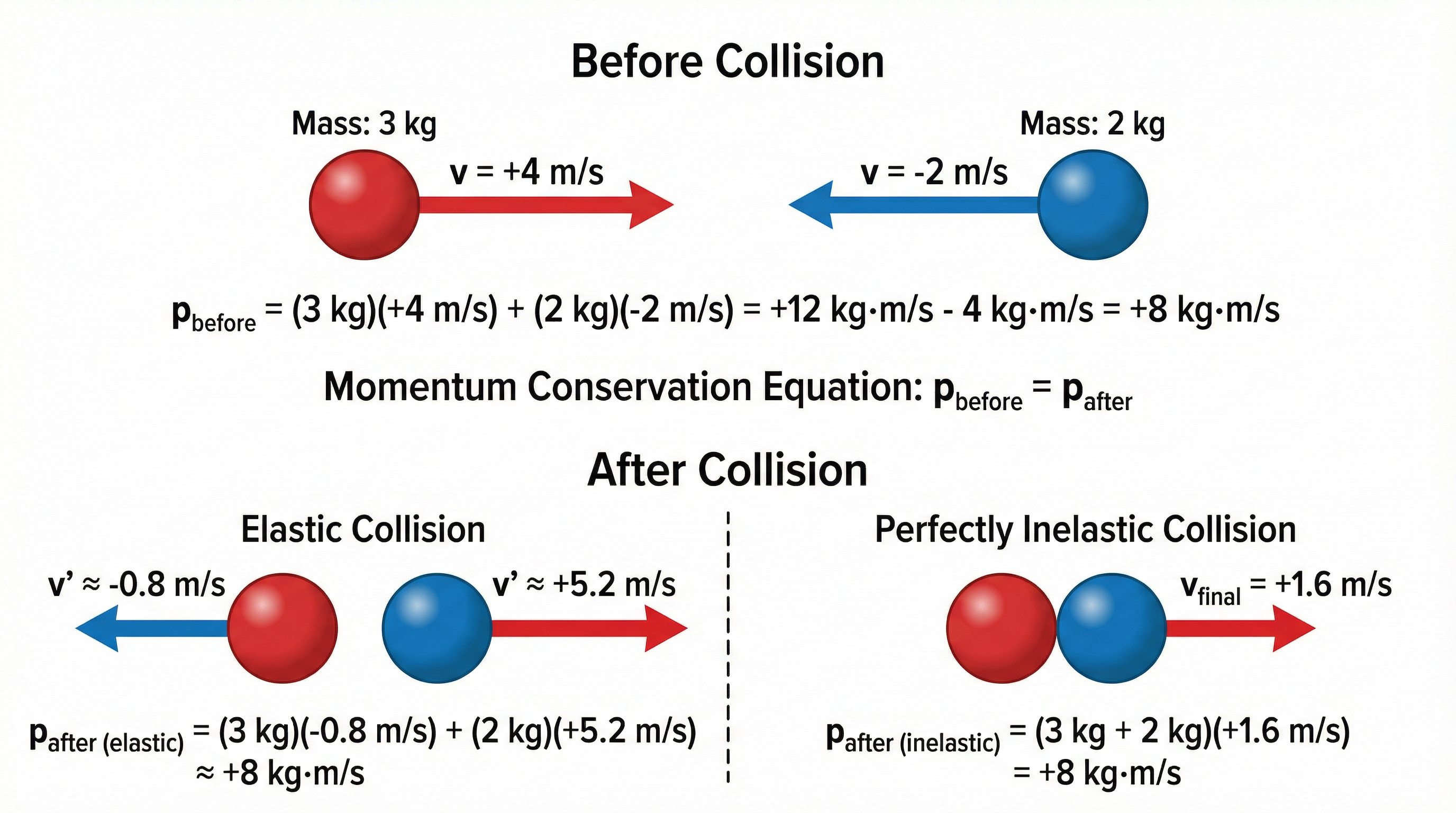
Setting up a conservation equation:
Total momentum before = Total momentum after
(m₁ × u₁) + (m₂ × u₂) = (m₁ × v₁) + (m₂ × v₂)
where u represents initial velocity and v represents final velocity.
Examiner's note: Candidates who simply write 'momentum is conserved' without stating 'in a closed system' will not receive the definition mark. Always include this qualifier.
Concept 3: Momentum as a Vector Quantity (Higher Tier)
Momentum is a vector quantity — it has both magnitude and direction. This distinction is critical for Higher Tier candidates tackling head-on collision problems, where objects travel in opposite directions.
The standard approach is to define a positive direction at the outset (typically rightward or the direction of the larger initial momentum) and assign negative values to any velocity in the opposite direction.
Example: Ball A (mass 4 kg) moves right at 5 m/s. Ball B (mass 3 kg) moves left at 3 m/s. Taking right as positive:
- Momentum of A = +4 × 5 = +20 kg m/s
- Momentum of B = 3 × (−3) = −9 kg m/s
- Total momentum before = 20 + (−9) = +11 kg m/sIf a candidate ignores the vector nature and adds magnitudes (20 + 9 = 29), they will score zero for the calculation. Always draw a diagram with arrows before starting.
Concept 4: Force and Rate of Change of Momentum (Higher Tier)
For Higher Tier candidates, the relationship between force and momentum is expressed as:
F = Δp / Δtwhere F is the resultant force in Newtons (N), Δp is the change in momentum in kg m/s, and Δt is the time over which the change occurs in seconds (s).
This can be expanded to: F = (mv − mu) / t, where u is initial velocity and v is final velocity.
This equation is the key to understanding vehicle safety features. In any collision, the change in momentum (Δp) is fixed — determined by the vehicle's mass and speed. Safety features cannot change this. What they CAN do is increase the time (Δt) over which the momentum changes. A larger Δt produces a smaller F, reducing the force on the passenger.
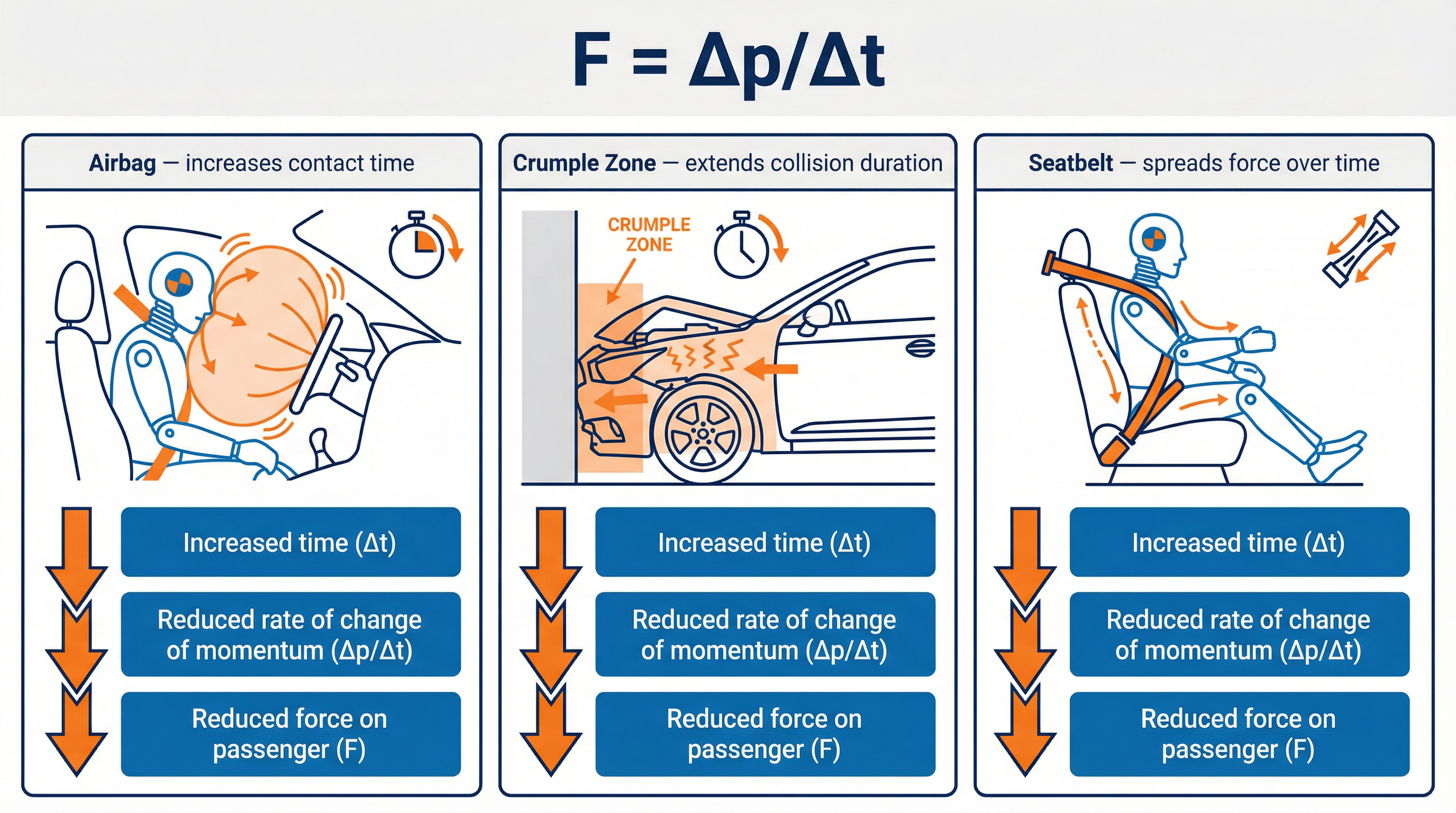
The safety feature argument (6-mark structure):
- Identify the feature (e.g., airbag, crumple zone, seatbelt)
- State that it increases the time of the collision
- State that this reduces the rate of change of momentum
- Apply F = Δp/Δt: smaller Δp/Δt means smaller F
- Conclude that the reduced force is less likely to cause injury
Critical distinction: Candidates must NOT say the safety feature 'reduces the momentum'. The total change in momentum is the same — the passenger still goes from moving to stationary. What changes is the RATE at which this happens.
Mathematical Relationships
| Formula | What It Calculates | Formula Sheet? | Tier |
|---|---|---|---|
| p = m × v | Momentum of an object | Given | Both |
| F = Δp / Δt | Force from rate of change of momentum | Given | Higher |
| F = (mv − mu) / t | Force from initial/final momentum | Derived | Higher |
| Δp = m × Δv | Change in momentum | Derived | Higher |
Unit conversions to memorise:
- grams → kilograms: divide by 1000 (e.g., 500 g = 0.5 kg)
- km/h → m/s: divide by 3.6 (e.g., 72 km/h = 20 m/s)
- milliseconds → seconds: divide by 1000 (e.g., 50 ms = 0.05 s)
Practical Applications
Momentum is not merely an abstract concept — it underpins the design of every safety system in modern vehicles. The crumple zone at the front of a car is engineered to deform progressively during a collision, extending the duration of impact from milliseconds to tens of milliseconds. This seemingly small increase in time can reduce the peak force on occupants by a factor of ten or more. Airbags deploy in approximately 30 milliseconds and provide a cushioned surface that further extends the contact time as the passenger decelerates. Seatbelts stretch slightly under load, again increasing the time over which the passenger's momentum changes to zero.
Beyond road safety, momentum conservation is the principle behind rocket propulsion (the rocket expels gas backwards, gaining momentum forwards), billiards and snooker (the cue ball transfers momentum to target balls), and even the recoil of a gun (the bullet gains forward momentum, the gun gains equal backward momentum).
In the OCR specification, there is no required practical specifically for momentum, but candidates may encounter data from trolley collision experiments using light gates and data loggers, where they are asked to verify conservation of momentum from recorded mass and velocity data.