Nuclear Fusion

    OCR
    GCSE
    Physics

    This guide provides a comprehensive, exam-focused breakdown of Nuclear Fusion (OCR GCSE Physics 7.9). It covers the fundamental process, the extreme conditions required, and the critical differences between fusion and fission, all tailored to help you secure maximum marks.

    6
    Min Read
    3
    Examples
    5
    Questions
    6
    Key Terms
    🎙 Podcast Episode
    Nuclear Fusion
    9:26
    0:00-9:26

    Study Notes

    Header image for OCR GCSE Physics: Nuclear Fusion (7.9)

    Overview

    Nuclear Fusion is the process that powers our Sun and every star in the universe. It involves the joining of light atomic nuclei to form a heavier nucleus, releasing a vast amount of energy in the process. For your OCR GCSE Physics exam, understanding fusion is not just about memorising a definition; it’s about explaining why it happens and the immense challenges in replicating it on Earth. This topic connects directly to your understanding of atomic structure (P7.1), energy transfers (P1), and radioactivity (P7.2). Examiners will test your ability to use precise scientific language, compare fusion with its counterpart, fission, and, for Higher Tier candidates, explain the underlying physics of the conditions required. Expect to see structured questions, comparisons, and calculation-based problems related to the energy released.

    GCSE Physics Revision Podcast: Nuclear Fusion

    Key Concepts

    Concept 1: The Fusion Process

    At its core, nuclear fusion is the forceful merging of two light nuclei. The most common example, and the one you should remember, is the fusion of hydrogen isotopes (like Deuterium, H-2) to form a helium nucleus. The crucial point is that the mass of the final helium nucleus is slightly less than the combined mass of the two original hydrogen nuclei. This ‘missing’ mass is not lost; it is converted directly into a huge amount of energy, as described by Albert Einstein’s famous equation, E=mc².

    Example: If two Deuterium nuclei fuse, the product is a Helium-3 nucleus and a neutron. The total mass before is greater than the total mass after. This difference in mass, known as the mass defect, is released as kinetic energy of the products.
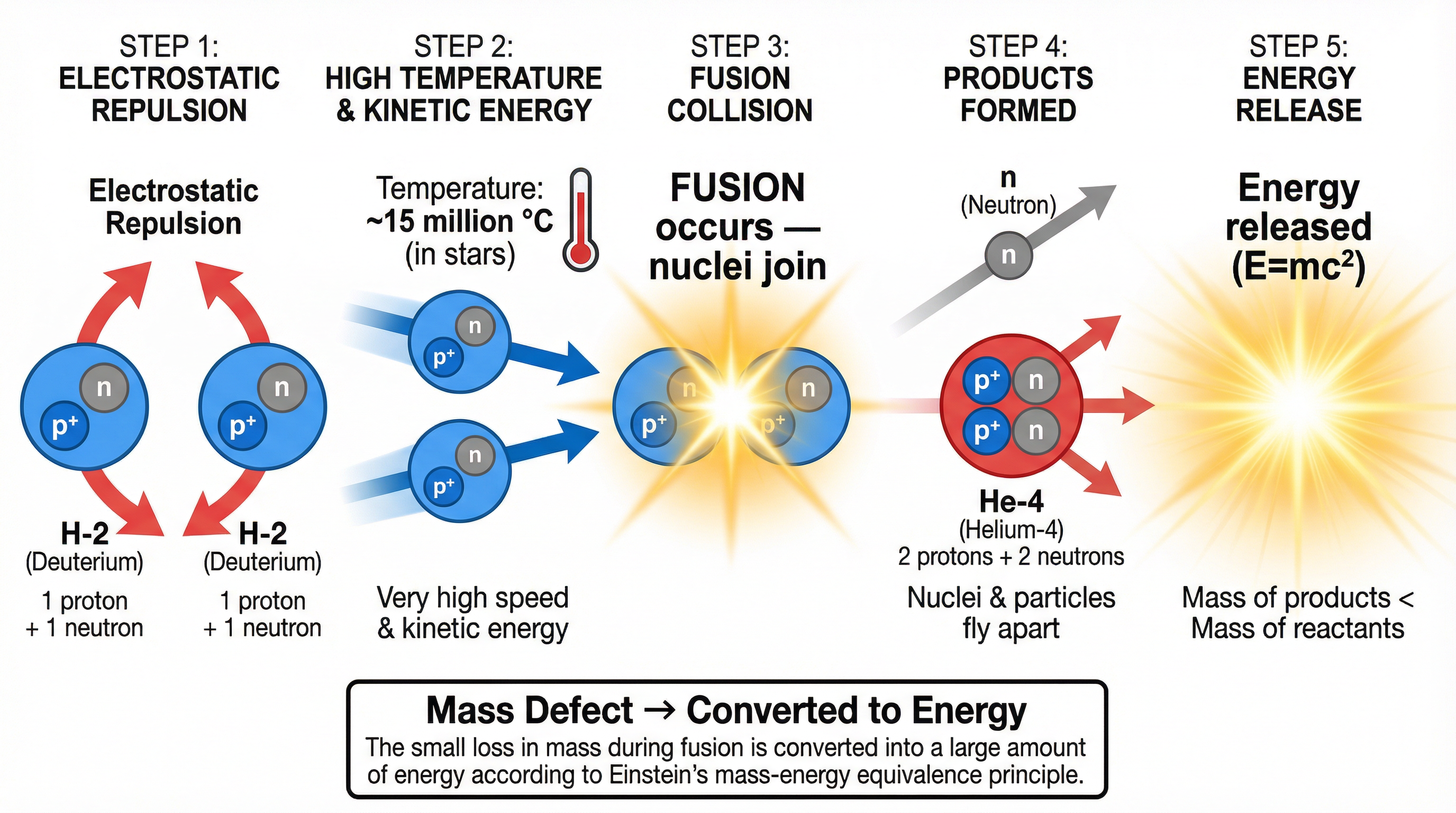
    The process of nuclear fusion, showing the role of high temperature in overcoming repulsion.

    Concept 2: The Conditions for Fusion (Higher Tier)

    Fusion doesn’t happen spontaneously. The reason is that atomic nuclei are positively charged (due to their protons). When you try to bring them close together, a powerful force of electrostatic repulsion pushes them apart. To overcome this repulsion, the nuclei must be moving at incredibly high speeds. This is achieved by heating them to extreme temperatures—over 100 million degrees Celsius in experimental reactors on Earth, even hotter than the Sun's core. At these temperatures, the material becomes a plasma, and the nuclei have enough kinetic energy to overcome the electrostatic barrier and get close enough for the short-range strong nuclear force to pull them together.

    • High Temperature: Gives nuclei high kinetic energy.
    • High Pressure/Density: Increases the collision rate, making fusion more likely.

    Concept 3: Fusion vs. Fission

    A common 6-mark question requires candidates to compare and contrast nuclear fusion with nuclear fission. It is vital to be able to describe both similarities and differences clearly.
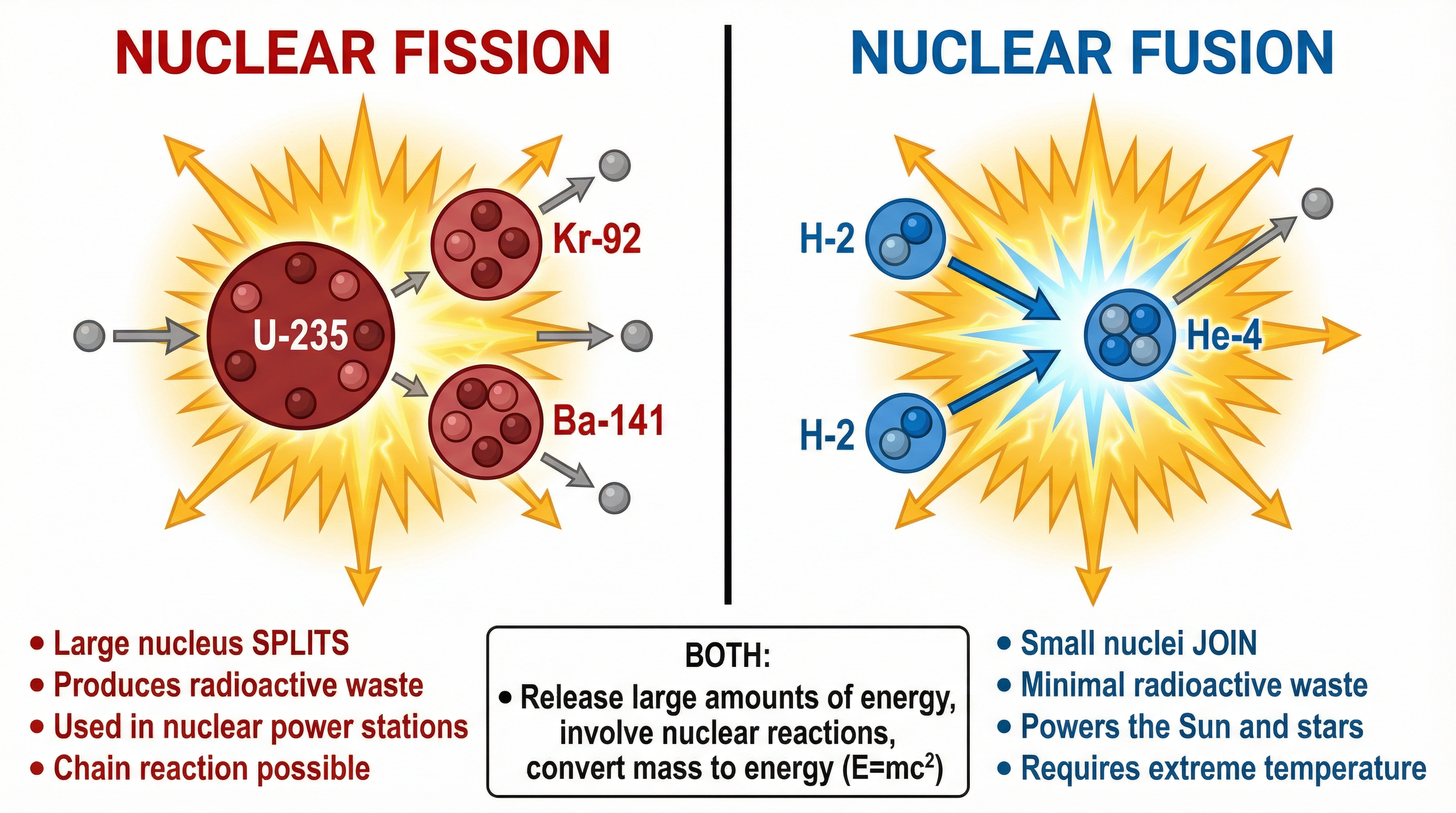
    Key differences and similarities between nuclear fission and fusion.

    FeatureNuclear FissionNuclear Fusion
    ProcessA large, unstable nucleus splits into two smaller nuclei.Two small, light nuclei join (fuse) to form a heavier nucleus.
    Nuclei InvolvedHeavy nuclei (e.g., Uranium-235, Plutonium-239).Light nuclei (e.g., Hydrogen isotopes like Deuterium and Tritium).
    ConditionsCan occur at normal temperatures; initiated by a slow neutron.Requires extremely high temperatures and pressures.
    Waste ProductsProduces highly radioactive waste with a long half-life.Produces very little long-lived radioactive waste (Helium is inert).
    Current UseUsed in nuclear power stations to generate electricity.Powers the Sun and stars; experimental on Earth (e.g., JET, ITER).

    Similarity: Both processes release a very large amount of energy per reaction and both involve a conversion of mass into energy (mass defect).

    Mathematical/Scientific Relationships

    E = mc² (Must memorise)

    This is the cornerstone equation for both fission and fusion. It states that energy (E) is equal to mass (m) multiplied by the speed of light squared (c²).

    • E: Energy released (in Joules, J)
    • m: The mass defect (the mass that is converted into energy, in kilograms, kg)
    • c: The speed of light in a vacuum (approximately 3 x 10⁸ m/s). You will be given this value.

    You will not be asked to perform complex calculations with this at GCSE, but you MUST be able to state that the energy released is due to a loss in mass.

    Practical Applications

    • Stellar Energy: All stars, including our Sun, are powered by nuclear fusion. The immense gravitational pressure in their cores creates the conditions necessary for fusion to occur, providing the energy that sustains them for billions of years.
    • Fusion Research (Tokamaks): On Earth, scientists are developing fusion reactors to generate clean electricity. The most common design is the tokamak, a doughnut-shaped device that uses powerful magnetic fields to confine and heat a hydrogen plasma to extreme temperatures. The Joint European Torus (JET) in the UK is a leading example. The goal is to achieve a net energy gain, where the reactor produces more energy than it consumes.
    • Nuclear Weapons: Hydrogen bombs (thermonuclear weapons) use a fission bomb as a trigger to create the intense temperatures and pressures needed to initiate a massive, uncontrolled fusion reaction.

    Visual Resources

    2 diagrams and illustrations

    The process of nuclear fusion, showing the role of high temperature in overcoming repulsion.
    The process of nuclear fusion, showing the role of high temperature in overcoming repulsion.
    Key differences and similarities between nuclear fission and fusion.
    Key differences and similarities between nuclear fission and fusion.

    Interactive Diagrams

    2 interactive diagrams to visualise key concepts

    High Temperature & PressureTwo Light NucleiOvercome Electrostatic RepulsionNuclei FuseHeavier Nucleus + NeutronEnergy Released (E=mc²)

    A flowchart summarising the key stages of the nuclear fusion process.

    Releases EnergyReleases EnergyFusionExtreme HeatExtreme HeatHydrogen-2JoinsHydrogen-3Helium-4NeutronFissionNeutronUranium-235SplitsDaughter Nucleus 1Daughter Nucleus 2NeutronsBoth

    A concept map comparing the inputs and outputs of nuclear fission and fusion.

    Worked Examples

    3 detailed examples with solutions and examiner commentary

    Practice Questions

    Test your understanding — click to reveal model answers

    Q1

    State the main energy source of the Sun and other stars. [1 mark]

    1 marks
    foundation

    Hint: Think about what process happens in the core of a star.

    Q2

    Describe the process of nuclear fusion. [3 marks]

    3 marks
    standard

    Hint: What joins together? What is formed? What is released?

    Q3

    A fusion reaction converts 5 x 10⁻²⁹ kg of mass into energy. Explain how this mass conversion leads to the release of a large amount of energy. You do not need to perform a calculation. [2 marks]

    2 marks
    standard

    Hint: Which famous equation links mass and energy? What is special about one of the terms in it?

    Q4

    Explain why containing a plasma in a fusion reactor is a significant challenge. [3 marks] (Higher Tier)

    3 marks
    challenging

    Hint: Think about the temperature of the plasma and what would happen to any normal container.

    Q5

    Evaluate the potential of nuclear fusion as a future energy source for the UK, considering both benefits and challenges. [5 marks]

    5 marks
    challenging

    Hint: Think about fuel, waste, and the current state of the technology. An evaluation requires a balanced argument.

    Explore this topic further

    View Topic PageAll Physics Topics

    Key Terms

    Essential vocabulary to know

    More Physics Study Guides

    View all

    Refraction

    OCR
    GCSE

    This guide explains light refraction for OCR GCSE Physics (4.6), covering why light bends, how to draw ray diagrams, and the secrets to exam success. Master the concepts of optical density and total internal reflection to secure top marks.

    Isotopes

    OCR
    GCSE

    This guide provides a comprehensive overview of isotopes for OCR GCSE Physics (7.2), focusing on core definitions, calculations, and exam technique. It's designed to help you secure maximum marks by mastering the difference between isotopes and ions, understanding nuclear notation, and avoiding common pitfalls.

    Galaxies

    OCR
    GCSE

    Unlock top marks in your OCR GCSE Physics exam by mastering Galaxies (Topic 8.7). This guide breaks down the vastness of space into bite-sized, exam-focused chunks, from the structure of our Milky Way to the mind-bending evidence for the Big Bang.

    Planets

    OCR
    GCSE

    This topic covers the structure of our Solar System, the role of gravitational forces in maintaining planetary orbits, and the historical shift from geocentric to heliocentric models. Understanding these concepts is essential for securing marks in both Foundation and Higher Tier questions, particularly those testing orbital mechanics and the nature of scientific progress.

    Stars

    OCR
    GCSE

    Explore the dramatic life and death of stars, from stable main sequence suns to explosive supernovae. This guide for OCR GCSE Physics (8.6) provides everything candidates need to master stellar evolution, secure top marks, and understand our cosmic origins."

    The Solar System

    OCR
    GCSE

    This guide covers OCR GCSE Physics Topic 8.1, The Solar System. It explores the shift from geocentric to heliocentric models, the physics of orbital motion, and the complete life cycles of stars. Mastering this topic is crucial for tackling high-mark questions on stellar evolution and gravitational forces.