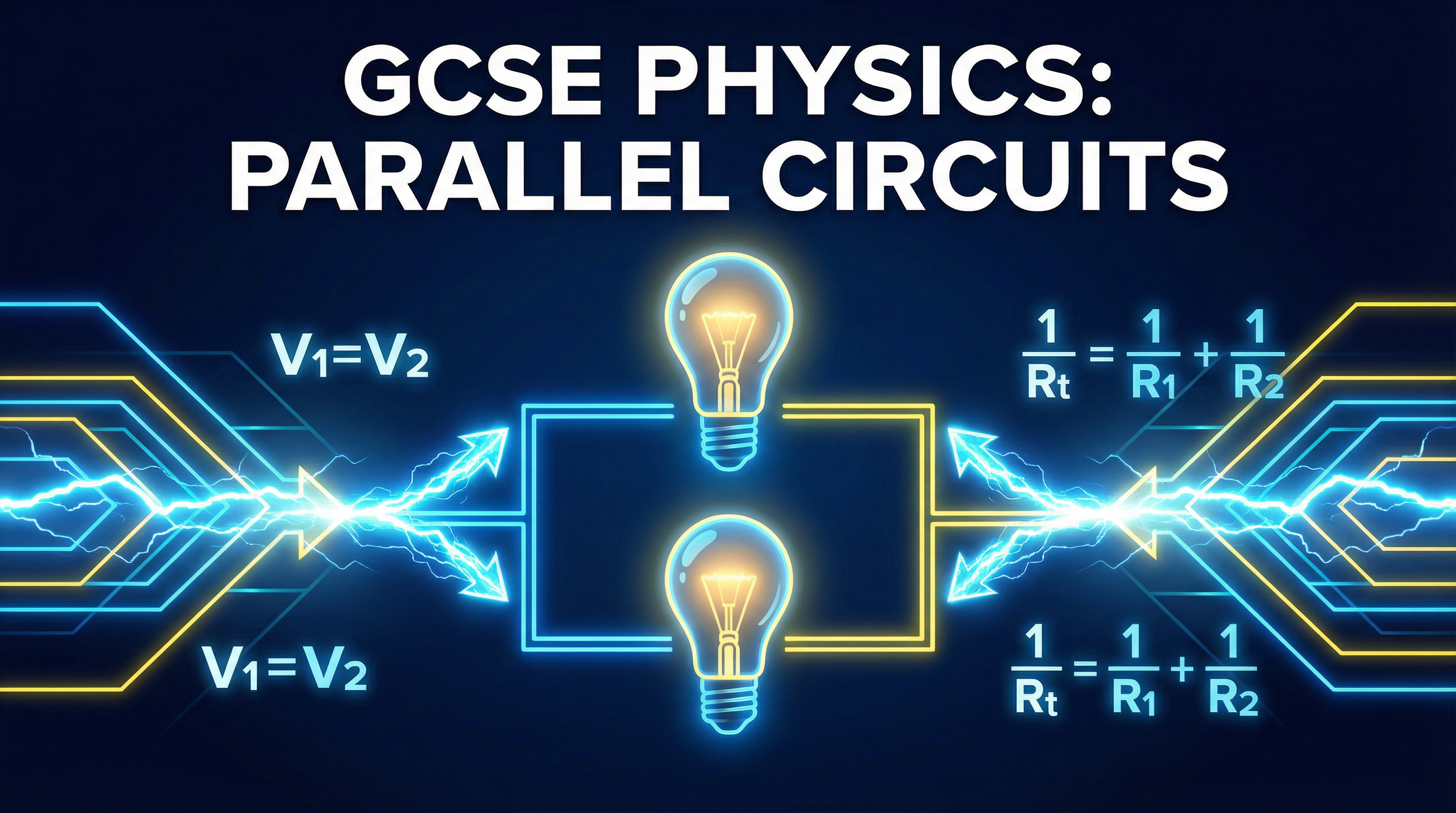
Parallel Circuits

    OCR
    GCSE
    Physics

    Master OCR GCSE Physics Parallel Circuits (3.6) with this comprehensive guide. We break down the core principles of voltage and current, show you how to tackle Higher Tier resistance calculations, and provide examiner-approved techniques to secure every mark. This is your essential resource for turning a tricky topic into guaranteed marks.

    5
    Min Read
    3
    Examples
    5
    Questions
    6
    Key Terms
    🎙 Podcast Episode
    Parallel Circuits
    11:55
    0:00-11:55

    Study Notes

    Header image for OCR GCSE Physics: Parallel Circuits

    Overview

    Parallel circuits form the backbone of all modern electrical systems, from the wiring in your home to the complex electronics in your phone. For your OCR GCSE Physics exam, this topic (specification reference 3.6) is a fundamental test of your understanding of how electricity behaves. Unlike series circuits where components follow one after another, parallel circuits offer multiple paths for the current to flow. This seemingly simple difference has profound consequences for voltage, current, and total resistance, which examiners love to probe. A solid grasp of parallel circuits is crucial as it directly connects to Ohm's Law, power calculations, and the application of electrical principles in real-world contexts. Expect to face a mix of calculation questions (especially for Higher Tier), descriptive explanations, and application-based problems, making up a significant portion of marks in the electricity module.

    GCSE Physics Revision Podcast: Parallel Circuits

    Key Concepts

    Concept 1: The Two Golden Rules of Parallel Circuits

    To solve any problem involving parallel circuits, you must internalise two fundamental rules. These are non-negotiable and form the basis for all marks awarded in this area.

    Rule 1: Potential Difference is ConstantIn a parallel circuit, the potential difference (voltage) provided by the source is the same across every single branch. If you have a 12V battery, every component in every parallel branch has a full 12V across it. It is not shared or divided. Think of it as each branch having its own direct connection to the positive and negative terminals of the battery.

    Examiner's Note: A common and costly mistake is to state that voltage is 'split' or 'shared' in parallel. This is only true for series circuits. For parallel, V_source = V_1 = V_2 = ...

    Rule 2: Current is Conserved and SplitsThe total current flowing from the source is equal to the sum of the currents flowing through each of the parallel branches. This is an application of Kirchhoff's First Law, which states that charge is conserved. The current splits at a junction to travel down the different paths, and then recombines as it leaves the branches. The total amount of current flowing into a junction must equal the total amount flowing out.

    Examiner's Note: The formula I_total = I_1 + I_2 + ... will always gain you credit. The amount of current in each branch is determined by the resistance of that branch (Ohm's Law), so branches are not guaranteed to have equal currents.
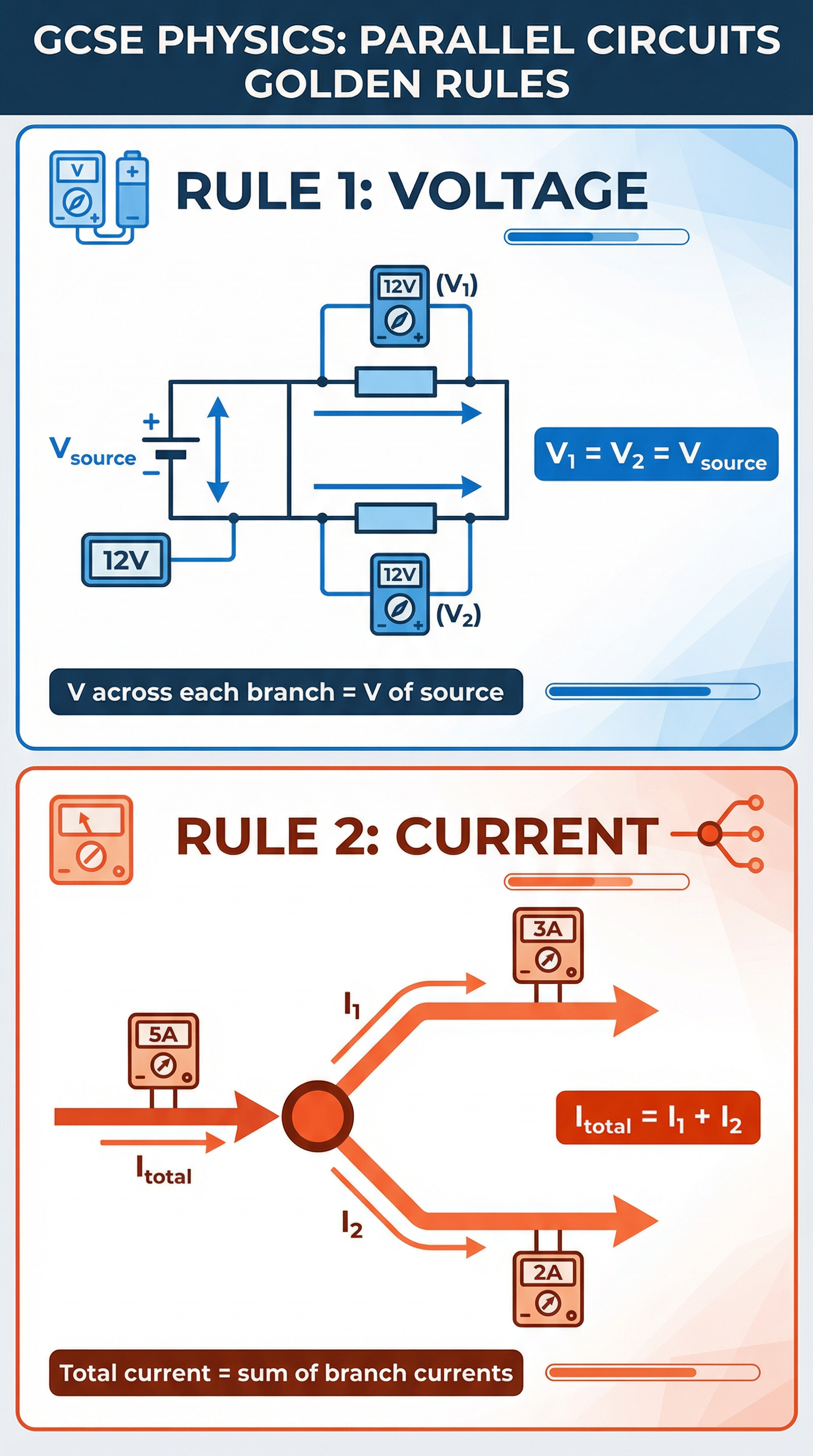
    The two golden rules of parallel circuits: voltage is constant, current splits.

    Concept 2: Total Resistance (Foundation & Higher Tier)

    This is a key area of differentiation between the tiers.

    For All Candidates: Adding a resistor in parallel decreases the total resistance of the circuit. This is a concept that many find counter-intuitive, but it is essential. By adding another branch, you are providing an additional pathway for the current to flow. More pathways make it easier for the overall current to flow, hence the total opposition (resistance) is lower.

    Analogy: Imagine a crowded hallway. Opening a second, parallel hallway gives people another route to take. The overall flow of people (current) becomes easier and faster, so the overall difficulty of getting through (resistance) has decreased.

    For Higher Tier Candidates Only: You must be able to calculate the total resistance (R_T) using the reciprocal formula. This formula is a mathematical expression of the principle described above.

    Mathematical/Scientific Relationships

    Here are the key equations you need. Pay close attention to which ones you must memorise.

    1. Current Summation Rule (Must memorise)
      I_total = I_1 + I_2 + ...

      • I_total: Total current from the source (Amperes, A)
      • I_1, I_2: Current in branch 1, branch 2, etc. (Amperes, A)
    2. Voltage Rule (Must memorise)
      V_source = V_1 = V_2 = ...

      • V_source: Potential difference of the source (Volts, V)
      • V_1, V_2: Potential difference across branch 1, branch 2, etc. (Volts, V)
    3. Ohm's Law (Given on formula sheet)
      V = I * R

      • V: Potential difference (Volts, V)
      • I: Current (Amperes, A)
      • R: Resistance (Ohms, Ω)
        This can be applied to the whole circuit (V_source = I_total * R_total) or to a single branch (V_1 = I_1 * R_1).
    4. Total Resistance in Parallel (Higher Tier Only) (Must memorise)
      1/R_total = 1/R_1 + 1/R_2 + ...

      • R_total: Total resistance of the circuit (Ohms, Ω)
      • R_1, R_2: Resistance of branch 1, branch 2, etc. (Ohms, Ω)
        CRITICAL: After calculating the value of 1/R_total, you MUST perform one final step: R_total = 1 / (your answer). Forgetting to invert is the most common mistake.

    Practical Applications

    Household Wiring: This is the classic example. All mains sockets and light fittings in a house are wired in parallel. Examiners expect you to explain why, and there are two key reasons that each earn a mark:

    1. Independent Switching: Each appliance can be turned on or off with its own switch without interrupting the circuit for all the other appliances.
    2. Constant Voltage: Each appliance receives the full 230V from the mains supply, allowing it to operate at the correct power and brightness. If they were in series, this voltage would be shared, and nothing would work correctly.
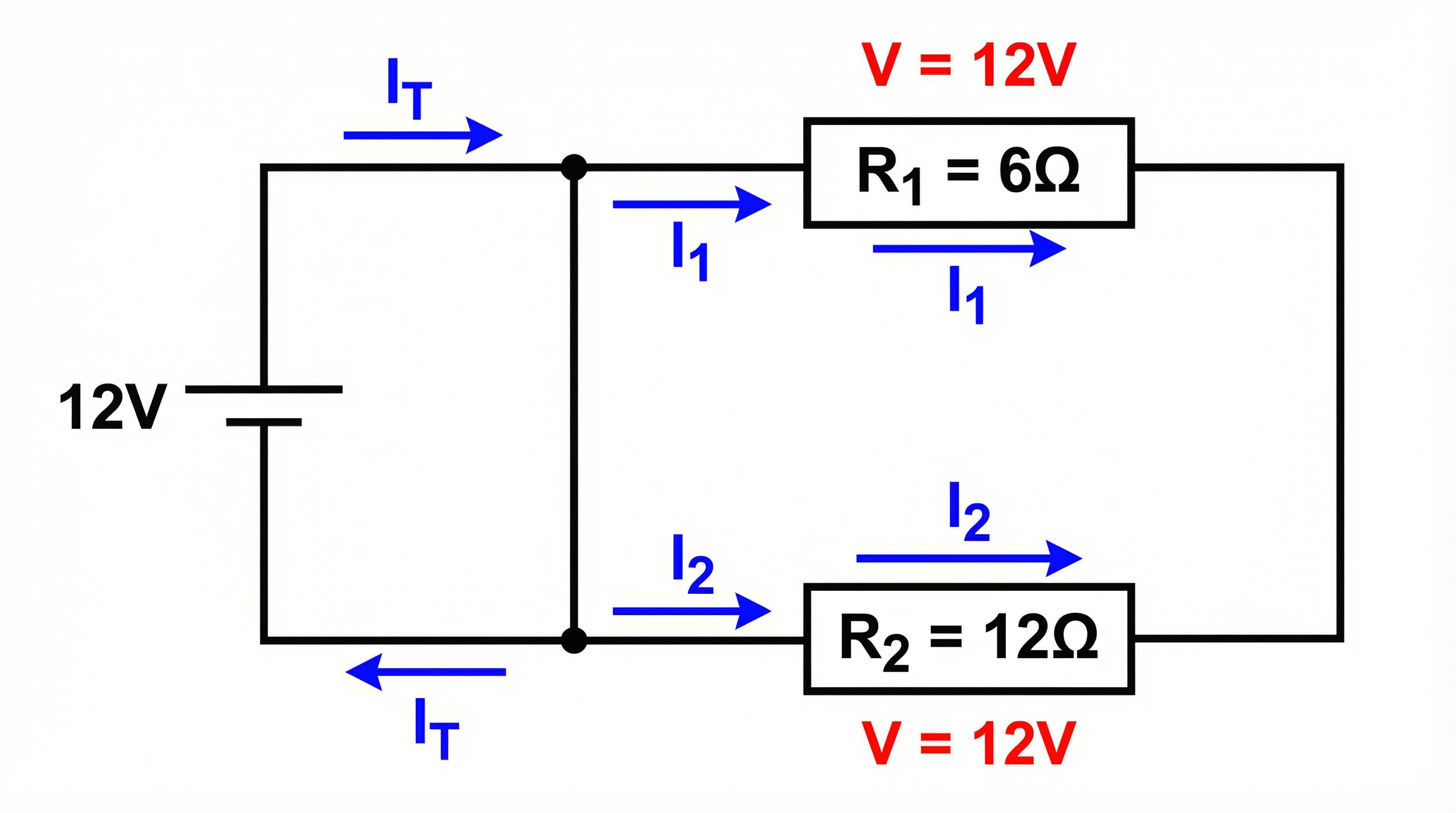
    Visual Resources

    2 diagrams and illustrations

    A standard parallel circuit diagram with key labels for current and voltage.
    A standard parallel circuit diagram with key labels for current and voltage.
    The two golden rules of parallel circuits: voltage is constant, current splits.
    The two golden rules of parallel circuits: voltage is constant, current splits.

    Interactive Diagrams

    2 interactive diagrams to visualise key concepts

    RulesV across R1 = V_sourceV across R2 = V_sourceI_total = I1 + I2Start: Current I_total leaves batteryJunction 1Branch 1: Current I1 flows through R1Branch 2: Current I2 flows through R2Junction 2End: Current I_total returns to battery

    Flowchart showing how current splits at a junction into different branches and then recombines. The rules for voltage and current are summarised.

    Higher Tier Calculation ProcessStart: Identify R1 and R2Write formula: 1/R_T = 1/R1 + 1/R2Substitute valuesCalculate 1/R_TINVERT THE ANSWER!Final Answer for R_T in Ω

    A process diagram for Higher Tier candidates on how to correctly calculate total resistance in a parallel circuit, highlighting the critical final step.

    Worked Examples

    3 detailed examples with solutions and examiner commentary

    Practice Questions

    Test your understanding — click to reveal model answers

    Q1

    A toaster with a resistance of 30 Ω and a kettle with a resistance of 20 Ω are connected in parallel to the 230V mains supply. State the potential difference across the toaster.

    1 marks
    foundation

    Hint: What is the first golden rule of parallel circuits?

    Q2

    Describe how the current in the wires from the mains supply is related to the currents in the toaster and the kettle from the previous question.

    2 marks
    foundation

    Hint: Think about what happens at the junctions where the wires split.

    Q3

    Calculate the total current drawn from the 230V mains supply by the 30 Ω toaster and 20 Ω kettle connected in parallel.

    4 marks
    standard

    Hint: Calculate the current in each appliance first, then combine them.

    Q4

    (Higher Tier Only) Calculate the total resistance of a 4.0 Ω resistor and a 12.0 Ω resistor connected in parallel. Give your answer to 2 significant figures.

    3 marks
    challenging

    Hint: Remember the reciprocal formula, and don't forget the final step!

    Q5

    A student has two identical lamps. They connect them to a battery in parallel. They then add a third identical lamp in parallel with the first two. Explain what happens to the brightness of the first two lamps and the total current drawn from the battery.

    4 marks
    challenging

    Hint: How does adding the third lamp affect the voltage across the first two? How does it affect the total resistance?

    Explore this topic further

    View Topic PageAll Physics Topics

    Key Terms

    Essential vocabulary to know

    More Physics Study Guides

    View all

    Refraction

    OCR
    GCSE

    This guide explains light refraction for OCR GCSE Physics (4.6), covering why light bends, how to draw ray diagrams, and the secrets to exam success. Master the concepts of optical density and total internal reflection to secure top marks.

    Isotopes

    OCR
    GCSE

    This guide provides a comprehensive overview of isotopes for OCR GCSE Physics (7.2), focusing on core definitions, calculations, and exam technique. It's designed to help you secure maximum marks by mastering the difference between isotopes and ions, understanding nuclear notation, and avoiding common pitfalls.

    Galaxies

    OCR
    GCSE

    Unlock top marks in your OCR GCSE Physics exam by mastering Galaxies (Topic 8.7). This guide breaks down the vastness of space into bite-sized, exam-focused chunks, from the structure of our Milky Way to the mind-bending evidence for the Big Bang.

    Planets

    OCR
    GCSE

    This topic covers the structure of our Solar System, the role of gravitational forces in maintaining planetary orbits, and the historical shift from geocentric to heliocentric models. Understanding these concepts is essential for securing marks in both Foundation and Higher Tier questions, particularly those testing orbital mechanics and the nature of scientific progress.

    Stars

    OCR
    GCSE

    Explore the dramatic life and death of stars, from stable main sequence suns to explosive supernovae. This guide for OCR GCSE Physics (8.6) provides everything candidates need to master stellar evolution, secure top marks, and understand our cosmic origins."

    The Solar System

    OCR
    GCSE

    This guide covers OCR GCSE Physics Topic 8.1, The Solar System. It explores the shift from geocentric to heliocentric models, the physics of orbital motion, and the complete life cycles of stars. Mastering this topic is crucial for tackling high-mark questions on stellar evolution and gravitational forces.