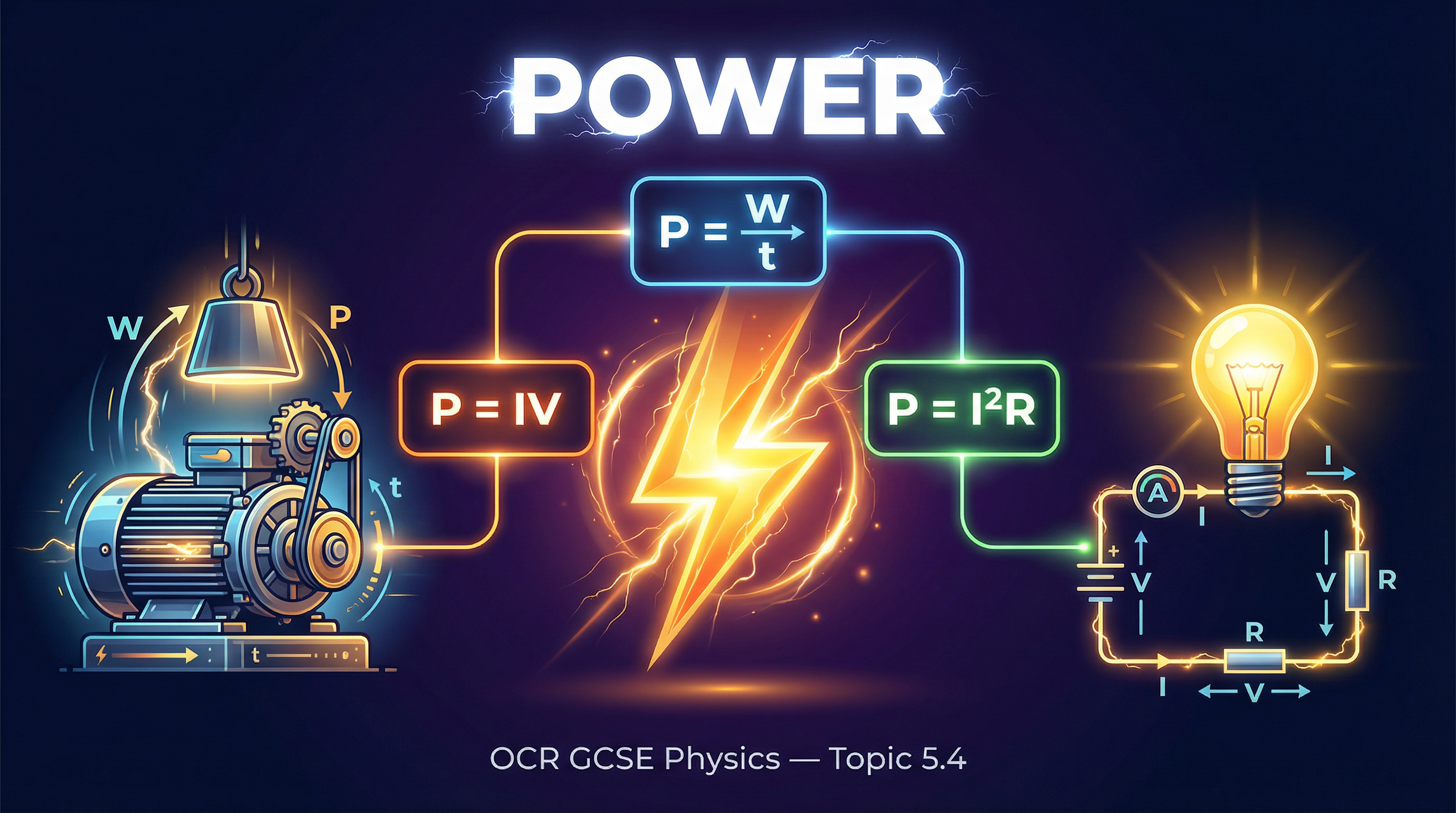
Power

    OCR
    GCSE
    Physics

    This guide provides a comprehensive, exam-focused breakdown of Power (OCR GCSE Physics 5.4), covering the crucial definitions and formulas for both mechanical and electrical contexts. It is designed to build confidence in tackling multi-step calculations and avoiding common pitfalls to maximise marks.

    5
    Min Read
    3
    Examples
    5
    Questions
    6
    Key Terms
    🎙 Podcast Episode
    Power
    10:47
    0:00-10:47

    Study Notes

    Header image for OCR GCSE Physics: Power (5.4)

    Overview

    Power, in Physics, is a fundamental concept that quantifies how quickly energy is transferred or work is done. For your OCR GCSE exam, a precise understanding of this topic is essential as it forms a bridge between the principles of mechanics (forces and motion) and electricity (circuits). Examiners frequently test candidates' ability to not only define power accurately but also to select and apply the correct formula from a suite of options depending on the context. Typical questions range from simple one-step calculations to more demanding multi-step problems, often involving efficiency calculations, which are a key area for Higher Tier candidates. Mastering this topic is not just about memorising formulas; it's about developing the analytical skill to deconstruct a problem, identify the known variables, and execute a logical, clearly-communicated solution. This guide will equip you with the knowledge and exam technique to do just that.

    Listen to the GCSE Physics Power revision podcast.

    Key Concepts

    Concept 1: Power as the Rate of Energy Transfer

    The single most important concept to grasp is the definition of power. It is not simply 'energy', but the rate at which energy is transferred. Examiners are looking for this specific wording. If you think of two identical cars, one with a 1.0-litre engine and one with a 3.0-litre engine, both can reach 70 mph. However, the car with the more powerful engine will reach that speed much faster. It is converting the chemical energy in its fuel into kinetic energy at a higher rate. This is the essence of power.

    Example: A crane lifts a 1000 kg container 15 metres upwards in 30 seconds. Another crane does the same job in 1 minute. The first crane is more powerful because it does the same amount of work (transfers the same amount of gravitational potential energy) in less time.

    Concept 2: Mechanical vs. Electrical Power

    Power is a universal concept, but in your exam, it will appear in two main flavours: mechanical and electrical. It is crucial to recognise the context of the question to choose the right formula.

    • Mechanical Power: This relates to forces and motion. When a force does work (e.g., a person running upstairs, a motor lifting a weight), the power is the work done divided by the time taken.
    • Electrical Power: This relates to circuits. When a current flows through a component (e.g., a bulb, a resistor, a motor), it transfers energy. The power is related to the current, voltage, and resistance of the component.
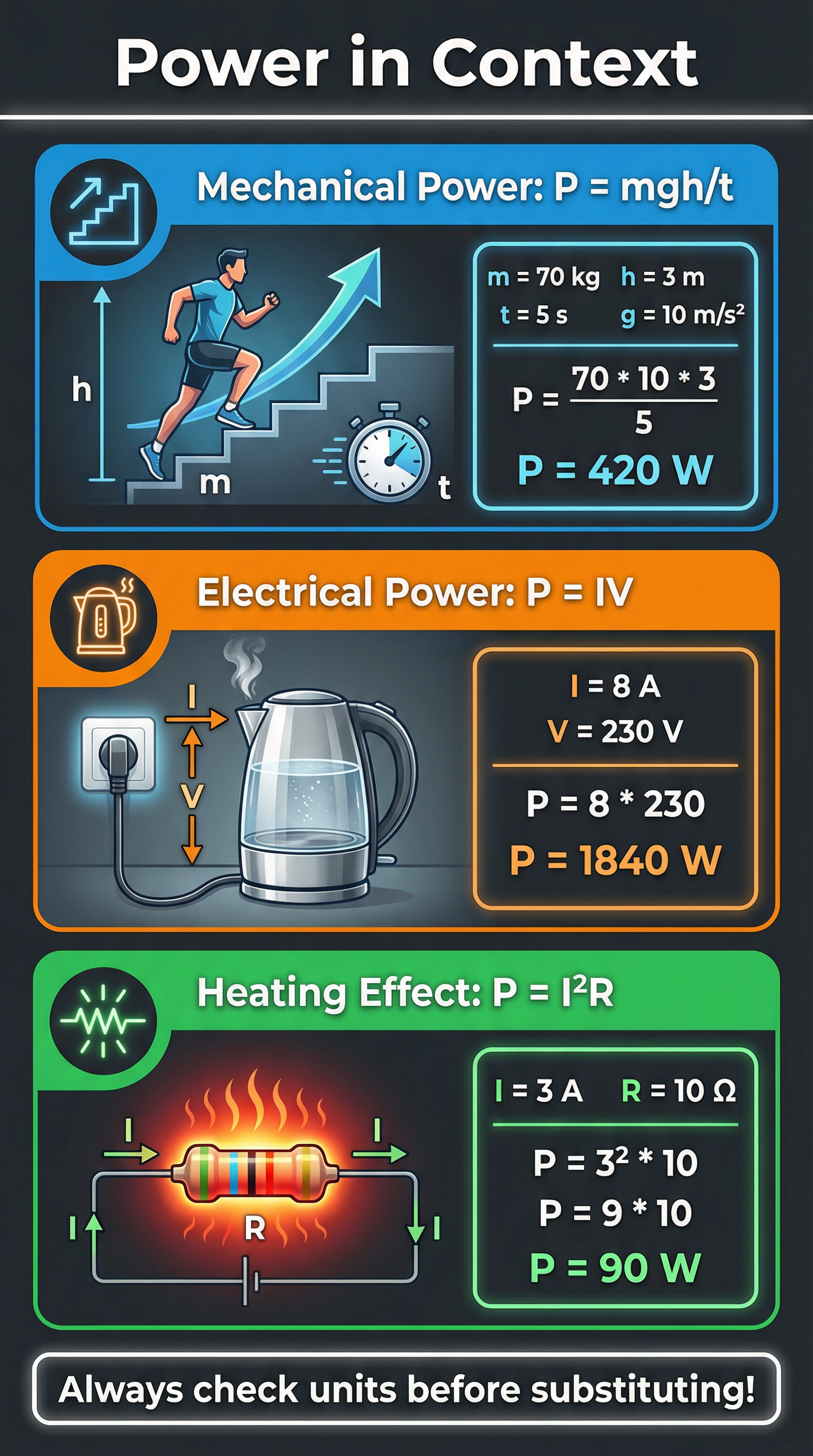
    Power in different physical contexts.

    Mathematical/Scientific Relationships

    Fluency with the following formulas is non-negotiable. You must know which to use and when.
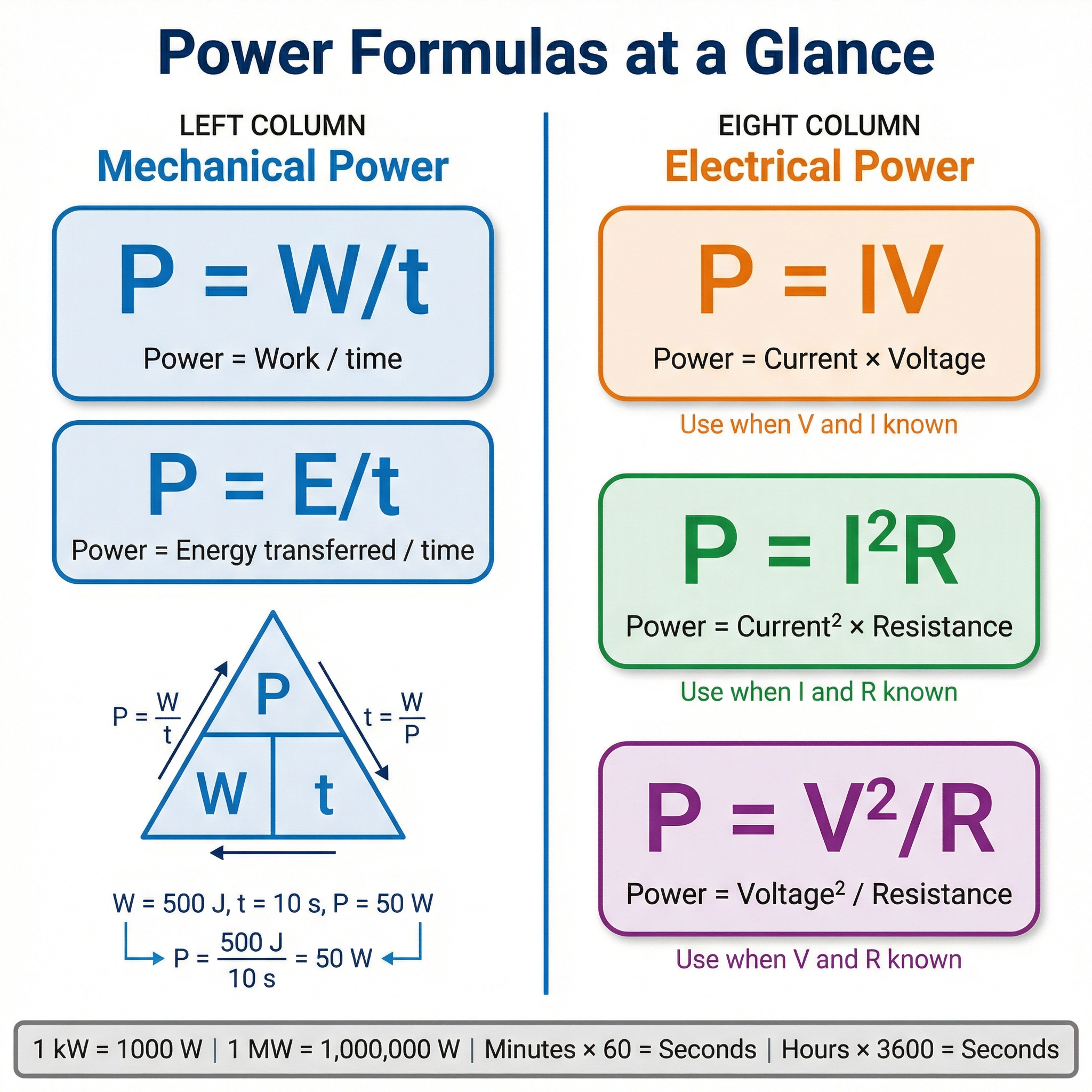
    A summary of the essential Power formulas.

    FormulaContextTierStatus
    P = W / t or P = E / tMechanical Power (Work Done / Energy Transferred over Time)BothMust memorise
    P = I × VElectrical Power (Current × Voltage)BothGiven on formula sheet
    P = I² × RElectrical Power (Current² × Resistance)BothGiven on formula sheet
    P = V² / RElectrical Power (Voltage² / Resistance)Higher OnlyGiven on formula sheet
    Efficiency = Useful Power Out / Total Power InEfficiency CalculationsBothMust memorise

    Symbol Meanings:

    • P: Power, measured in Watts (W)
    • W: Work Done, measured in Joules (J)
    • E: Energy Transferred, measured in Joules (J)
    • t: Time, measured in seconds (s)
    • I: Current, measured in Amperes (A)
    • V: Potential Difference (Voltage), measured in Volts (V)
    • R: Resistance, measured in Ohms (Ω)

    Required Practical: Investigating Power

    While there isn't a single 'Power' required practical, skills are often tested through investigations into motors or circuits.

    Example Investigation: Power of a Small Electric Motor

    • Apparatus: Low voltage DC motor, set of masses (e.g., 100g each), metre ruler, stopwatch, retort stand, clamp, boss, thread, power supply, voltmeter, ammeter.
    • Method:
      1. Set up the motor to lift a known mass (e.g., 200g = 0.2kg) by winding a thread around its spindle.
      2. Measure the height the mass will be lifted in metres (e.g., 0.5m).
      3. Connect the motor to the power supply with the ammeter in series and the voltmeter in parallel.
      4. Turn on the power supply and simultaneously start the stopwatch. Stop the watch when the mass reaches the target height.
      5. Record the time taken (t), the current (I), and the voltage (V).
      6. Calculate the input power to the motor: P_in = I × V.
      7. Calculate the useful output power: First, find the work done (Gravitational Potential Energy): E = m × g × h. Then, P_out = E / t.
      8. Calculate the efficiency of the motor: Efficiency = (P_out / P_in) × 100%.
    • Common Errors: Parallax error in reading the ruler or meters; reaction time error with the stopwatch; assuming the motor is 100% efficient.
    • Exam Application: Examiners can ask you to describe this method, analyse results from it, identify sources of error, or calculate the efficiency.

    Visual Resources

    2 diagrams and illustrations

    Power in different physical contexts.
    Power in different physical contexts.
    A summary of the essential Power formulas.
    A summary of the essential Power formulas.

    Interactive Diagrams

    2 interactive diagrams to visualise key concepts

    MechanicalElectricalWork done W and time tEnergy E and time tMotor lifting loadCurrent I and Voltage VCurrent I and Resistance RVoltage V and Resistance RTime in seconds?Time NOT in secondsStart: Power QuestionWhat context?What is given?What is given?P = W/tP = E/tStep 1: E = mgh\nStep 2: P = E/tP = IVP = I²RP = V²/RCalculate P in WattsCheck units!Final Answer in Watts ✓Convert: min×60 or hr×3600

    A flowchart to help you decide which Power formula to use based on the information given in an exam question.

    (POWER\nP = W/t\nUnit: WattMechanical PowerP = W/tW = Work Done in Joulest = Time in SecondsP = E/tE = Energy TransferredMotor ProblemsE = mgh firstThen P = E/tElectrical PowerP = IVI = Current in AmperesV = Voltage in VoltsP = I²RSquare the current!R = Resistance in OhmsP = V²/RHigher Tier focusKey Units1 W = 1 J/s1 kW = 1000 W1 MW = 1000000 WCommon MistakesJoules vs Watts confusionForgetting to square ITime not in secondsLinks to Other TopicsEnergy StoresEfficiencyElectrical CircuitsWork Done and Forces

    A concept map showing the key ideas within the topic of Power and its connections to other areas of the Physics specification.

    Worked Examples

    3 detailed examples with solutions and examiner commentary

    Practice Questions

    Test your understanding — click to reveal model answers

    Q1

    State the principle of conservation of energy.

    1 marks
    foundation

    Hint: What can and can't happen to energy?

    Q2

    A toaster with a power rating of 1.2 kW is used for 2 minutes. Calculate the energy transferred.

    3 marks
    standard

    Hint: Remember to convert both kilowatts and minutes into their standard units before calculating.

    Q3

    Explain why a thick wire is used for the heating element in a powerful electric heater.

    3 marks
    standard

    Hint: Think about the relationship between thickness and resistance, and then how resistance affects power.

    Q4

    A crane has a motor with an input power of 20 kW. It lifts a 1.5-tonne car 10 m high in 12 s. Calculate the efficiency of the motor. (g = 10 N/kg)

    5 marks
    challenging

    Hint: This is a multi-step problem. First find the useful output power, then use the given input power to find efficiency. Remember to convert tonnes to kg!

    Q5

    Two resistors, R1 = 10 Ω and R2 = 20 Ω, are connected in series to a 6 V battery. Compare the power dissipated by R1 with the power dissipated by R2.

    4 marks
    challenging

    Hint: In a series circuit, the current is the same through both components. Which power formula is most useful here?

    Explore this topic further

    View Topic PageAll Physics Topics

    Key Terms

    Essential vocabulary to know

    More Physics Study Guides

    View all

    Refraction

    OCR
    GCSE

    This guide explains light refraction for OCR GCSE Physics (4.6), covering why light bends, how to draw ray diagrams, and the secrets to exam success. Master the concepts of optical density and total internal reflection to secure top marks.

    Isotopes

    OCR
    GCSE

    This guide provides a comprehensive overview of isotopes for OCR GCSE Physics (7.2), focusing on core definitions, calculations, and exam technique. It's designed to help you secure maximum marks by mastering the difference between isotopes and ions, understanding nuclear notation, and avoiding common pitfalls.

    Galaxies

    OCR
    GCSE

    Unlock top marks in your OCR GCSE Physics exam by mastering Galaxies (Topic 8.7). This guide breaks down the vastness of space into bite-sized, exam-focused chunks, from the structure of our Milky Way to the mind-bending evidence for the Big Bang.

    Planets

    OCR
    GCSE

    This topic covers the structure of our Solar System, the role of gravitational forces in maintaining planetary orbits, and the historical shift from geocentric to heliocentric models. Understanding these concepts is essential for securing marks in both Foundation and Higher Tier questions, particularly those testing orbital mechanics and the nature of scientific progress.

    Stars

    OCR
    GCSE

    Explore the dramatic life and death of stars, from stable main sequence suns to explosive supernovae. This guide for OCR GCSE Physics (8.6) provides everything candidates need to master stellar evolution, secure top marks, and understand our cosmic origins."

    The Solar System

    OCR
    GCSE

    This guide covers OCR GCSE Physics Topic 8.1, The Solar System. It explores the shift from geocentric to heliocentric models, the physics of orbital motion, and the complete life cycles of stars. Mastering this topic is crucial for tackling high-mark questions on stellar evolution and gravitational forces.