Study Notes
Overview
Welcome to the essential guide for Topic 5.6: Renewable and Non-Renewable Energy Resources. This topic is a cornerstone of your GCSE Physics course, blending pure scientific principles with real-world applications and environmental considerations. Examiners frequently test this area through a mix of short-answer (AO1) and longer, evaluative (AO3) questions. A solid grasp of the distinctions between resources, their operational principles, and their respective advantages and disadvantages is crucial. This guide will equip you with the precise language, comparative skills, and exam technique needed to analyse energy resources like a top-tier candidate. We will connect these concepts to electricity generation (Topic 5.2) and the particle model (Topic 3.1), providing the synoptic links that examiners reward.
Key Concepts
Concept 1: The Fundamental Split - Renewable vs. Non-Renewable
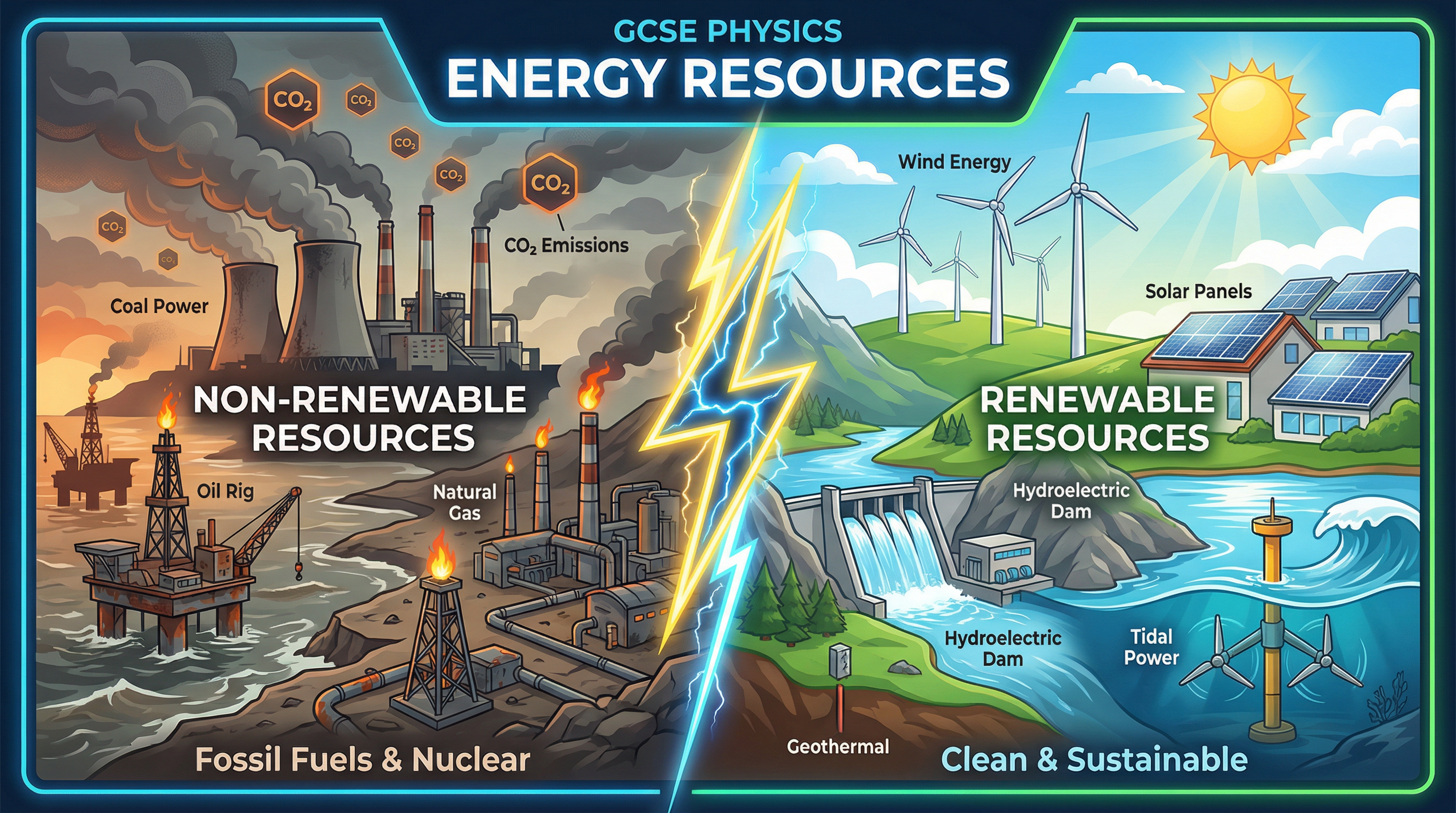
At its core, this topic is about classifying energy resources. The primary distinction is based on whether a resource is finite or can be replenished.
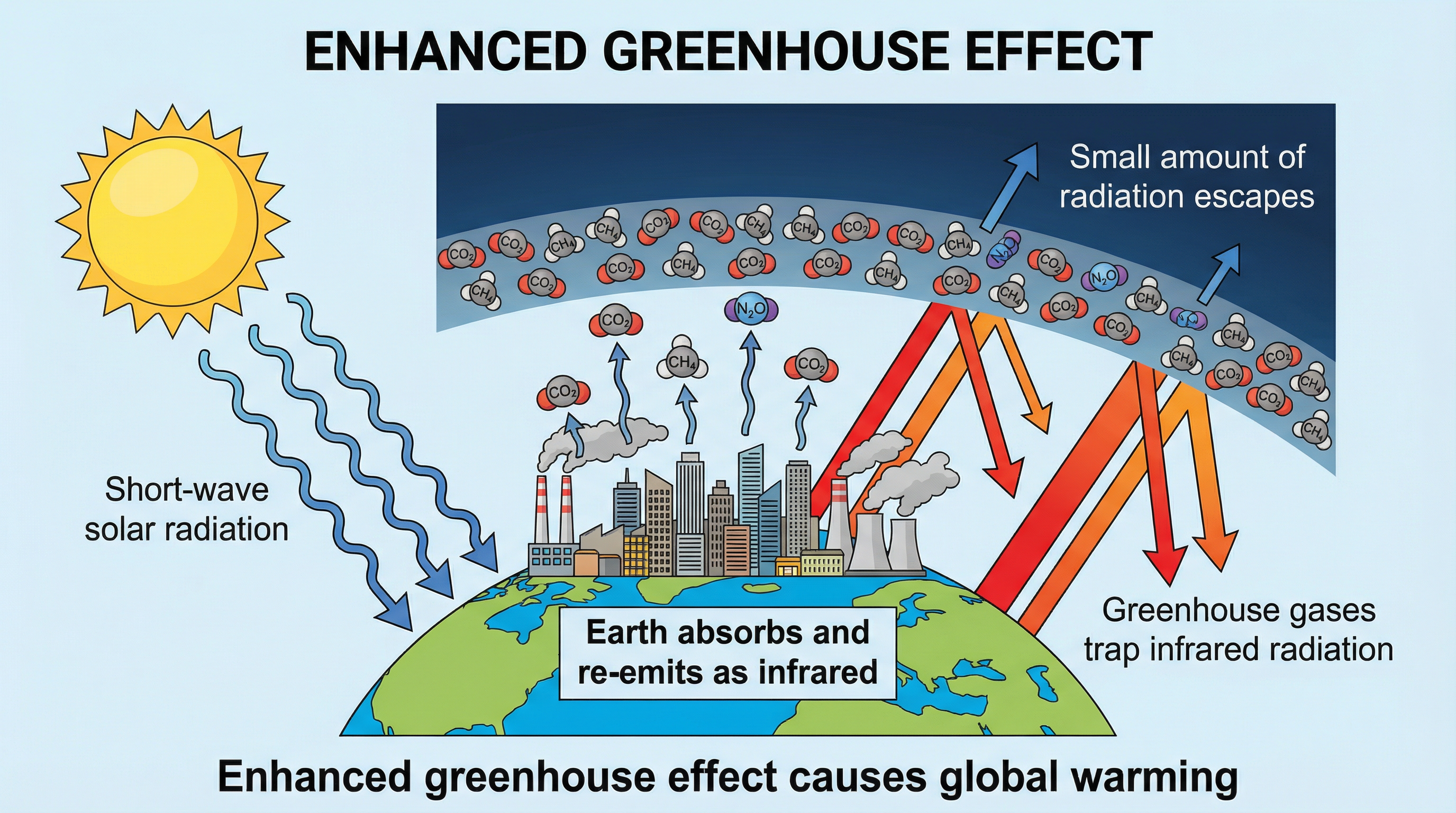
Non-Renewable Resources are finite - they are consumed when used and cannot be replaced within a human lifespan. The main categories are fossil fuels (coal, oil, natural gas) and nuclear fuels (like uranium and plutonium). Fossil fuels were formed from the remains of ancient plants and animals over millions of years. When combusted, the stored chemical energy is released to heat water into steam, which drives turbines connected to generators. The critical environmental problem is the release of large quantities of carbon dioxide (CO2), a greenhouse gas that enhances the greenhouse effect and drives global warming. Nuclear fuels store vast energy within the atomic nucleus, released via nuclear fission. Nuclear power produces no greenhouse gases during operation, but generates highly dangerous radioactive waste and requires expensive, time-consuming decommissioning at the end of the plant's life.
Renewable Resources are naturally replenished as they are used and will not run out. Examples include solar, wind, hydroelectric, tidal, geothermal, and biomass. These harness ongoing natural processes: photovoltaic cells convert sunlight directly into electricity; wind turbines capture the kinetic energy of moving air; hydroelectric dams harness the gravitational potential energy of falling water.
Concept 2: Reliability - The 24/7 Question
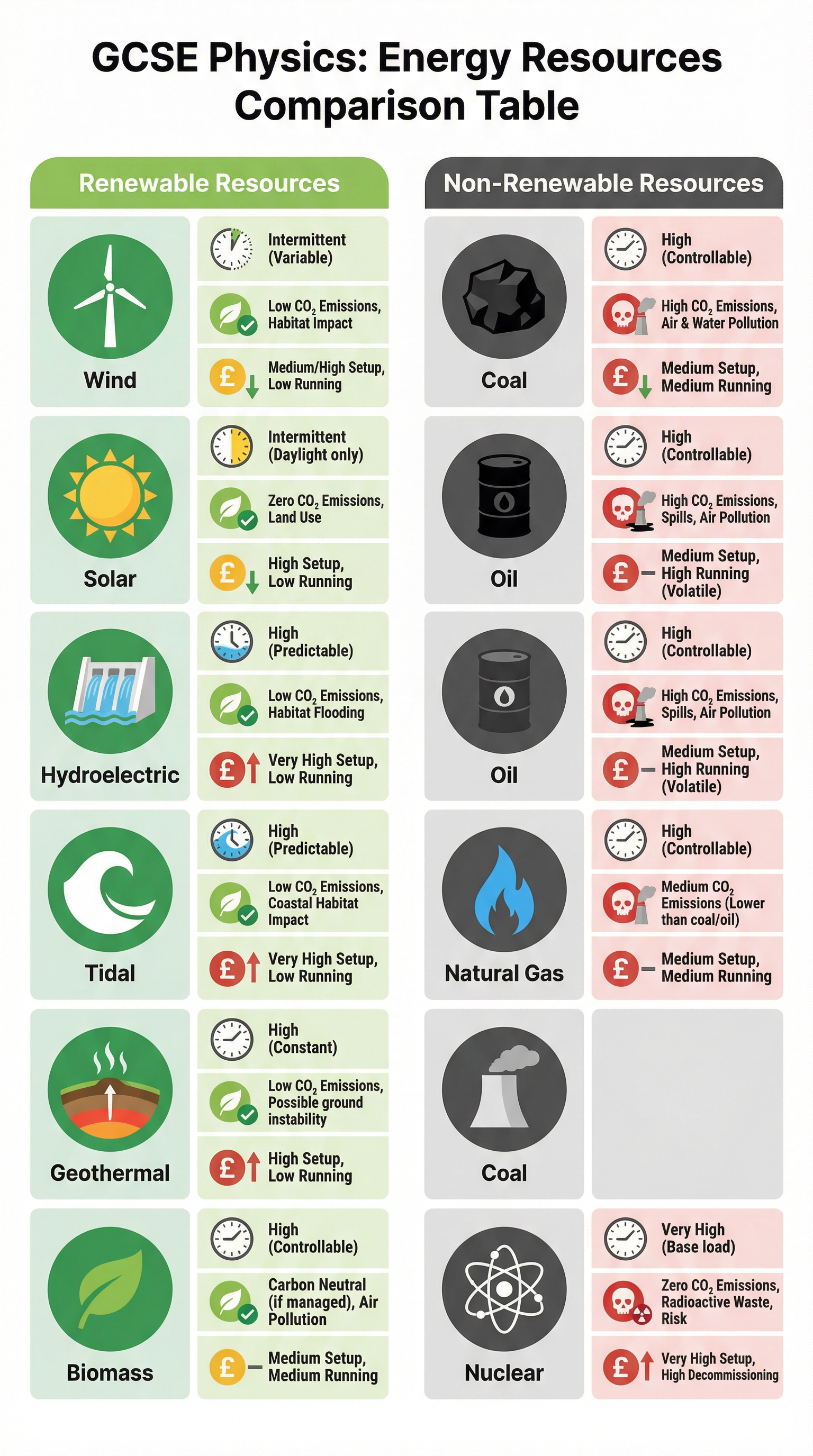
Reliability is a critical evaluation point and a common source of confusion. A reliable energy resource can generate electricity on demand, at any time, regardless of external conditions.
- Reliable Sources: Fossil fuels, nuclear, geothermal, tidal, and biomass are generally reliable. Their output is controllable.
- Unreliable (Intermittent) Sources: Wind and solar are unreliable. Their output depends entirely on the weather.
Examiner Tip: Do not confuse 'reliable' with 'renewable'. A resource can be renewable but unreliable (e.g., wind). A resource can be reliable but non-renewable (e.g., coal). Marks are awarded for this precise distinction.
Concept 3: Environmental Impact - Be Specific!
Examiners expect specific details, not vague statements like 'harms the environment'. Always name the pollutant and its specific effect.
- Fossil Fuels: Release carbon dioxide (CO2), contributing to the enhanced greenhouse effect and global warming. Burning coal also releases sulfur dioxide (SO2), which causes acid rain.
- Nuclear: Produces no greenhouse gases during operation. However, it generates radioactive waste that remains hazardous for centuries and requires secure, long-term storage. There is also a small risk of catastrophic accidents releasing radioactive material.
- Renewables: While often described as 'clean', most have some environmental impact. Hydroelectric dams require flooding vast areas, destroying terrestrial habitats. Wind turbines can be a visual and noise pollutant. Tidal barrages can alter coastal ecosystems. Biomass releases CO2 on burning, though this is considered 'carbon neutral' if managed sustainably.
Concept 4: Economic Considerations - Capital vs. Running Costs
A key distinction that earns marks in evaluation questions is the difference between start-up (capital) costs and running (fuel/operational) costs.
| Resource | Start-Up Cost | Running Cost | Rationale |
|---|---|---|---|
| Nuclear | Very High | Low | Expensive to build and decommission; fuel is cheap |
| Wind | High | Very Low | Turbines are expensive; no fuel needed |
| Solar | High | Very Low | Panels are expensive; no fuel needed |
| Coal/Gas | Medium | Medium-High | Cheaper to build; ongoing fuel costs |
| Hydroelectric | Very High | Very Low | Dam construction is enormous; no fuel needed |
Mathematical/Scientific Relationships
While this topic is largely descriptive and evaluative, it builds on the core formula for power and energy.
Power, Energy and Time (Must memorise):
- Power (W) = Energy transferred (J) / Time (s), or P = E / t
- Rearranged: E = P x t
- In practical contexts, energy is often measured in kilowatt-hours (kWh) and power in kilowatts (kW).
- Energy (kWh) = Power (kW) x Time (h)
Efficiency (Given on formula sheet):
- Efficiency = Useful power output / Total power input
- No energy transfer is 100% efficient; some energy is always dissipated as heat.
Unit Conversions to Remember:
- 1 kW = 1000 W
- 1 MW = 1,000,000 W = 1000 kW
- 1 GW = 1,000,000,000 W = 1,000,000 kW
Practical Applications
The UK's National Grid is the prime real-world application of this topic. It is a complex network that balances supply from various power stations to meet national demand at all times. To manage the unreliability of renewables, the grid requires reliable fossil fuel or nuclear power stations to be available as a 'spinning reserve' - ready to increase output at short notice. This is a perfect context for an evaluation question about the need for a diverse energy mix.