Study Notes
Overview
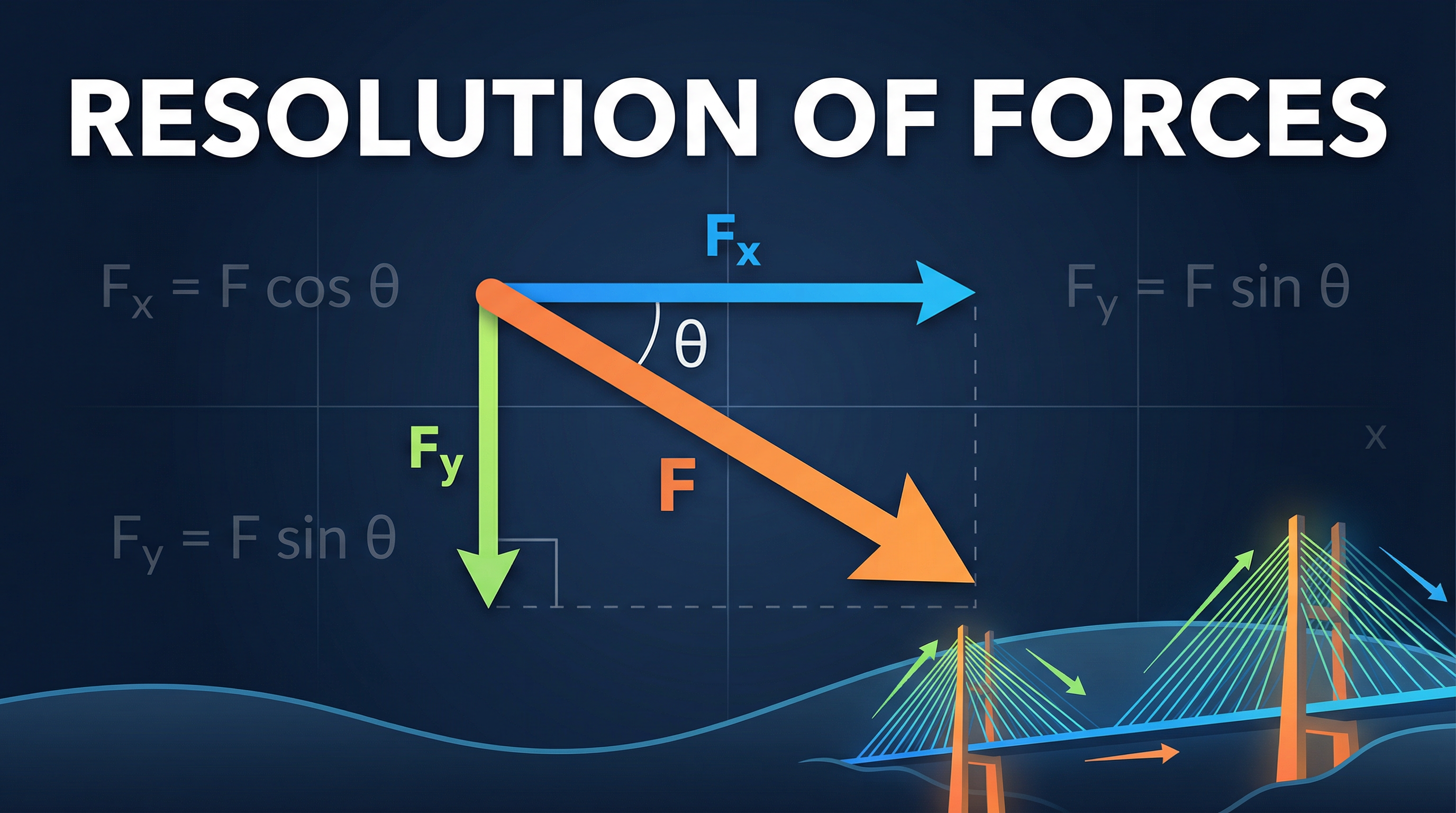
Welcome to your deep dive into the Resolution of Forces, section 2.4 of the OCR GCSE Physics specification. This topic is fundamental to understanding how objects behave under the influence of multiple forces. At its core, resolving forces is about breaking down a single force that acts at an angle into two separate forces that act at right angles to each other, typically horizontally and vertically. This skill is essential because it simplifies complex problems, allowing us to apply Newton's Laws in a more straightforward manner. For example, understanding how the tension in a suspension bridge cable supports the roadway requires us to resolve that tension into its vertical and horizontal parts. In your exam, questions will test your ability to do this using both precise scale drawings (a key AO2 skill) and, for Higher Tier candidates, trigonometric calculations. You will be expected to find a resultant force from several components or resolve a single force into its components. Mastering this topic is not just about learning formulas; it's about developing a powerful analytical tool that unlocks a deeper understanding of mechanics.
Key Concepts
Concept 1: Forces as Vectors
A force is a vector quantity. This is a definition that carries marks. It means a force has both magnitude (its size, measured in Newtons, N) and direction. This is unlike a scalar quantity, like mass or temperature, which only has magnitude. When we draw forces, we represent them as arrows. The length of the arrow represents the magnitude of theforce, and the way the arrow points shows its direction. This is why scale drawings are so important in this topic; the length and direction of your drawn arrows must accurately represent the forces in the question.
Example: A force of 10 N acting to the right is a different vector from a force of 10 N acting upwards, even though their magnitudes are the same.
Concept 2: The Resultant Force
Often, an object has multiple forces acting on it simultaneously. The resultant force is the single force that would have the same effect as all the individual forces acting together. If the resultant force is zero, the forces are balanced, and the object is in equilibrium (it is either stationary or moving at a constant velocity). If the resultant force is not zero, the object will accelerate in the direction of the resultant force, as described by Newton's Second Law (F=ma).
Concept 3: The Tip-to-Tail Method for Finding Resultants
To find the resultant of two or more forces graphically, we use the tip-to-tail method. You draw the vector arrows one after another, with the tail of each new vector starting at the tip (the arrowhead) of the previous one. The resultant force is the vector drawn from the tail of the very first vector to the tip of the very last vector. It 'closes the triangle' (or polygon, if there are more than two forces).
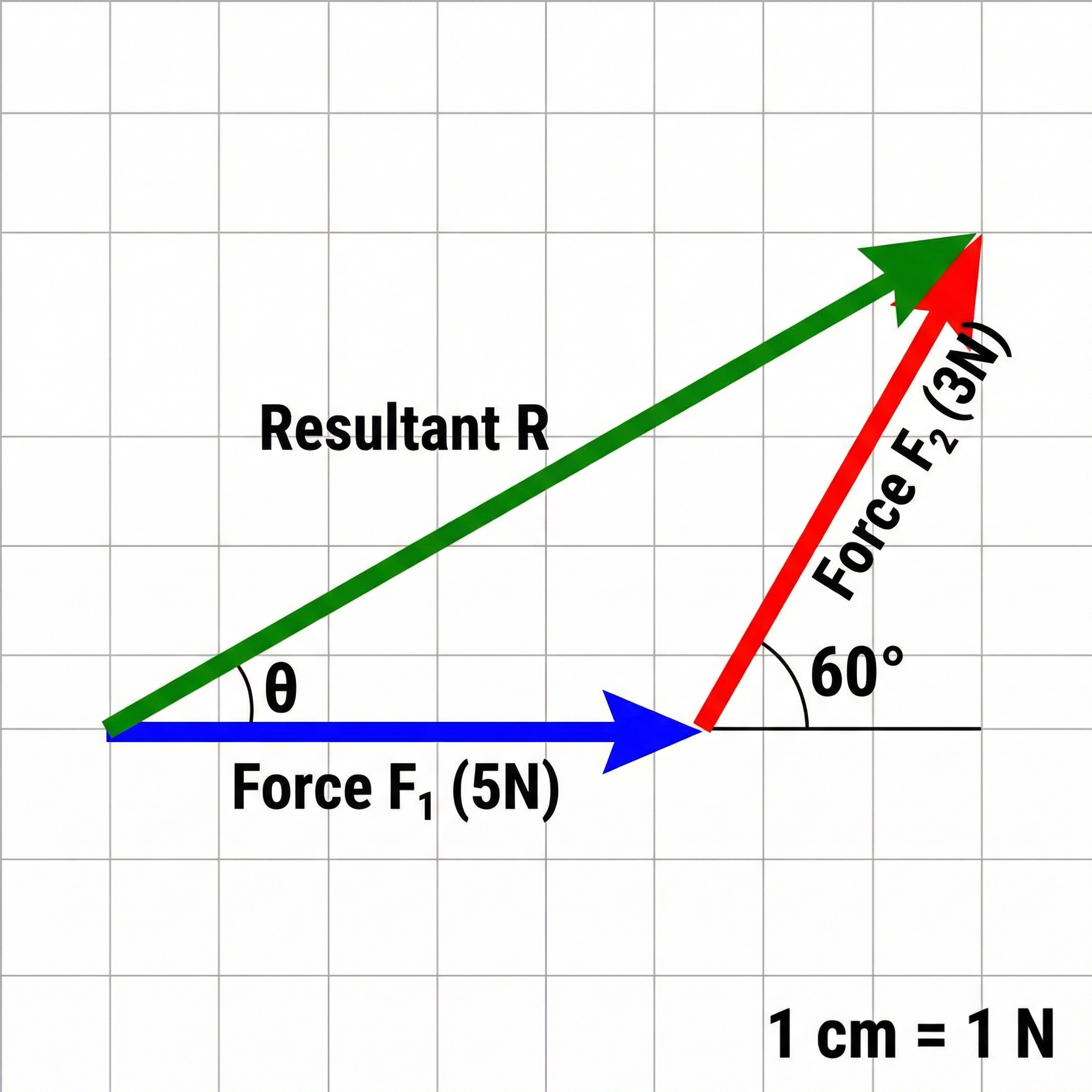
Example: If a force of 4 N acts to the right and a force of 3 N acts upwards, you would draw a 4 cm arrow (assuming a scale of 1 cm = 1 N) to the right, and then from its tip, draw a 3 cm arrow upwards. The resultant is the arrow from the start of the first arrow to the end of the second. Its length would be 5 cm (representing 5 N) and it would point up and to the right.
Concept 4: Resolving a Force into Components
This is the reverse of finding a resultant. We start with a single force acting at an angle and split it into two perpendicular components. These components, acting together, are equivalent to the original force. This is incredibly useful for analysing situations like an object on a slope or the forces in a cable.
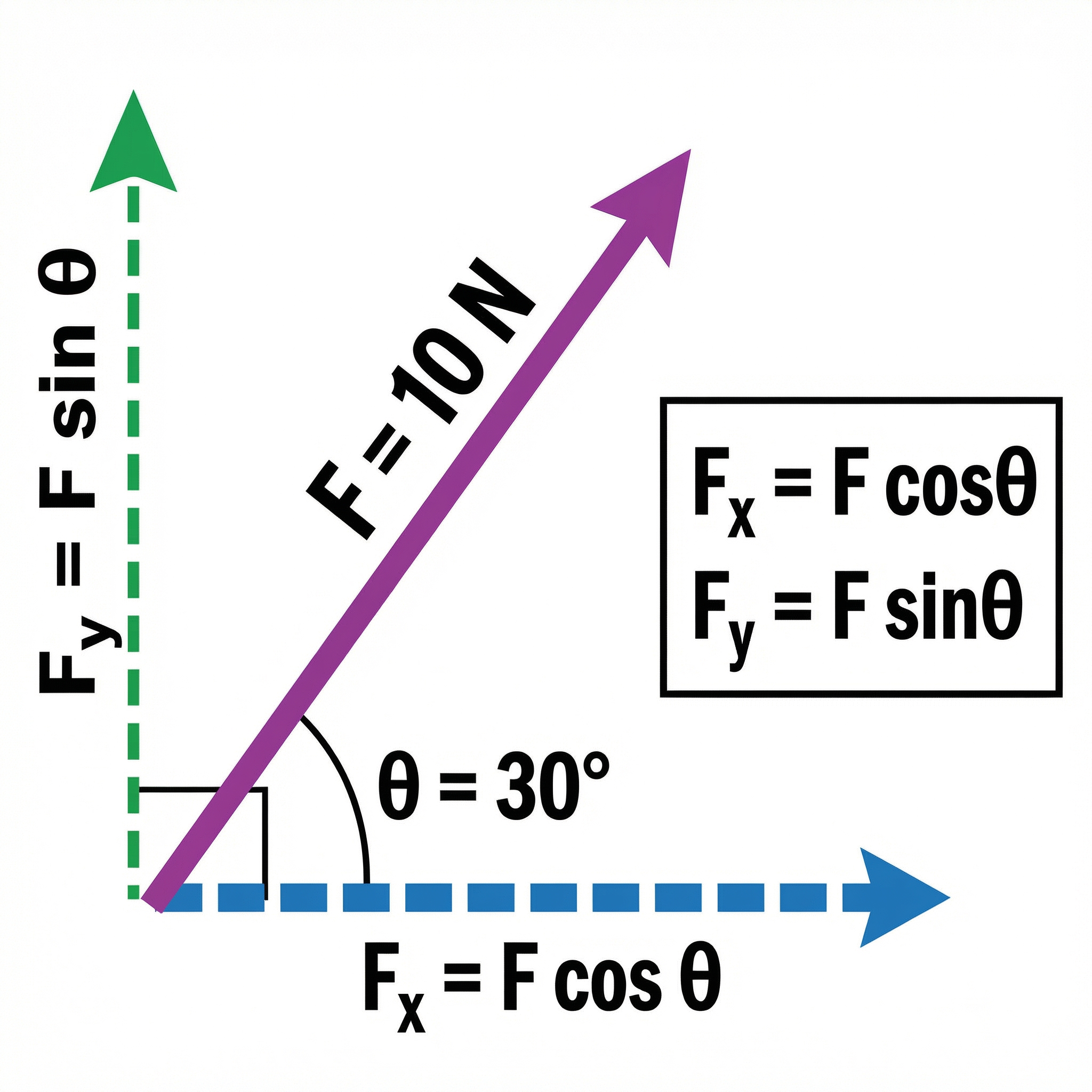
Example: A child pulls a toy cart with a string at an angle of 30° to the horizontal. Only the horizontal component of the pulling force actually moves the cart forward. The vertical component is just lifting the cart slightly. To find out how much force is causing the acceleration, we must resolve the tension in the string into its horizontal and vertical components.
Mathematical/Scientific Relationships
Here are the key mathematical tools you need. Examiners expect you to select the correct one for the job.
1. Scale Drawing
- Usage: For finding the resultant of any number of forces acting in different directions.
- Method: Choose a scale (e.g., 1 cm = 5 N). Draw vectors to scale and tip-to-tail. The resultant is the vector that closes the shape.
- Formula Sheet: Not a formula, but a key AO2 skill.
2. Pythagoras' Theorem
- Usage: For calculating the magnitude of the resultant force only when two forces are acting at right angles (90°) to each other.
- Formula:
R² = Fx² + Fy²where R is the resultant and Fx and Fy are the perpendicular component forces. - Formula Sheet: You must memorise this relationship.
3. Trigonometry (SOHCAHTOA) - Higher Tier Only
- Usage: For calculating the components of a force, or for finding the angle of a resultant force.
- Formulas:
sin(θ) = Opposite / Hypotenusecos(θ) = Adjacent / Hypotenusetan(θ) = Opposite / Adjacent
- To Resolve a Force F at angle θ to the horizontal:
- Horizontal Component (Fx) =
F * cos(θ)(Must memorise) - Vertical Component (Fy) =
F * sin(θ)(Must memorise)
- Horizontal Component (Fx) =
- Formula Sheet: The basic SOHCAHTOA definitions are assumed knowledge. The component formulas must be memorised and, more importantly, understood.
Warning: Always check your calculator is in Degrees (DEG) mode before an exam. Using Radians (RAD) will lead to incorrect answers and zero marks for calculations.
Practical Applications
- Suspension Bridges: The angled cables are under tension. This tension force can be resolved into a vertical component, which holds the road deck up, and a horizontal component, which pulls inwards on the towers.
- Sailing: A sailboat can sail into the wind by angling its sail. The wind pushes on the sail, and this force is resolved. A component of the wind force pushes the boat forward.
- Objects on a Slope: An object on a ramp has its weight acting vertically downwards. We resolve this weight into a component acting parallel to the slope (trying to make it slide down) and a component acting perpendicular to the slope (pushing it into the ramp).
- Towing a Car: When a tow truck pulls a car with a rope at an angle, the tension in the rope has a horizontal component that pulls the car forward and a vertical component that lifts it slightly.