Study Notes
Overview
Welcome to one of the most foundational topics in your entire OCR GCSE Physics course: Scalar and Vector Quantities (Specification reference 1.1). Understanding the distinction between these two types of measurement is not just a small topic to tick off; it is the bedrock upon which your understanding of motion, forces, momentum, and even electricity will be built. Examiners frequently test this concept directly through multiple-choice questions and short-answer definitions, but more importantly, a failure to grasp it can lead to lost marks in longer, more complex problems throughout both exam papers. This guide will break down the core ideas, show you how to represent vectors, and provide step-by-step methods for solving vector-based problems, ensuring you can confidently demonstrate your understanding under exam conditions. You will learn not just what scalars and vectors are, but why this distinction is critical for accurately describing the physical world.
Key Concepts
Concept 1: Defining Scalar and Vector Quantities
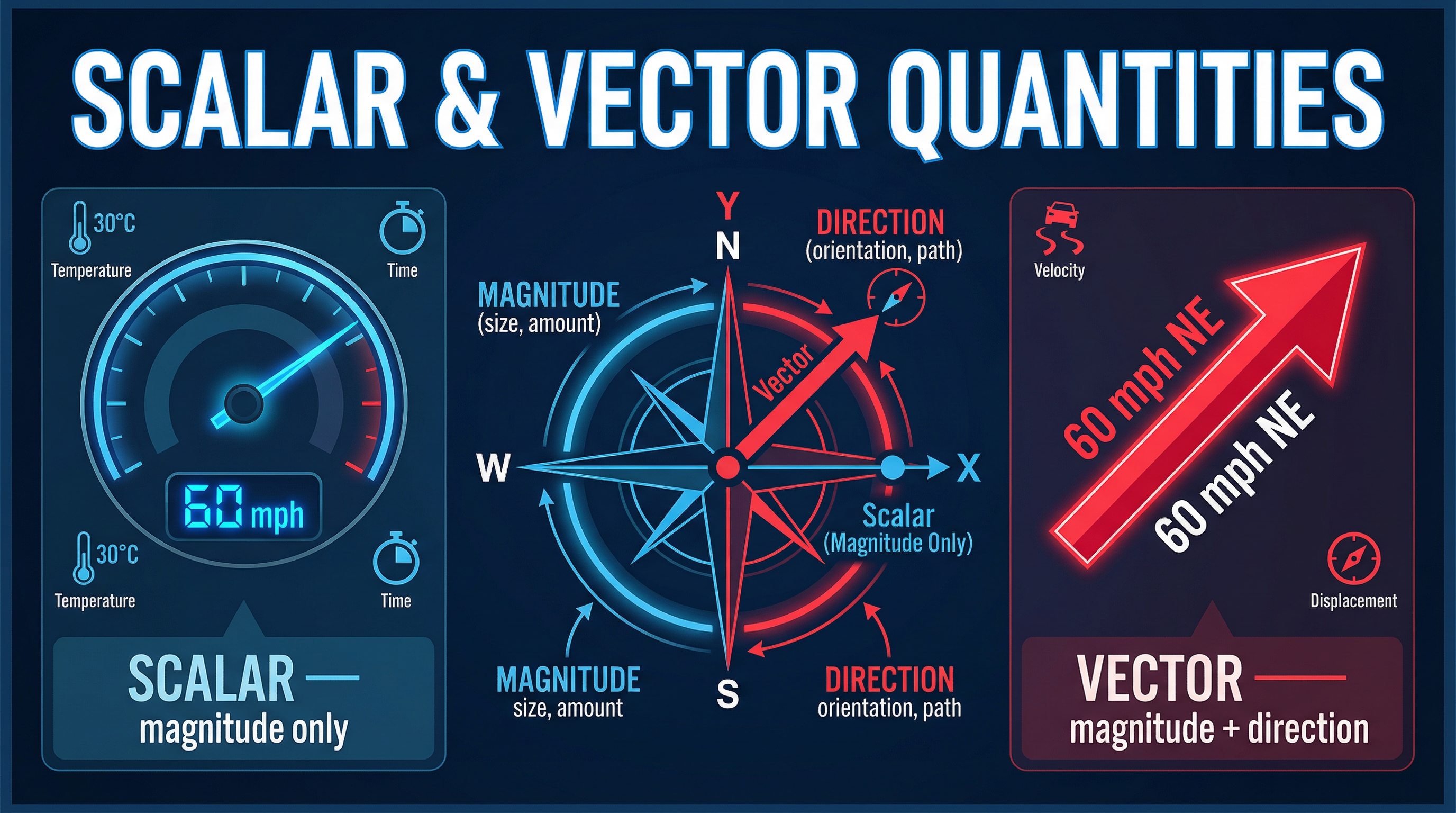
A scalar quantity is a measurement that is fully described by a magnitude (a numerical value or size) alone. Think of it as answering the question "how much?". For example, if you measure the mass of an apple to be 0.15 kilograms, you have all the information needed. The direction is irrelevant and meaningless. Examiners award one mark for a clear definition: "a quantity with magnitude only".
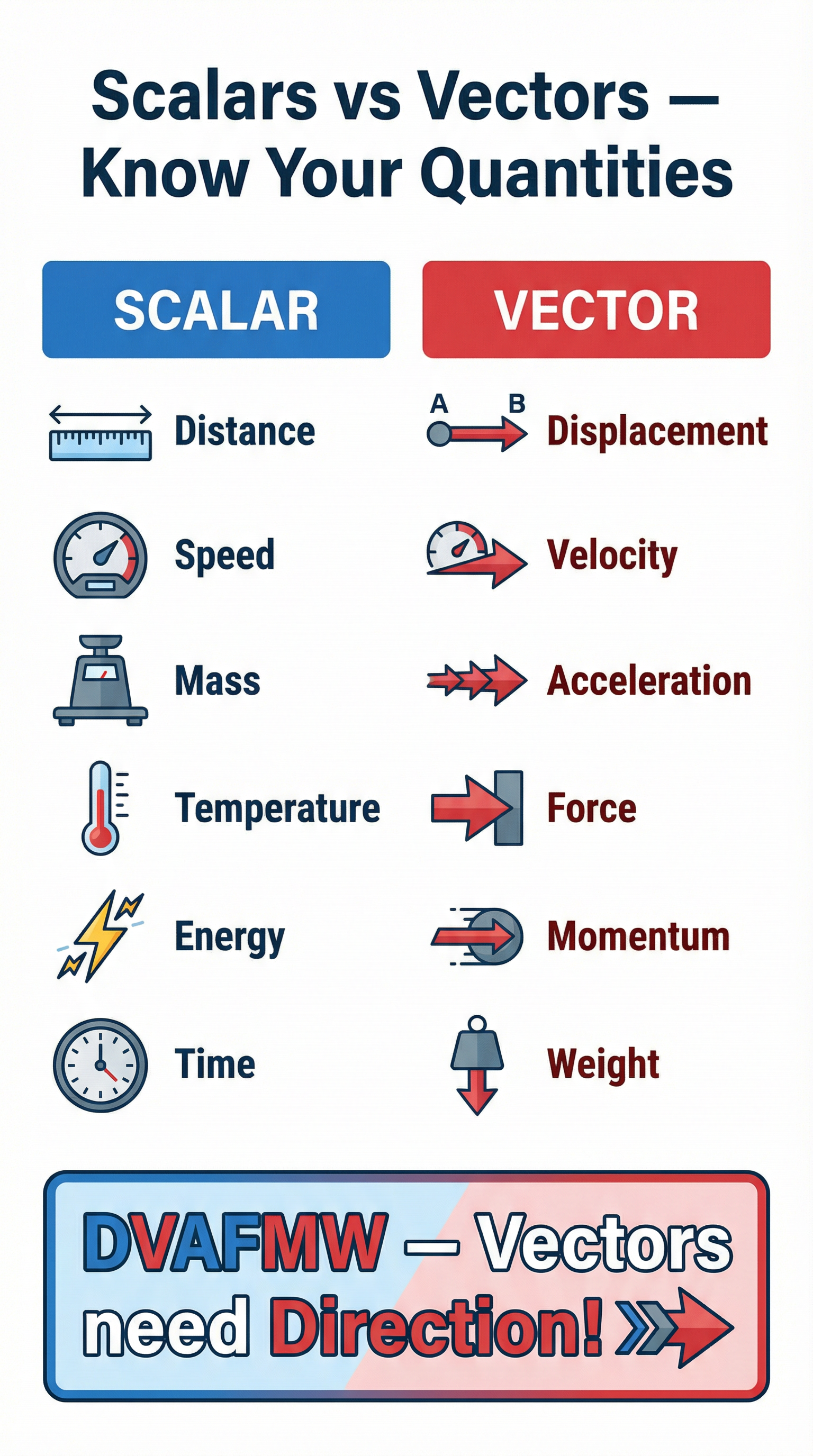
Examples of Scalars:
- Distance: The total path length covered by a moving object (e.g., 500 metres).
- Speed: How fast an object is moving (e.g., 30 metres per second).
- Mass: The amount of matter in an object (e.g., 70 kilograms).
- Energy: The capacity to do work (e.g., 1200 Joules).
- Temperature: The degree of hotness or coldness (e.g., 25 degrees Celsius).
- Time: The duration between two events (e.g., 60 seconds).
A vector quantity is a measurement that requires both magnitude and direction to be fully described. It answers both "how much?" and "which way?". A classic example is force. Pushing a door with a force of 20 Newtons is not enough information; you must specify the direction of the push (e.g., forwards, upwards, north) to understand the effect. The corresponding mark-scheme definition is: "a quantity with both magnitude and direction".
Examples of Vectors:
- Displacement: The straight-line distance and direction from a starting point to a finishing point (e.g., 50 metres due East).
- Velocity: The rate of change of displacement; i.e., speed in a given direction (e.g., 30 metres per second North).
- Acceleration: The rate of change of velocity (e.g., 9.8 m/s² downwards).
- Force: A push or pull on an object (e.g., 50 Newtons to the right).
- Weight: The force of gravity acting on an object (e.g., 686 Newtons downwards).
- Momentum: The product of mass and velocity (e.g., 200 kg m/s forwards).
Concept 2: The Distance vs. Displacement Trap
This is a favourite area for examiners to catch out unwary candidates.
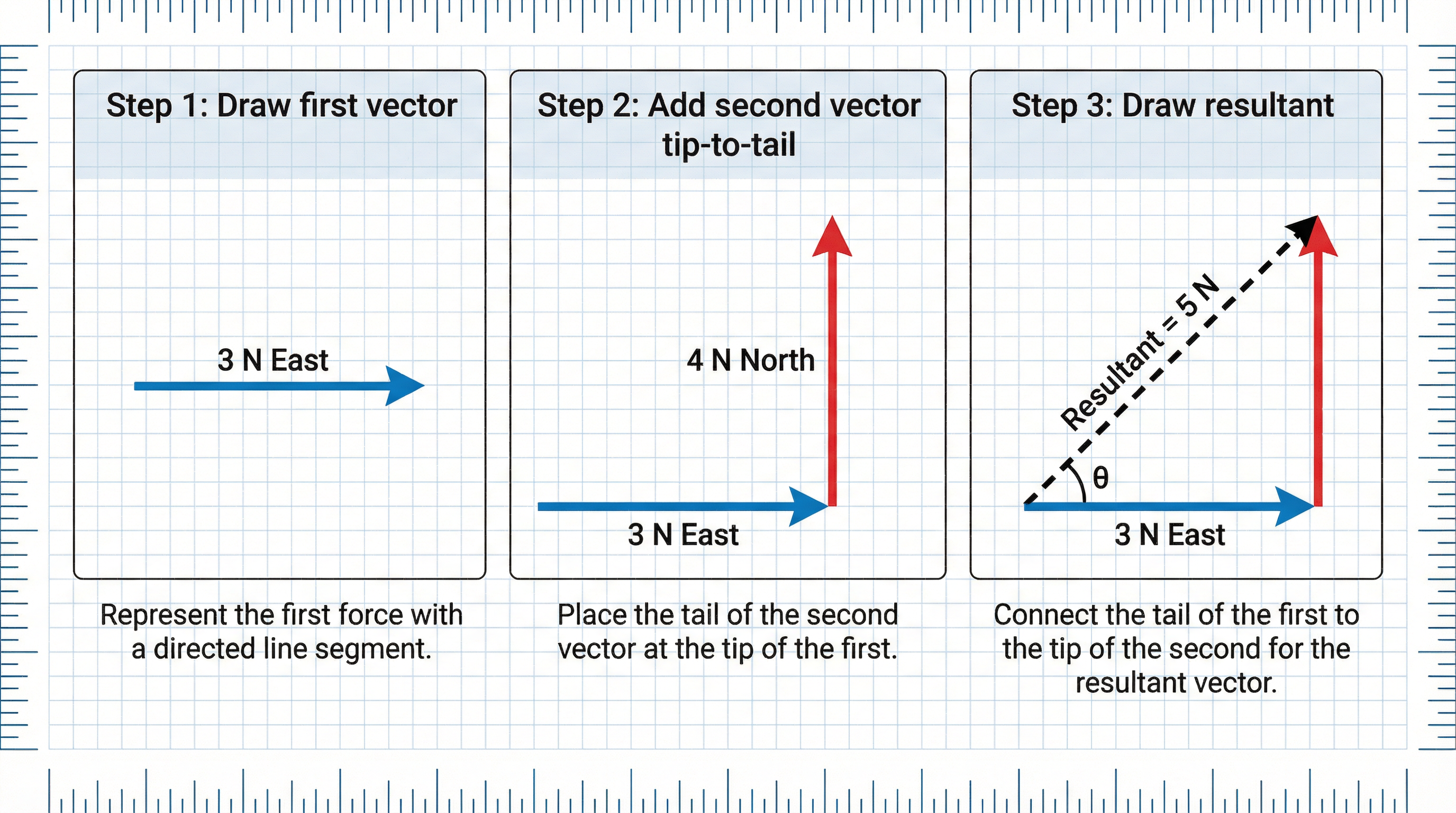
- Distance (scalar): Imagine walking 3 metres east, then turning and walking 4 metres north. The total distance you have walked is simply the sum of the path lengths: 3 m + 4 m = 7 metres.
- Displacement (vector): Using the same example, your displacement is the straight-line separation between your start and end points. You have moved from your origin to a point that is 3 metres east and 4 metres north of where you began. The magnitude of this displacement is found using Pythagoras' theorem (√(3² + 4²) = 5 metres), and the direction must also be stated (e.g., at a bearing of 037 degrees). If you walk one full lap of a 400m running track and end up where you started, your distance travelled is 400m, but your displacement is 0m.
Concept 3: Representing Vectors
Vectors are visually represented by an arrow. This is a fundamental skill. Credit is given in exams for correctly drawn vector diagrams.
- The length of the arrow is drawn to scale to represent the magnitude of the vector.
- The direction the arrow points represents the direction of the vector.
An arrow without an arrowhead is just a line and will not be credited as a vector.
Mathematical/Scientific Relationships
Resultant of Two Perpendicular Vectors (Higher Tier)
When two vectors act at a right angle (90°) to each other, their combined effect, the resultant vector, can be calculated using Pythagoras' Theorem and basic trigonometry. This is a common 2 or 3-mark calculation.
- Formula for Magnitude: R² = A² + B² (where R is the resultant, and A and B are the two perpendicular vectors). This is from the formula sheet, but you must know how to apply it.
- Formula for Direction: tan(θ) = Opposite / Adjacent. This must be memorised.
Example: A force of 6 N acts horizontally and a force of 8 N acts vertically on a point. To find the resultant:
- Magnitude: R = √(6² + 8²) = √(36 + 64) = √100 = 10 N.
- Direction: θ = tan⁻¹(8/6) = 53.1°. The full answer is 10 N at 53.1° to the horizontal.
Vector Addition by Scale Drawing (Both Tiers)
To find the resultant of any two vectors (not just perpendicular ones), you can use a scale diagram. This requires precision.
- Choose a scale: e.g., 1 cm = 5 N.
- Draw the first vector: Use a ruler and protractor to draw the first arrow to the correct length and in the correct direction.
- Draw the second vector tip-to-tail: Start drawing the second vector from the tip (the arrowhead) of the first vector.
- Draw the resultant: The resultant is the arrow drawn from the tail of the first vector to the tip of the second vector.
- Measure: Measure the length of the resultant arrow and use your scale to find its magnitude. Measure the angle with a protractor to find its direction.
Practical Applications
- Navigation and Aviation: Pilots and ship captains constantly use vector addition to determine their velocity relative to the ground. They must account for their engine velocity and the velocity of the wind or water current. The resultant velocity determines their actual path.
- Structural Engineering: When designing bridges and buildings, engineers must calculate the forces acting in all the structural members. These are vector quantities, and the resultant force at any point must be zero for the structure to be in equilibrium (stable).
- Sports Science: The velocity of a tennis ball after being struck by a racket is the resultant of its initial velocity and the velocity imparted by the racket. Understanding vector addition is key to analysing performance in many sports.
- Required Practical Context: While there isn't a specific required practical on vectors, the principles are tested in the context of forces. For example, in experiments with forces on an inclined plane or resolving forces using a force board, you are applying vector principles directly.