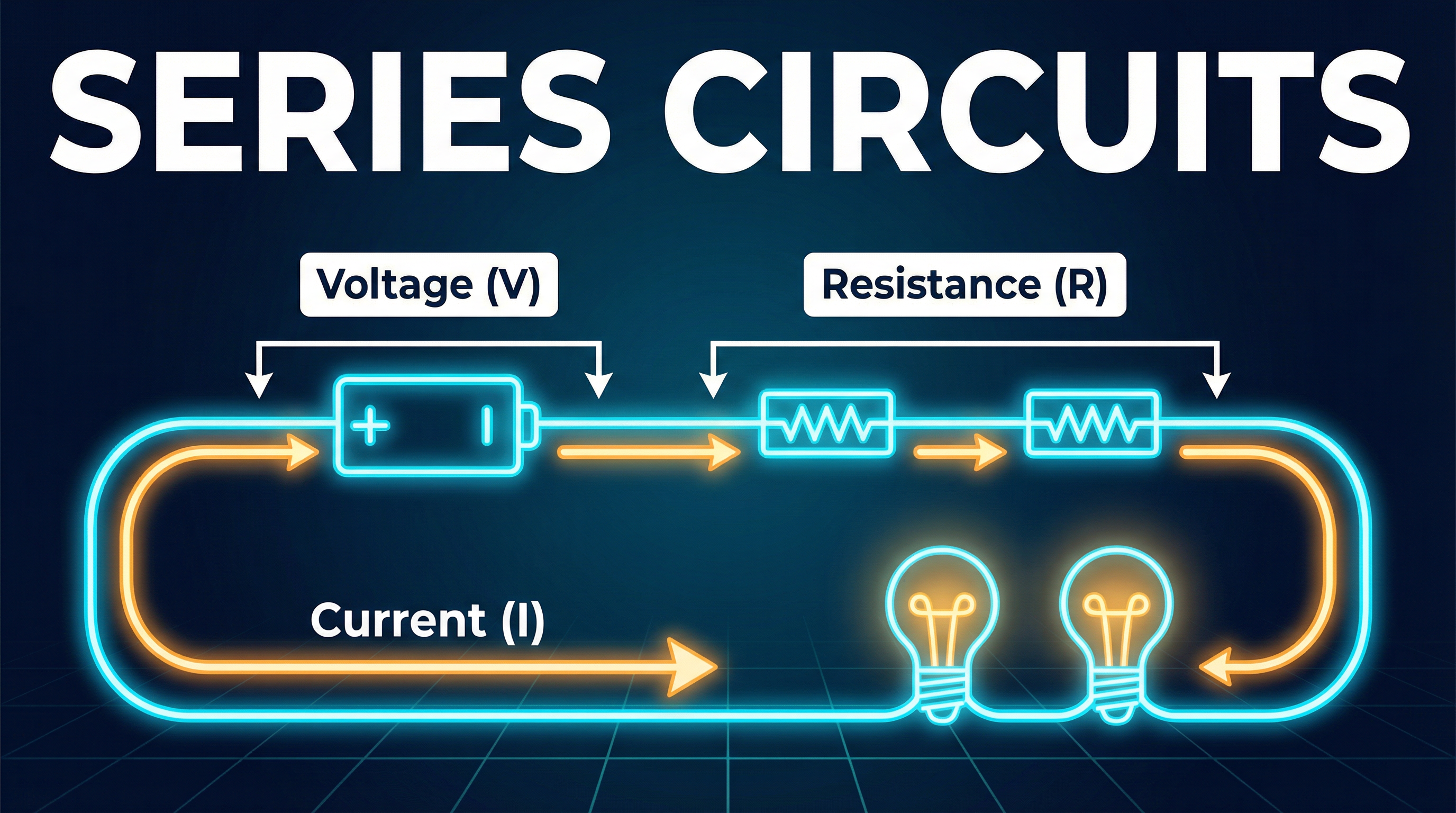
Series Circuits

    OCR
    GCSE
    Physics

    Master OCR GCSE Physics Series Circuits (3.5) with this comprehensive guide. We break down the core principles of current, voltage, and resistance, providing examiner-level insights and multi-modal resources to help you secure every available mark.

    6
    Min Read
    3
    Examples
    5
    Questions
    6
    Key Terms
    🎙 Podcast Episode
    Series Circuits
    11:21
    0:00-11:21

    Study Notes

    Header image for Series Circuits

    Overview

    Welcome to your deep dive into Series Circuits for OCR GCSE Physics. This topic is a cornerstone of the electricity module, and a solid understanding here will pay dividends across the entire specification. In a series circuit, components are connected end-to-end, forming a single, unbroken loop. This simple arrangement dictates two fundamental rules that you must know: current is the same everywhere, and the total voltage is shared between the components. Examiners rigorously test these concepts, often combining them with Ohm's Law (V=IR) and resistance calculations. Expect to see questions ranging from simple definitions and calculations to more complex problems where you must analyse the effect of changing a component. This guide will equip you with the knowledge, exam technique, and memory tools to tackle them all with confidence.

    Key Concepts

    Concept 1: Conservation of Current

    In a series circuit, there is only one path for the electric current to flow. This means that the rate of flow of charge (the current) must be the same at any point in the circuit. It is not 'used up' or diminished as it passes through components. An ammeter placed anywhere in a series circuit will give the same reading. This is a direct consequence of the conservation of charge.

    Examiner's Note: A common and costly mistake is to state that current is lower after a resistor. This is incorrect. Credit is awarded for stating that current is constant at all points in a series loop.
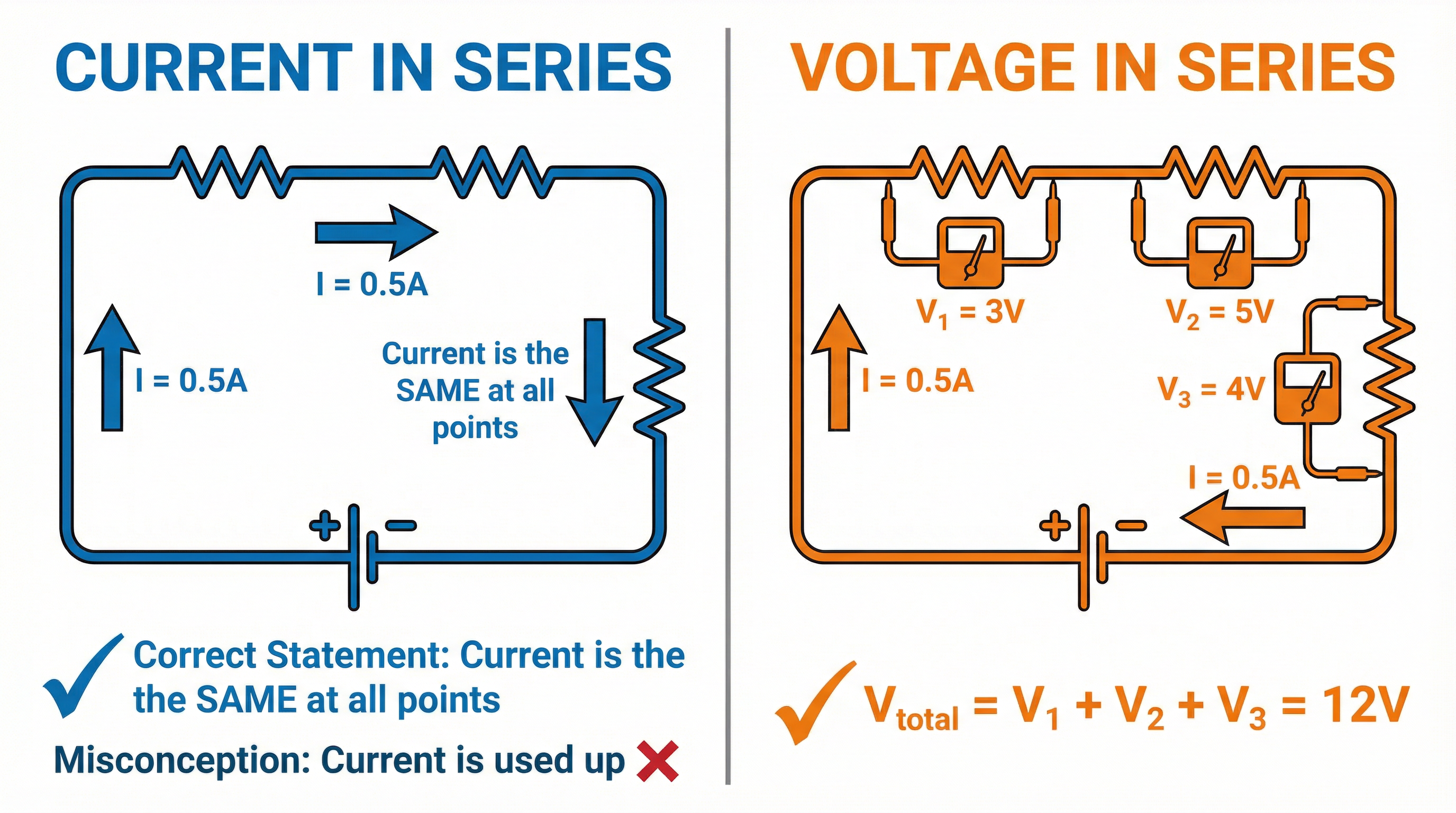
    Visual comparison of how current and voltage behave in series.

    Concept 2: Sharing of Potential Difference (Voltage)

    Potential difference (voltage) is the energy transferred per unit of charge. The total voltage provided by the power supply (e.g., a battery) is shared between all the components in the series circuit. The sum of the potential differences across each individual component is equal to the total potential difference of the supply.

    Formula: V_supply = V₁ + V₂ + V₃ + ...

    This means that components with higher resistance will take a larger share of the voltage, while components with lower resistance will take a smaller share. This relationship is governed by Ohm's Law.

    Concept 3: Total Resistance

    Adding resistors in a series circuit increases the overall total resistance. The total resistance is simply the sum of the individual resistances of each component in the loop. This is a rule you must memorise, as it is not provided on the formula sheet.

    Formula (Must Memorise): R_total = R₁ + R₂ + R₃ + ...

    Example: If three resistors of 2Ω, 4Ω, and 6Ω are connected in series, the total resistance is 2 + 4 + 6 = 12Ω. Adding another resistor would further increase this total, and consequently, decrease the total current flowing in the circuit (assuming the supply voltage remains constant).
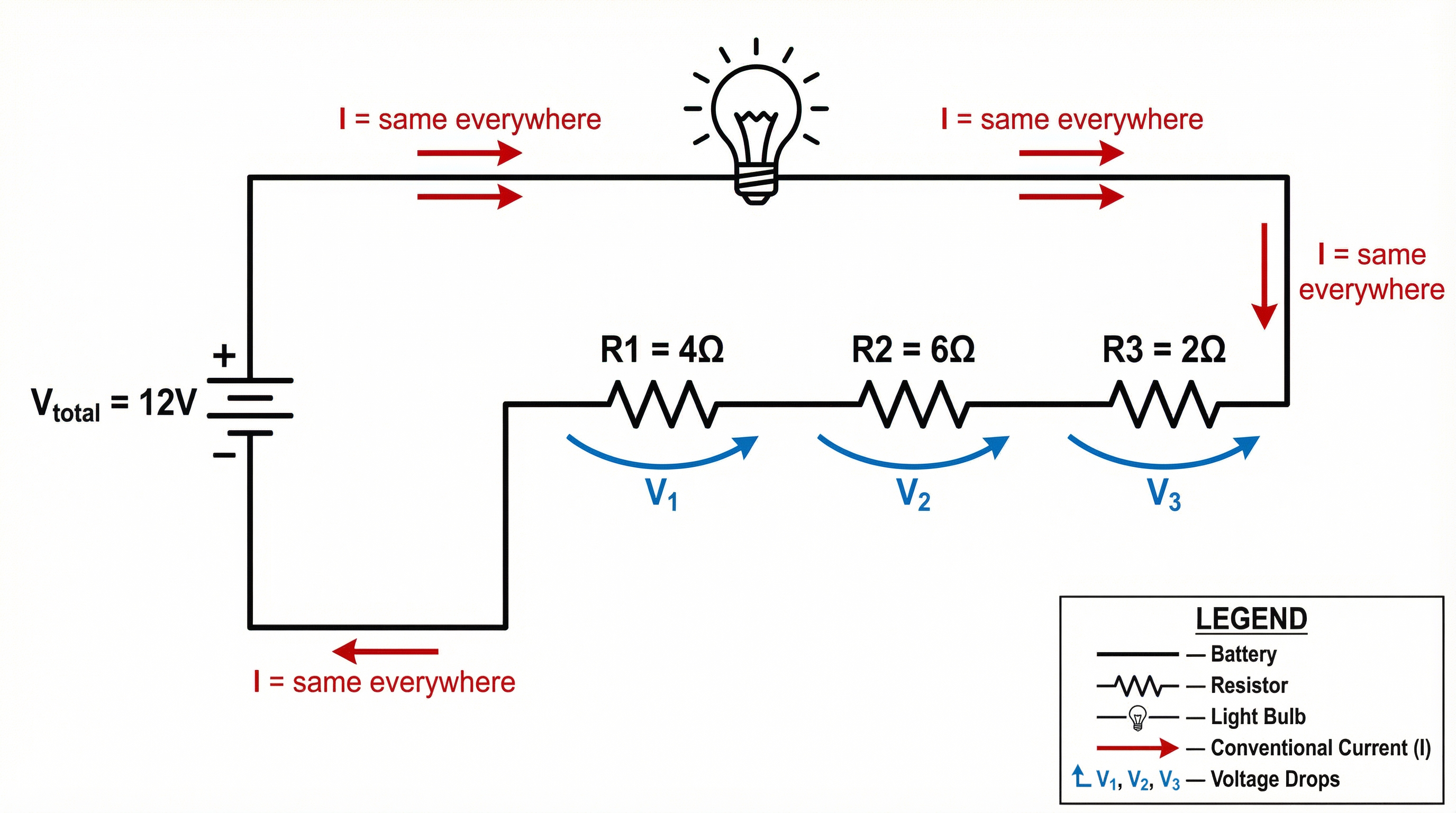
    Diagram of a typical series circuit with resistors and a bulb.

    Mathematical/Scientific Relationships

    Ohm's Law (Given on formula sheet)

    Ohm's Law is the central equation linking voltage, current, and resistance. You must be fluent in its application and rearrangement.

    • V = I × R (Voltage = Current × Resistance)
    • I = V / R (Current = Voltage / Resistance)
    • R = V / I (Resistance = Voltage / Current)

    Crucial Application: When applying Ohm's Law to a single component in a series circuit, you MUST use the voltage across that specific component, not the total supply voltage. To find the voltage across a single resistor, you first need to calculate the total current flowing through the circuit.
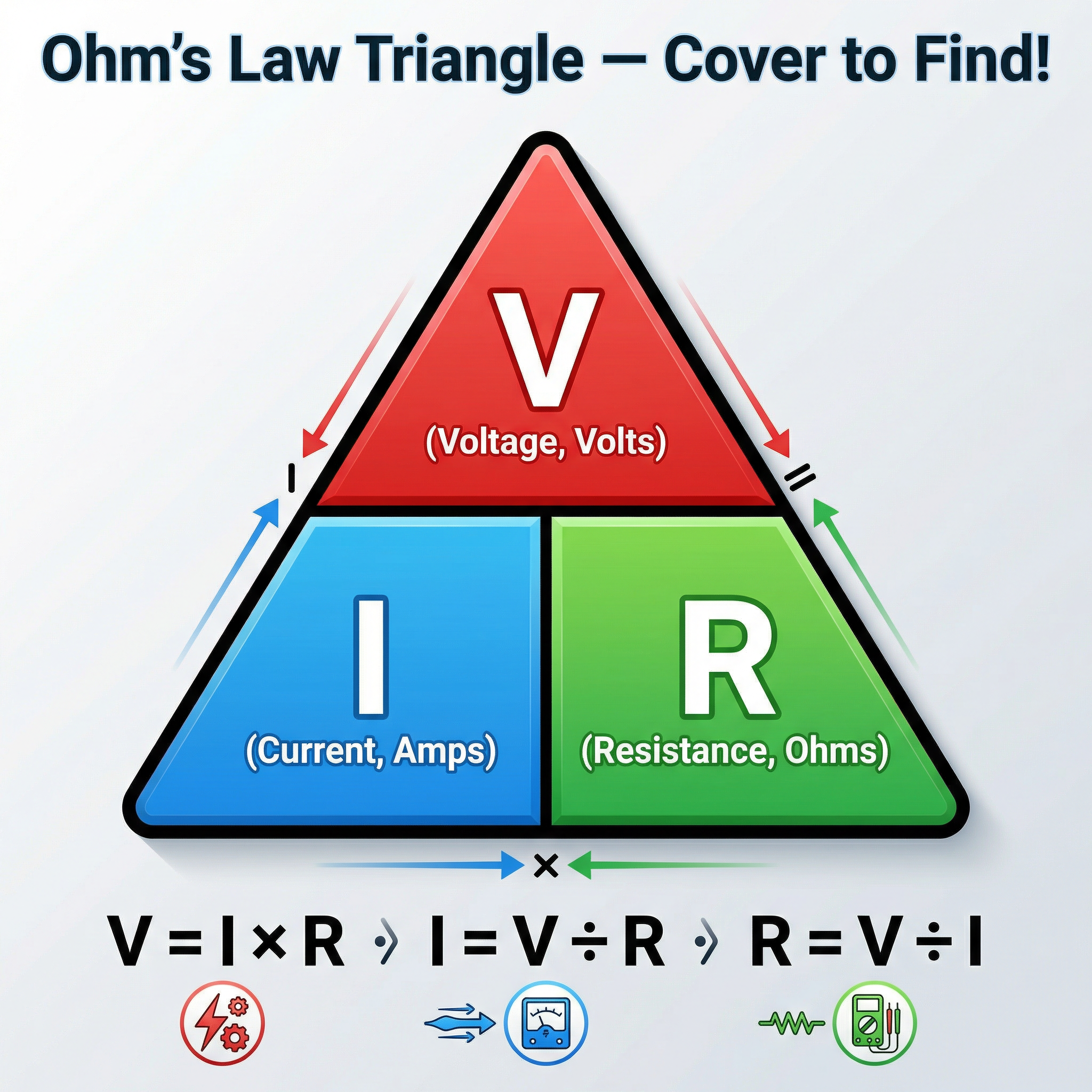
    The Ohm's Law (VIR) triangle is a crucial tool for calculations.

    Practical Applications

    Series circuits have several real-world uses, although they are less common in household wiring than parallel circuits. A classic example is a string of simple, old-fashioned fairy lights. If one bulb breaks, the entire circuit is broken, and all the lights go out. This is a key disadvantage. They are also used in simple switches and some sensor circuits where a change in resistance of one component (like a thermistor or LDR) affects the voltage across another, which can be used to trigger an action.

    Required Practical (PAG 3): Investigating Resistance

    Examiners frequently test your knowledge of the practical used to investigate the factors affecting resistance. For a series circuit, this often involves building a circuit to determine the resistance of a component.

    • Apparatus: Power supply, ammeter, voltmeter, component (e.g., a resistor), and connecting leads.
    • Method: Construct a series circuit containing the power supply, ammeter, and the component. Connect the voltmeter in parallel across the component. Record the readings on the ammeter (current) and voltmeter (voltage). Vary the voltage of the supply and take several pairs of readings. Plot a graph of Voltage (y-axis) against Current (x-axis). The gradient of this graph (ΔV/ΔI) gives the resistance of the component.
    • Common Errors: Connecting the voltmeter in series or the ammeter in parallel. Misreading the scales on the meters. Not taking a range of readings to plot a reliable graph.

    Podcast Episode

    For an in-depth audio walkthrough of this topic, including exam tips and a quick-fire quiz, listen to our dedicated podcast episode.
    Podcast: OCR GCSE Physics - Series Circuits Deep Dive

    Visual Resources

    5 diagrams and illustrations

    Diagram of a typical series circuit with resistors and a bulb.
    Diagram of a typical series circuit with resistors and a bulb.
    The Ohm's Law (VIR) triangle is a crucial tool for calculations.
    The Ohm's Law (VIR) triangle is a crucial tool for calculations.
    Visual comparison of how current and voltage behave in series.
    Visual comparison of how current and voltage behave in series.
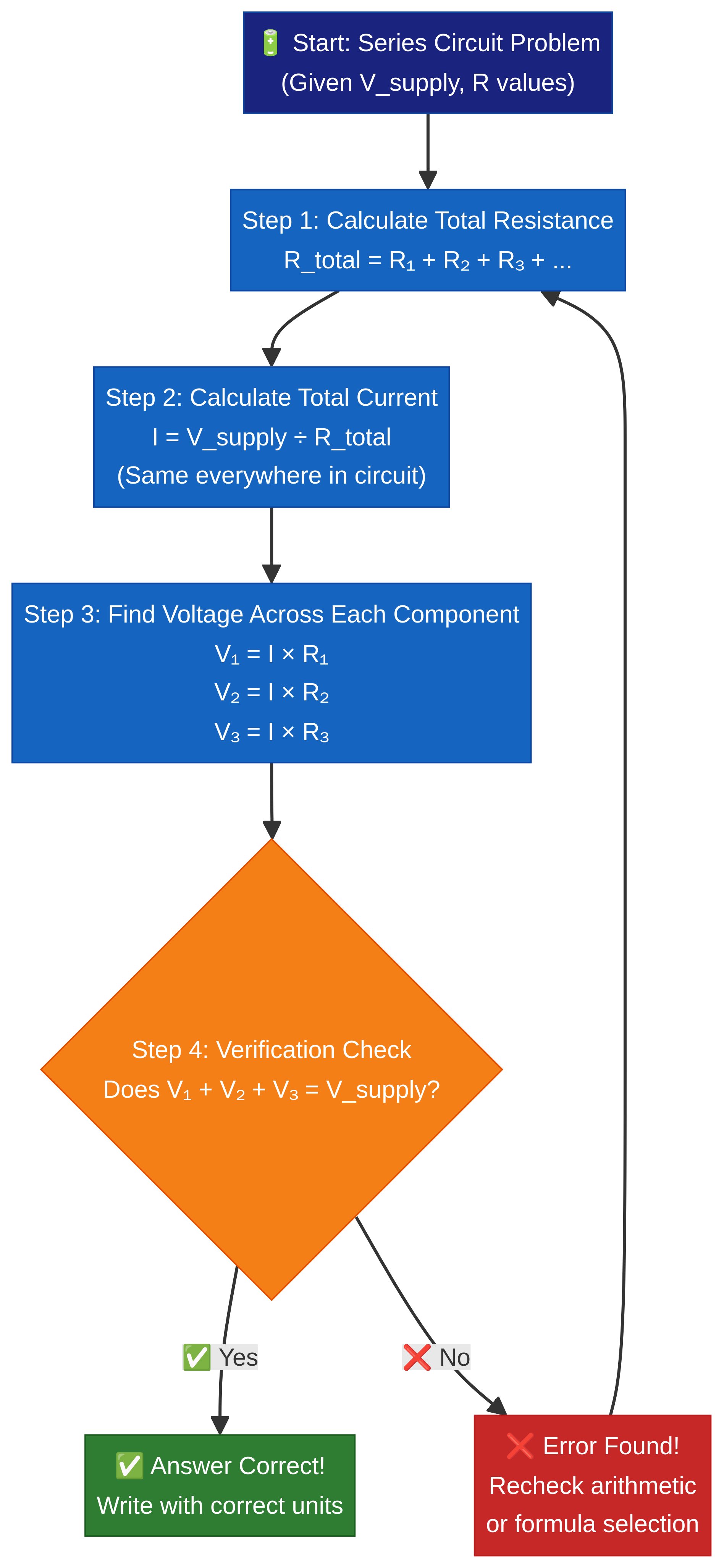
    A logical flowchart for solving series circuit calculation problems.
    A logical flowchart for solving series circuit calculation problems.
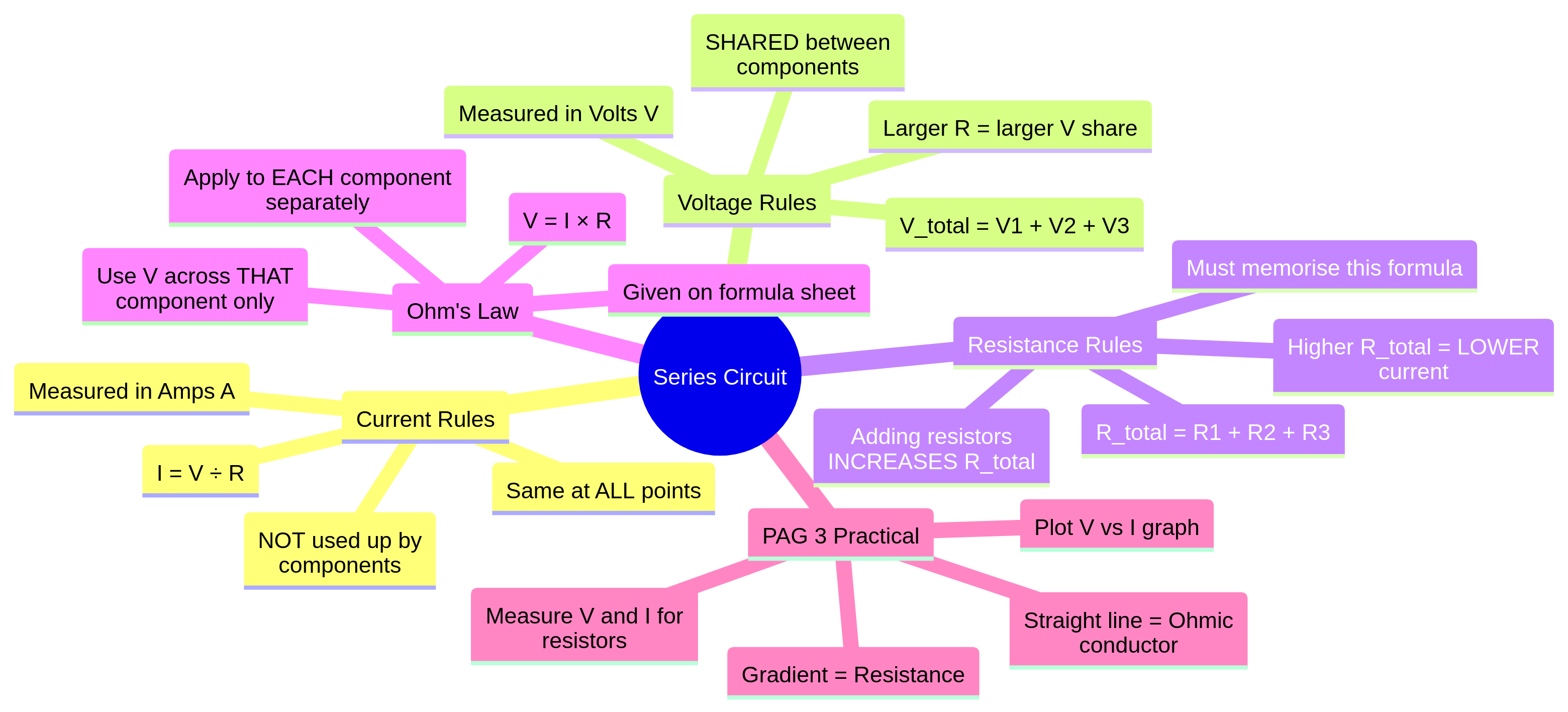
    A mind map for quick revision of series circuit rules.
    A mind map for quick revision of series circuit rules.

    Interactive Diagrams

    2 interactive diagrams to visualise key concepts

    ✅ Yes❌ No🔋 Start: Series Circuit Problem\n(Given V_supply, R values)Step 1: Calculate Total Resistance\nR_total = R₁ + R₂ + R₃ + ...Step 2: Calculate Total Current\nI = V_supply ÷ R_total\n(Same everywhere in circuit)Step 3: Find Voltage Across Each Component\nV₁ = I × R₁\nV₂ = I × R₂\nV₃ = I × R₃Step 4: Verification Check\nDoes V₁ + V₂ + V₃ = V_supply?✅ Answer Correct!\nWrite with correct units❌ Error Found!\nRecheck arithmetic\nor formula selection

    A flowchart showing the logical step-by-step process for solving almost any series circuit calculation problem. Following these steps ensures no marks are lost.

    (Series CircuitCurrent RulesSame at ALL pointsMeasured in Amps AI = V ÷ RNOT used up by componentsVoltage RulesSHARED between componentsV_total = V1 + V2 + V3Measured in Volts VLarger R = larger V shareResistance RulesR_total = R1 + R2 + R3Must memorise this formulaAdding resistors INCREASES R_totalHigher R_total = LOWER current

    A concept map summarising the three fundamental rules (for Current, Voltage, and Resistance) that govern series circuits. Ideal for quick revision.

    Worked Examples

    3 detailed examples with solutions and examiner commentary

    Practice Questions

    Test your understanding — click to reveal model answers

    Q1

    A 6.0V battery is connected to a 2.0Ω resistor and a 4.0Ω resistor in series. Calculate the current in the circuit. [3 marks]

    3 marks
    foundation

    Hint: First, find the total resistance of the circuit.

    Q2

    A lamp and a resistor are connected in series with a power supply. The potential difference across the lamp is 4.5V and the current is 0.2A. The potential difference across the resistor is 7.5V. Calculate the resistance of the lamp. [2 marks]

    2 marks
    standard

    Hint: You only need the values for the lamp itself to answer this question.

    Q3

    Describe how a student could investigate the I-V characteristic of a filament lamp using a series circuit. [6 marks]

    6 marks
    challenging

    Hint: Think about the required practical (PAG 3). What do you need to measure, and what do you need to vary? A circuit diagram is essential.

    Q4

    A series circuit has a 10Ω resistor and a component X. The supply voltage is 9V. The potential difference across the 10Ω resistor is 4V. Determine the resistance of component X. [4 marks]

    4 marks
    challenging

    Hint: First find the voltage across X. Then find the current in the circuit.

    Q5

    Explain why adding more bulbs to a string of fairy lights connected in series makes them all dimmer. [3 marks]

    3 marks
    standard

    Hint: Follow the logical chain: What happens to total resistance? Then what happens to current? Then what happens to the power of each bulb?

    Explore this topic further

    View Topic PageAll Physics Topics

    Key Terms

    Essential vocabulary to know

    More Physics Study Guides

    View all

    Refraction

    OCR
    GCSE

    This guide explains light refraction for OCR GCSE Physics (4.6), covering why light bends, how to draw ray diagrams, and the secrets to exam success. Master the concepts of optical density and total internal reflection to secure top marks.

    Isotopes

    OCR
    GCSE

    This guide provides a comprehensive overview of isotopes for OCR GCSE Physics (7.2), focusing on core definitions, calculations, and exam technique. It's designed to help you secure maximum marks by mastering the difference between isotopes and ions, understanding nuclear notation, and avoiding common pitfalls.

    Galaxies

    OCR
    GCSE

    Unlock top marks in your OCR GCSE Physics exam by mastering Galaxies (Topic 8.7). This guide breaks down the vastness of space into bite-sized, exam-focused chunks, from the structure of our Milky Way to the mind-bending evidence for the Big Bang.

    Planets

    OCR
    GCSE

    This topic covers the structure of our Solar System, the role of gravitational forces in maintaining planetary orbits, and the historical shift from geocentric to heliocentric models. Understanding these concepts is essential for securing marks in both Foundation and Higher Tier questions, particularly those testing orbital mechanics and the nature of scientific progress.

    Stars

    OCR
    GCSE

    Explore the dramatic life and death of stars, from stable main sequence suns to explosive supernovae. This guide for OCR GCSE Physics (8.6) provides everything candidates need to master stellar evolution, secure top marks, and understand our cosmic origins."

    The Solar System

    OCR
    GCSE

    This guide covers OCR GCSE Physics Topic 8.1, The Solar System. It explores the shift from geocentric to heliocentric models, the physics of orbital motion, and the complete life cycles of stars. Mastering this topic is crucial for tackling high-mark questions on stellar evolution and gravitational forces.