Study Notes
Overview
Welcome to your deep dive into Solar Power, a critical component of the OCR GCSE Physics specification (5.9) within the broader Energy Resources topic. This guide is designed to equip you with the precise knowledge and exam technique required to secure top marks. Solar power is a favourite of examiners because it elegantly tests all three Assessment Objectives: your recall of the science (AO1), your ability to apply it to different situations and calculations (AO2), and your skill in evaluating its use against other energy sources (AO3). We will dissect the two core solar technologies, master the efficiency calculations that frequently appear, and build a robust framework for answering those challenging 6-mark evaluation questions. By the end of this guide, you will understand not just how solar power works, but how to articulate that understanding in a way that examiners will reward.
Key Concepts
Concept 1: The Two Types of Solar Technology
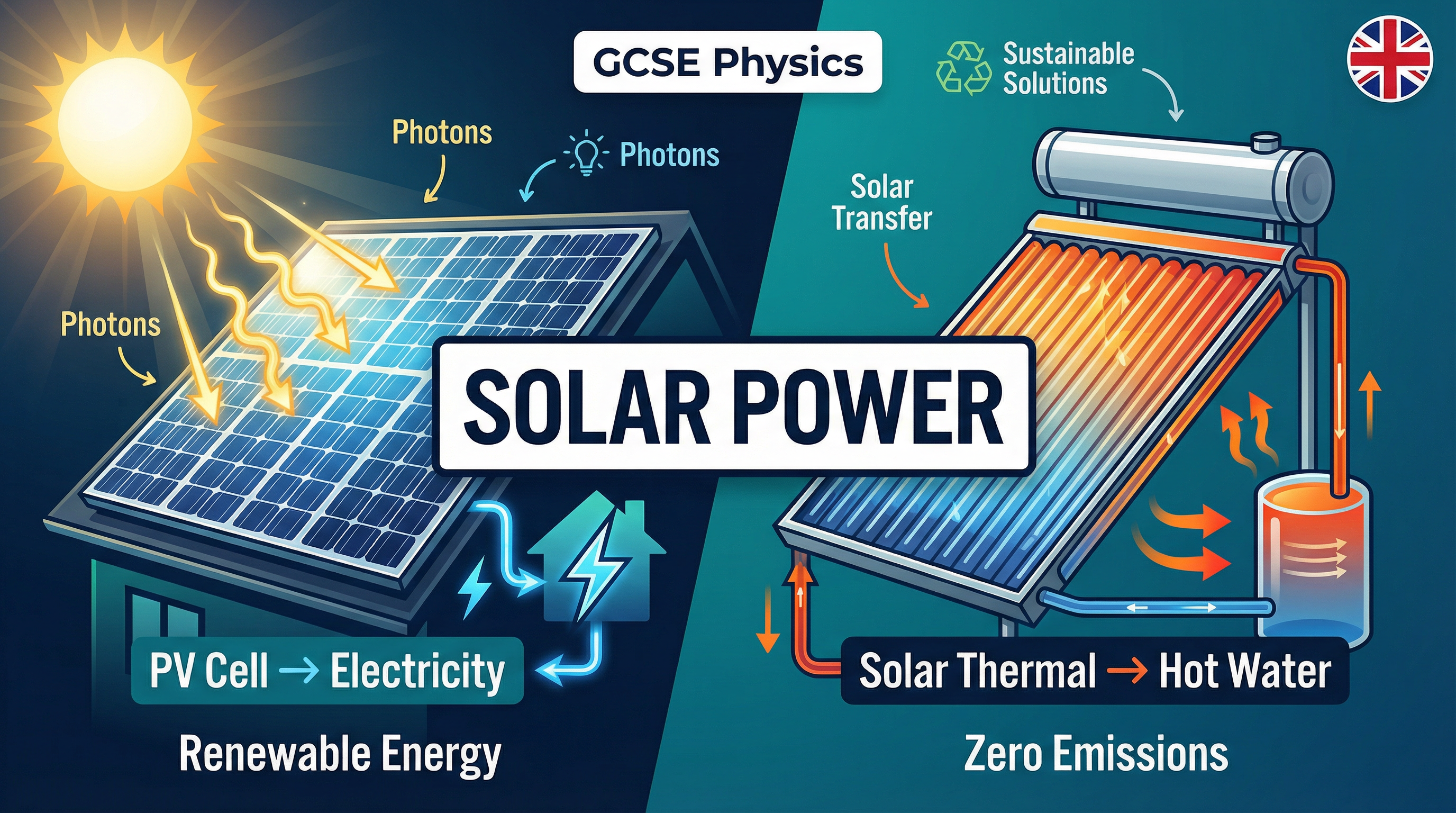
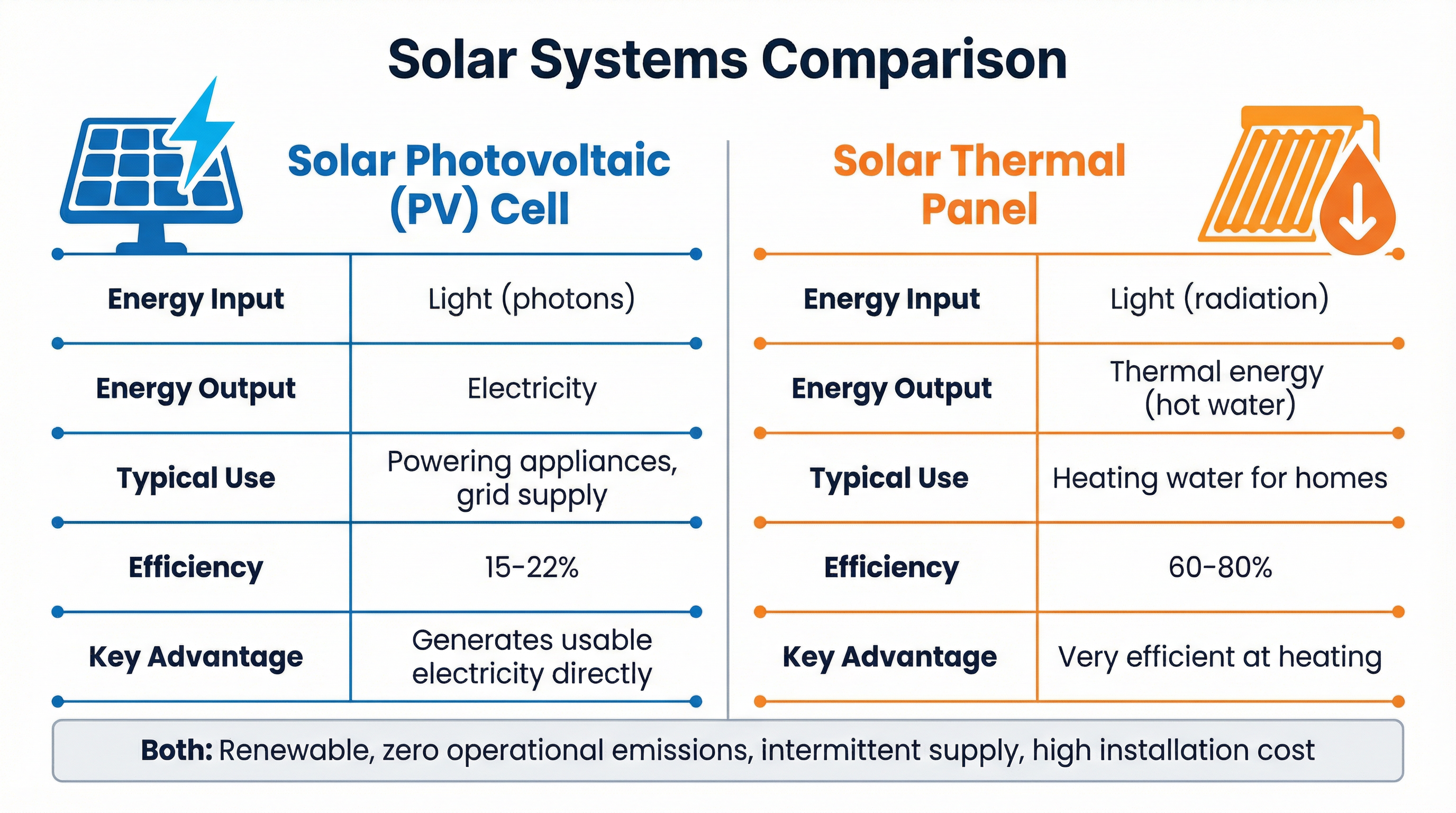
This is the most common source of confusion, and therefore a place where prepared candidates can easily stand out. You MUST be able to distinguish between Solar Photovoltaic (PV) cells and Solar Thermal Panels. They are not the same.
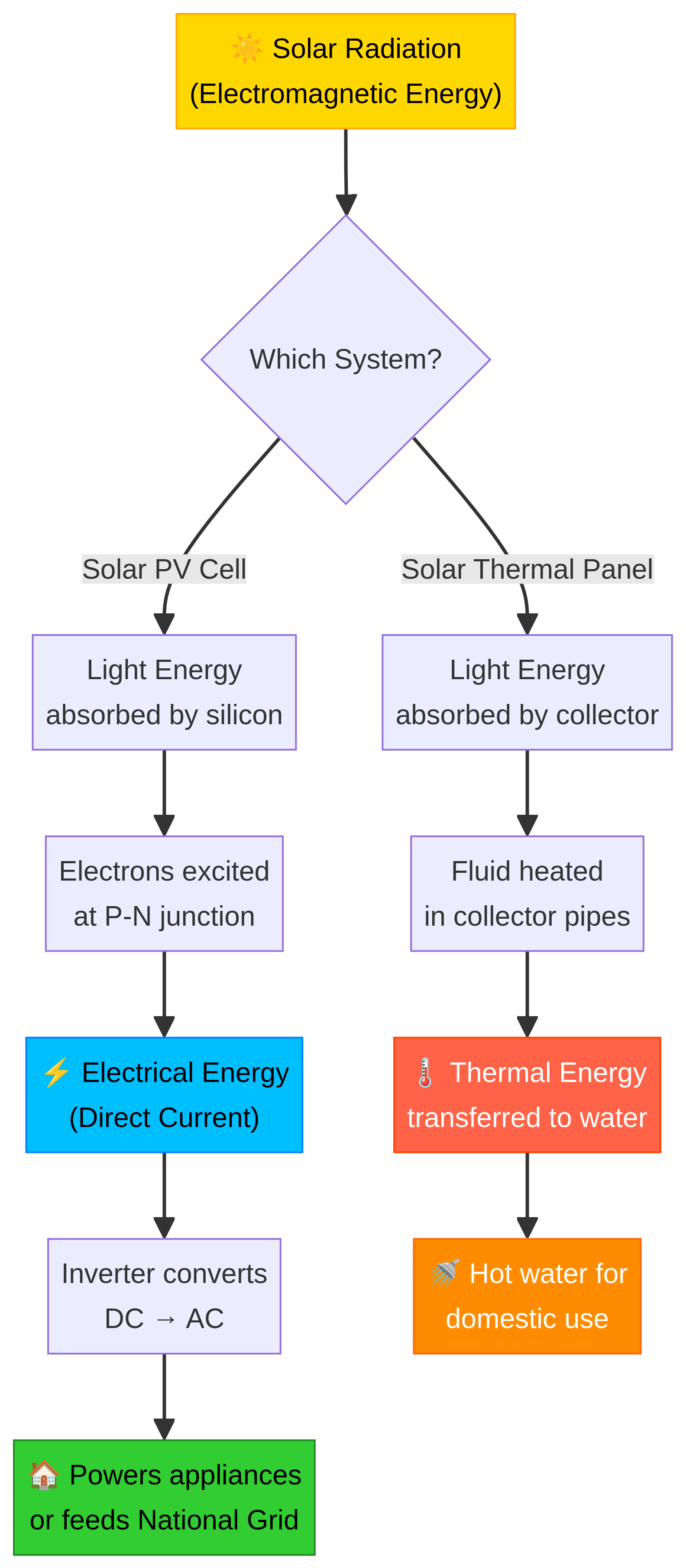
- Solar Photovoltaic (PV) Cells: These devices perform a direct energy conversion: Light Energy → Electrical Energy. They are the technology used to generate electricity. When photons (particles of light) from the sun strike the PV cell, they transfer energy to electrons within the semiconductor material (usually silicon). This energy liberates the electrons, allowing them to flow and create a direct current (DC). This is known as the photovoltaic effect. Multiple cells are connected to form a module, and multiple modules form an array.
- Solar Thermal Panels: These devices perform a different energy conversion: Light Energy → Thermal Energy. Their job is to get hot and transfer that heat to a fluid (usually water). A solar thermal panel consists of a series of pipes, often painted black to be a good absorber of radiation, located within an insulated box with a glass lid to trap heat. As sunlight shines on the panel, the fluid in the pipes gets hot. This hot fluid is then pumped to a storage tank, where it heats the domestic water supply via a heat exchanger.
An examiner would award credit for stating this distinction clearly. For example: 'A solar PV cell generates electricity directly from light, whereas a solar thermal panel uses light to heat water.'
Concept 2: The Principle of a PV Cell (Higher Tier)
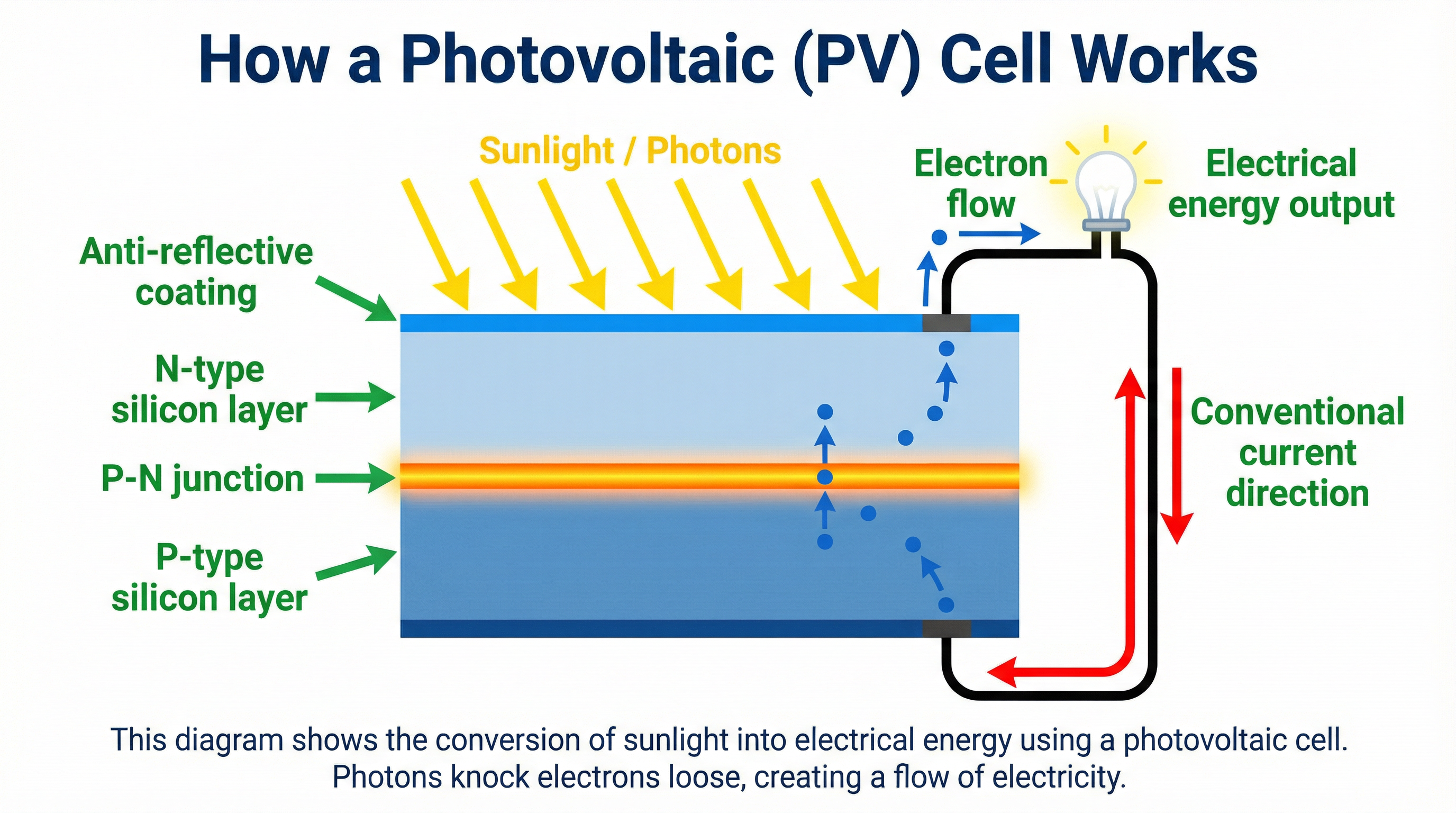
For Higher Tier candidates, a slightly deeper understanding is expected. A PV cell is made of two layers of silicon. One layer is 'doped' to create N-type silicon, which has a surplus of free electrons. The other is doped to create P-type silicon, which has a deficit of electrons (or 'holes'). Where these two layers meet is called the P-N junction. An electric field naturally forms at this junction. When a photon strikes the cell and knocks an electron loose, this electric field acts like a slope, forcing the electron to move towards the N-type side and the 'hole' to move towards the P-type side. This separation of charge creates a voltage across the cell. If you connect an external circuit, the electrons will flow from the N-type side, through the circuit (powering a device), and back to the P-type side, creating a continuous direct current.
Concept 3: Reliability and Intermittency
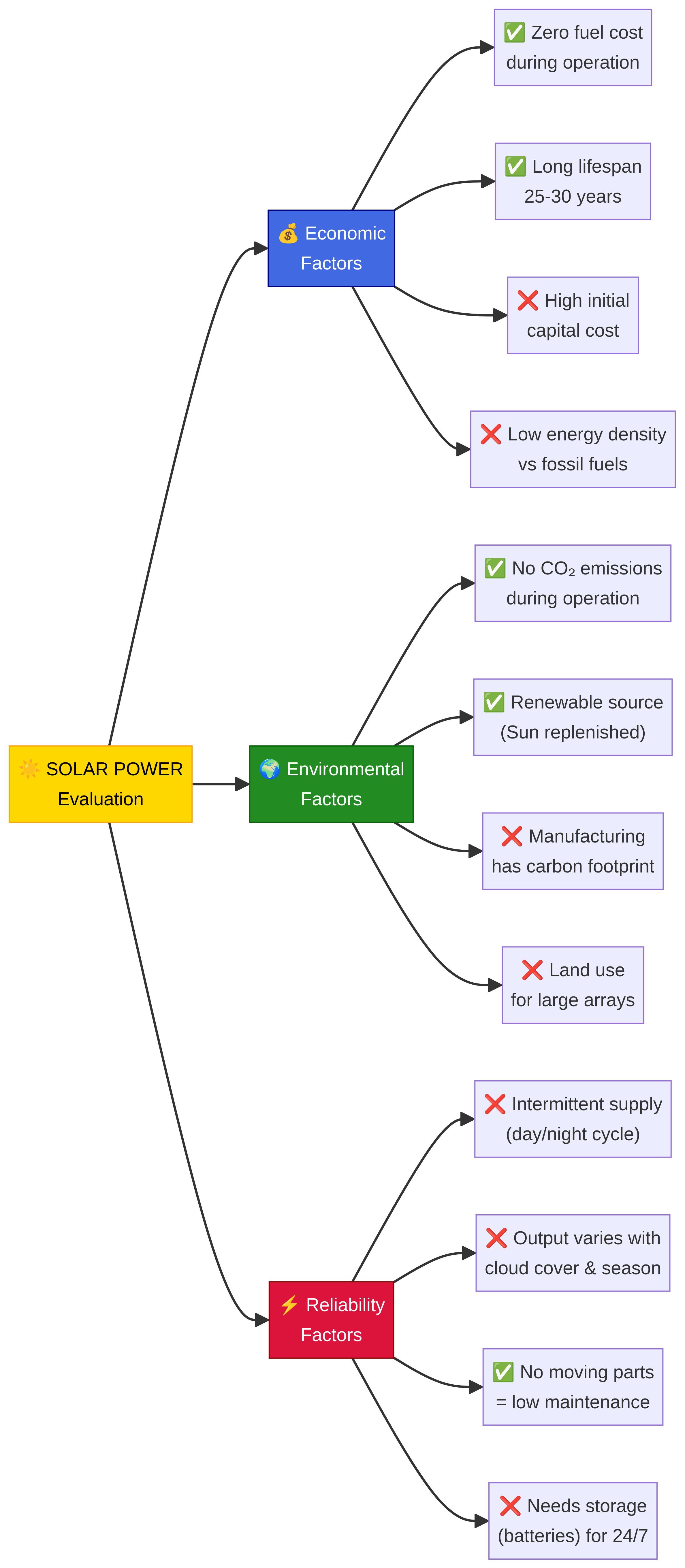
The single biggest drawback of solar power is its intermittency. This is the specific term examiners want you to use. It means the supply is not constant or predictable. The power output of a solar panel depends directly on the light intensity reaching it. This is affected by several factors:
- Time of Day: Power output is highest around midday when the sun is highest in the sky and its rays are most direct. Output is zero at night.
- Cloud Cover: Clouds block and scatter sunlight, significantly reducing the light intensity reaching the panel and therefore reducing the power output.
- Season: In the UK, the sun is lower in the sky during winter and there are fewer daylight hours, leading to much lower energy generation compared to summer.
- Location: A solar panel in a sunny country like Spain will generate significantly more energy over a year than the same panel in the UK.
Because of this intermittency, solar power cannot be relied upon as a sole source for a consistent 24/7 power supply without a storage solution, such as batteries.
Mathematical/Scientific Relationships
Formula 1: Efficiency (Given on formula sheet)
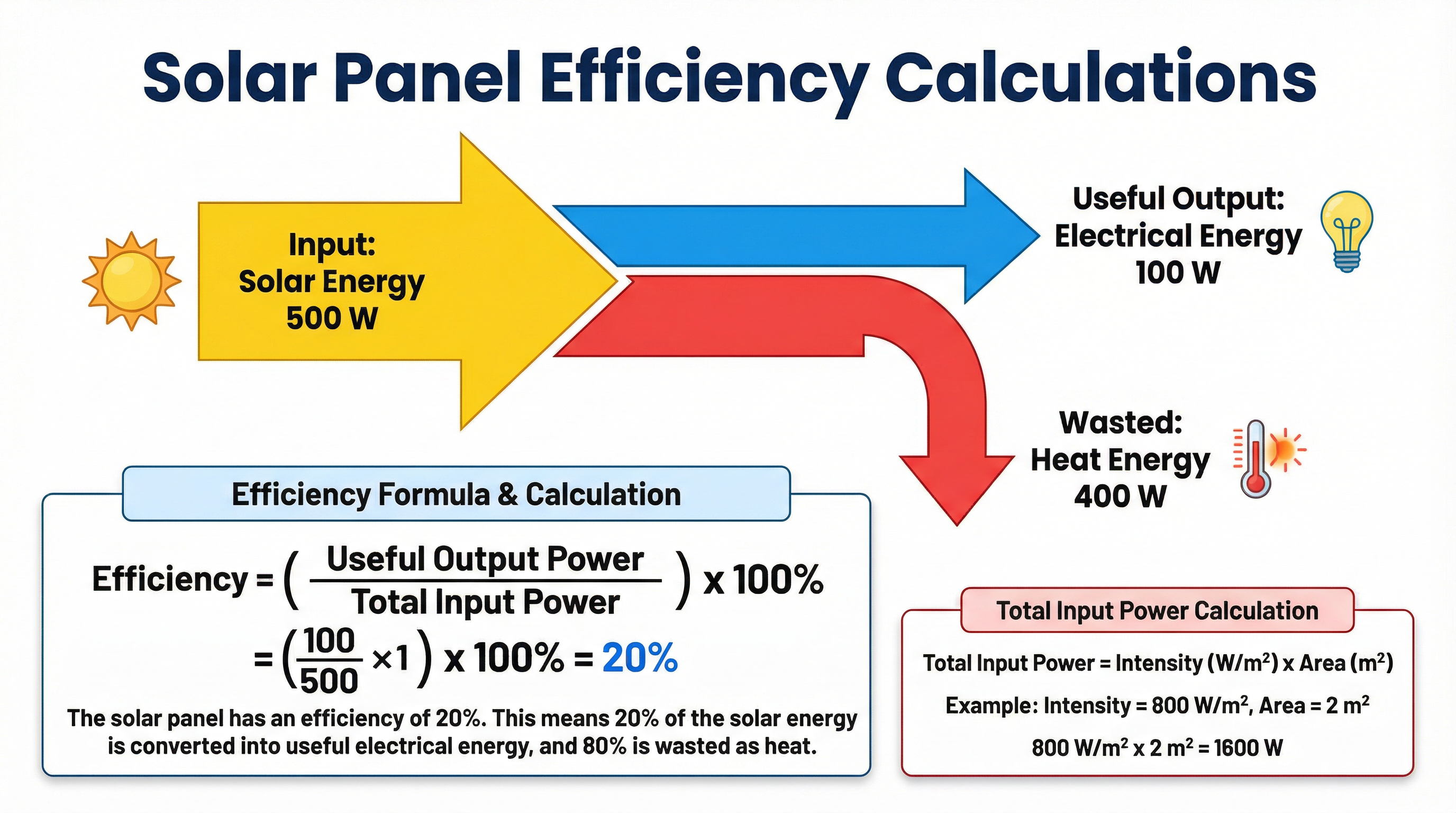
Efficiency is a measure of how much of the input energy is converted into useful output energy. It is usually expressed as a percentage.
Efficiency = (Useful Power Output / Total Power Input) x 100%
- Useful Power Output (W): The electrical power generated by the PV panel.
- Total Power Input (W): The total power of the solar radiation hitting the panel.
This formula can also be used with energy: Efficiency = (Useful Energy Output / Total Energy Input) x 100%
Formula 2: Power Input from Solar Intensity (Must memorise)
Examiners will often give you the solar intensity (or irradiance) in Watts per square metre (W/m²). To find the total power input, you must multiply this by the area of the panel.
Total Power Input (W) = Solar Intensity (W/m²) x Area (m²)
Common Pitfall: A very common mistake is to use the solar intensity value as the total power input without multiplying by the area first. This will lose you marks.
Formula 3: Energy, Power, and Time (Given on formula sheet)
This fundamental physics equation is often used in solar power questions.
Energy Transferred (J) = Power (W) x Time (s)
Or, for electricity billing:
Energy Transferred (kWh) = Power (kW) x Time (h)
Unit Conversions: Be careful with units! Power must be in Watts and time in seconds for energy in Joules. Or Power in kilowatts and time in hours for energy in kilowatt-hours. (1 kW = 1000 W).
Practical Applications
Solar power has a vast range of applications, from tiny calculators to enormous solar farms.
- Domestic Power: Small-scale PV systems on rooftops can power a home, reducing electricity bills. Solar thermal panels can provide most of a home's hot water during the summer.
- Off-Grid Power: For remote locations where connecting to the National Grid is prohibitively expensive (e.g., remote farms, monitoring stations, road signs), solar power with battery storage is an ideal solution.
- Spacecraft: Satellites and space stations rely almost exclusively on solar panels for their power, as they are above the atmosphere and receive constant, high-intensity sunlight.
- Utility-Scale Solar Farms: Large arrays of PV panels covering many acres can generate electricity on an industrial scale, feeding directly into the National Grid.
There is no specific required practical for solar power in the OCR specification, but questions may test your understanding of experimental design, such as investigating how the angle of a solar panel affects its power output.