Spring Constant

    OCR
    GCSE
    Physics

    This guide provides a comprehensive, exam-focused breakdown of the OCR GCSE Physics topic on the Spring Constant (2.7). It covers Hooke's Law, elastic potential energy, and the required practical (PAG P1), equipping candidates with the knowledge to secure maximum marks.

    7
    Min Read
    3
    Examples
    5
    Questions
    7
    Key Terms
    🎙 Podcast Episode
    Spring Constant
    9:43
    0:00-9:43

    Study Notes

    An overview of the key concepts in the OCR GCSE Physics Spring Constant topic.

    Overview

    Welcome to your deep dive into one of the foundational topics of mechanics: the Spring Constant and Hooke's Law. This area of physics, specification point 2.7, is crucial for both Foundation and Higher tier candidates as it explores how materials behave when stretched or compressed. Understanding the relationship between force, extension, and energy storage is not just about springs; it's the basis for understanding material properties, engineering design, and energy transformations. Examiners frequently test this topic through a combination of calculations using the F=kx and E=0.5kx² equations, interpretation of force-extension graphs, and questions related to the required practical (PAG P1). By mastering the concepts of elastic and plastic deformation, you'll be able to confidently tackle a wide range of questions, from simple definitions to multi-step calculations and graph analysis.

    Listen to our 10-minute revision podcast on the Spring Constant.

    Key Concepts

    Concept 1: Hooke's Law and the Spring Constant (k)

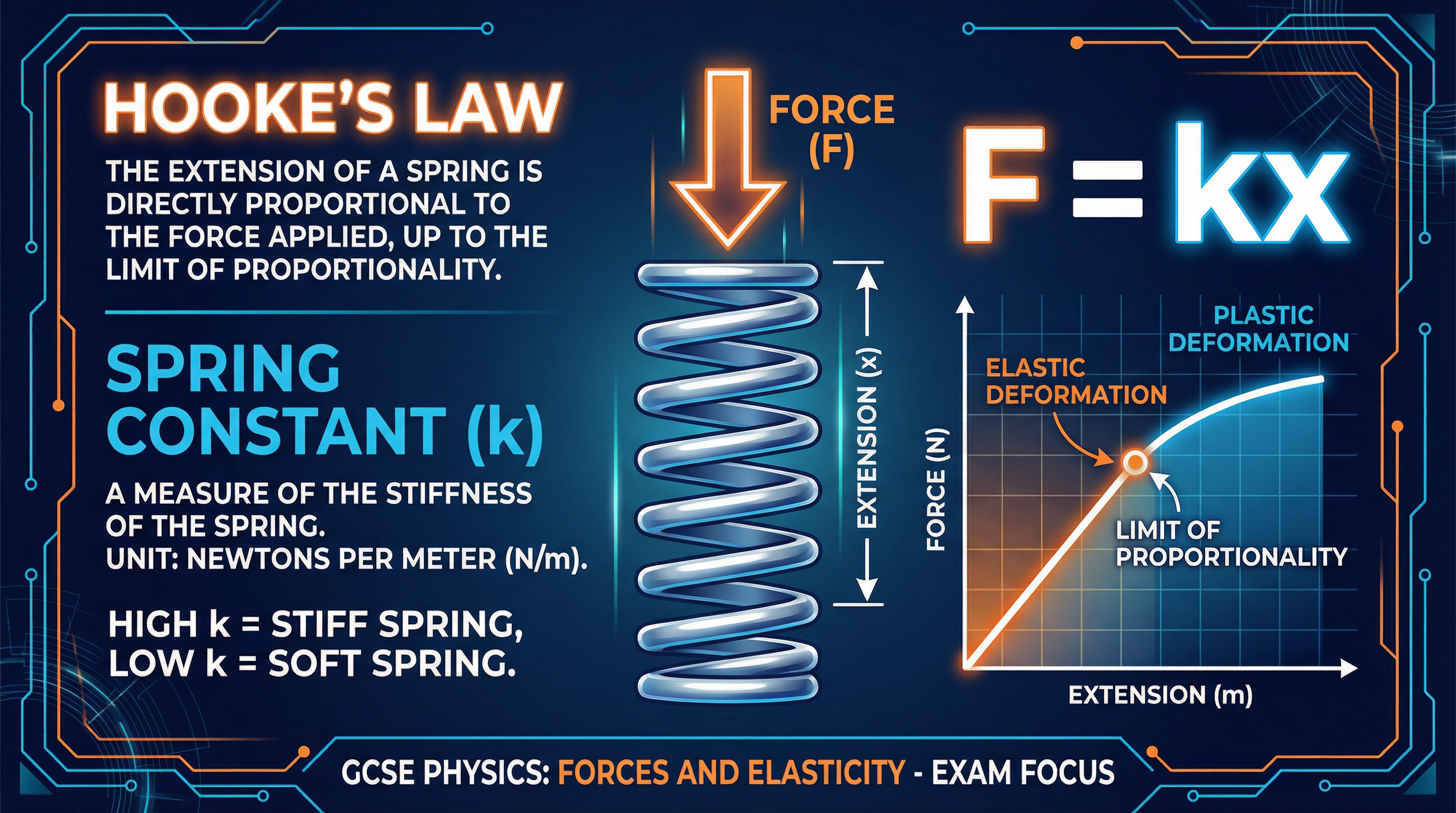
    Hooke's Law is the central principle of this topic. It states that the extension of a spring is directly proportional to the force applied to it, as long as the limit of proportionality is not exceeded. This means that if you double the force, you double the extension. This linear relationship is what makes the behaviour of springs predictable and useful.

    The 'stiffness' of a spring is quantified by its spring constant (k). This value tells you how much force is needed to stretch the spring by one metre. A higher spring constant means a stiffer spring, requiring more force for the same extension. The unit for the spring constant is Newtons per metre (N/m).

    Example: A spring with k = 100 N/m requires 100 Newtons of force to stretch it by 1 metre. A softer spring with k = 20 N/m would only require 20 Newtons for the same 1-metre extension.

    Concept 2: Elastic vs. Plastic Deformation

    When a force is applied to a material, it can deform in one of two ways:

    • Elastic Deformation: This is a temporary change in shape. When the force is removed, the object returns to its original, unstretched length. This is the behaviour described by Hooke's Law. For marks to be awarded, candidates must state that the object returns to its original shape.
    • Plastic Deformation: This is a permanent change in shape. If you stretch a spring too far (beyond its elastic limit), it will not return to its original length. It has been permanently deformed. Credit is given for responses that clearly state the deformation is permanent.
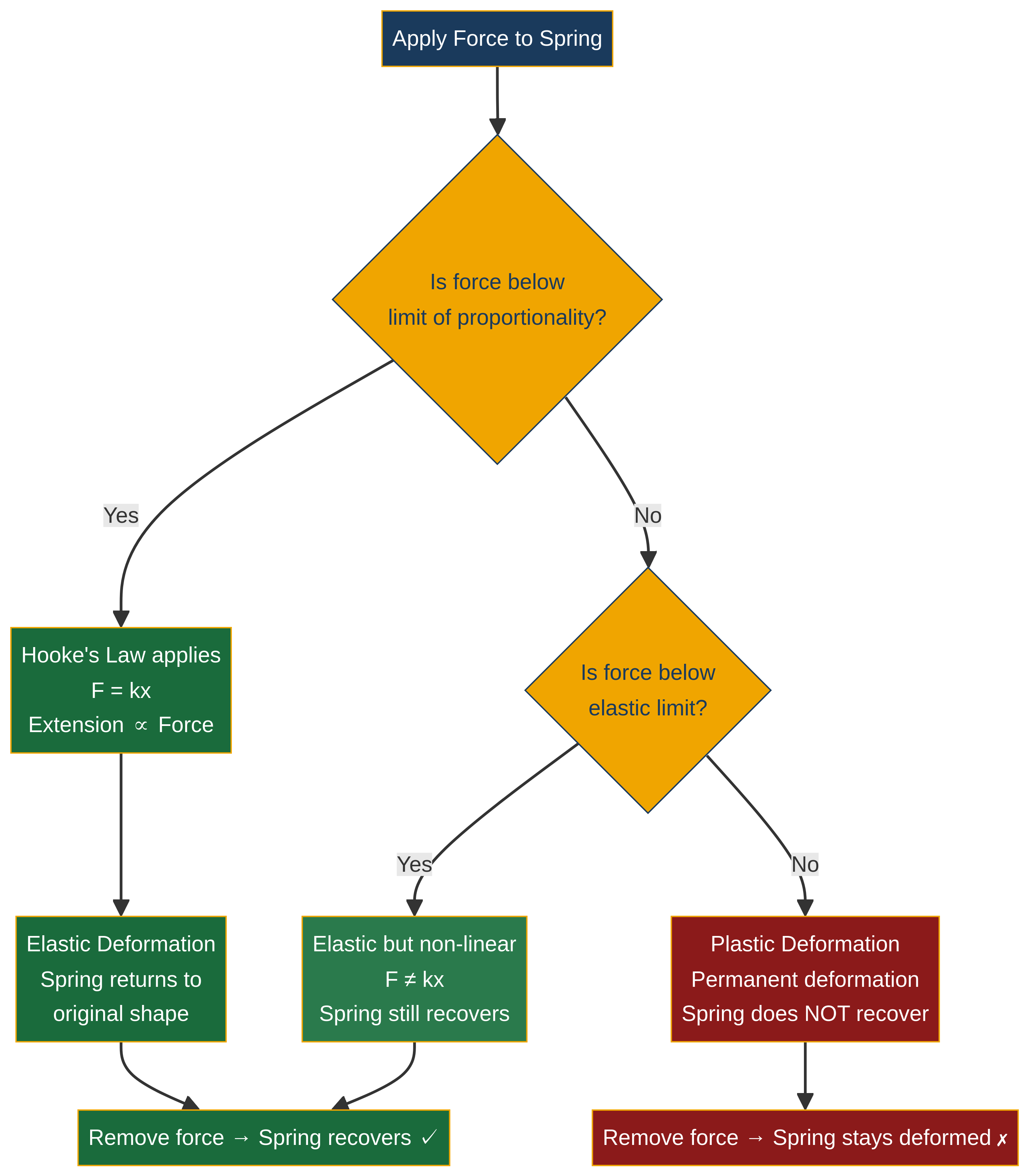
    Flowchart illustrating the conditions for elastic and plastic deformation.

    Concept 3: Force-Extension Graphs

    Examiners love using graphs to test this topic. A graph of Force (y-axis) vs. Extension (x-axis) provides a wealth of information:

    • The Linear Region: The initial straight-line section passing through the origin shows where Hooke's Law is obeyed. The gradient (change in y / change in x) of this section is equal to the spring constant, k.
    • The Limit of Proportionality: This is the precise point where the graph stops being a straight line and begins to curve. OCR requires this exact terminology. Beyond this point, force is no longer directly proportional to extension.
    • The Elastic Limit: A point just beyond the limit of proportionality. Up to this point, the object will still return to its original shape (elastic deformation). Beyond it, the object undergoes plastic deformation.
    • The Area Under the Graph: The work done in stretching the spring is stored as elastic potential energy. This energy is represented by the area under the force-extension graph. For the linear region, this is the area of a triangle.
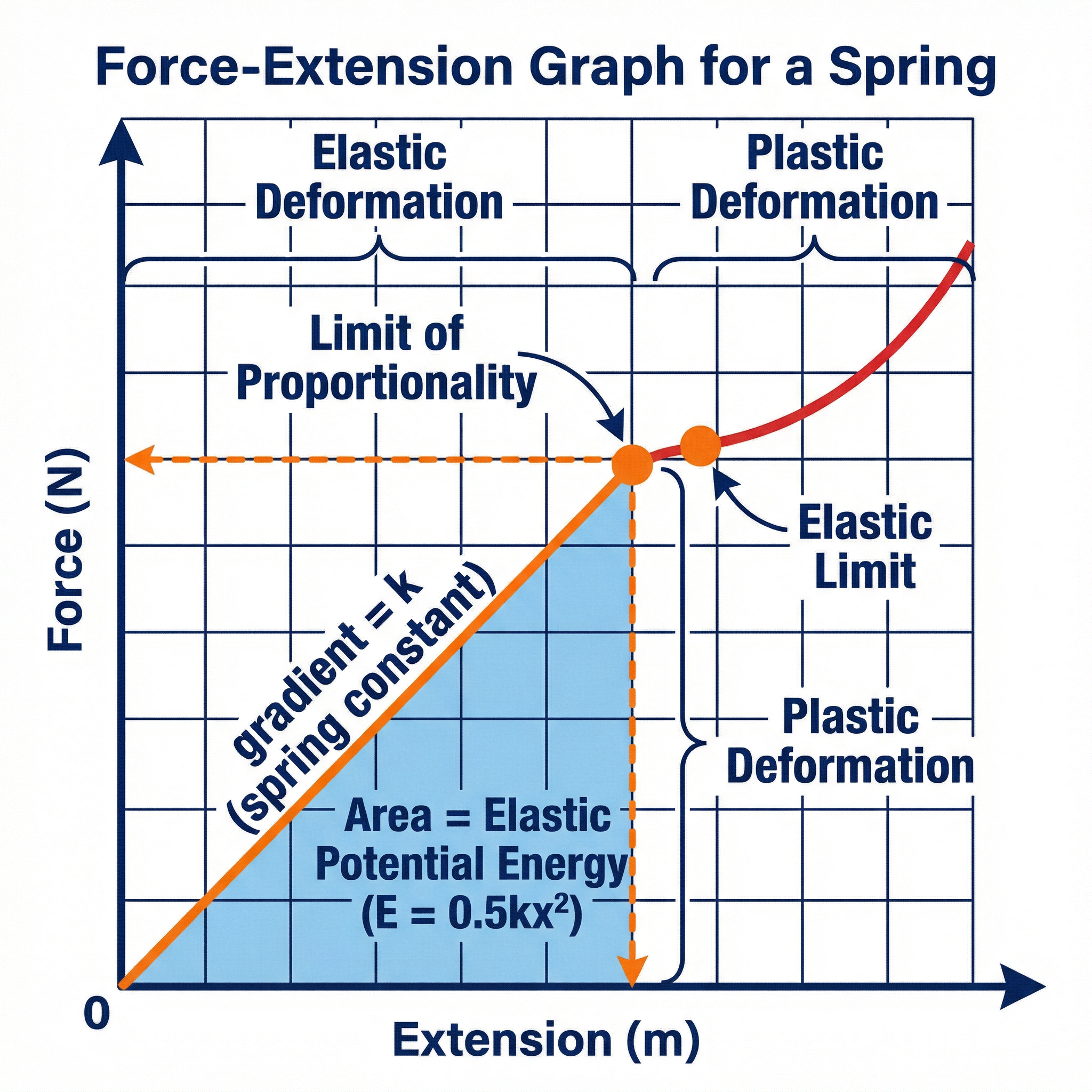
    A detailed force-extension graph showing key features like the limit of proportionality and the area representing elastic potential energy.

    Mathematical/Scientific Relationships

    There are two key equations you must be able to use and rearrange. One is given on the formula sheet, the other you must memorise.

    1. Hooke's Law Equation (Given on formula sheet)
      F = kx

      • F: Force applied, in Newtons (N)
      • k: Spring Constant, in Newtons per metre (N/m)
      • x: Extension (not total length!), in metres (m)
    2. Elastic Potential Energy Equation (Must memorise)
      Eₑ = 0.5 * k * x²

      • Eₑ: Elastic Potential Energy stored, in Joules (J)
      • k: Spring Constant, in Newtons per metre (N/m)
      • x: Extension, in metres (m)

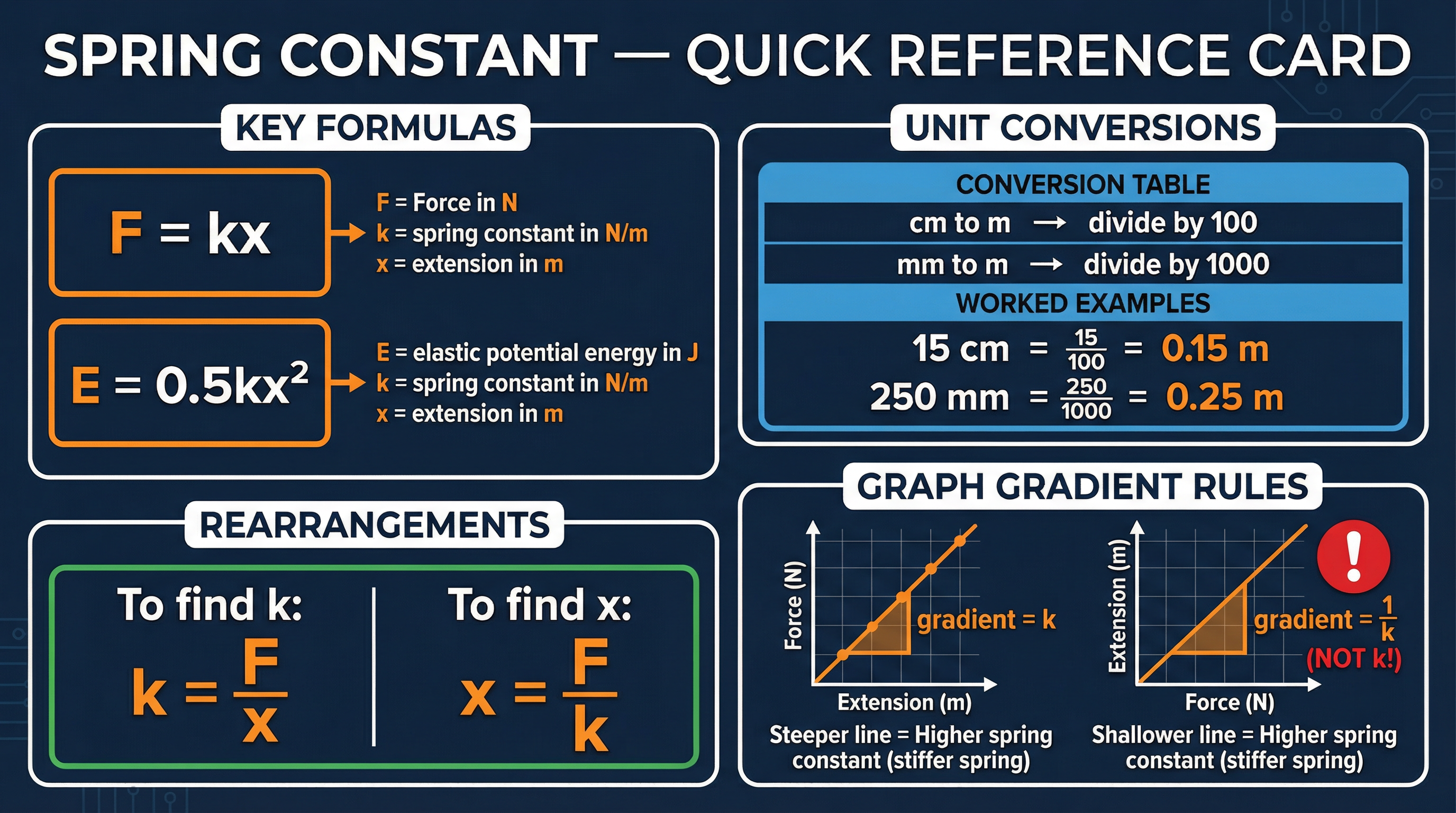
    A handy reference card for the essential formulas, unit conversions, and graph rules.

    Practical Applications

    This topic is directly assessed through the Required Practical Activity Group (PAG) P1: Investigating Springs. Candidates must be familiar with the experimental setup and procedure.

    PAG P1: Investigating the relationship between force and extension for a spring

    • Apparatus: Retort stand, clamp, boss; spring; metre rule; mass hanger and slotted masses (e.g., 100g masses); safety goggles.
    • Method:
      1. Set up the apparatus as shown in the diagram, ensuring the ruler is vertical and close to the spring.
      2. Measure the original, unloaded length of the spring. This is the 'natural length'.
      3. Add a single mass (e.g., 100g, which is a weight of 0.98N). Measure the new length of the spring.
      4. Calculate the extension by subtracting the natural length from the new length.
      5. Repeat this process, adding one mass at a time, recording the new length and calculating the extension for each new total mass.
      6. Plot a graph of Force (y-axis) against Extension (x-axis).
      7. Draw a line of best fit through the points that form a straight line.
      8. Calculate the gradient of this straight-line section to find the spring constant, k.
    • Common Errors: Failing to measure from the same point on the spring each time; parallax error when reading the ruler; using total length instead of extension; adding too much mass and exceeding the elastic limit.
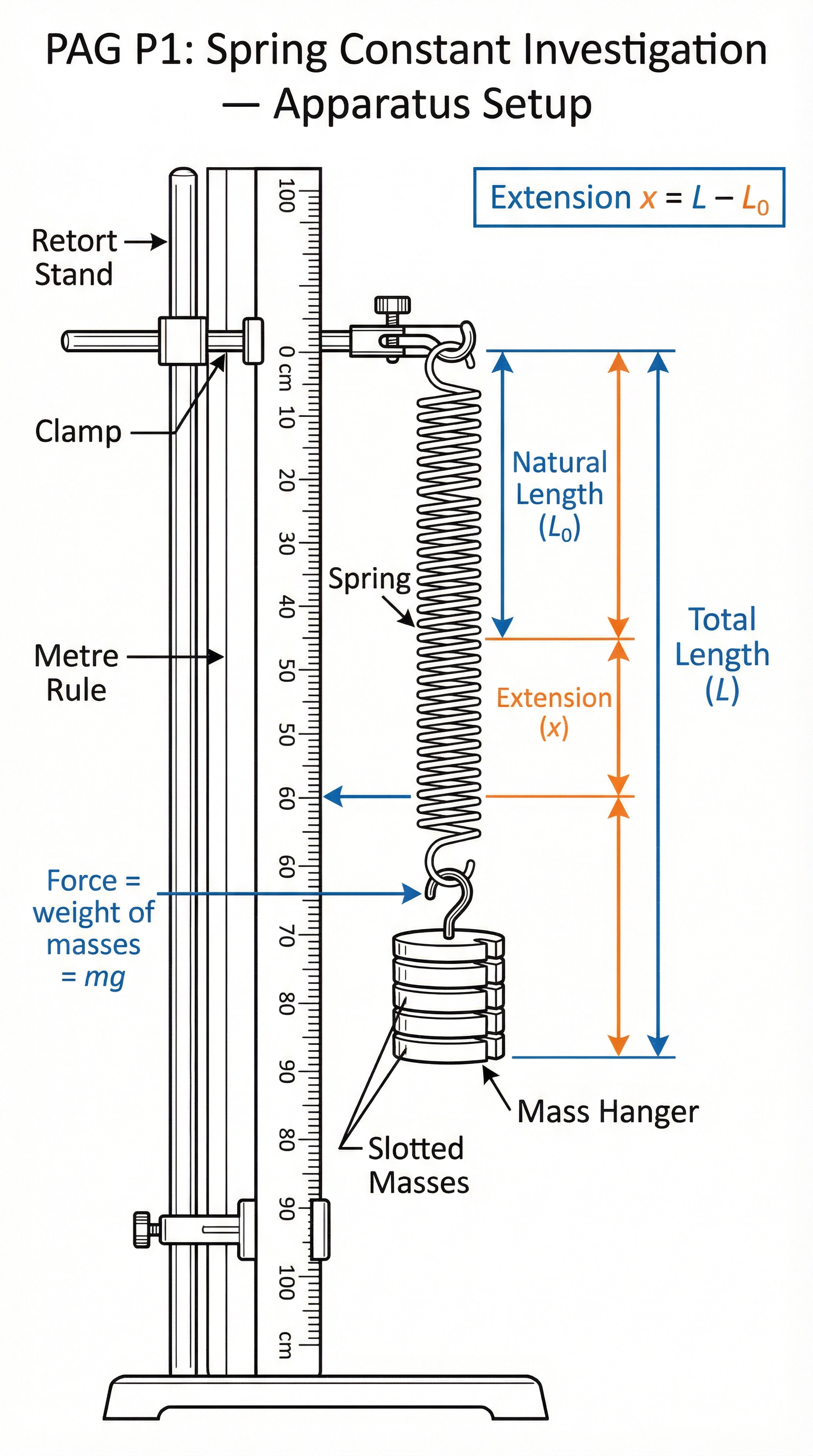
    The standard apparatus setup for investigating the relationship between force and extension in a spring (PAG P1).

    Visual Resources

    5 diagrams and illustrations

    A detailed force-extension graph showing key features like the limit of proportionality and the area representing elastic potential energy.
    A detailed force-extension graph showing key features like the limit of proportionality and the area representing elastic potential energy.
    The standard apparatus setup for investigating the relationship between force and extension in a spring (PAG P1).
    The standard apparatus setup for investigating the relationship between force and extension in a spring (PAG P1).
    A handy reference card for the essential formulas, unit conversions, and graph rules.
    A handy reference card for the essential formulas, unit conversions, and graph rules.
    Flowchart illustrating the conditions for elastic and plastic deformation.
    Flowchart illustrating the conditions for elastic and plastic deformation.
    Concept map showing how the key ideas in this topic are linked.
    Concept map showing how the key ideas in this topic are linked.

    Interactive Diagrams

    2 interactive diagrams to visualise key concepts

    YesNoYesNoApply Force to SpringIs force below\nlimit of proportionality?Hooke's Law applies\nF = kx\nExtension ∝ ForceIs force below\nelastic limit?Elastic Deformation\nSpring returns to\noriginal shapeElastic but non-linear\nF ≠ kx\nSpring still recoversPlastic Deformation\nPermanent deformation\nSpring does NOT recoverRemove force → Spring recovers ✓Remove force → Spring stays deformed ✗

    A flowchart showing the process of determining the type of deformation in a spring based on the applied force.

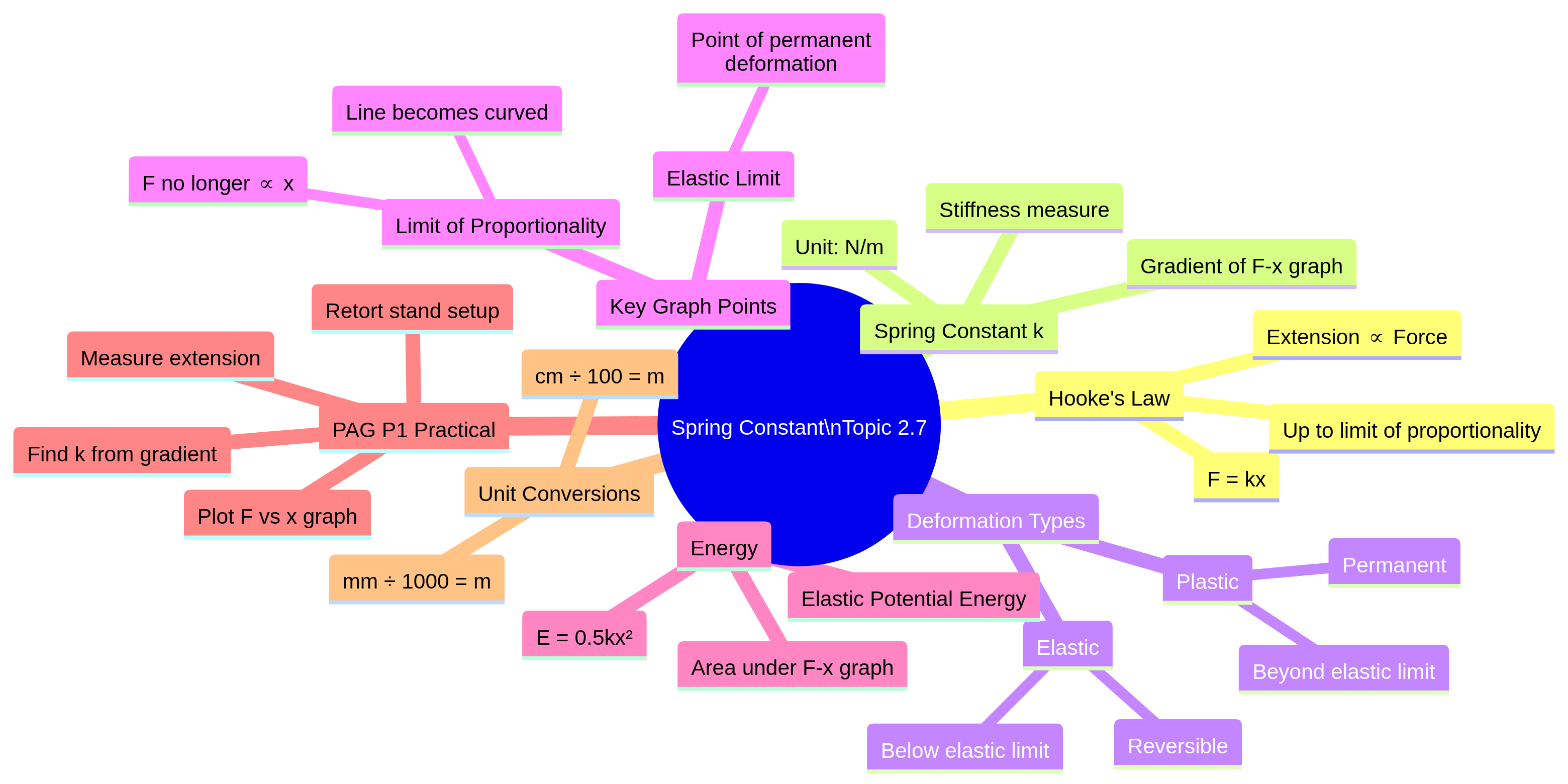
    (Spring Constant\nTopic 2.7Hooke's LawF = kxExtension ∝ ForceUp to limit of proportionalitySpring Constant kUnit: N/mStiffness measureGradient of F-x graphDeformation TypesElasticReversibleBelow elastic limitPlasticPermanentBeyond elastic limitKey Graph PointsLimit of ProportionalityLine becomes curvedF no longer ∝ xElastic LimitPoint of permanent deformationEnergyE = 0.5kx²Area under F-x graphElastic Potential EnergyPAG P1 PracticalRetort stand setupMeasure extensionPlot F vs x graphFind k from gradientUnit Conversionscm ÷ 100 = mmm ÷ 1000 = m

    A concept map linking the key ideas within the Spring Constant topic, from Hooke's Law to the required practical.

    Worked Examples

    3 detailed examples with solutions and examiner commentary

    Practice Questions

    Test your understanding — click to reveal model answers

    Q1

    A spring has a natural length of 15 cm. When a 400 g mass is hung from it, its length becomes 23 cm. Calculate the spring constant of the spring. (g = 9.8 N/kg)

    4 marks
    standard

    Hint: First, calculate the force (weight) from the mass. Then, calculate the extension in metres.

    Q2

    State two ways a student could improve the accuracy of the experiment to determine a spring constant.

    2 marks
    foundation

    Hint: Think about sources of error when measuring.

    Q3

    A spring with a spring constant of 200 N/m is stretched by 10 cm. How much elastic potential energy is stored in the spring?

    3 marks
    standard

    Hint: Remember to use the energy formula and convert your units first!

    Q4

    A force-extension graph for a different spring is plotted with Extension (m) on the y-axis and Force (N) on the x-axis. The gradient of the straight line section is 0.025. What is the spring constant of this spring?

    2 marks
    challenging

    Hint: Be very careful! Look at which way the axes are plotted.

    Q5

    Explain why a spring feels stiffer the more it is stretched, even within its elastic limit.

    2 marks
    challenging

    Hint: Think about the relationship F=kx.

    Explore this topic further

    View Topic PageAll Physics Topics

    Key Terms

    Essential vocabulary to know

    More Physics Study Guides

    View all

    Refraction

    OCR
    GCSE

    This guide explains light refraction for OCR GCSE Physics (4.6), covering why light bends, how to draw ray diagrams, and the secrets to exam success. Master the concepts of optical density and total internal reflection to secure top marks.

    Isotopes

    OCR
    GCSE

    This guide provides a comprehensive overview of isotopes for OCR GCSE Physics (7.2), focusing on core definitions, calculations, and exam technique. It's designed to help you secure maximum marks by mastering the difference between isotopes and ions, understanding nuclear notation, and avoiding common pitfalls.

    Galaxies

    OCR
    GCSE

    Unlock top marks in your OCR GCSE Physics exam by mastering Galaxies (Topic 8.7). This guide breaks down the vastness of space into bite-sized, exam-focused chunks, from the structure of our Milky Way to the mind-bending evidence for the Big Bang.

    Planets

    OCR
    GCSE

    This topic covers the structure of our Solar System, the role of gravitational forces in maintaining planetary orbits, and the historical shift from geocentric to heliocentric models. Understanding these concepts is essential for securing marks in both Foundation and Higher Tier questions, particularly those testing orbital mechanics and the nature of scientific progress.

    Stars

    OCR
    GCSE

    Explore the dramatic life and death of stars, from stable main sequence suns to explosive supernovae. This guide for OCR GCSE Physics (8.6) provides everything candidates need to master stellar evolution, secure top marks, and understand our cosmic origins."

    The Solar System

    OCR
    GCSE

    This guide covers OCR GCSE Physics Topic 8.1, The Solar System. It explores the shift from geocentric to heliocentric models, the physics of orbital motion, and the complete life cycles of stars. Mastering this topic is crucial for tackling high-mark questions on stellar evolution and gravitational forces.