Study Notes
Overview
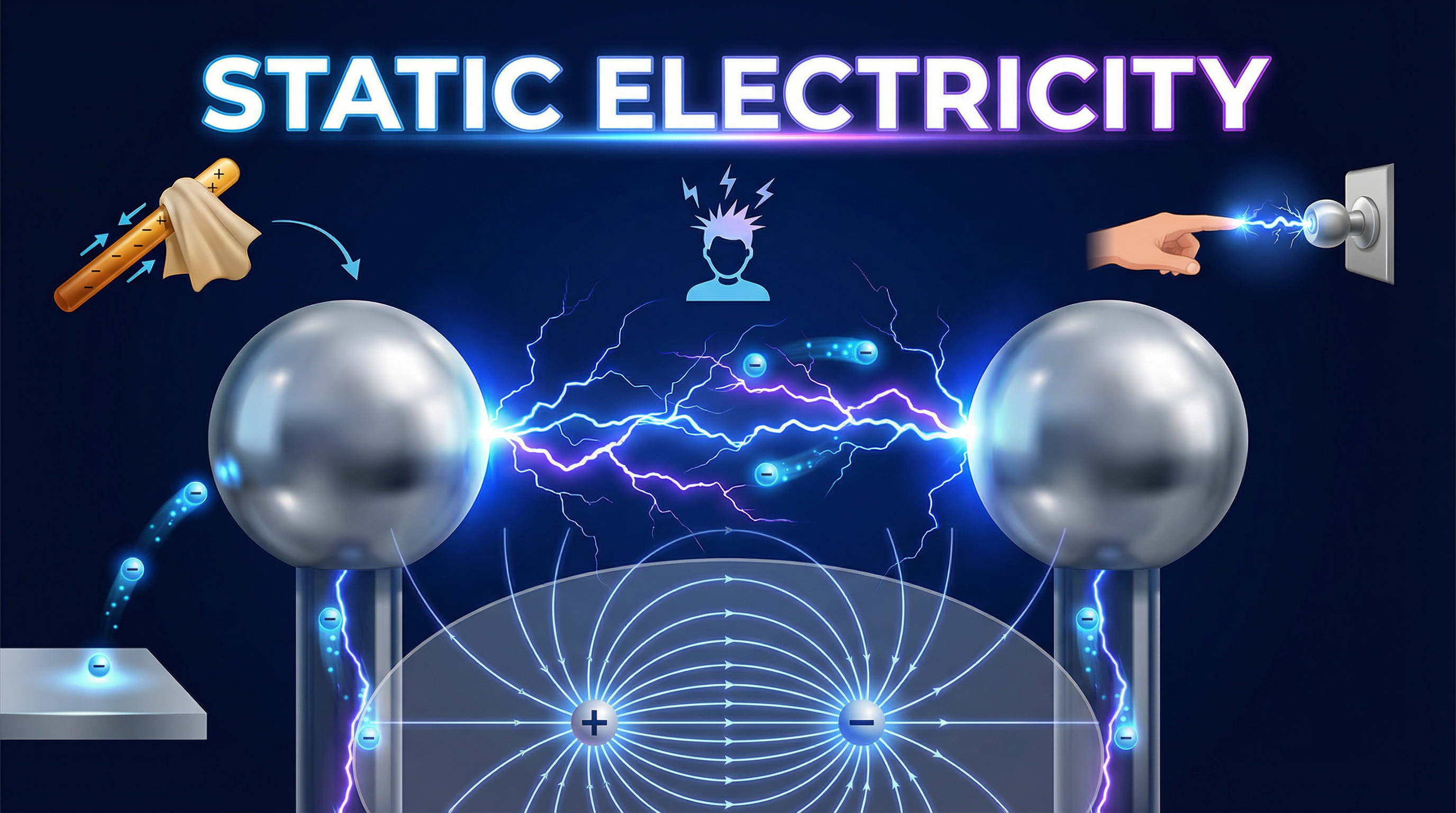
Static electricity sits at the intersection of particle physics and field theory, making it one of the most conceptually rich topics at GCSE level. At its heart, this topic asks a deceptively simple question: why do some objects attract or repel one another without touching? The answer lies in the microscopic world of electrons — particles so small they are invisible, yet capable of producing forces powerful enough to generate lightning bolts.
For OCR candidates, topic 2.5 is assessed across both Foundation and Higher tiers, with Higher Tier extending into the relationship between potential difference and electrical discharge (sparking). Exam questions range from one-mark recall tasks ("State what is meant by an electric field") to extended six-mark explanations of electric shock mechanisms. The Assessment Objective breakdown for this topic is approximately AO1: 40%, AO2: 40%, AO3: 20%, meaning that application and analysis are just as important as pure recall.
This guide covers every examinable concept, provides worked examples with full examiner commentary, and includes the visual and audio resources you need to consolidate your understanding across multiple learning modalities.
Key Concepts
Concept 1: Charging by Friction — The Microscopic Model
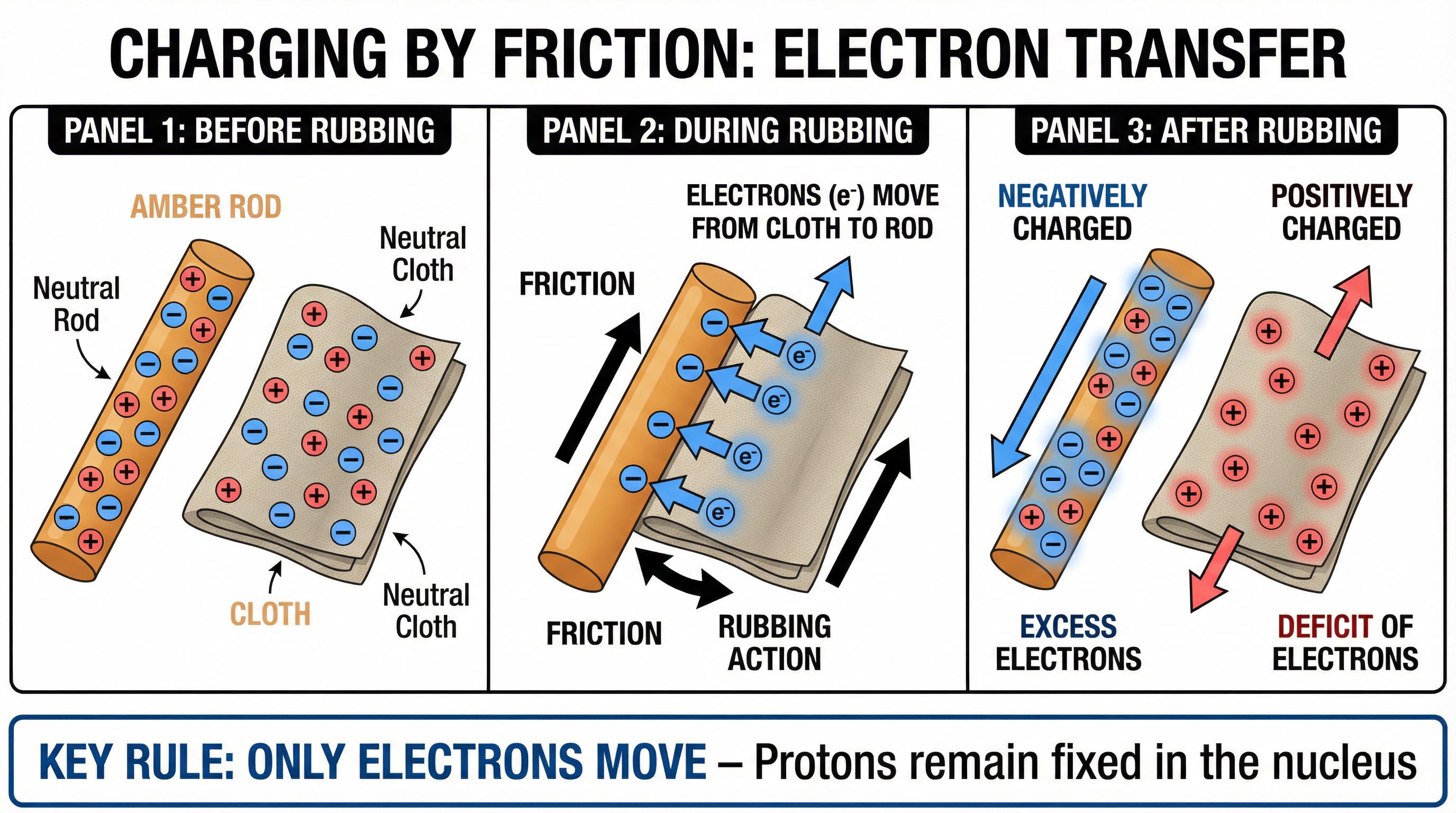
All matter is made of atoms, and atoms contain positively charged protons in the nucleus and negatively charged electrons orbiting around it. In a neutral object, the number of protons equals the number of electrons, so the charges cancel out perfectly.
When two insulating materials are rubbed together — for example, a perspex rod with a woollen cloth — friction provides the energy needed for electrons to transfer from one material to the other. The material that gains electrons acquires an excess of negative charge and becomes negatively charged. The material that loses electrons now has more protons than electrons and becomes positively charged.
The single most important rule in this topic: only electrons move. Protons are bound tightly in the nucleus and cannot be transferred. This is the most frequently penalised error in OCR mark schemes. Candidates who write "protons move to create a positive charge" receive no credit for that marking point.
The examiner's model answer for a charging question always includes: (1) the name of the particle — electron; (2) the direction of transfer — from cloth to rod, or from rod to cloth; (3) the consequence — the rod gains/loses electrons and becomes negatively/positively charged.
Real-world analogy: Think of electrons like coins. If you rub two objects together and coins fall from one into the other, the one that gained coins is now "richer" (more negative). The one that lost coins is now "poorer" (more positive). The total number of coins in the system hasn't changed — charge is always conserved.
Concept 2: The Law of Electrostatics
Once objects carry a charge, they exert forces on one another. The law of electrostatics states:
**Like charges repel; unlike charges attract.**Two negatively charged rods brought near each other will experience a repulsive force — they push apart. A negatively charged rod brought near a positively charged rod will experience an attractive force — they pull together.
Critically, these are non-contact forces: the objects do not need to touch for the force to act. The force is transmitted through an electric field that surrounds every charged object. Examiners award marks specifically for the use of the terms "non-contact force" and "electrostatic force." Simply writing "they attract" without this vocabulary will not earn full credit on a describe or explain question.
| Charge Combination | Force Type | Direction |
|---|---|---|
| Positive + Positive | Electrostatic | Repulsion |
| Negative + Negative | Electrostatic | Repulsion |
| Positive + Negative | Electrostatic | Attraction |
Concept 3: Electric Fields and Field Line Diagrams
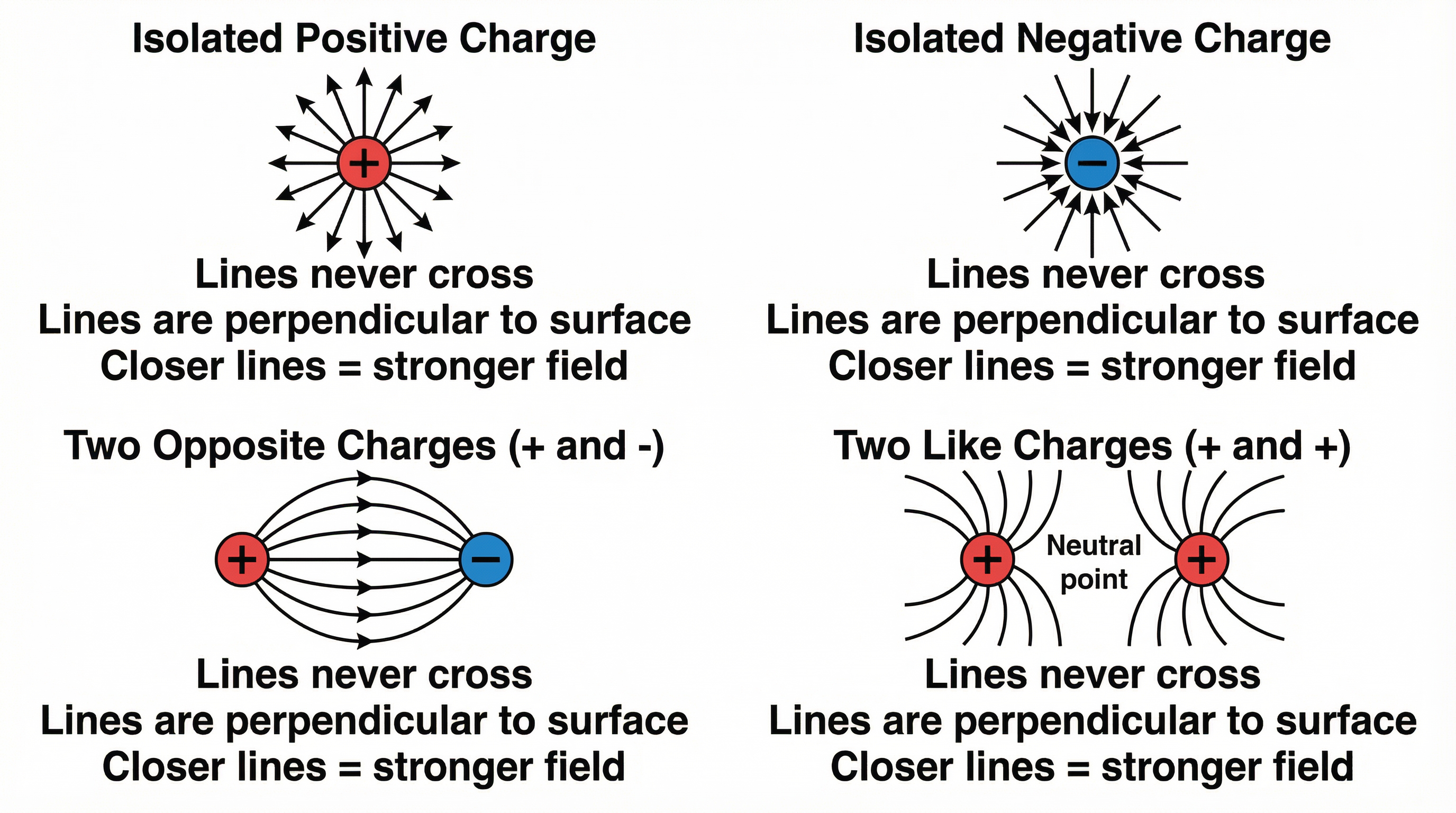
An electric field is defined as a region of space in which a charged object experiences a force. Electric fields are represented by field lines (also called lines of force), and drawing these accurately is a skill that is directly assessed in OCR examinations.
Rules for drawing electric field lines (each rule is a potential mark):
- Field lines always point from positive to negative — they start on positive charges and end on negative charges.
- Field lines are always perpendicular (at 90°) to the surface of the charged object at the point where they meet it.
- Field lines never cross one another. If your lines cross, the diagram is physically impossible and will lose marks.
- The spacing of field lines indicates field strength: closely spaced lines represent a strong field; widely spaced lines represent a weak field.
For a uniform electric field (between two parallel plates), the field lines are parallel, equally spaced, and perpendicular to both plates. For a radial field around a point charge, the lines radiate outward (positive) or inward (negative) like the spokes of a wheel.
Examiner insight: In 3-mark field diagram questions, candidates typically earn one mark for correct direction, one mark for perpendicularity at the surface, and one mark for lines that never cross. Drawing with a ruler and taking care at the surface of the object are the two most effective strategies.
Concept 4: Earthing
Earthing is the process of connecting a charged object to the ground (earth) via a conducting path, allowing charge to be neutralised safely.
The earth acts as an enormous reservoir of charge. When a negatively charged object is earthed, the excess electrons flow from the object through the conducting path to the earth. When a positively charged object is earthed, electrons flow from the earth to the object, filling the "deficit" of electrons. In both cases, the object ends up electrically neutral.
The key language for exam answers: "Electrons flow from the object to the earth" (for a negative object) or "electrons flow from the earth to the object" (for a positive object). Never write that charge "disappears" or "is destroyed." Charge is always conserved — it is redistributed, not eliminated.
Earthing has important practical applications: fuel tankers are earthed before unloading to prevent sparks from static discharge igniting fuel vapour; surgeons use earthed equipment to prevent static shocks during operations; and electronic components are handled using earthed wristbands to prevent damage from electrostatic discharge.
Concept 5: Charge Induction
Charge induction occurs when a charged object is brought near a neutral conductor without touching it, causing a redistribution of charge within the conductor.
Consider a negatively charged rod held near a neutral metal sphere. The free electrons in the metal sphere are repelled by the negative rod and migrate to the far side of the sphere. This leaves the near side of the sphere with a net positive charge (a deficit of electrons) and the far side with a net negative charge. The sphere as a whole is still neutral, but its charges have been separated.
The consequence is that the near side (positive) is attracted to the negative rod, while the far side (negative) is repelled — but since the positive side is closer to the rod, the attractive force is stronger than the repulsive force, and the overall effect is attraction. This is why a charged balloon sticks to a neutral wall, and why small pieces of paper are attracted to a charged comb.
Examiner's mark scheme language: "The charged object induces a charge separation in the neutral conductor" — this phrasing earns the mark. Simply saying "the charges move" is insufficient.
Concept 6: Sparking and Discharge (Higher Tier)
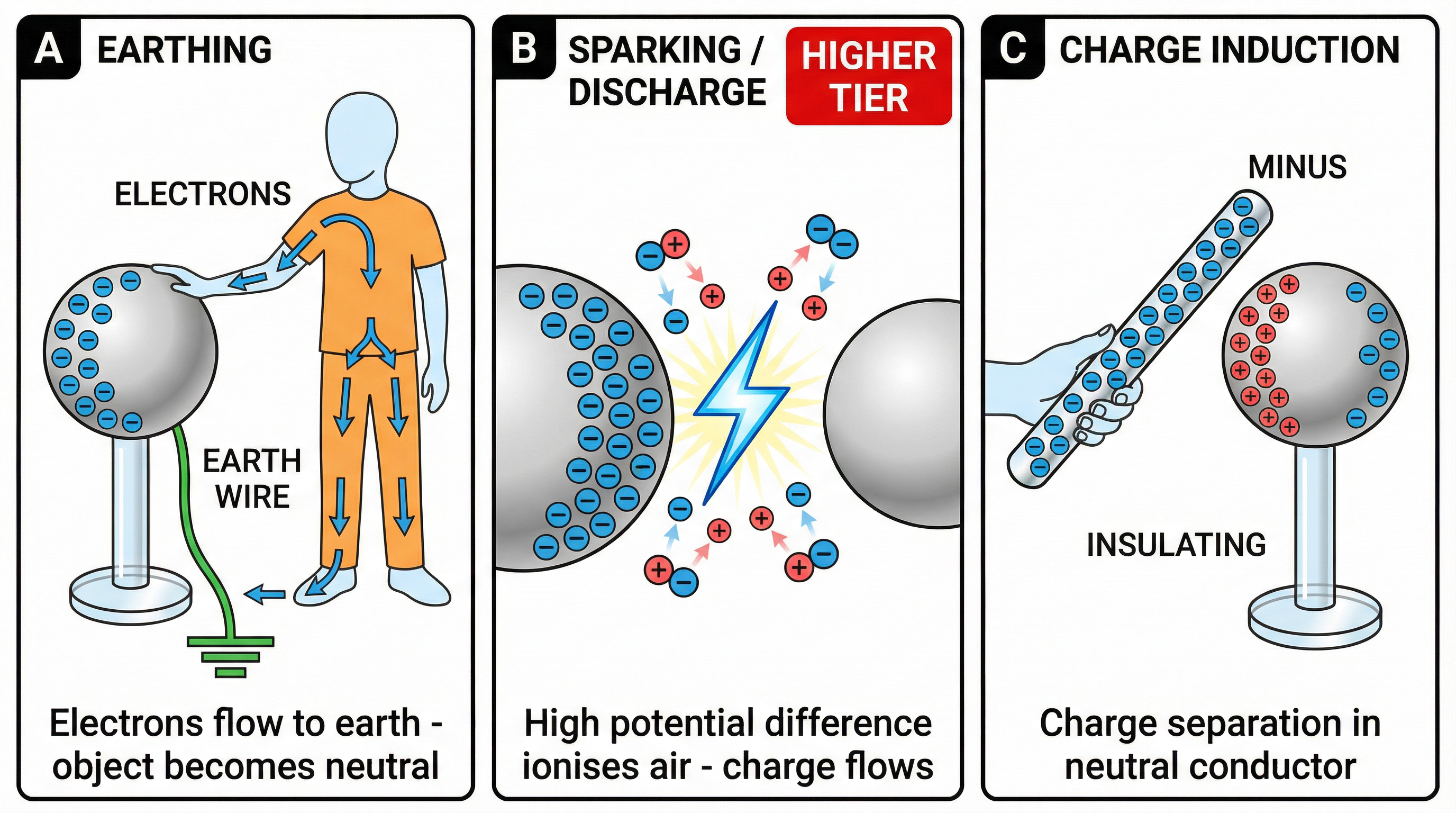
As charge accumulates on an insulating object, the potential difference (voltage) between that object and its surroundings increases. Potential difference is a measure of the "electrical pressure" driving charge to move — the greater the charge, the higher the potential difference.
When the potential difference becomes sufficiently large (typically thousands of volts), the electric field in the surrounding air becomes strong enough to ionise the air molecules. Ionisation means that electrons are stripped away from air molecules, creating positive ions and free electrons. These charged particles can move freely, so the air — normally an excellent insulator — temporarily becomes a conductor. Charge flows rapidly through this conducting path: this is a spark.
The three-step mechanism for sparking (the structure OCR examiners expect):
- Charge build-up: charge accumulates on the object, increasing the potential difference between the object and its surroundings.
- Ionisation: the potential difference becomes large enough that the electric field ionises the surrounding air molecules, producing free ions and electrons.
- Discharge: the ionised air conducts charge, allowing current to flow and the object to discharge.
Lightning is the most dramatic natural example: charge builds up in storm clouds, the potential difference between cloud and ground reaches millions of volts, air ionises along a conducting channel, and charge flows — producing the visible flash and the thunder caused by rapid heating and expansion of air.
Mathematical and Scientific Relationships
Static electricity at GCSE level is primarily conceptual rather than mathematical. However, the following relationships are important:
| Relationship | Formula | Status | Notes |
|---|---|---|---|
| Charge, current, and time | Q = I × t | Must memorise | Q in coulombs (C), I in amperes (A), t in seconds (s) |
| Potential difference and work done | W = Q × V | Must memorise | W in joules (J), Q in coulombs (C), V in volts (V) |
For Higher Tier, the concept of potential difference (V) is central to understanding sparking. The higher the charge Q on an object, the higher the potential difference V between it and its surroundings. When V exceeds the breakdown voltage of air (approximately 3 million volts per metre), discharge occurs.
Unit note: Charge is measured in coulombs (C). One coulomb is the charge carried by approximately 6.24 × 10¹⁸ electrons. In static electricity contexts, charges are typically in the range of microcoulombs (μC) or nanocoulombs (nC) — very small fractions of a coulomb, but enough to produce significant forces and sparks.
Practical Applications
OCR examiners regularly set questions in applied contexts. The following applications are most commonly assessed:
Photocopiers and laser printers: The drum is given a positive charge. A laser beam selectively discharges parts of the drum to create a pattern. Negatively charged toner particles are attracted to the remaining positive areas, then transferred to paper.
Electrostatic paint spraying: Paint droplets are given a charge as they leave the nozzle. Like charges repel, so the droplets spread out evenly. The object being painted is given the opposite charge, attracting the paint droplets for an even, efficient coat with minimal waste.
Fuel tanker earthing: When fuel is pumped, friction can cause charge to build up on the tanker. If the potential difference becomes large enough, a spark could ignite fuel vapour. Earthing the tanker before pumping prevents charge accumulation.
Defibrillators: Store charge on capacitors, then discharge it through the patient's chest to restart the heart — a controlled application of electrostatic discharge.
Tier Content Summary
| Content Area | Foundation | Higher |
|---|---|---|
| Charging by friction (electron transfer) | Yes | Yes |
| Law of electrostatics (like/unlike) | Yes | Yes |
| Electric field lines — drawing and interpreting | Yes | Yes |
| Earthing — mechanism and applications | Yes | Yes |
| Charge induction | Yes | Yes |
| Sparking — ionisation mechanism | No | Yes |
| Potential difference and discharge | No | Yes |
| Breakdown voltage of air | No | Yes |