Stopping Distance

    OCR
    GCSE
    Physics

    This guide provides a comprehensive breakdown of Stopping Distance for OCR GCSE Physics (1.11). It covers the core concepts of thinking and braking distance, the crucial mathematical relationships involved, and provides examiner-level insights to help you secure top marks. Master this topic and you'll be ready for both calculation and long-answer questions.

    4
    Min Read
    3
    Examples
    5
    Questions
    6
    Key Terms
    🎙 Podcast Episode
    Stopping Distance
    6:39
    0:00-6:39

    Study Notes

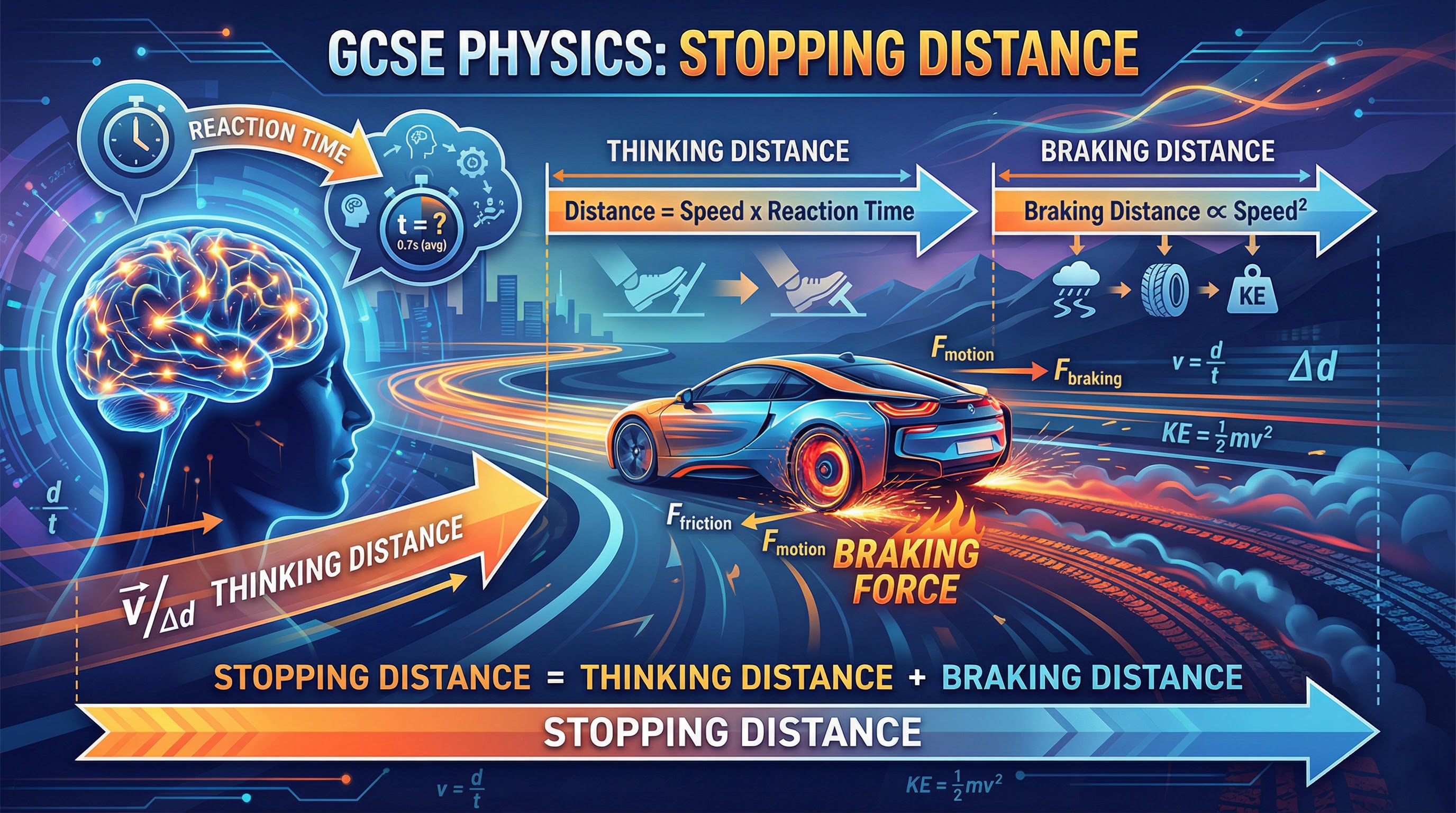
    A visual summary of the key concepts in stopping distance.

    Overview

    Stopping distance is a classic physics topic that combines concepts of motion, forces, and energy. For an examiner, it is a perfect way to test a candidate's ability to distinguish between different physical concepts and apply them to a real-world safety scenario. This guide will deconstruct the topic into two key parts: the driver's reaction time (thinking distance) and the vehicle's braking mechanics (braking distance). You will learn the factors that influence each, the mathematical models used to describe them, and how they combine to determine the total stopping distance. Expect to see this topic appear in your exam as both short-answer definition questions and longer, 6-mark extended-response questions, particularly on the Higher Tier paper where calculations involving kinetic energy are common.

    Key Concepts

    Concept 1: Thinking Distance

    Thinking distance is the distance the vehicle travels during the driver's reaction time. This is the time interval between the driver spotting a hazard and physically applying the brakes. During this period, the car continues to travel at a constant velocity. The key relationship is straightforward: Thinking Distance = Speed × Reaction Time. This means thinking distance is directly proportional to the vehicle's speed. If you double your speed, you will double your thinking distance, assuming your reaction time remains constant. A typical reaction time for a focused driver is around 0.7 seconds, but this can be significantly longer.

    Example: A car is travelling at 20 m/s. The driver has a reaction time of 0.8 seconds. The thinking distance would be 20 m/s × 0.8 s = 16 metres.

    Concept 2: Braking Distance

    Braking distance is the distance the vehicle travels from the moment the brakes are applied until it comes to a complete stop. This is governed by the principles of work and energy. To stop the car, the brakes must do work to dissipate the car's kinetic energy as heat. The work done by the braking force is equal to the initial kinetic energy of the vehicle. This gives us the crucial equation for Higher Tier candidates: Work Done by Brakes = Kinetic Energy of Vehicle, or F × d = ½ × m × v², where F is the braking force, d is the braking distance, m is the mass, and v is the velocity.

    From this, we can see that braking distance (d) is proportional to the square of the velocity (v²). This is a vital relationship to remember. If you double your speed, you quadruple your braking distance (2² = 4). If you triple your speed, your braking distance increases by a factor of nine (3² = 9).
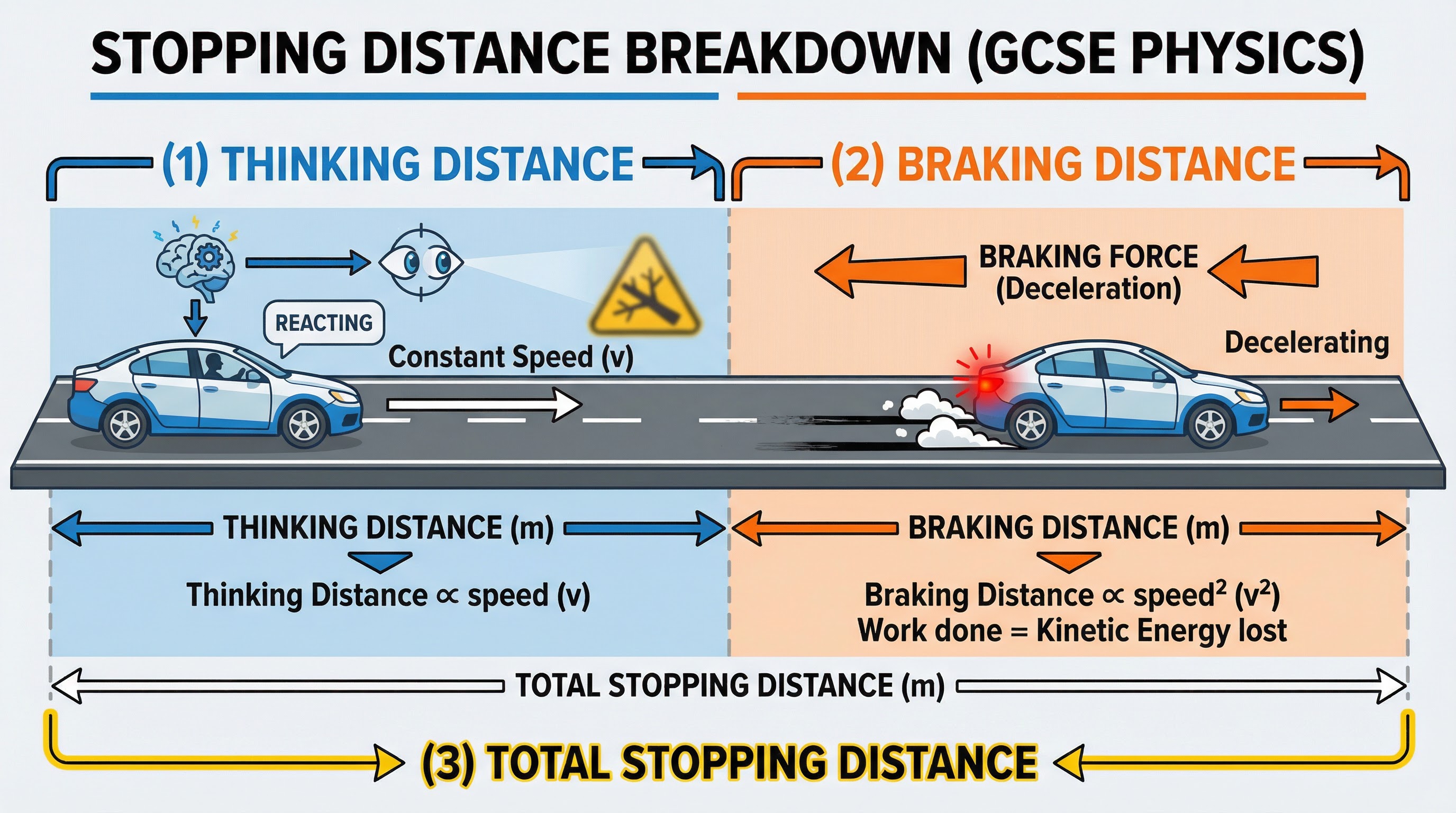
    The breakdown of stopping distance into thinking and braking distance.

    Mathematical/Scientific Relationships

    Here are the key formulas you need to know for the Stopping Distance topic.

    • Stopping Distance = Thinking Distance + Braking Distance (Must memorise)
    • Thinking Distance = Speed × Reaction Time (Must memorise)
    • Kinetic Energy (KE) = ½mv² (Given on formula sheet)
    • Work Done = Force × Distance (Given on formula sheet)
    • Fd = ½mv² (Higher Tier - derived, but must understand and apply)

    Symbol Meanings:

    • d: distance (in metres, m)
    • v: speed or velocity (in metres per second, m/s)
    • t: time (in seconds, s)
    • m: mass (in kilograms, kg)
    • F: force (in Newtons, N)
    • KE: Kinetic Energy (in Joules, J)

    Practical Applications

    Understanding stopping distance is fundamental to road safety design and regulations. It informs speed limits, the design of braking systems (like ABS), and public safety campaigns about the dangers of drink-driving or using a phone at the wheel. The concepts are also applied in accident investigation to determine vehicle speeds prior to a collision. There isn't a specific required practical on stopping distance, but questions often use data from experiments measuring reaction times (e.g., the ruler drop test) or investigating friction.
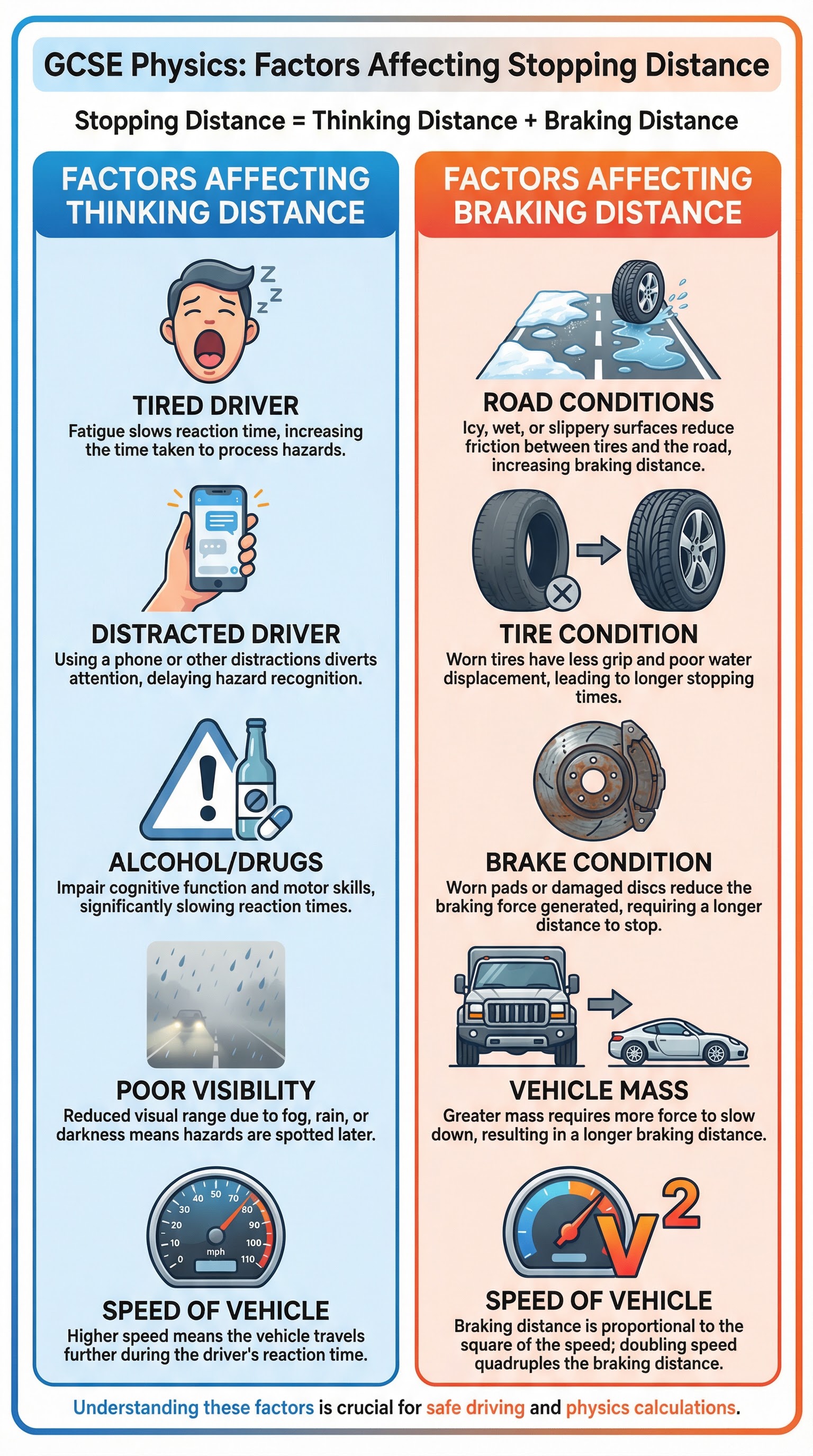
    A summary of the factors affecting thinking and braking distance.

    Visual Resources

    2 diagrams and illustrations

    The breakdown of stopping distance into thinking and braking distance.
    The breakdown of stopping distance into thinking and braking distance.
    A summary of the factors affecting thinking and braking distance.
    A summary of the factors affecting thinking and braking distance.

    Interactive Diagrams

    2 interactive diagrams to visualise key concepts

    Total Stopping DistanceDriver ReactsBrakes AppliedHazard SpottedThinking DistanceBraking DistanceVehicle Stopped

    A flowchart showing the sequence of events that make up the total stopping distance.

    Factors Affecting Braking DistanceFactors Affecting Thinking DistanceTirednessReaction TimeDistractionsAlcohol/DrugsRoad SurfaceBraking ForceTyre ConditionVehicle MassKinetic EnergyThinking DistanceBraking Distance

    A concept map illustrating how different factors influence either thinking distance or braking distance.

    Worked Examples

    3 detailed examples with solutions and examiner commentary

    Practice Questions

    Test your understanding — click to reveal model answers

    Q1

    State the relationship between a car's speed and its braking distance. [1 mark]

    1 marks
    foundation

    Hint: Is the relationship linear or something else?

    Q2

    A driver's typical reaction time is 0.8s. If they are travelling at 30 m/s and become distracted, their reaction time increases by 50%. Calculate the increase in their thinking distance. [3 marks]

    3 marks
    standard

    Hint: First, calculate the new reaction time. Then find the original and new thinking distances.

    Q3

    Two cars, A and B, are identical. Car B has twice the mass of Car A because it is fully loaded. Both cars travel at the same speed. Compare the kinetic energies and the minimum braking distances of the two cars. [4 marks]

    4 marks
    challenging

    Hint: Think about the formulas for KE and braking distance. What happens when you double the mass (m)?

    Q4

    Describe why driving in icy conditions is more dangerous than driving in the rain. Use ideas about friction and braking distance in your answer. [3 marks]

    3 marks
    standard
    Q5

    A lorry has a mass of 30,000 kg. A car has a mass of 1,500 kg. If both are travelling at the same speed, explain why the lorry's stopping distance is much greater. [4 marks]

    4 marks
    challenging

    Explore this topic further

    View Topic PageAll Physics Topics

    Key Terms

    Essential vocabulary to know

    More Physics Study Guides

    View all

    Refraction

    OCR
    GCSE

    This guide explains light refraction for OCR GCSE Physics (4.6), covering why light bends, how to draw ray diagrams, and the secrets to exam success. Master the concepts of optical density and total internal reflection to secure top marks.

    Isotopes

    OCR
    GCSE

    This guide provides a comprehensive overview of isotopes for OCR GCSE Physics (7.2), focusing on core definitions, calculations, and exam technique. It's designed to help you secure maximum marks by mastering the difference between isotopes and ions, understanding nuclear notation, and avoiding common pitfalls.

    Galaxies

    OCR
    GCSE

    Unlock top marks in your OCR GCSE Physics exam by mastering Galaxies (Topic 8.7). This guide breaks down the vastness of space into bite-sized, exam-focused chunks, from the structure of our Milky Way to the mind-bending evidence for the Big Bang.

    Planets

    OCR
    GCSE

    This topic covers the structure of our Solar System, the role of gravitational forces in maintaining planetary orbits, and the historical shift from geocentric to heliocentric models. Understanding these concepts is essential for securing marks in both Foundation and Higher Tier questions, particularly those testing orbital mechanics and the nature of scientific progress.

    Stars

    OCR
    GCSE

    Explore the dramatic life and death of stars, from stable main sequence suns to explosive supernovae. This guide for OCR GCSE Physics (8.6) provides everything candidates need to master stellar evolution, secure top marks, and understand our cosmic origins."

    The Solar System

    OCR
    GCSE

    This guide covers OCR GCSE Physics Topic 8.1, The Solar System. It explores the shift from geocentric to heliocentric models, the physics of orbital motion, and the complete life cycles of stars. Mastering this topic is crucial for tackling high-mark questions on stellar evolution and gravitational forces.