The Universe

    OCR
    GCSE
    Physics

    Explore the life and death of stars and uncover the evidence for the Big Bang. This guide provides everything you need to master OCR GCSE Physics Topic 8.8, from stellar evolution to cosmic expansion, ensuring you can tackle any exam question with confidence.

    6
    Min Read
    3
    Examples
    5
    Questions
    6
    Key Terms
    🎙 Podcast Episode
    The Universe
    8:47
    0:00-8:47

    Study Notes

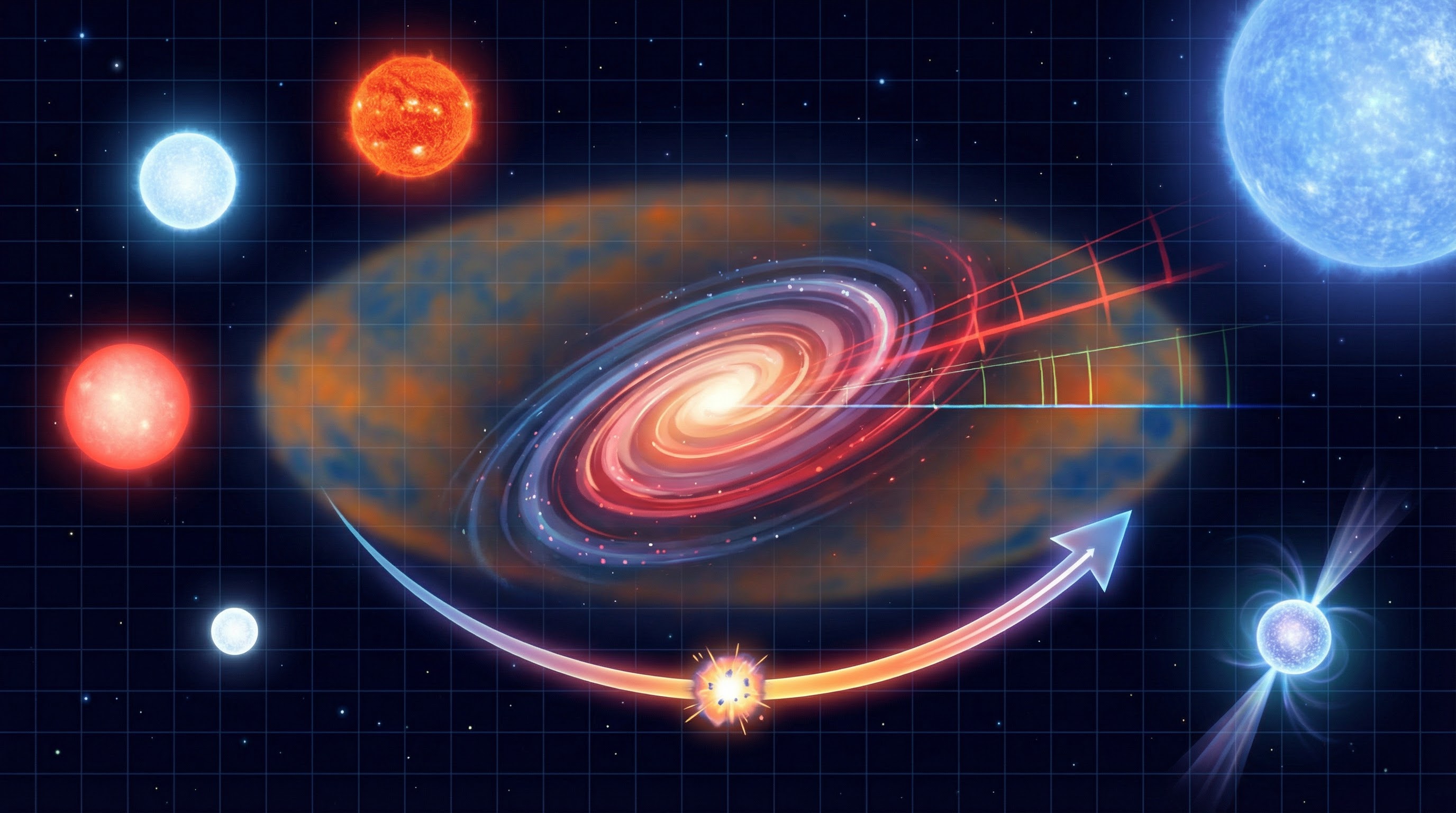
    An artist's impression of key cosmological concepts, including stellar evolution and the expanding universe.

    Overview

    Welcome to the study of The Universe, a topic that spans from the birth of stars to the origin of everything. In this section of the OCR GCSE Physics specification, you will explore the two major pillars of modern cosmology: the life cycle of stars and the evidence supporting the Big Bang theory. Understanding this topic is not just about memorising facts; it is about appreciating the vast scales of space and time and the physical laws that govern them. Examiners will expect you to be able to describe the processes of stellar evolution, explain the significance of red-shift and the Cosmic Microwave Background Radiation (CMBR), and for Higher Tier candidates, apply principles of orbital mechanics. This topic frequently links to concepts such as forces (gravity), energy transfers, and the electromagnetic spectrum, making it a prime candidate for synoptic questions that test your broader understanding of physics.

    Listen to our 10-minute podcast guide to The Universe.

    Key Concepts

    Concept 1: The Life Cycle of Stars

    Every star you see in the night sky is on a journey, a life cycle determined by its mass. All stars are born from nebulae, which are enormous clouds of gas and dust. Gravity pulls this material together into a dense, hot core called a protostar. When the core becomes hot and dense enough for nuclear fusion to begin, a star is born and enters its main sequence phase, a long, stable period where it fuses hydrogen into helium.

    **Sun-like Stars (Low Mass):**After billions of years, a star like our Sun will exhaust the hydrogen in its core. It then swells into a red giant. The outer layers drift away, leaving behind a hot, dense core known as a white dwarf. Over an immense timescale, this white dwarf will cool and fade, becoming a black dwarf.

    **Massive Stars (High Mass):**Stars much more massive than our Sun have a more dramatic fate. They evolve into red supergiants and fuse heavier elements in their cores. Their life ends in a cataclysmic supernova explosion. The remnant of this explosion can be either an incredibly dense neutron star or, if the original star was massive enough, a black hole – an object with gravity so strong that nothing, not even light, can escape.
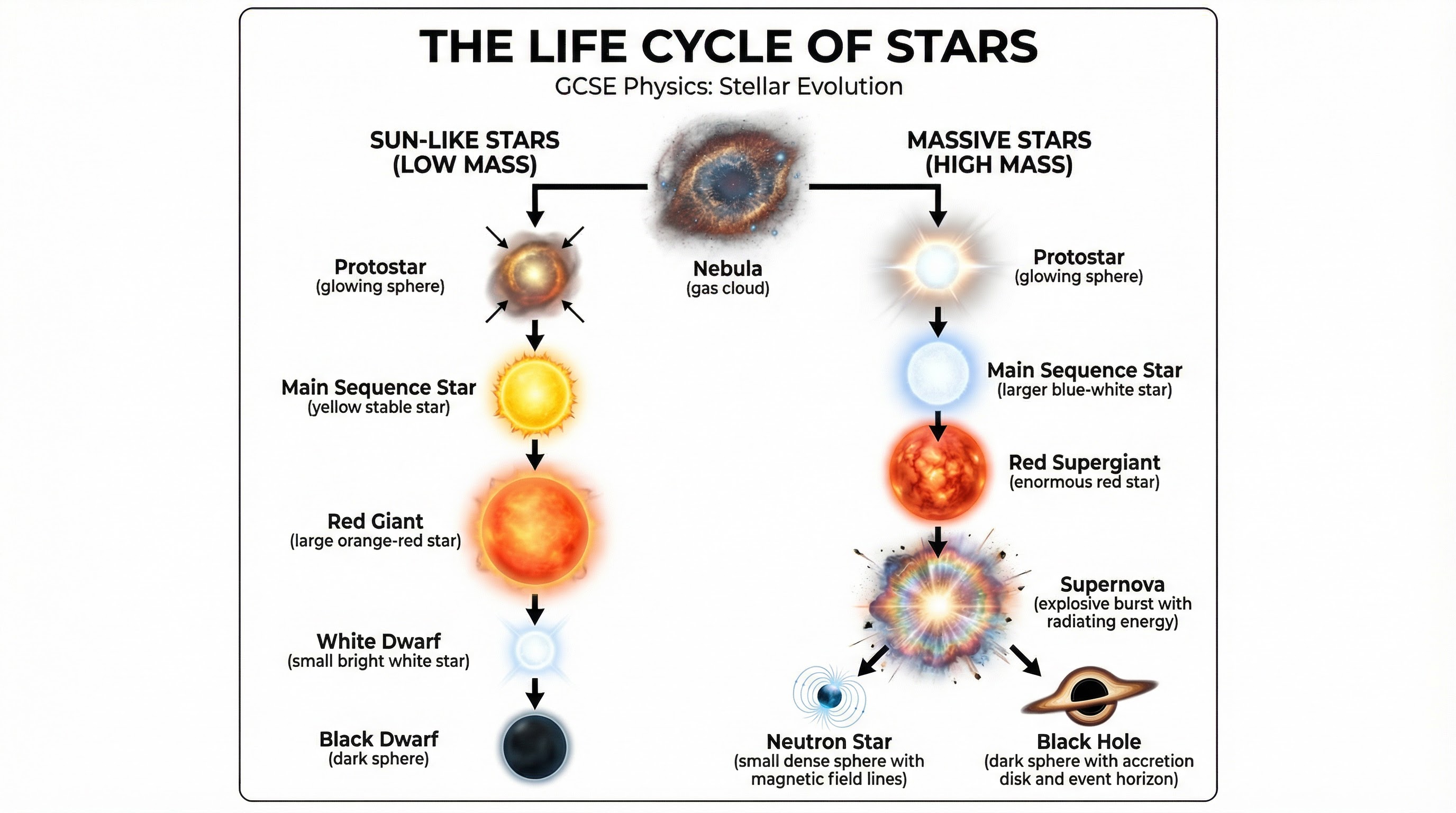
    The life cycle of stars, from nebula to their final stages.

    Concept 2: The Big Bang Theory and Evidence

    The Big Bang theory is the leading scientific model for how the universe began. It states that the universe started from a single point that was extremely hot and dense, and has been expanding and cooling ever since. This is not an explosion in space, but an expansion of space itself.

    Evidence 1: Red-ShiftWhen we observe light from distant galaxies, we find that the light is ‘red-shifted’. This means the wavelength of the light has been stretched, so it appears shifted towards the red end of the electromagnetic spectrum. This happens because the galaxies are moving away from us. Crucially, the further away a galaxy is, the greater its red-shift, meaning it is moving away faster. This observation provides strong evidence for the expansion of the universe.
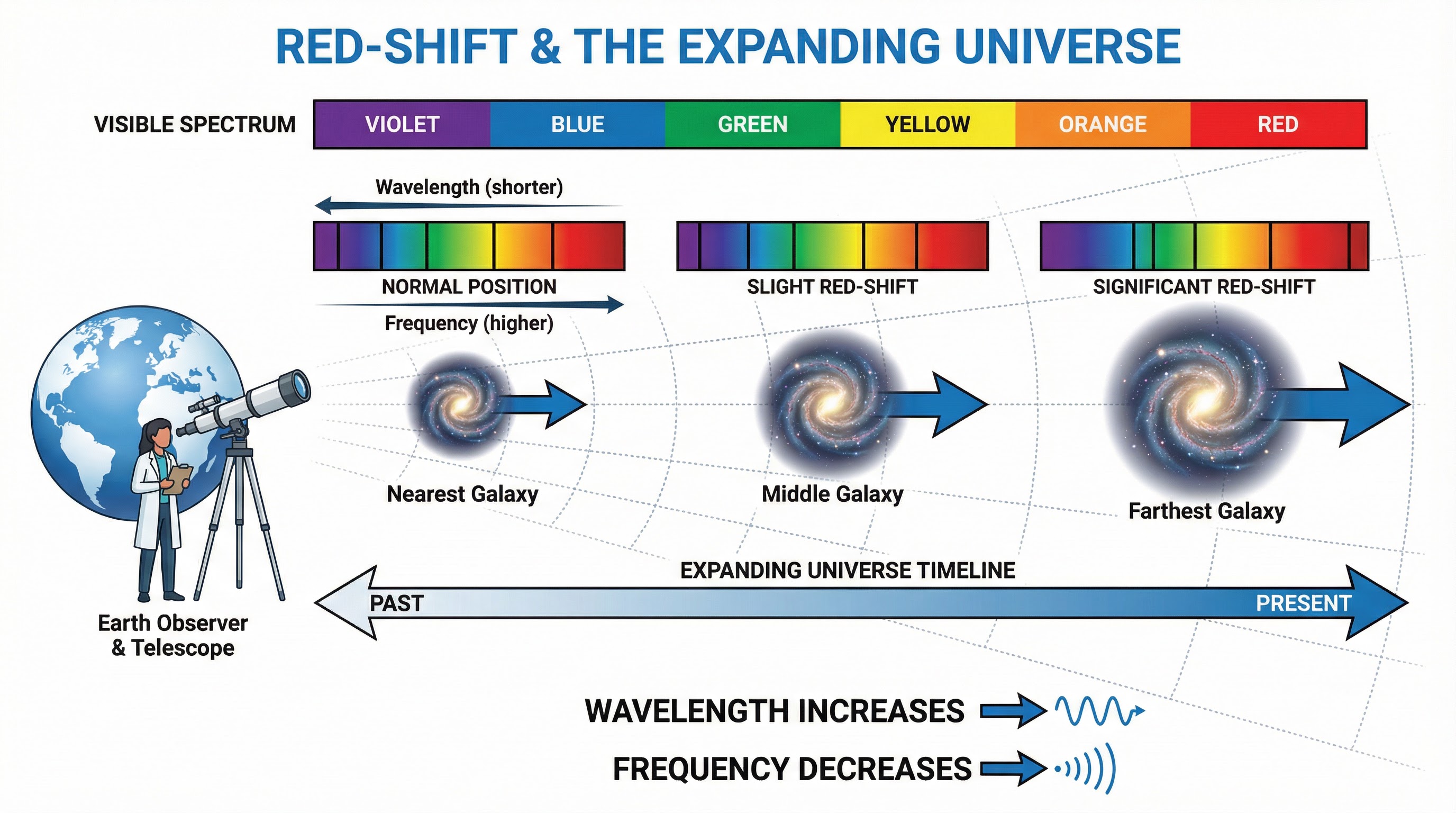
    How red-shift in light from distant galaxies shows they are moving away from us.

    **Evidence 2: Cosmic Microwave Background Radiation (CMBR)**CMBR is faint microwave radiation that comes from all directions in space. It is considered to be the ‘afterglow’ of the Big Bang. When the universe was young and hot, it was filled with high-energy radiation. As the universe expanded and cooled, this radiation stretched to longer wavelengths, becoming the microwaves we detect today. Its existence and uniform temperature (about 2.7 Kelvin) are powerful confirmations of the Big Bang model.
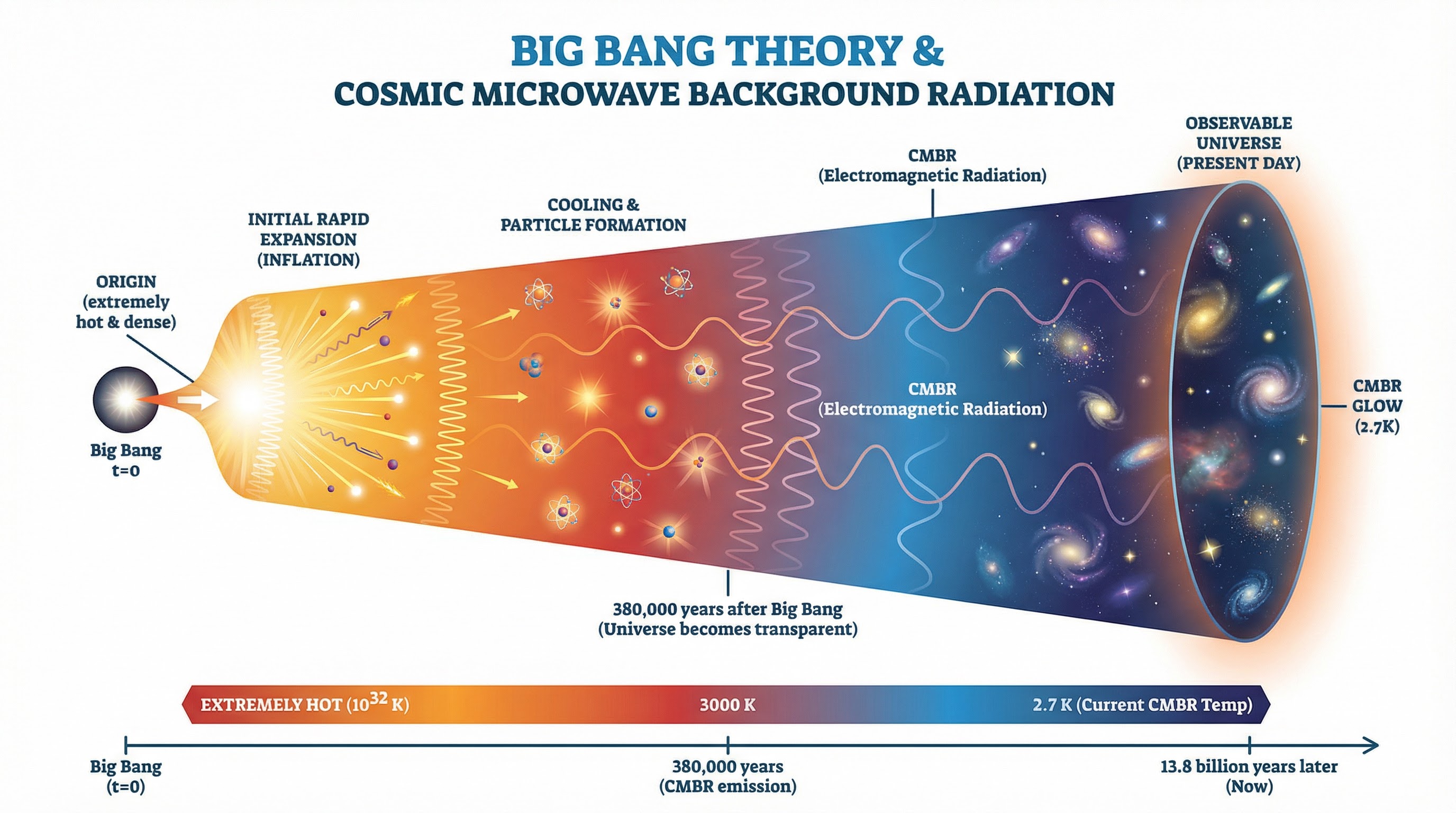
    A timeline of the universe from the Big Bang to the present day, showing the origin of CMBR.

    Concept 3: Orbital Motion (Higher Tier)

    Planets, moons, and satellites all follow orbits. The force that keeps these objects in orbit is gravity. For an object to travel in a circle, it needs a force acting towards the centre of the circle – this is called the centripetal force. In the case of orbits, gravity provides this centripetal force. Although an object in a stable orbit may have a constant speed, its velocity is always changing because its direction is always changing. A change in velocity is acceleration, so an orbiting object is constantly accelerating towards the object it is orbiting.

    Mathematical/Scientific Relationships

    For Higher Tier candidates, you may be expected to understand the relationship between orbital speed, orbital radius, and the time period of an orbit.

    • Formula: v = (2 * π * r) / T
      • v = orbital speed (in metres per second, m/s)
      • r = orbital radius (in metres, m)
      • T = time period (in seconds, s)
    • Status: This formula is Given on the formula sheet.
    • Explanation: This equation calculates the speed of an object moving in a circular path. It is the circumference of the orbit (2 * π * r) divided by the time it takes to complete one orbit (T). Examiners may ask you to calculate any of the three variables, so be prepared to rearrange the formula.

    Visual Resources

    3 diagrams and illustrations

    The life cycle of stars, from nebula to their final stages.
    The life cycle of stars, from nebula to their final stages.
    How red-shift in light from distant galaxies shows they are moving away from us.
    How red-shift in light from distant galaxies shows they are moving away from us.
    A timeline of the universe from the Big Bang to the present day, showing the origin of CMBR.
    A timeline of the universe from the Big Bang to the present day, showing the origin of CMBR.

    Interactive Diagrams

    2 interactive diagrams to visualise key concepts

    Sun-like MassMassive StarNebulaProtostarMain Sequence StarRed GiantWhite DwarfBlack DwarfRed SupergiantSupernovaNeutron StarBlack Hole

    Flowchart showing the two possible life cycles for a star, depending on its initial mass.

    Big Bang EvidenceBig Bang TheoryUniverse is ExpandingGalaxies move awayRed-Shift ObservedUniverse was Hot & DenseRadiation RemnantCMBR Detected

    Concept map linking the core ideas of the Big Bang theory to the key pieces of observational evidence.

    Worked Examples

    3 detailed examples with solutions and examiner commentary

    Practice Questions

    Test your understanding — click to reveal model answers

    Q1

    State two pieces of evidence that support the Big Bang theory. [2 marks]

    2 marks
    foundation
    Q2

    A main sequence star is in a stable phase of its life. Explain the forces acting on the star that keep it stable. [3 marks]

    3 marks
    standard
    Q3

    Compare the final stages of a Sun-like star with a star that is much more massive. [4 marks]

    4 marks
    standard
    Q4

    The light from a distant galaxy is observed to have a red-shift. What does this tell us about the galaxy's motion and the frequency of the light we detect? [2 marks]

    2 marks
    standard
    Q5

    The orbital radius of a satellite is 4.2 x 10^7 m and its time period is 8.64 x 10^4 s. Calculate the orbital speed of the satellite. Give your answer to 3 significant figures. [3 marks] (Higher Tier)

    3 marks
    challenging

    Hint: Use the formula `v = (2 * π * r) / T` provided on the formula sheet.

    Explore this topic further

    View Topic PageAll Physics Topics

    Key Terms

    Essential vocabulary to know

    More Physics Study Guides

    View all

    Refraction

    OCR
    GCSE

    This guide explains light refraction for OCR GCSE Physics (4.6), covering why light bends, how to draw ray diagrams, and the secrets to exam success. Master the concepts of optical density and total internal reflection to secure top marks.

    Isotopes

    OCR
    GCSE

    This guide provides a comprehensive overview of isotopes for OCR GCSE Physics (7.2), focusing on core definitions, calculations, and exam technique. It's designed to help you secure maximum marks by mastering the difference between isotopes and ions, understanding nuclear notation, and avoiding common pitfalls.

    Galaxies

    OCR
    GCSE

    Unlock top marks in your OCR GCSE Physics exam by mastering Galaxies (Topic 8.7). This guide breaks down the vastness of space into bite-sized, exam-focused chunks, from the structure of our Milky Way to the mind-bending evidence for the Big Bang.

    Planets

    OCR
    GCSE

    This topic covers the structure of our Solar System, the role of gravitational forces in maintaining planetary orbits, and the historical shift from geocentric to heliocentric models. Understanding these concepts is essential for securing marks in both Foundation and Higher Tier questions, particularly those testing orbital mechanics and the nature of scientific progress.

    Stars

    OCR
    GCSE

    Explore the dramatic life and death of stars, from stable main sequence suns to explosive supernovae. This guide for OCR GCSE Physics (8.6) provides everything candidates need to master stellar evolution, secure top marks, and understand our cosmic origins."

    The Solar System

    OCR
    GCSE

    This guide covers OCR GCSE Physics Topic 8.1, The Solar System. It explores the shift from geocentric to heliocentric models, the physics of orbital motion, and the complete life cycles of stars. Mastering this topic is crucial for tackling high-mark questions on stellar evolution and gravitational forces.