Study Notes
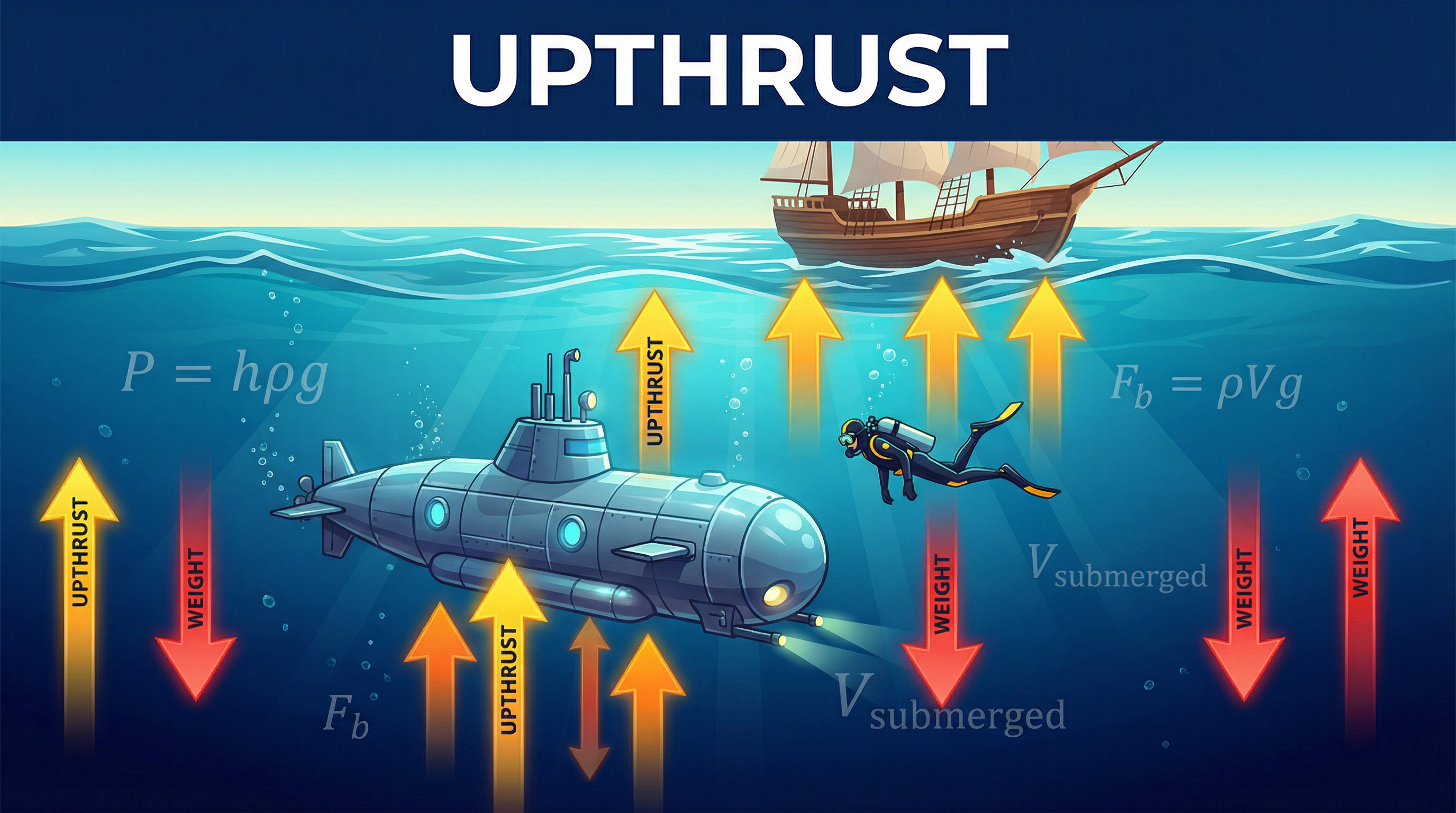
Overview
Upthrust, a key concept in OCR GCSE Physics (2.10), is the upward force exerted by a fluid on a submerged object. Understanding this topic is crucial as it not only explains everyday phenomena like why ships float but also underpins principles of pressure and density. Examiners frequently test this through both calculation and explanation questions, often requiring candidates to link the pressure difference at varying depths to the resultant upward force. This guide will equip you with the core knowledge, mathematical skills, and exam strategies to confidently tackle questions on upthrust, floating, and sinking, ensuring you can explain the 'why' behind the 'what' and earn maximum credit.
Key Concepts
Concept 1: The Origin of Upthrust
Upthrust is not a mysterious force; it is a direct consequence of pressure increasing with depth in a fluid. For any submerged object, the fluid exerts pressure on all its surfaces. According to the equation P = hρg, the deeper you go (increasing h), the greater the pressure (P). This means the pressure on the bottom surface of an object is always greater than the pressure on its top surface. Since Force = Pressure × Area, the upward force on the bottom surface is larger than the downward force on the top surface. This difference in forces creates a net upward force, which we call upthrust. Examiners award full marks for this specific chain of reasoning.
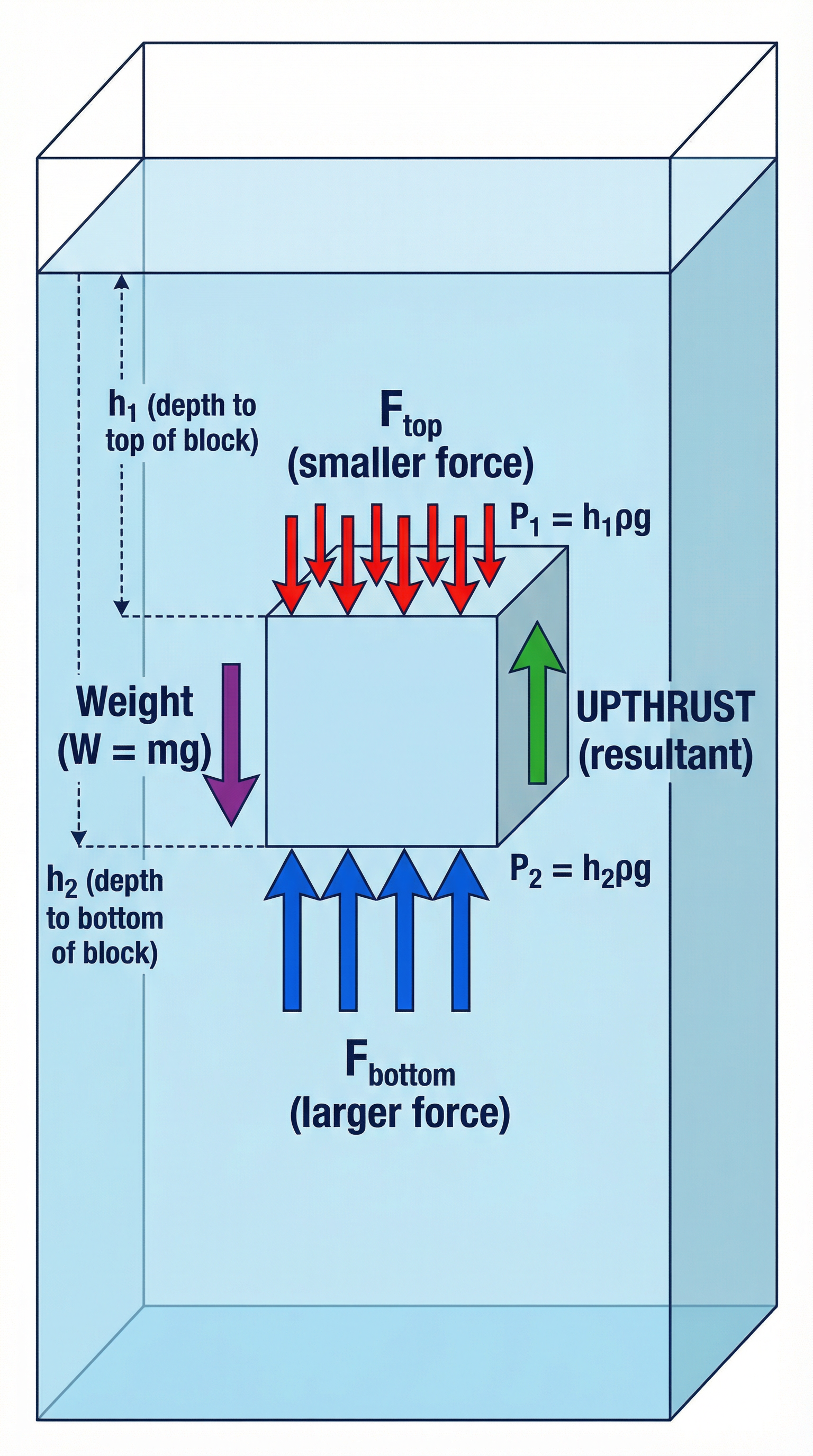
Example: Imagine a cubic block of side 0.1m submerged in water (density 1000 kg/m³). The top face is at a depth of 0.2m and the bottom face is at 0.3m. The pressure difference is ΔP = (0.3 - 0.2)m × 1000 kg/m³ × 10 N/kg = 1000 Pa. The upthrust is this pressure difference multiplied by the area (0.1m × 0.1m = 0.01m²), giving a force of 10 N.
Concept 2: Archimedes' Principle
A more direct way to quantify upthrust is using Archimedes' Principle, which states that the upthrust on an object is equal to the weight of the fluid it displaces. When an object is placed in a fluid, it pushes some of that fluid out of the way. The weight of this displaced fluid is precisely the magnitude of the upward force the object experiences. This is a powerful concept that simplifies many calculations.
Concept 3: Floating and Sinking
The fate of an object in a fluid—whether it floats or sinks—is decided by a simple comparison of two forces: its weight (acting downwards) and the upthrust (acting upwards).
- Floating: An object floats if the upthrust is equal to its weight. The object sinks into the fluid just enough to displace a volume of fluid with a weight equal to its own. This is a state of equilibrium.
- Sinking: An object sinks if its weight is greater than the maximum possible upthrust. The maximum upthrust occurs when the object is fully submerged, as this is when it displaces the maximum volume of fluid. If the object's weight still exceeds this value, it will sink.
- Neutral Buoyancy: An object has neutral buoyancy if its weight is exactly equal to the upthrust when fully submerged. It will remain at a constant depth, neither rising nor sinking. Submarines use this principle to control their depth.
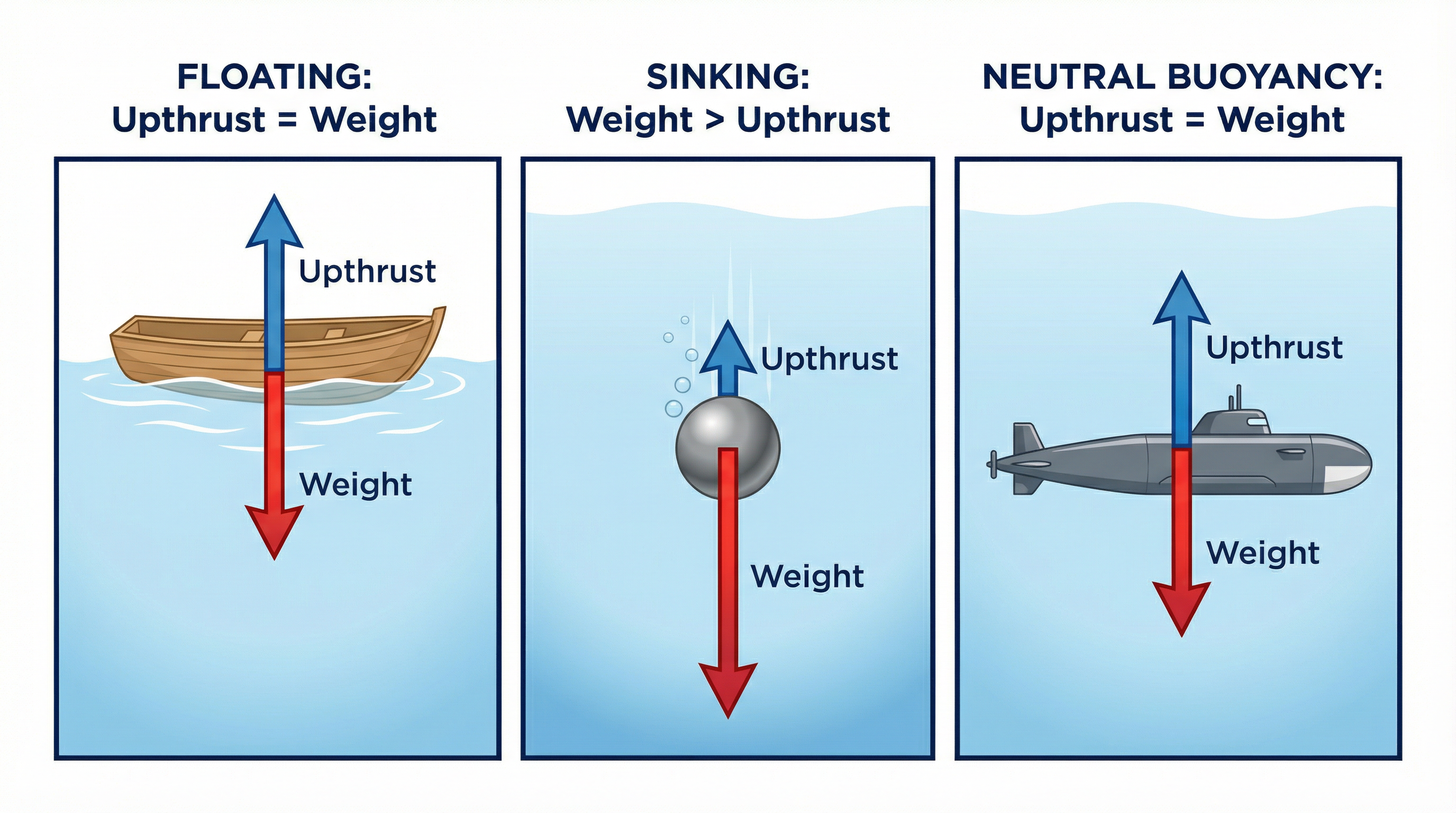
A crucial factor determining this balance is density. An object will float if its average density is less than the density of the fluid. It will sink if its average density is greater than the density of thefluid.
Mathematical/Scientific Relationships
-
Pressure in a Fluid:
P = hρg- P: Pressure (in Pascals, Pa)
- h: Depth or height of the fluid column (in metres, m)
- ρ: Density of the fluid (in kilograms per cubic metre, kg/m³)
- g: Gravitational field strength (10 N/kg for GCSE)
- Status: Given on formula sheet.
-
Upthrust (from Archimedes' Principle):
Upthrust = Weight of displaced fluid- This can be written as:
Upthrust = V_submerged × ρ_fluid × g - V_submerged: Volume of the object submerged in the fluid (in cubic metres, m³)
- ρ_fluid: Density of the fluid (in kg/m³)
- g: Gravitational field strength (10 N/kg)
- Status: Must memorise the principle; the formula is derived.
- This can be written as:
-
Weight:
W = mg- W: Weight (in Newtons, N)
- m: Mass (in kilograms, kg)
- g: Gravitational field strength (10 N/kg)
- Status: Must memorise.
Practical Applications
- Ships: A steel ship can float because its hull is shaped to displace a huge volume of water. This creates an enormous upthrust force that is equal to the combined weight of the ship, its cargo, and crew. The ship's average density (including the air inside the hull) is less than the density of water.
- Submarines: Submarines control their depth by altering their weight and average density. They have ballast tanks that can be filled with water to increase weight and sink, or filled with compressed air to expel water, decrease weight, and rise.
- Hot Air Balloons: A hot air balloon rises because the hot, less dense air inside the balloon makes its average density lower than the cooler, denser air outside. The upthrust from the surrounding air is greater than the balloon's weight.
- Hydrometers: This is a required practical area. A hydrometer is an instrument used to measure the density of liquids. It consists of a weighted glass bulb with a thin stem. It floats at different levels in different liquids – the denser the liquid, the higher it floats, because it needs to displace less fluid to generate an upthrust equal to its weight.
Unit Conversions
- Area: 1 cm² = 0.0001 m²
- Volume: 1 cm³ = 0.000001 m³
- Density: To convert from g/cm³ to kg/m³, multiply by 1000. (e.g., water is 1 g/cm³ or 1000 kg/m³)
- Pressure: 1 kPa (kilopascal) = 1000 Pa