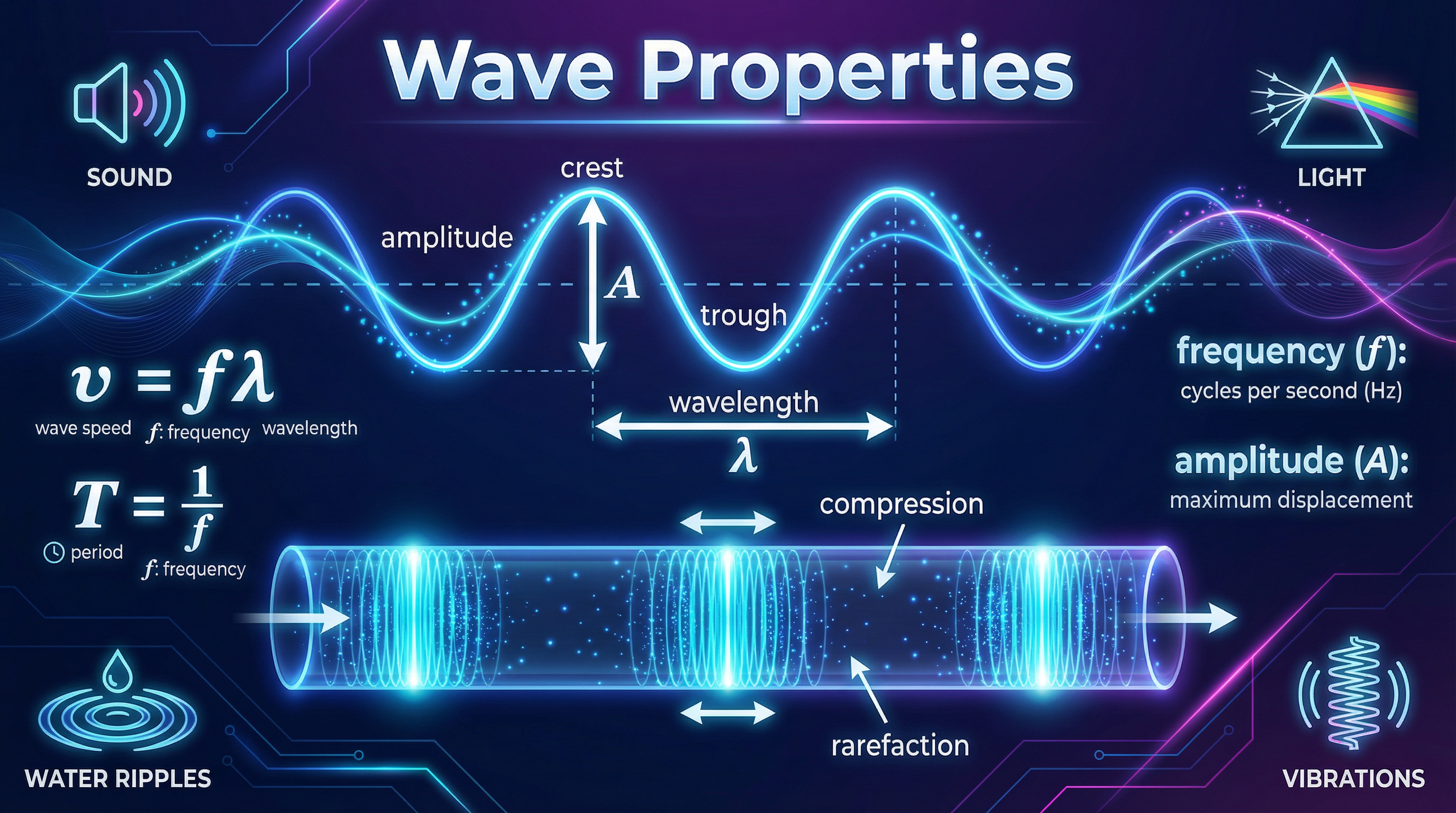
Wave Properties (amplitude, wavelength, frequency, period)

    OCR
    GCSE
    Physics

    This guide provides a comprehensive, exam-focused breakdown of Wave Properties for OCR GCSE Physics (4.2). It covers all key concepts, from amplitude to the wave equation, and is packed with worked examples, exam tips, and multi-modal resources to help you secure top marks.

    6
    Min Read
    3
    Examples
    5
    Questions
    6
    Key Terms
    🎙 Podcast Episode
    Wave Properties (amplitude, wavelength, frequency, period)
    0:00-0:00

    Study Notes

    An overview of the key properties of waves.

    Overview

    Welcome to the study of Wave Properties, a cornerstone of your OCR GCSE Physics course. This topic explores the fundamental characteristics that define all waves, from the ripples in a pond to the light from a distant star. Understanding these properties is not just about memorising definitions; it's about learning to see the world in terms of energy transfer. In the exam, you will be expected to define terms with precision, interpret graphical information, and apply the crucial wave equation (v = fλ) in a variety of contexts. This topic has strong synoptic links to the electromagnetic spectrum, sound, and even medical physics. Questions are often a mix of short-answer definitions (1-2 marks) and longer calculation or graph-based problems (4-6 marks), so a solid grasp of both the concepts and the maths is essential for success.

    Listen to the Wave Properties audio tutorial.

    Key Concepts

    Concept 1: Transverse and Longitudinal Waves

    Waves are fundamentally about transferring energy without transferring matter. The particles of the medium the wave travels through oscillate, but they don't travel along with the wave. There are two main ways they can do this, leading to two types of waves.

    • Transverse Waves: In a transverse wave, the oscillations are perpendicular (at 90°) to the direction of energy transfer. Imagine shaking a long rope up and down; the wave travels horizontally, but the parts of the rope move vertically. All electromagnetic waves (like light, radio waves, and X-rays) are transverse, as are ripples on water.

    • Longitudinal Waves: In a longitudinal wave, the oscillations are parallel to the direction of energy transfer. The classic example is sound. Think of a Slinky spring: if you push one end, a pulse of compression travels along its length. The coils of the spring move back and forth along the same line that the wave is travelling. These waves are made of alternating areas of compression (where particles are bunched together) and rarefaction (where particles are spread apart).
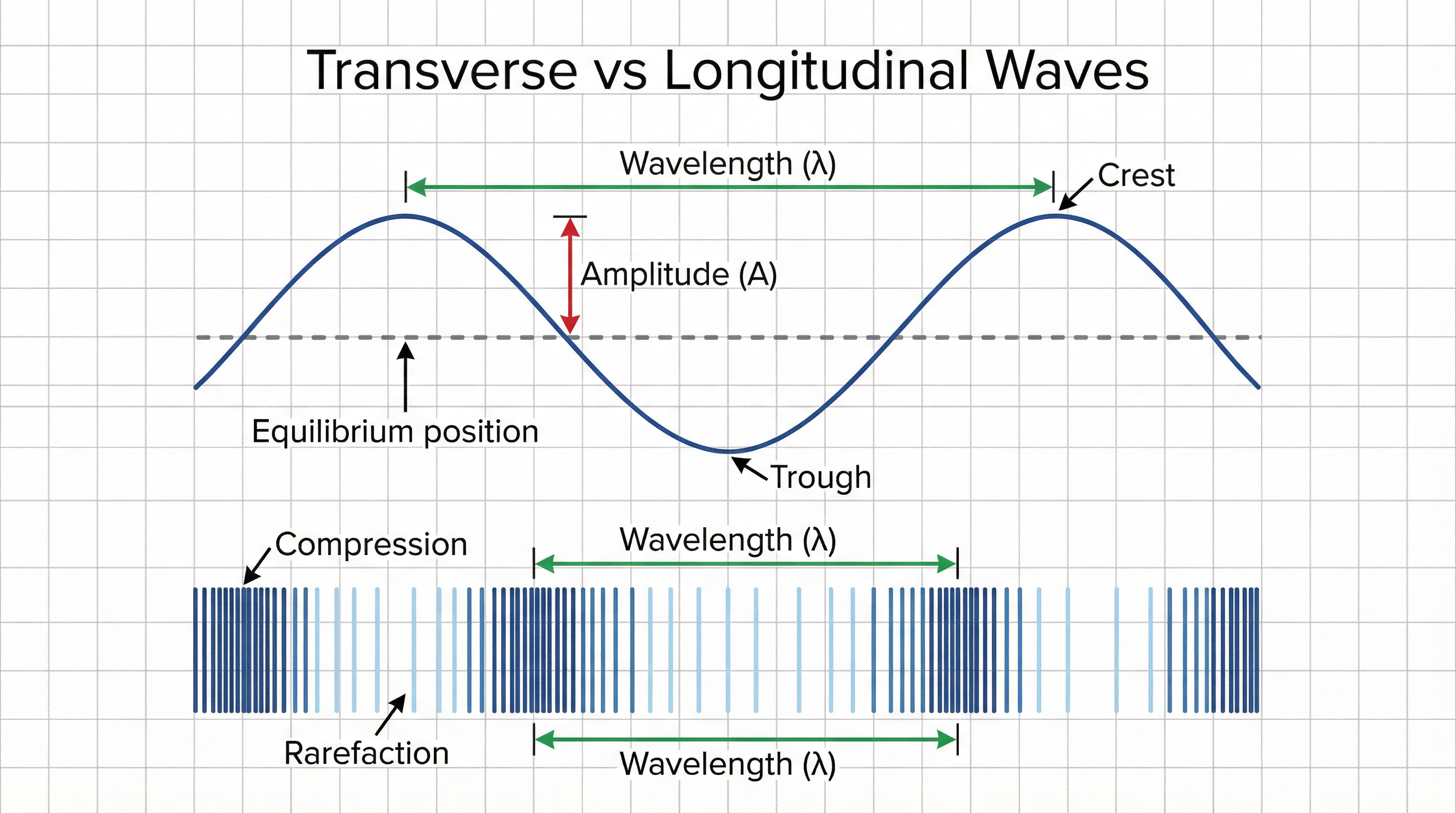
    Diagram comparing transverse and longitudinal waves.

    Concept 2: The Four Key Properties

    To describe a wave, we use four key properties. An examiner will expect you to define these precisely.

    1. Amplitude (A): This is the maximum displacement or distance moved by a point on a vibrating body or wave measured from its equilibrium position. Crucially, it is not the distance from the top (crest) to the bottom (trough). It's from the middle to the top. Amplitude is measured in metres (m) and is related to the energy the wave carries – a higher amplitude means more energy.

    2. Wavelength (λ): This is the distance between two consecutive corresponding points on a wave. For a transverse wave, this is easily measured from one crest to the next crest, or one trough to the next. For a longitudinal wave, it's the distance from the centre of one compression to the centre of the next. Wavelength is also measured in metres (m).

    3. Frequency (f): This is the number of complete waves that pass a fixed point per second. It is measured in Hertz (Hz). 1 Hz means one wave passes per second. If you see prefixes like kilo (kHz) or mega (MHz), you must convert them to Hz for calculations.

    4. Period (T): This is the time it takes for one full wave to pass a fixed point. It is measured in seconds (s). Period and frequency are inversely related, a relationship you must know.

    Mathematical/Scientific Relationships

    There are two equations in this topic that are absolutely vital. You must be able to recall, rearrange, and apply them correctly.

    1. The Wave Speed Equation: This links wave speed, frequency, and wavelength.

      v = f × λ

      • v = Wave Speed, in metres per second (m/s)
      • f = Frequency, in Hertz (Hz)
      • λ = Wavelength, in metres (m)

      (This equation is Given on the formula sheet)

    2. The Period-Frequency Relationship: This links the period of a wave to its frequency.

      T = 1 / f

      • T = Period, in seconds (s)
      • f = Frequency, in Hertz (Hz)

      (This equation Must be memorised)
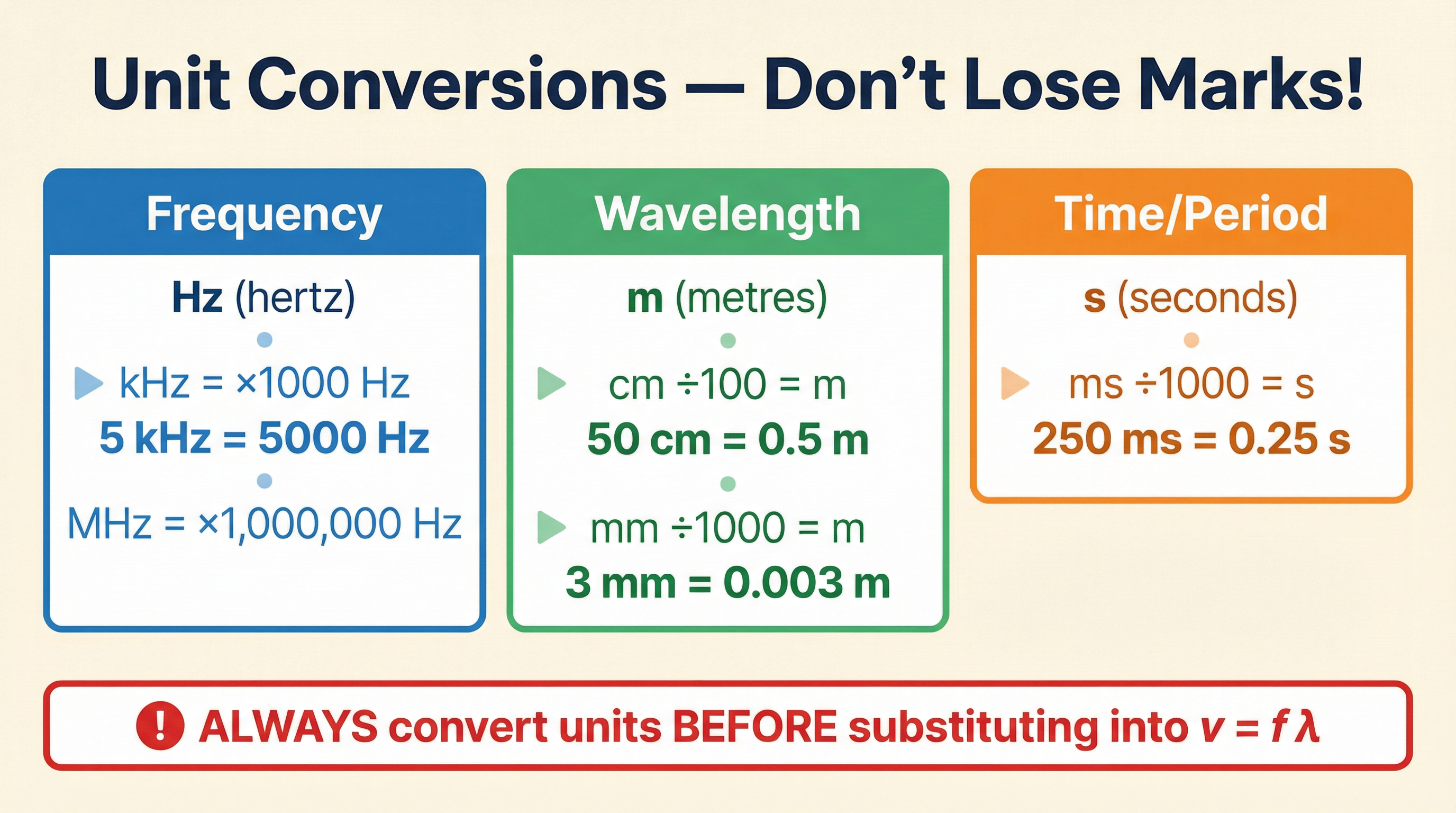
    Essential unit conversions for wave property calculations.

    Practical Applications: The Ripple Tank

    A common required practical involves using a ripple tank to observe and measure the properties of water waves.

    • Apparatus: A shallow transparent tray of water, a light source above, a white screen below, a wave generator (often an oscillating bar), and a ruler. A stroboscope can also be used to 'freeze' the waves, making wavelength easier to measure.
    • Method:
      1. Set up the ripple tank and turn on the light source. You will see the shadows of the wave crests on the screen below.
      2. To measure wavelength (λ), place a ruler on the screen and measure the distance across a set number of waves (e.g., 10), then divide by that number to find the average wavelength. This is more accurate than measuring just one.
      3. To measure frequency (f), mark a point on the screen and count the number of waves that pass that point in a set time (e.g., 20 seconds). Then divide the count by the time to get the frequency in Hz.
      4. Calculate the wave speed (v) using v = f × λ.
    • Common Errors: Parallax error when reading the ruler; miscounting waves; inaccurate timing. Using a stroboscope set to the same frequency as the waves makes the pattern appear stationary, allowing for a very accurate wavelength measurement.

    Visual Resources

    2 diagrams and illustrations

    Diagram comparing transverse and longitudinal waves.
    Diagram comparing transverse and longitudinal waves.
    Essential unit conversions for wave property calculations.
    Essential unit conversions for wave property calculations.

    Interactive Diagrams

    2 interactive diagrams to visualise key concepts

    YesDistanceTimeNo: CalculationStart: See a Wave QuestionIs it a graph?Check x-axisRead Wavelength λRead Period TCalculate f = 1/TCheck UnitsConvert to m, Hz, sUse v = fλ

    A flowchart showing the decision-making process when tackling a wave properties exam question.

    Longitudinal WaveParallelOscillation: Left/RightEnergy Transfer: Left/RightTransverse WavePerpendicularOscillation: Up/DownEnergy Transfer: Left/Right

    Concept map illustrating the key difference between transverse and longitudinal waves based on the direction of oscillation versus energy transfer.

    Worked Examples

    3 detailed examples with solutions and examiner commentary

    Practice Questions

    Test your understanding — click to reveal model answers

    Q1

    State two examples of transverse waves and one example of a longitudinal wave.

    3 marks
    foundation

    Hint: Think about waves you can see and waves you can hear.

    Q2

    A wave on a graph has a peak at +3 cm and a trough at -3 cm. What is the amplitude of the wave in metres?

    2 marks
    standard

    Hint: Remember the definition of amplitude and the standard unit for distance.

    Q3

    Describe the difference between a transverse and a longitudinal wave. You may draw a diagram to support your answer.

    3 marks
    standard

    Hint: Focus on the direction of oscillation compared to the direction of energy transfer.

    Q4

    The speed of light is 3.0 x 10^8 m/s. A radio station broadcasts at a frequency of 102.5 MHz. Calculate the wavelength of the radio waves.

    4 marks
    challenging

    Hint: Be very careful with the unit prefix 'M' for Mega.

    Q5

    Explain how a ripple tank can be used to measure the frequency, wavelength, and speed of water waves.

    6 marks
    challenging

    Hint: Structure your answer into three parts: one for each measurement.

    Explore this topic further

    View Topic PageAll Physics Topics

    Key Terms

    Essential vocabulary to know

    More Physics Study Guides

    View all

    Refraction

    OCR
    GCSE

    This guide explains light refraction for OCR GCSE Physics (4.6), covering why light bends, how to draw ray diagrams, and the secrets to exam success. Master the concepts of optical density and total internal reflection to secure top marks.

    Isotopes

    OCR
    GCSE

    This guide provides a comprehensive overview of isotopes for OCR GCSE Physics (7.2), focusing on core definitions, calculations, and exam technique. It's designed to help you secure maximum marks by mastering the difference between isotopes and ions, understanding nuclear notation, and avoiding common pitfalls.

    Galaxies

    OCR
    GCSE

    Unlock top marks in your OCR GCSE Physics exam by mastering Galaxies (Topic 8.7). This guide breaks down the vastness of space into bite-sized, exam-focused chunks, from the structure of our Milky Way to the mind-bending evidence for the Big Bang.

    Planets

    OCR
    GCSE

    This topic covers the structure of our Solar System, the role of gravitational forces in maintaining planetary orbits, and the historical shift from geocentric to heliocentric models. Understanding these concepts is essential for securing marks in both Foundation and Higher Tier questions, particularly those testing orbital mechanics and the nature of scientific progress.

    Stars

    OCR
    GCSE

    Explore the dramatic life and death of stars, from stable main sequence suns to explosive supernovae. This guide for OCR GCSE Physics (8.6) provides everything candidates need to master stellar evolution, secure top marks, and understand our cosmic origins."

    The Solar System

    OCR
    GCSE

    This guide covers OCR GCSE Physics Topic 8.1, The Solar System. It explores the shift from geocentric to heliocentric models, the physics of orbital motion, and the complete life cycles of stars. Mastering this topic is crucial for tackling high-mark questions on stellar evolution and gravitational forces.