Study Notes
Overview
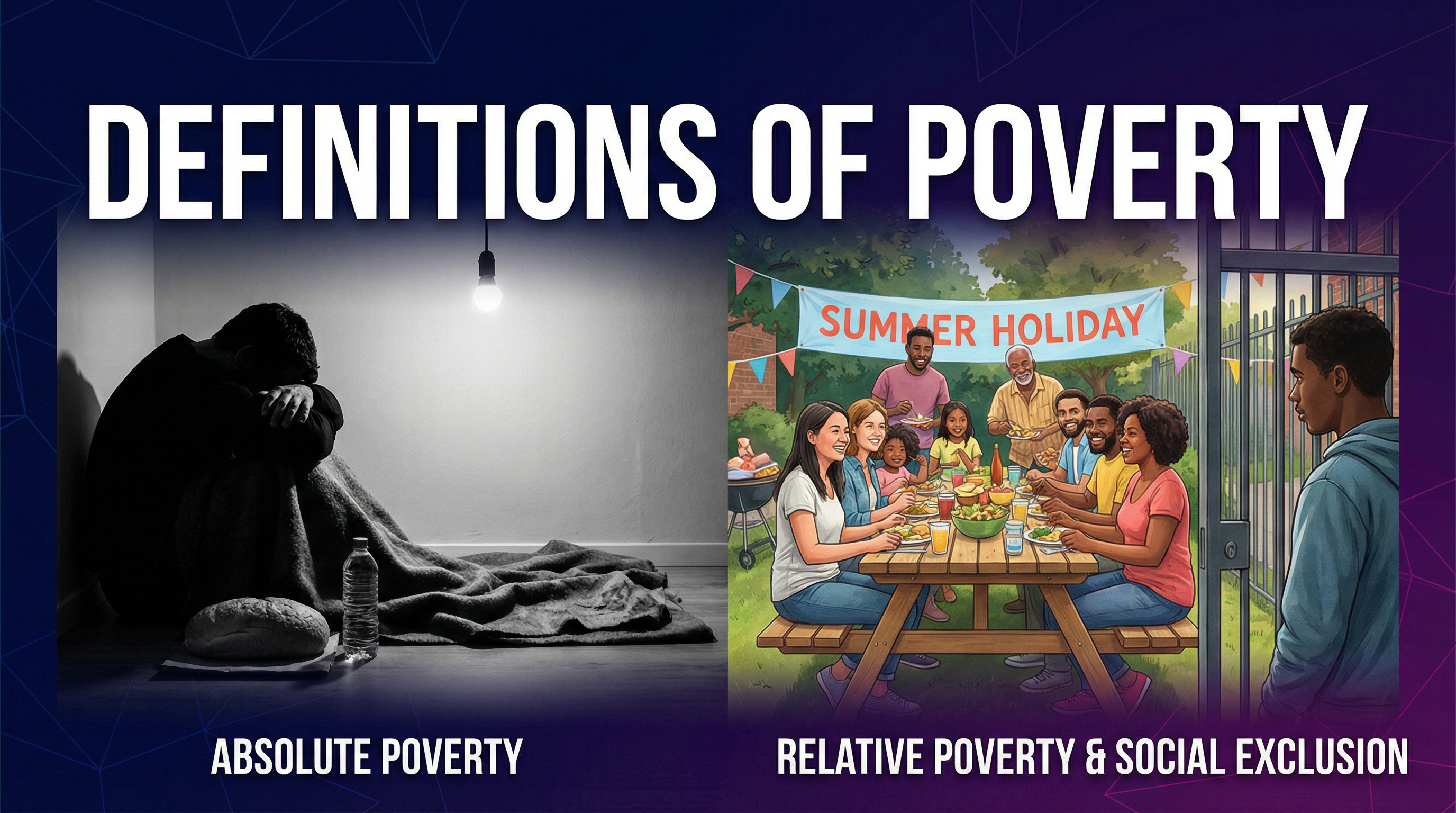
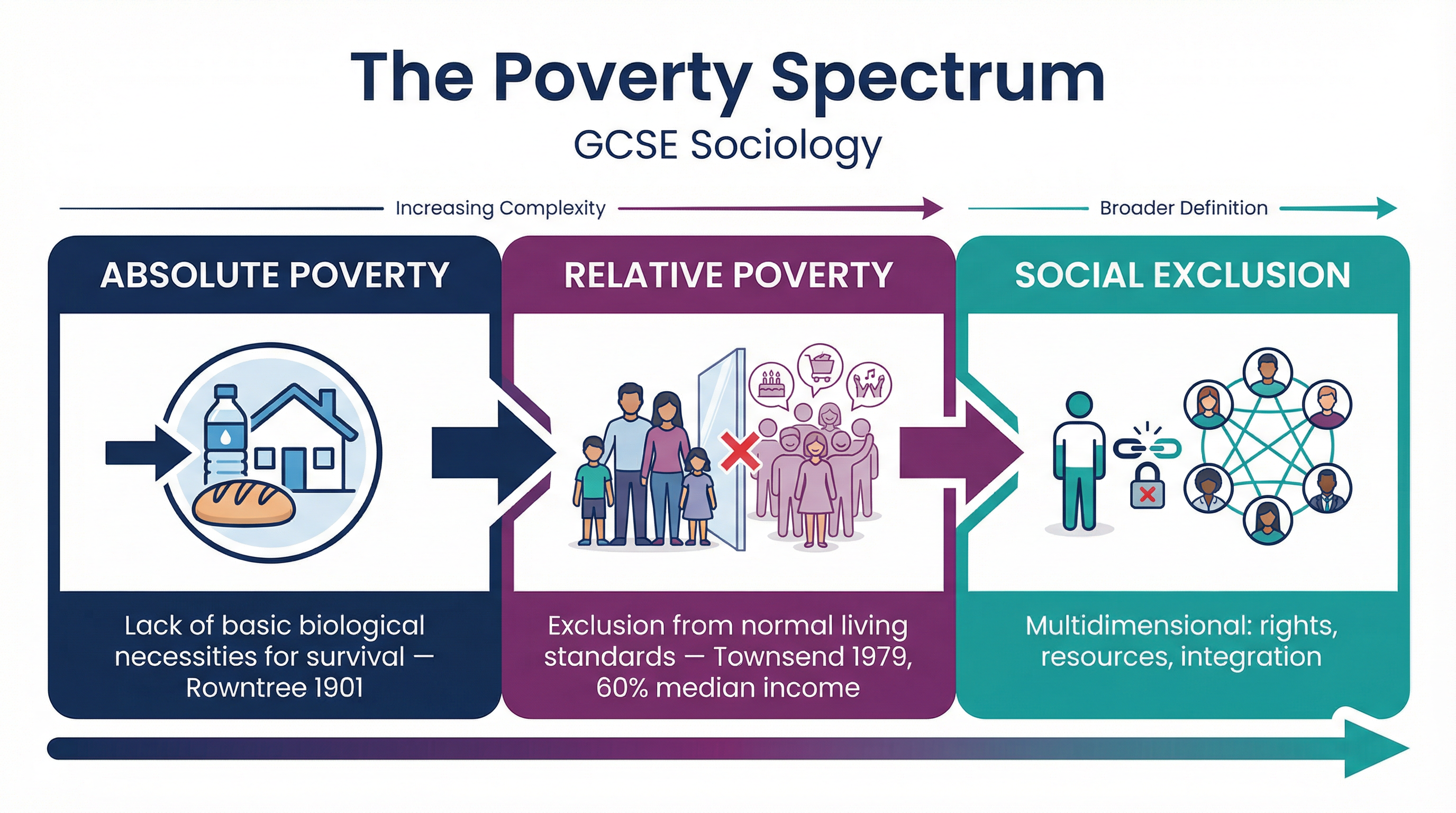
This guide focuses on the operationalisation of poverty, a key area within the OCR J204 specification. Examiners expect candidates to move beyond common-sense understandings and engage with sociological debates about how poverty is defined and measured. The core of this topic is the distinction between Absolute Poverty (a biological, subsistence-based definition) and Relative Poverty (a social, culturally-specific definition). A strong response will not only define these terms but critically analyse the historical and methodological shifts in their measurement, from Rowntree's early 'basket of goods' to Townsend's influential 'Deprivation Index' and the more recent consensual measures pioneered by Mack and Lansley. Marks are awarded for demonstrating a clear understanding that poverty is not a fixed concept, but one that is socially constructed and contested. High-level analysis will connect these definitions to the broader concept of Social Exclusion, showing an appreciation for the multidimensional nature of disadvantage in contemporary Britain.
Key Concepts & Developments
The Subsistence Model (Absolute Poverty)
Date(s): 1901
What happened: Seebohm Rowntree conducted a pioneering study of poverty in York, aiming to measure the problem scientifically. He created a 'basket of goods' containing the bare minimum food, fuel, and clothing a family needed for physical survival. Any family whose income fell below the cost of this basket was defined as being in 'primary poverty'.
Why it matters: This was the first major attempt to create an objective, scientific poverty line. It established the concept of absolute poverty: a state of lacking the basic necessities for human survival. Examiners credit candidates who can explain that this definition is rigid, universal, and allows for historical comparison.
Specific Knowledge: Seebohm Rowntree, York Study (1901), 'basket of goods', subsistence model.
The Social Participation Model (Relative Poverty)
Date(s): 1979
What happened: Peter Townsend published his landmark study, "Poverty in the United Kingdom", in which he powerfully critiqued the subsistence model. He argued that in modern societies, poverty is not just about survival but about being unable to participate in the normal activities and customs of that society. He famously stated that individuals are in poverty when they are excluded from the 'ordinary living patterns, customs and activities' of their society.
Why it matters: Townsend shifted the focus from biological survival to social participation. This established the concept of relative poverty: a state of lacking the resources to meet the normal social expectations of a given society. This definition is dynamic, changing over time and between cultures. Candidates must be able to contrast this with the absolute model.
Specific Knowledge: Peter Townsend (1979), Deprivation Index, social participation, relative definition.
The Consensual Measure
Date(s): 1983
What happened: Responding to criticism that Townsend's Deprivation Index was subjective (i.e., he chose the items), Joanna Mack and Stewart Lansley conducted the 'Breadline Britain' study. They surveyed the public to ask what items they considered to be 'necessities' that no one in Britain should have to go without. If more than 50% of the public agreed an item was a necessity, it was included in their measure.
Why it matters: This introduced a methodological solution to the problem of subjectivity. The consensual measure of poverty is based on a democratic agreement about what constitutes an acceptable standard of living. It strengthens the relative definition by grounding it in public opinion rather than expert judgement.
Specific Knowledge: Mack and Lansley (1983), 'Breadline Britain', consensual measure, public vote on necessities.
Key Individuals
Seebohm Rowntree
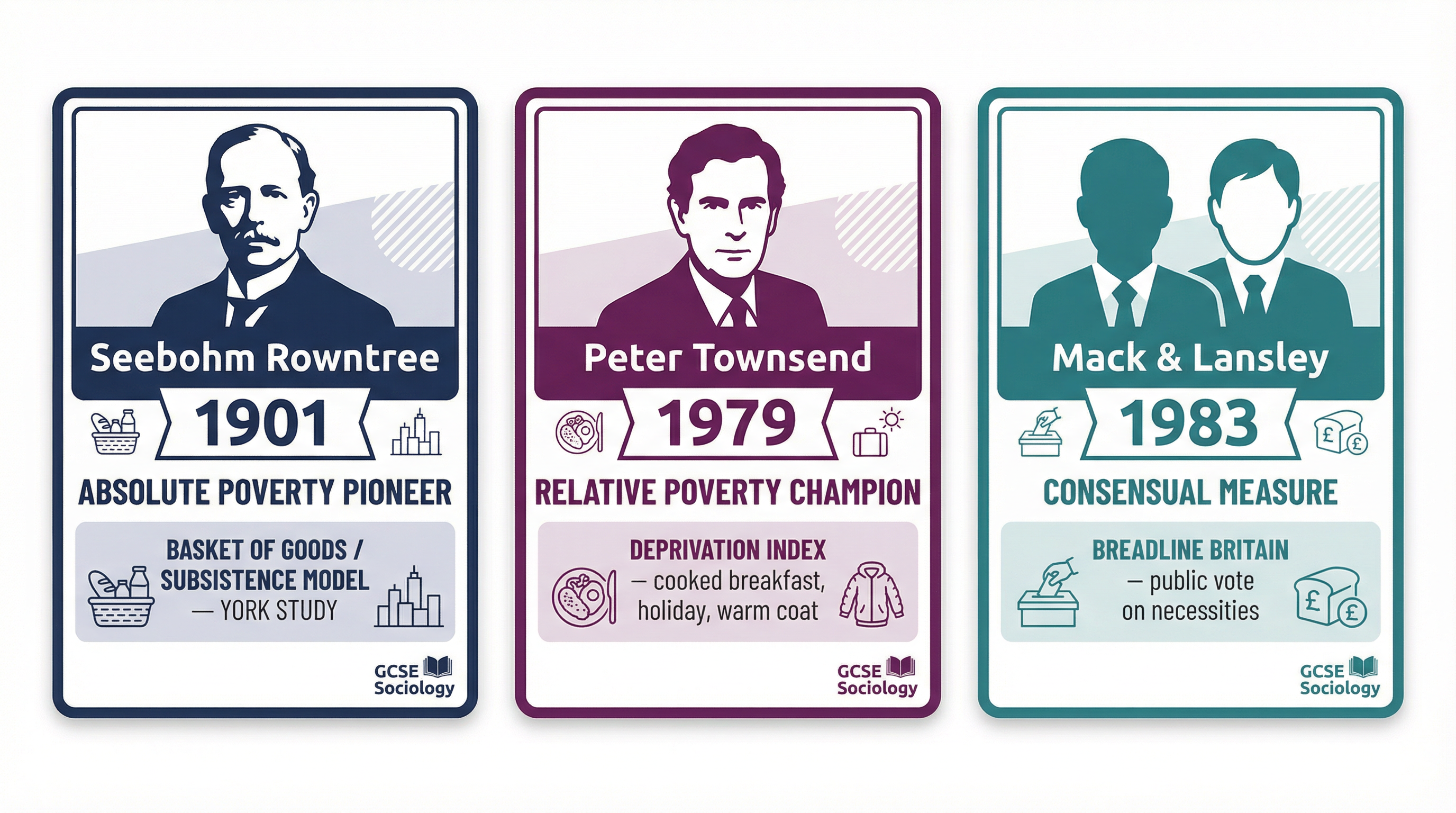
Role: Social researcher and philanthropist.
Key Actions: Conducted the 1901 York study, developing the 'basket of goods' to create a subsistence-based poverty line.
Impact: Pioneered the concept of absolute poverty and the scientific measurement of the problem.
Peter Townsend
Role: Professor of Sociology.
Key Actions: Wrote "Poverty in the United Kingdom" (1979), critiqued the absolute model, and developed the Deprivation Index.
Impact: Championed the concept of relative poverty, arguing that poverty is about exclusion from societal norms, not just a lack of income.
Mack & Lansley
Role: Social researchers.
Key Actions: Conducted the 'Breadline Britain' (1983) study, asking the public to define necessities.
Impact: Created the consensual measure of poverty, a methodological innovation designed to overcome the subjectivity of earlier relative measures.
Second-Order Concepts
Causation
The shift in definitions was caused by several factors. Firstly, rising living standards in the 20th century made the subsistence definition seem increasingly irrelevant in wealthy countries like the UK. Secondly, the development of the welfare state aimed to provide a safety net that went beyond mere survival. Thirdly, the discipline of sociology itself became more critical, questioning whether a purely economic definition could capture the social experience of poverty.
Consequence
The major consequence of this debate is that there is no single, agreed-upon definition of poverty. This has huge implications for policy. A government using an absolute definition will report much lower poverty rates than a government using a relative one. The shift to relative definitions led to a greater focus on inequality and social justice, influencing policies around minimum wage, benefits, and social inclusion.
Change & Continuity
Change: The dominant definition of poverty in UK sociology and policy has changed from absolute to relative. The method of measurement has evolved from Rowntree's expert-led 'basket' to Townsend's Deprivation Index, and then to Mack and Lansley's consensual approach.
Continuity: Despite the dominance of relative definitions, the concept of absolute poverty remains relevant, particularly in discussions of global poverty, homelessness, and destitution within the UK. The government still tracks measures related to material deprivation.
Significance
This topic is significant because how we define a problem determines how we try to solve it. A narrow, absolute definition leads to minimalist solutions (e.g., food parcels), whereas a broad, relative definition leads to more ambitious policies aimed at reducing inequality and promoting social inclusion. For a sociologist, understanding this debate is fundamental to understanding the relationship between individuals, society, and the state.
Source Skills
When presented with a source on poverty (e.g., a table of statistics, a quote from a politician, a case study), candidates must apply their knowledge of the definitions. For example, if a source shows that incomes have risen but a family still can't afford a holiday, a candidate should identify this as an example of relative poverty. When analysing statistical sources, do not just describe the data; calculate trends (e.g., 'the number of people in relative poverty increased by 2 million') and explain what the data tells you about the type of poverty being measured. Always question the provenance: who created this data and for what purpose? A government source might use a definition that minimises the problem, whereas a charity might use one that highlights it.