Study Notes
Overview
This study guide covers the Theories of Crime and Deviance unit for OCR GCSE Sociology (J204). Examiners expect candidates to move beyond common-sense explanations and apply sociological theory rigorously. You must be able to contrast structural theories like Functionalism and Marxism, which see crime as a product of the social system, with action theories like Interactionism, which focus on how individuals are labelled as deviant. A key area for high marks is evaluating these perspectives, particularly by using the concept of the 'dark figure of crime' to critique theories that rely on official statistics. This topic is not just about listing sociologists; it’s about setting them in a debate to explain why crime and deviance occur and how society responds.
Key Theoretical Perspectives
Functionalism (Consensus Theory)
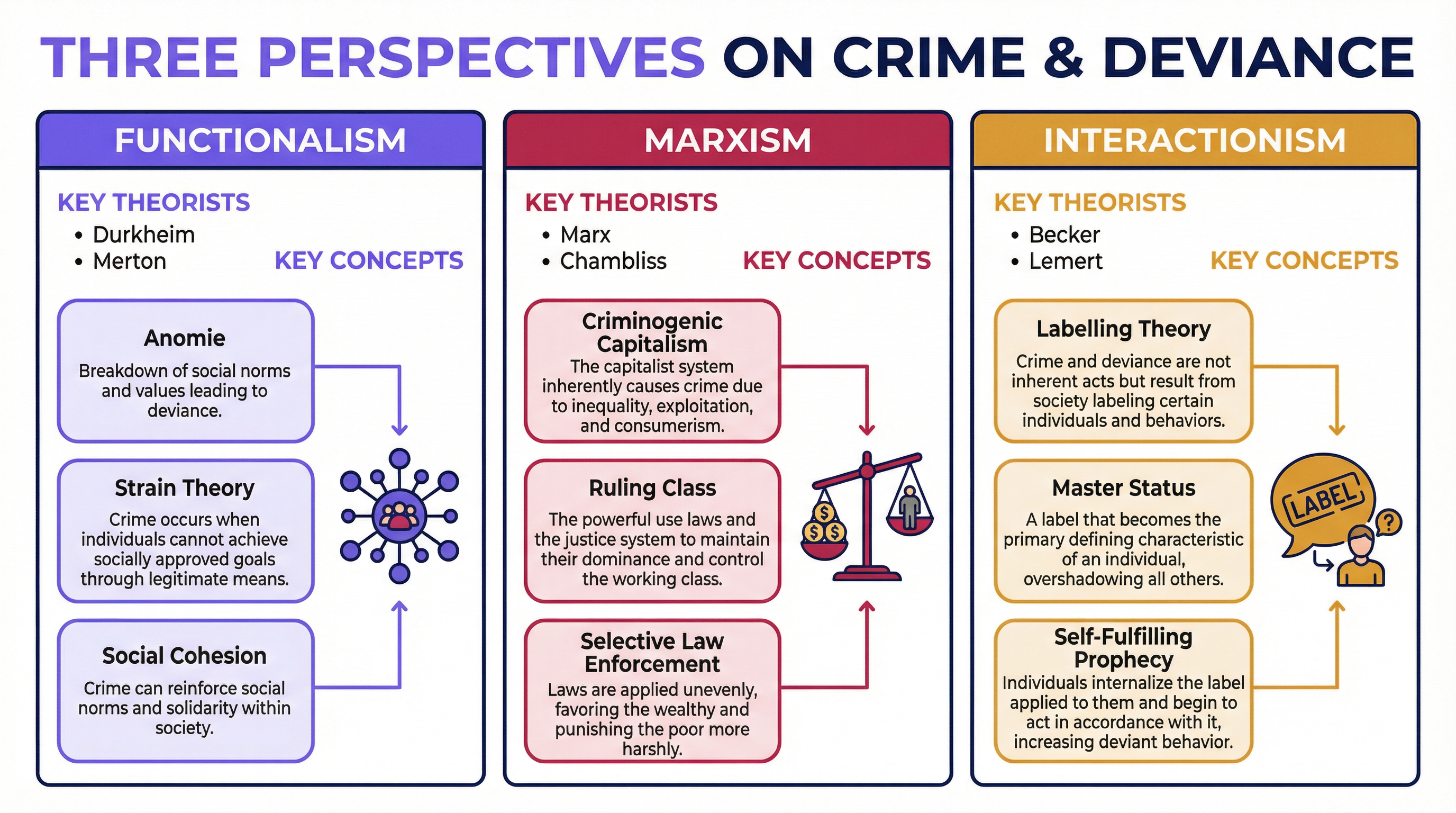
Core Idea: Society is like a body, with institutions working together to maintain social order. Crime is seen as a normal, and even necessary, part of a healthy society.
Key Thinkers & Concepts:
- Émile Durkheim: Argued crime is inevitable and performs positive functions, such as reinforcing social norms (boundary maintenance) and enabling social change. He introduced the concept of anomie: a state of normlessness where social rules break down, leading to higher levels of deviance.
- Robert Merton: Developed Strain Theory. He argued that society creates a 'strain' by encouraging everyone to pursue cultural goals (like wealth) but not providing everyone with the legitimate means to achieve them. This leads to different responses, including 'Innovation' (using criminal means to achieve success), which he used to explain working-class crime.
Why it matters: Functionalism explains why crime exists in all societies and how it can contribute to social solidarity. However, it is criticised for downplaying the injustices of the criminal justice system and for relying on official statistics.
Marxism (Conflict Theory)
Core Idea: Society is based on conflict between the ruling class (bourgeoisie) and the working class (proletariat). The law and the criminal justice system are tools used by the ruling class to maintain power and control.
Key Thinkers & Concepts:
- Karl Marx: Argued that the capitalist system is criminogenic – it inherently causes crime. Poverty drives utilitarian crime, while the promotion of greed encourages corporate crime.
- William Chambliss: Argued that laws are made to protect the private property of the rich. He found that the powerful in society could engage in widespread corruption without facing legal consequences.
- Selective Law Enforcement: The idea that the police and courts tend to ignore the crimes of the powerful (white-collar and corporate crime) while focusing on the more visible street crimes of the working class.
Why it matters: Marxism highlights the relationship between power, inequality, and crime. It forces us to question who makes the laws and in whose interest. Its main weakness is its failure to explain non-utilitarian crime (e.g., vandalism) and the fact that not all working-class people commit crime.
Interactionism (Action Theory)
Core Idea: This is a micro-level approach that focuses on how individuals are defined and labelled as deviant. Deviance is not inherent in an act but is a consequence of the application of rules and sanctions to an 'offender'.
Key Thinkers & Concepts:
- Howard Becker: Famously stated, "Deviant behaviour is behaviour that people so label." He developed Labelling Theory, arguing that powerful groups (moral entrepreneurs) create rules and label those who break them as outsiders.
- Edwin Lemert: Distinguished between Primary Deviance (the initial deviant act, which has few consequences) and Secondary Deviance (which occurs after an individual accepts the deviant label, leading to a master status and a self-fulfilling prophecy).
Why it matters: Interactionism reveals how the criminal justice system can amplify deviance rather than reduce it. It also explains why official statistics may be a social construction rather than an objective fact. However, it is criticised for being too deterministic and for not explaining the original causes of the deviant act.
The Dark Figure of Crime
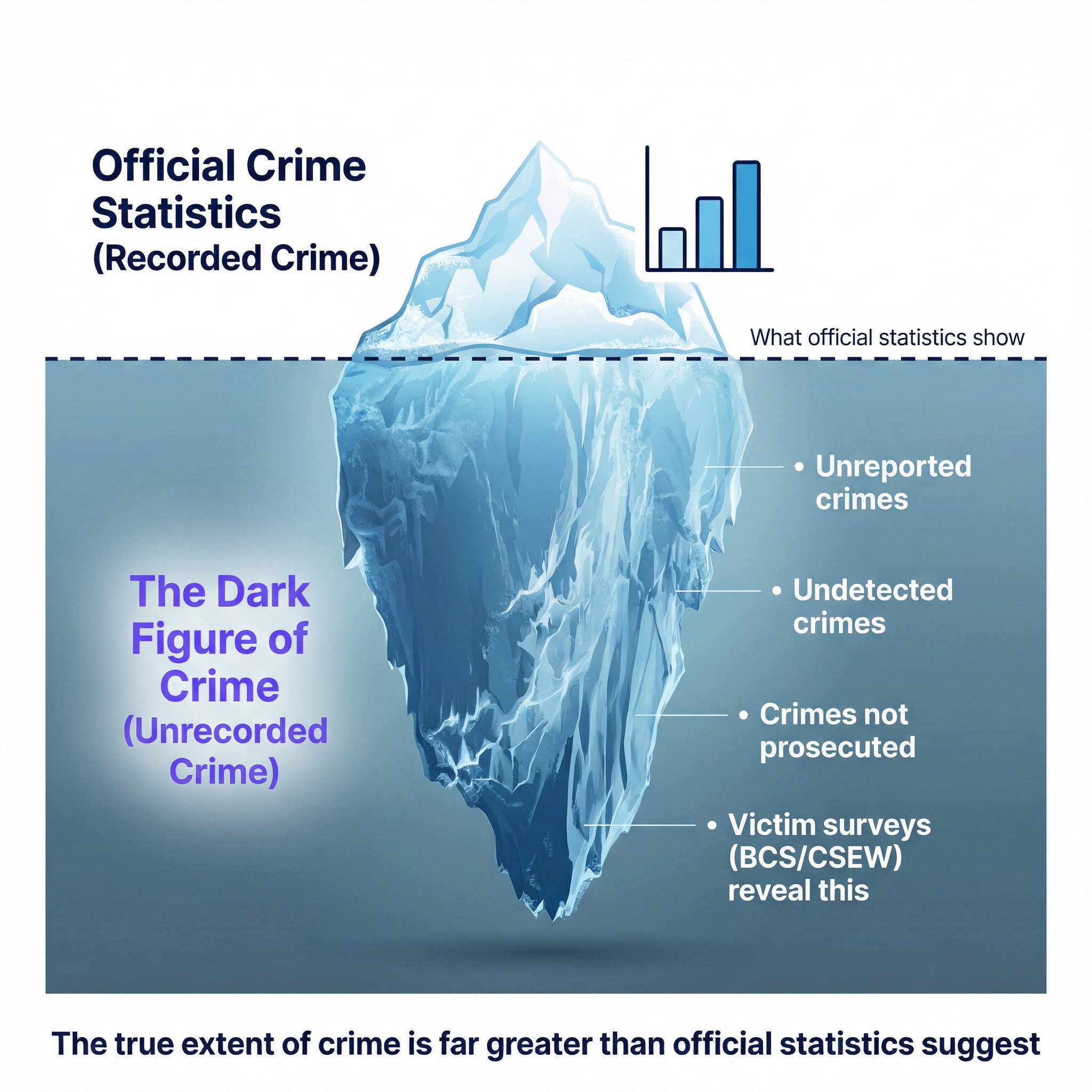
What it is: The vast amount of crime that is never recorded in official police statistics. This includes crimes that are not reported by victims and crimes that are not recorded by the police.
Why it matters: The existence of the dark figure is a major problem for sociologists who rely on official statistics (like Functionalists and Marxists). It suggests that statistics may tell us more about policing strategies and public reporting habits than about the true extent and nature of crime. Victim surveys like the Crime Survey for England and Wales (CSEW) are used to try and uncover some of this hidden crime."