Study Notes
Overview
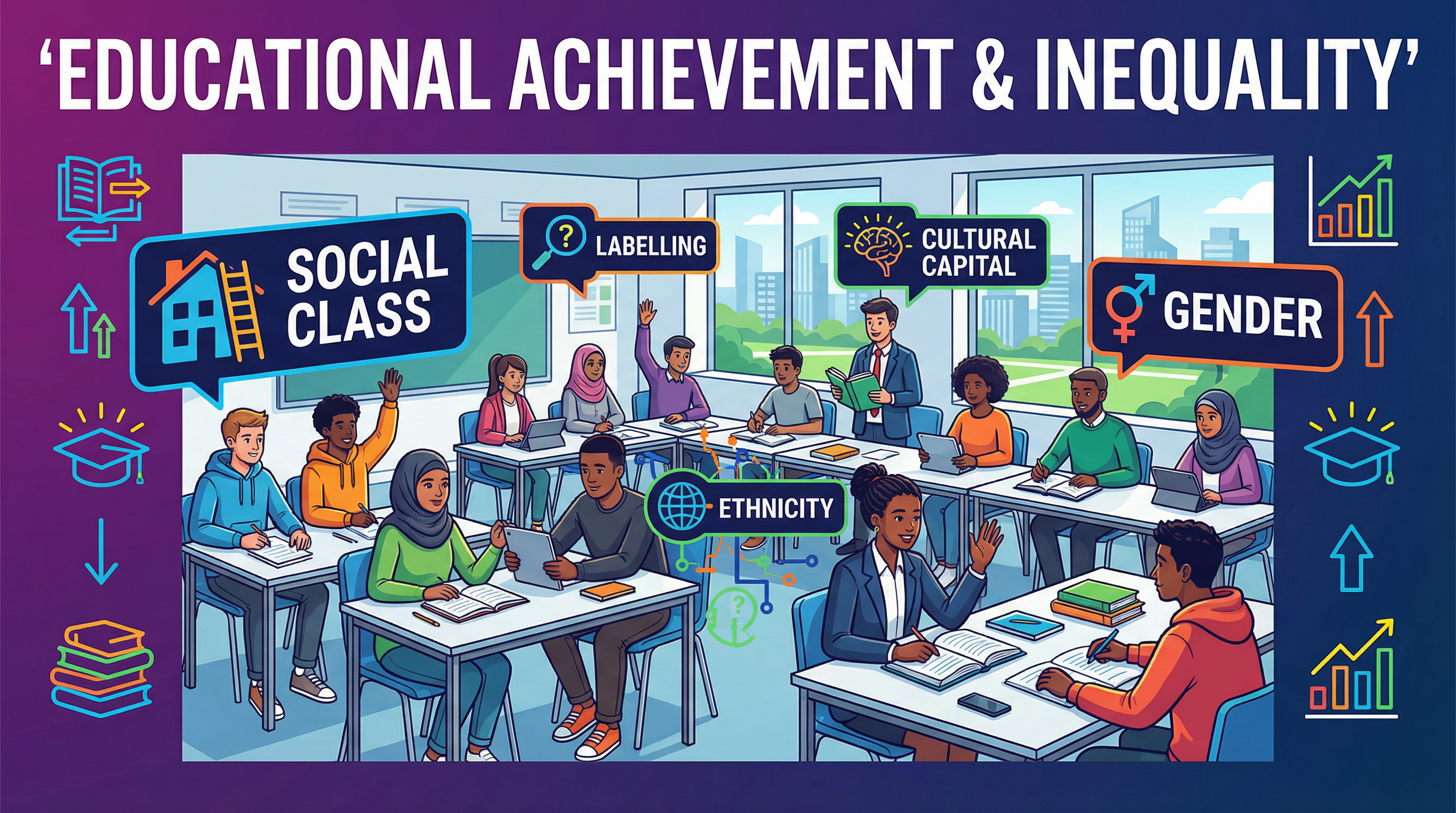
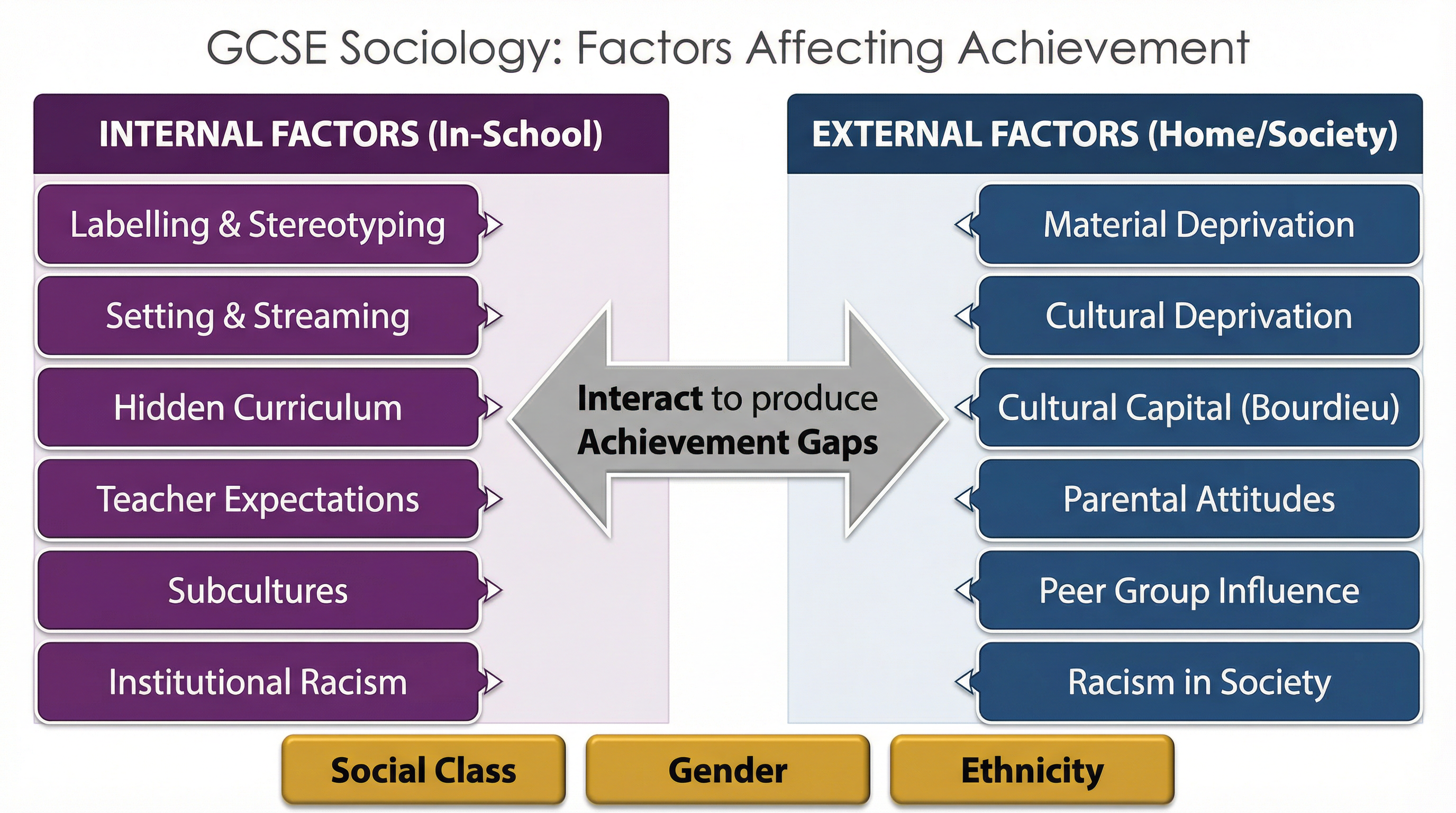
Educational Achievement and Inequality sits at the heart of OCR J204 Section B and is one of the most mark-rich areas of the specification. Candidates are required to explain differential achievement — the persistent gaps in educational outcomes between groups defined by social class, gender, and ethnicity — using both sociological theory and empirical research. Examiners consistently reward responses that deploy precise sociological vocabulary (such as 'cultural capital', 'self-fulfilling prophecy', and 'institutional racism'), cite named studies (Becker, Willis, Bowles and Gintis, Bourdieu), and apply theoretical frameworks (Functionalism, Marxism, Feminism) to evaluate competing explanations. The topic demands that candidates distinguish clearly between internal factors — processes operating within schools — and external factors — influences from the home, family, and wider society — while also demonstrating how these interact to compound disadvantage.
Key Concepts and Developments
Social Class and Educational Achievement
What it covers: Social class remains the single most powerful predictor of educational achievement in the UK. Children from higher socio-economic backgrounds consistently outperform those from working-class backgrounds across all key stages. The gap is measurable and persistent: in 2023, only 39% of pupils eligible for free school meals achieved grade 4 or above in both English and Maths GCSE, compared to 65% of non-eligible pupils.
External Factors — Material Deprivation: Material deprivation refers to the lack of financial resources that disadvantages working-class students. Halsey's research identified material factors as the primary barrier to working-class educational success. Practical consequences include the inability to afford revision materials, lack of a quiet study space, poor diet affecting concentration, and the need to undertake part-time employment. Candidates must be precise: material deprivation concerns money and physical resources, not values or attitudes.
External Factors — Cultural Deprivation: Cultural deprivation theory argues that working-class families fail to transmit the values, attitudes, and linguistic codes necessary for academic success. Sugarman identified immediate gratification (prioritising present rewards) as a characteristic of working-class culture, contrasted with the deferred gratification (sacrificing present pleasure for future reward) associated with middle-class culture. Bernstein distinguished between the restricted code (simple, context-dependent language) used predominantly in working-class homes and the elaborated code (complex, context-free language) that schools reward. However, this perspective is criticised by Marxists for victim-blaming rather than addressing structural inequality.
External Factors — Cultural Capital (Bourdieu): Pierre Bourdieu's concept of cultural capital refers to the knowledge, skills, values, and cultural practices that middle-class families transmit to their children — museum visits, familiarity with formal language, understanding of how institutions work. This gives middle-class children a significant advantage in a system designed around middle-class norms. Bourdieu also identified social capital (networks and contacts) and economic capital as reinforcing advantages.
Internal Factors — Labelling and the Self-Fulfilling Prophecy: Howard Becker's research found that teachers judged pupils against an 'ideal pupil' type — typically white, middle-class, and well-behaved. Working-class and ethnic minority students were more likely to receive negative labels. Once labelled, the self-fulfilling prophecy operates: the student internalises the label, adjusts their behaviour accordingly, and ultimately confirms the original prediction. This is one of the most frequently examined concepts on the paper.
Internal Factors — Setting, Streaming, and Educational Triage: Ball's research demonstrated that students placed in lower sets received a less challenging curriculum, experienced lower teacher expectations, and were more likely to form anti-school subcultures. Gillborn and Youdell identified 'educational triage' — the practice of concentrating resources on borderline students at the expense of those deemed unlikely to achieve, disproportionately affecting working-class and Black students.
Gender and Educational Achievement
What it covers: Since the 1990s, girls have consistently outperformed boys at GCSE and A-Level. In 2023, 73% of girls achieved grade 4 or above in English and Maths compared to 65% of boys. Sociologists examine both why girls now outperform boys and why boys' underachievement has become a policy concern.
External Factors — Changing Gender Roles: Sue Sharpe's longitudinal research is essential here. In the 1970s, girls prioritised 'love, marriage, husbands, and children'. By the 1990s, priorities had shifted to 'jobs, careers, and being able to support themselves'. This reflects the impact of second-wave feminism, equal opportunities legislation (the Sex Discrimination Act 1975, the Equal Pay Act 1970), and the expansion of female employment. Girls now have greater aspirations and see education as a route to independence.
External Factors — Gender Socialisation: Girls are socialised from an early age to be more organised, communicative, and patient — attributes that benefit academic performance. McRobbie's research on girls' magazines showed how media reinforces domestic roles, though this has shifted significantly in recent decades.
Internal Factors — The Hidden Curriculum and Gender: Feminists argue the hidden curriculum reinforces gender inequality through gendered subject choices (boys steered towards STEM, girls towards humanities), the underrepresentation of women in textbooks, and teacher interactions that reward passive, compliant behaviour — more associated with girls.
Boys' Underachievement: Sociologists point to laddish subcultures (Mac an Ghaill's research on masculinity and schooling), the devaluation of academic effort as 'uncool' among some male peer groups, and the decline of traditional male employment (deindustrialisation) reducing the perceived value of qualifications.
Ethnicity and Educational Achievement
What it covers: Ethnic minority achievement is complex and varied. Chinese and Indian students perform above the national average. Black Caribbean, Pakistani, and White working-class boys perform below average. Sociologists must avoid generalisation and explain both underachievement and high achievement.
External Factors: Many ethnic minority groups are disproportionately represented in lower socio-economic groups, meaning material deprivation intersects with ethnicity. Racism in wider society — including housing discrimination, employment discrimination, and experiences of poverty — compounds educational disadvantage.
Internal Factors — Institutional Racism: The Macpherson Report (1999), following the murder of Stephen Lawrence, defined institutional racism as 'the collective failure of an organisation to provide an appropriate and professional service to people because of their colour, culture, or ethnic origin'. Applied to schools, this manifests in higher exclusion rates for Black Caribbean boys, lower entry to higher-tier GCSE papers, and curriculum content that marginalises non-Western perspectives.
Internal Factors — Teacher Expectations: Gillborn's research found that teachers were more likely to perceive Black Caribbean boys as threatening or disruptive, leading to disproportionate exclusions and lower academic expectations. Wright's research in primary schools found similar patterns of differential treatment.
Theoretical Perspectives
Functionalism
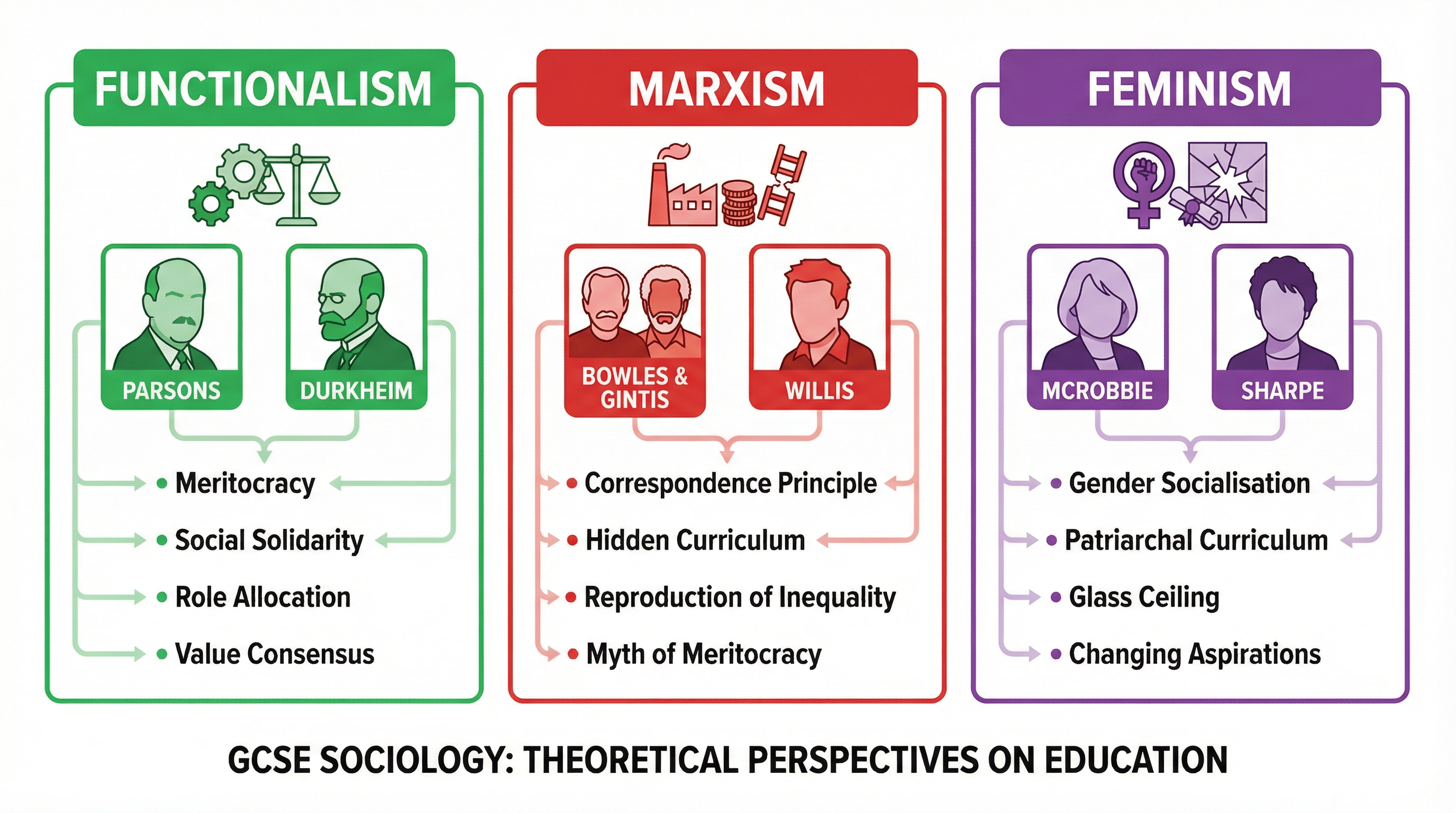
Parsons argued that education performs two key functions: socialisation (transmitting shared values and norms) and role allocation (matching individuals to occupational roles based on merit). The education system is, in Parsons' view, meritocratic — talent and effort are rewarded regardless of background. Durkheim emphasised education's role in creating social solidarity and transmitting the collective conscience. Functionalists therefore see differential achievement as reflecting genuine differences in ability and effort, not structural inequality.
Evaluation: Critics argue this ignores the structural advantages of the middle class. The system is not a level playing field — cultural capital, material resources, and teacher expectations all distort the meritocratic ideal.
Marxism
Bowles and Gintis, in 'Schooling in Capitalist America' (1976), argued that education reproduces class inequality through the correspondence principle — the hidden curriculum mirrors the hierarchical structure of the workplace, teaching working-class students to be obedient, punctual, and accepting of authority. Willis's ethnographic study 'Learning to Labour' (1977) followed 12 working-class boys ('the lads') who formed an anti-school subculture, rejecting academic values. Willis argued this was a rational response to a system that offered them little reward, but it ultimately reproduced their working-class position — they ended up in manual labour just like their fathers.
Evaluation: Willis's study has been criticised for being based on a very small, unrepresentative sample. Not all working-class students form anti-school subcultures.
Feminism
Feminists argue that education historically reproduced patriarchal inequality through the hidden curriculum, gendered subject choices, and a curriculum that marginalised women's contributions. Liberal feminists point to the success of equal opportunities policies in closing the gender gap. Radical feminists argue deeper patriarchal structures remain. McRobbie and Sharpe provide key empirical support.
Key Sociological Studies — Named Example Bank
| Sociologist | Study/Concept | Key Finding | Theoretical Link |
|---|---|---|---|
| Howard Becker | Labelling Theory (1971) | Teachers judge against an 'ideal pupil' type; working-class students more likely to be negatively labelled | Interactionism |
| Paul Willis | Learning to Labour (1977) | Working-class boys form anti-school subcultures; reproduce their own class position | Marxism |
| Bowles & Gintis | Correspondence Principle (1976) | Hidden curriculum mirrors workplace hierarchy; education reproduces class inequality | Marxism |
| Pierre Bourdieu | Cultural Capital (1984) | Middle-class families transmit cultural advantages; working-class lack this capital | Marxism/Conflict |
| Sue Sharpe | Just Like a Girl (1970s/1990s) | Girls' aspirations shifted from marriage to careers between the 1970s and 1990s | Feminism |
| Gillborn & Youdell | Educational Triage (2000) | Schools focus resources on borderline students; Black and working-class students disadvantaged | Critical Race Theory |
| Stephen Ball | Setting and Streaming (1981) | Lower sets receive inferior curriculum; self-fulfilling prophecy operates | Interactionism/Marxism |
| A.H. Halsey | Origins and Destinations (1980) | Material deprivation is the primary barrier to working-class educational success | Marxism |
Second-Order Concepts
Causation
The causes of differential achievement are multi-layered and interactive. External factors — material deprivation, cultural deprivation, and lack of cultural capital — create structural disadvantages before students enter school. These interact with internal factors: a student experiencing material deprivation may arrive at school tired, hungry, and without materials, making them more likely to be negatively labelled by teachers, placed in lower sets, and exposed to a less challenging curriculum. The self-fulfilling prophecy then compounds the original disadvantage. Examiners credit responses that trace this causal chain explicitly.
Consequence
The immediate consequence of differential achievement is unequal access to qualifications, which restricts access to higher education and professional employment. The long-term consequence is the reproduction of social inequality across generations — a central concern of Marxist sociology. Willis demonstrated how working-class students, through their own agency, paradoxically reproduce their subordinate class position.
Change and Continuity
Significant change has occurred in gender achievement since the 1990s, driven by feminist campaigns, legislative reform, and shifting cultural attitudes. However, social class remains the most persistent predictor of educational outcome — the gap between free school meal-eligible students and their peers has barely narrowed in decades. Ethnicity patterns are also changing, with some groups showing marked improvement while others remain disadvantaged.
Significance
This topic is significant because it connects education to the broader sociological question of whether society is meritocratic. If achievement gaps persist despite decades of reform, this challenges Functionalist claims about meritocracy and supports Marxist arguments about the reproduction of inequality. It also has direct policy relevance — debates about grammar schools, academy schools, and pupil premium funding all connect to this topic.