Study Notes
Overview
This topic, central to OCR J204 Component 02, requires candidates to move beyond a common-sense understanding of poverty and apply a rigorous sociological lens. Examiners expect a structural analysis of how poverty dictates life chances, from health and education to housing and employment. A key requirement is the ability to distinguish between absolute poverty (a lack of basic subsistence) and relative poverty (social exclusion from the norms of society), with credit given for referencing the foundational work of Peter Townsend. Furthermore, candidates must be able to critically evaluate the two dominant and opposing explanations for the persistence of poverty: the New Right's 'culture of poverty' thesis, championed by Charles Murray, versus the structural or Marxist explanations that emphasize material deprivation and systemic inequality. Success in this area hinges on using specific sociological terminology, applying theoretical perspectives, and using contemporary evidence to support arguments. This guide will provide the specific knowledge and exam techniques needed to achieve high marks.
Key Concepts & Theories
Defining and Measuring Poverty
Absolute Poverty: This refers to a condition where individuals lack the minimum resources to sustain a physically healthy life. This includes essentials like food, safe drinking water, shelter, and warmth. It is a universal measure, but less used in developed countries like the UK.
Relative Poverty: This is the key concept for UK sociology. It defines poverty in relation to the standards of living in a society at a specific time. Peter Townsend (1979) was a pioneer here, arguing that individuals are in relative poverty if they lack the resources to participate in the normal activities, customs, and diets of their society. This is about social exclusion, not just survival. For example, not being able to afford a school trip or a family holiday.
Specific Knowledge: The UK government often uses a measure of households with below 60% of median income as a relative poverty line.
The Effects of Poverty on Life Chances
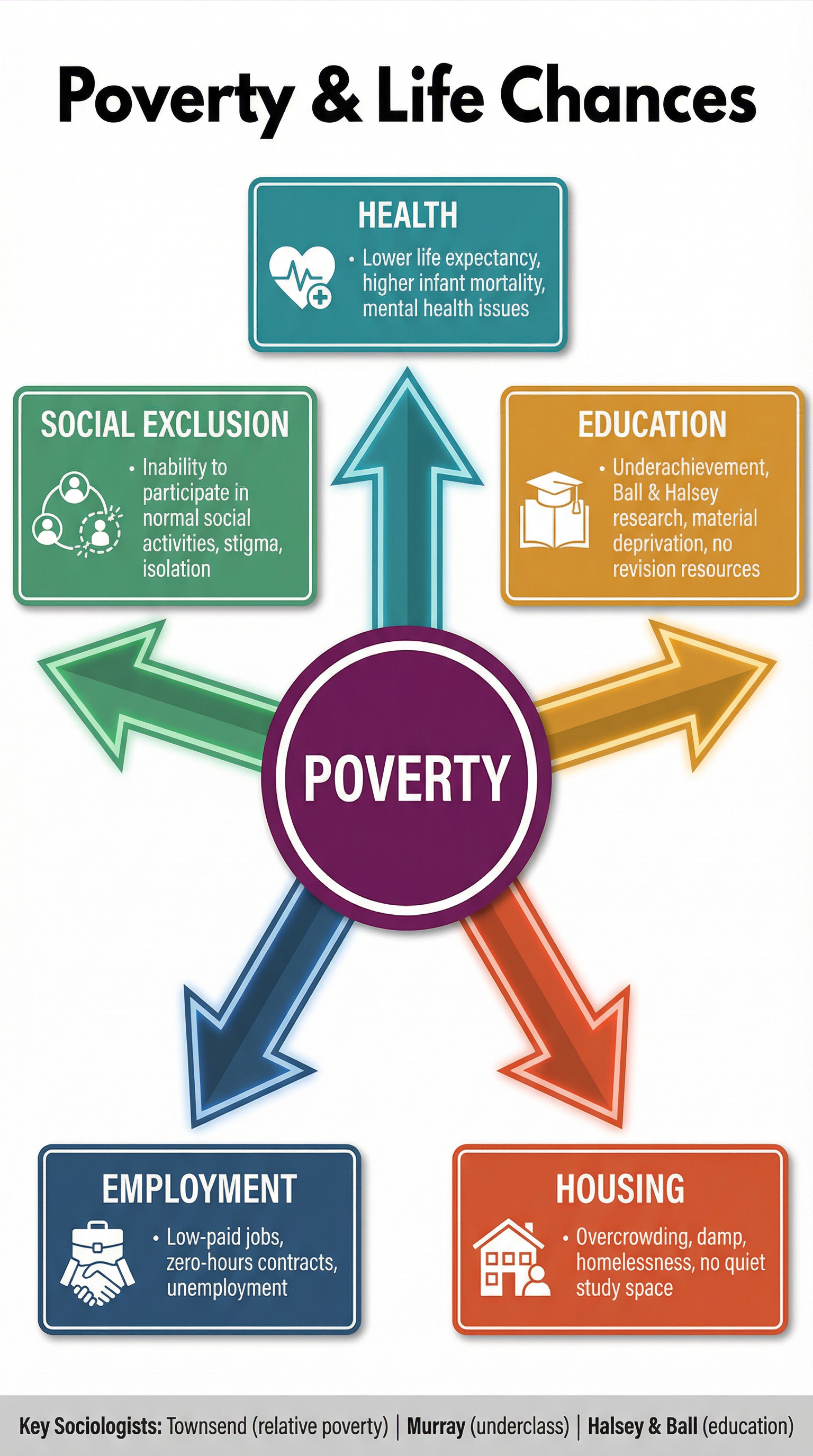
What it is: 'Life chances' refers to the opportunities each individual has to improve their quality of life. Poverty severely limits these chances.
Why it matters: Examiners award marks for linking poverty to specific, evidence-based outcomes.
- Education: Research by Halsey, Heath and Ridge (1980) and later Stephen Ball demonstrates a strong correlation between poverty and educational underachievement. Material deprivation (lacking money for books, trips, quiet study space) and cultural deprivation (the theory that working-class families may lack the values to succeed, a controversial view) are key explanatory concepts.
- Health: The poorest social classes have lower life expectancy, higher infant mortality rates, and higher rates of chronic illness. This is linked to poor diet, damp housing, and the stress of living in poverty.
- Housing: Poverty is linked to homelessness, overcrowding, and living in damp, unsafe accommodation, which in turn affects health and a child's ability to study.
Competing Explanations of Poverty
1. The New Right / Cultural Explanation
- Key Sociologist: Charles Murray (1984)
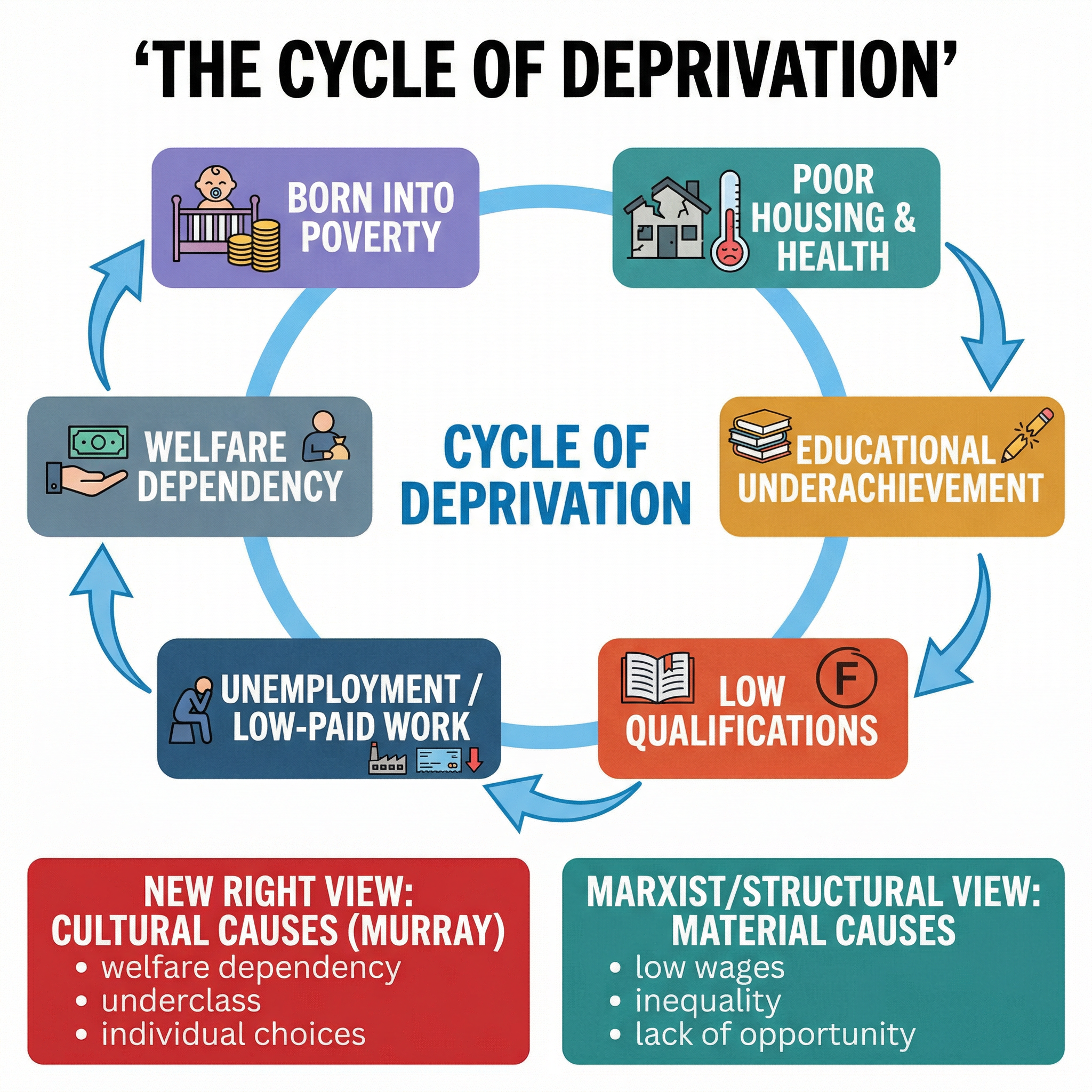
- Core Idea: Murray argues that an 'underclass' exists that is dependent on the welfare state. This group has a distinct culture and value system characterized by a lack of interest in employment, high rates of lone parenthood, and criminality. This creates a 'culture of poverty' and a 'cycle of deprivation' passed through generations.
- Impact: This perspective blames the individual and their choices, suggesting that overly generous welfare benefits create a disincentive to work.
2. Structural / Marxist Explanation
- Key Sociologists: Marxist and other structural theorists.
- Core Idea: This view rejects the 'culture of poverty' and blames the structure of capitalist society. Poverty is seen as an inevitable consequence of a system that creates vast inequalities in wealth and income. Low pay, insecure employment (e.g., zero-hours contracts), and unemployment are the real causes.
- Impact: This perspective argues that poverty is a social problem requiring structural solutions, such as wealth redistribution, a higher minimum wage, and investment in jobs and education. They point to the existence of the 'working poor' as evidence against Murray's claims.
Key Individuals
Peter Townsend
- Role: British sociologist, a key figure in poverty research.
- Key Actions: Developed the concept of relative poverty and the idea of measuring poverty through a 'deprivation index' based on social participation.
- Impact: Shifted the focus of poverty studies in the UK from mere subsistence to social exclusion. His work is fundamental to the OCR specification.
Charles Murray
- Role: American New Right political scientist.
- Key Actions: Coined the term 'underclass' to describe a segment of the population he believed was trapped in a cycle of welfare dependency and deviant behaviour.
- Impact: His 'culture of poverty' thesis has been highly influential in political debates about welfare reform, but is heavily criticized by structural sociologists for 'blaming the victim'.
A. H. Halsey
- Role: British sociologist focused on education.
- Key Actions: His research in the 1980s (with Heath and Ridge) provided strong statistical evidence of the link between social class and educational attainment, highlighting the disadvantages faced by children from working-class backgrounds.
- Impact: Provided empirical weight to the argument that poverty and social class are major determinants of educational life chances, supporting structural explanations.