Study Notes
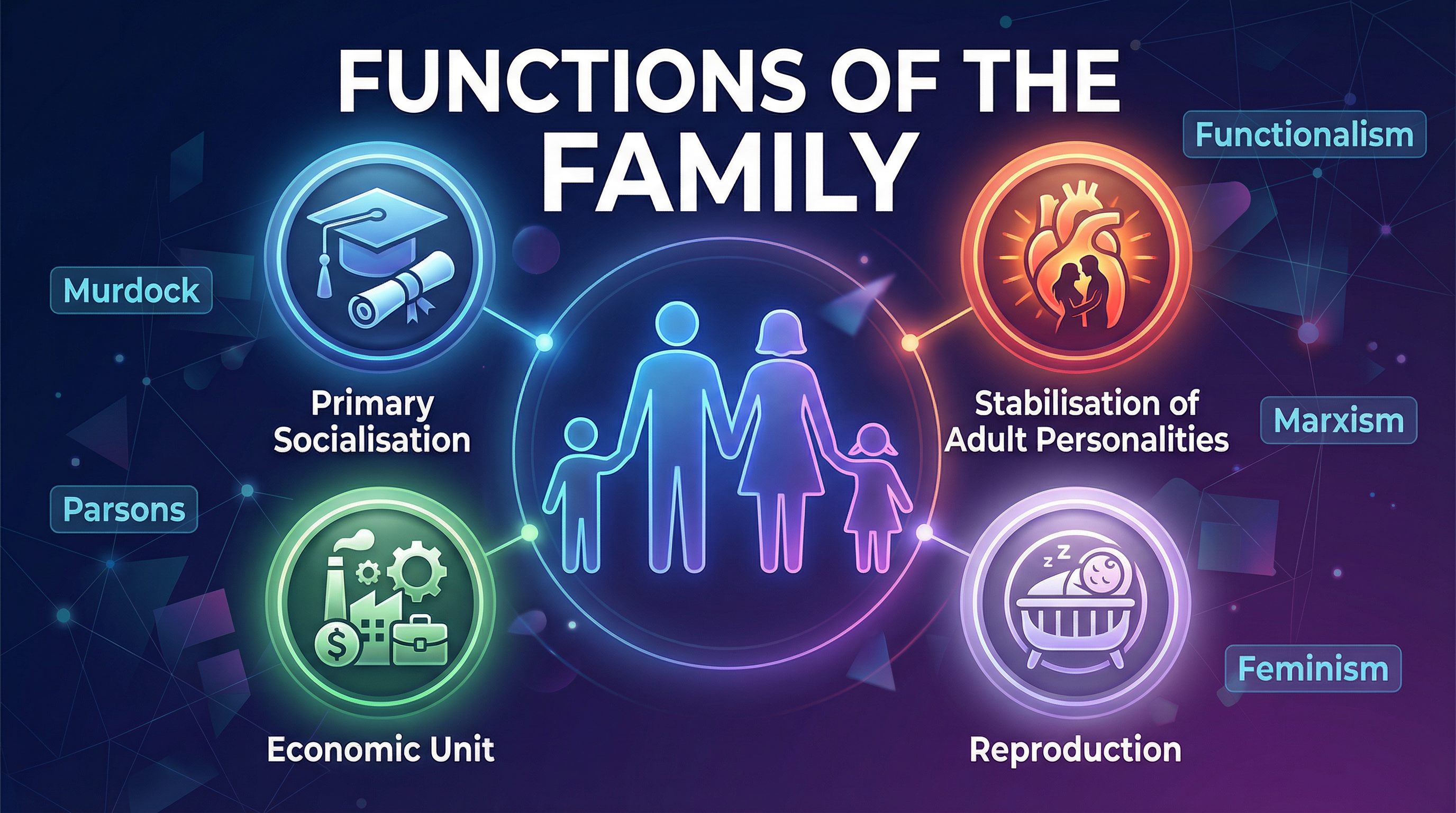
Overview
This guide explores the sociological perspectives on the functions of the family, a central topic in OCR's GCSE Sociology Component 01. Understanding this topic is crucial for candidates as it forms the foundation for analysing family structures and their relationship to society. Examiners expect a detailed comparison of the consensus view of Functionalism with the conflict theories of Marxism and Feminism. This involves not only knowing the key functions identified by sociologists like Murdock and Parsons but also being able to critically evaluate these ideas using contrasting theories. This guide will provide the necessary knowledge, key terminology, and exam strategies to excel in questions on this topic.
Key Sociological Perspectives
Functionalism
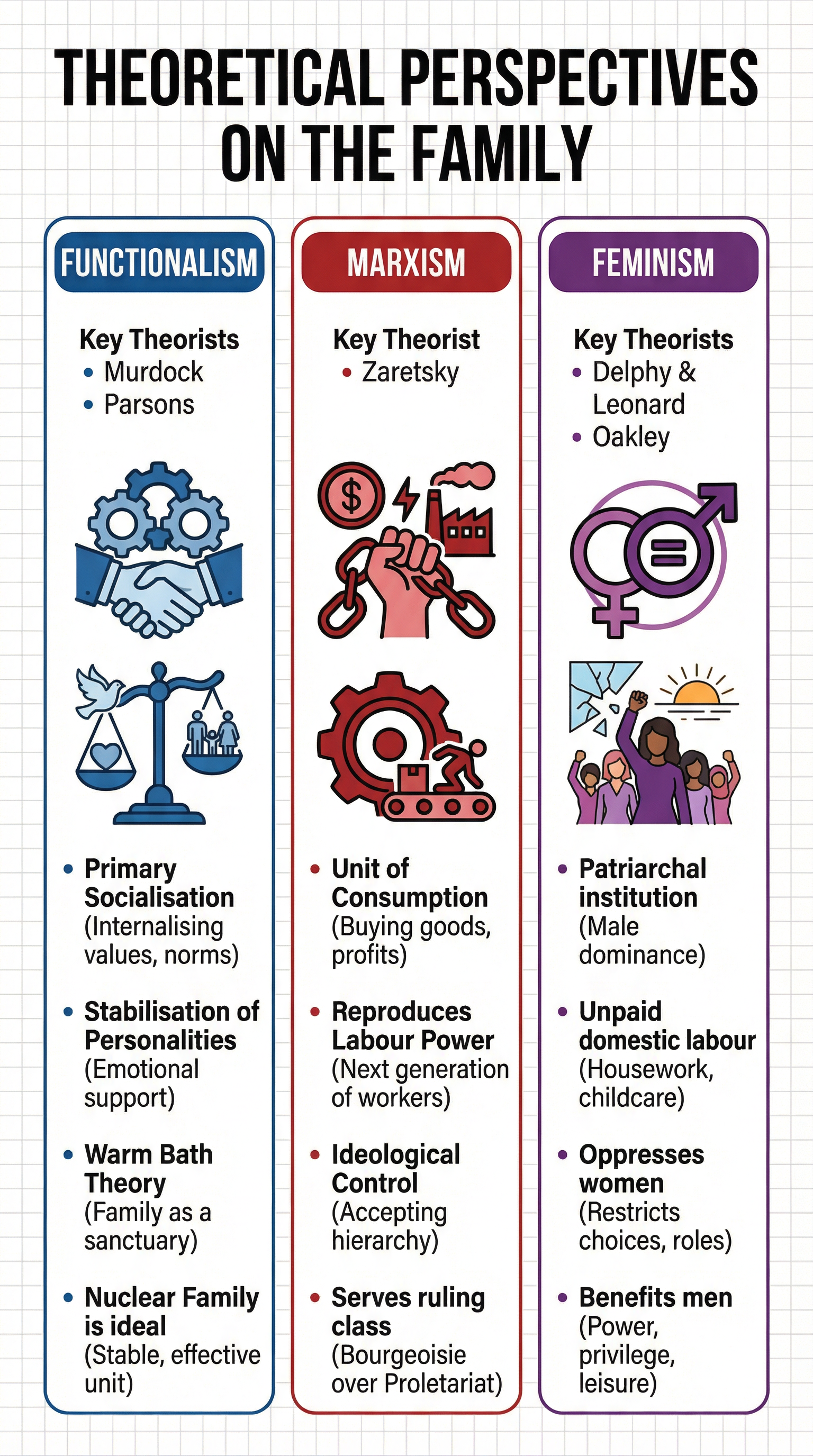
Core Idea: Functionalists view the family as a vital social institution that performs positive functions for both society and individuals. They see it as a cornerstone of a stable and harmonious society.
Key Theorists:
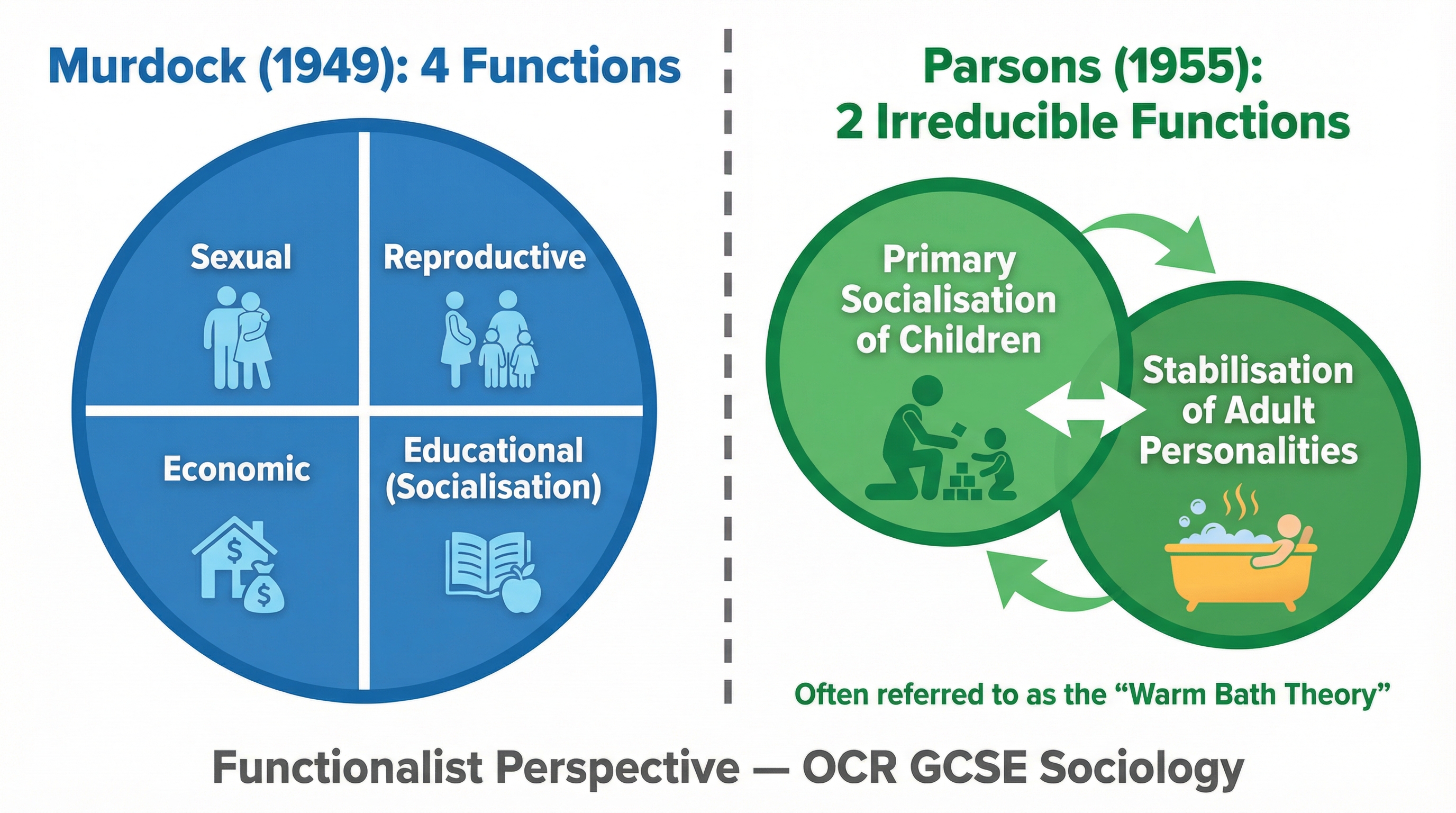
- George Murdock (1949): Argued that the nuclear family is a universal institution that performs four essential functions: Sexual, Reproductive, Economic, and Educational (Primary Socialisation). Credit is given for remembering these four functions.
- Talcott Parsons (1955): Believed that in modern societies, the family has two 'irreducible' functions: Primary Socialisation of children and the Stabilisation of Adult Personalities (the 'Warm Bath' theory). Candidates should be able to explain the instrumental (male) and expressive (female) roles Parsons identified.
Marxism
Core Idea: Marxists see the family as an institution that serves the interests of the capitalist system and the ruling class (bourgeoisie). It is not a harmonious institution but one that helps to maintain social inequality.
Key Theorist:
- Eli Zaretsky (1976): Argued the family serves capitalism by being a 'unit of consumption', reproducing the next generation of workers, and acting as a form of ideological control, teaching children to accept hierarchy.
Feminism
Core Idea: Feminists argue that the family is a patriarchal institution that primarily benefits men at the expense of women. It is a key site of female oppression.
Key Theorists:
- Ann Oakley: A key thinker who distinguished between sex (biological differences) and gender (socially constructed roles). She argues that gender roles within the family are not natural but are learned, and they disadvantage women.
- Delphy and Leonard (1992): See the family as an economic system where women's unpaid labour (housework, childcare) is exploited by men.
Second-Order Concepts
Causation
- Functionalism's rise: The dominance of the Functionalist view of the family in the mid-20th century was caused by the social context of the post-war era, which idealised the nuclear family and social stability.
- Conflict theories' emergence: The rise of Marxism and Feminism in the 1960s and 70s was a direct response to the perceived failings and overly optimistic views of Functionalism, reflecting wider social movements challenging authority and tradition.
Consequence
- Consequence of Functionalist view: The idealisation of the nuclear family had significant social consequences, reinforcing traditional gender roles and stigmatising alternative family structures.
- Consequence of Conflict views: Marxist and Feminist critiques have had a major impact on social policy and legislation, leading to greater recognition of gender inequality and the 'dark side' of family life (e.g., domestic abuse).
Change & Continuity
- Change: The functions of the family have changed over time. For example, the economic function has shifted from a unit of production to a unit of consumption. The rise of the welfare state has also meant the family is no longer the sole provider of education and healthcare.
- Continuity: Despite these changes, the family, in its various forms, remains a central institution for primary socialisation across most societies.
Significance
- The debate about the family's functions is significant because it reflects the major ideological divides in sociology. How one views the family is a good indicator of whether one subscribes to a consensus or conflict view of society as a whole. For the exam, showing you understand this significance is key to achieving higher-level analysis.