Study Notes

Overview
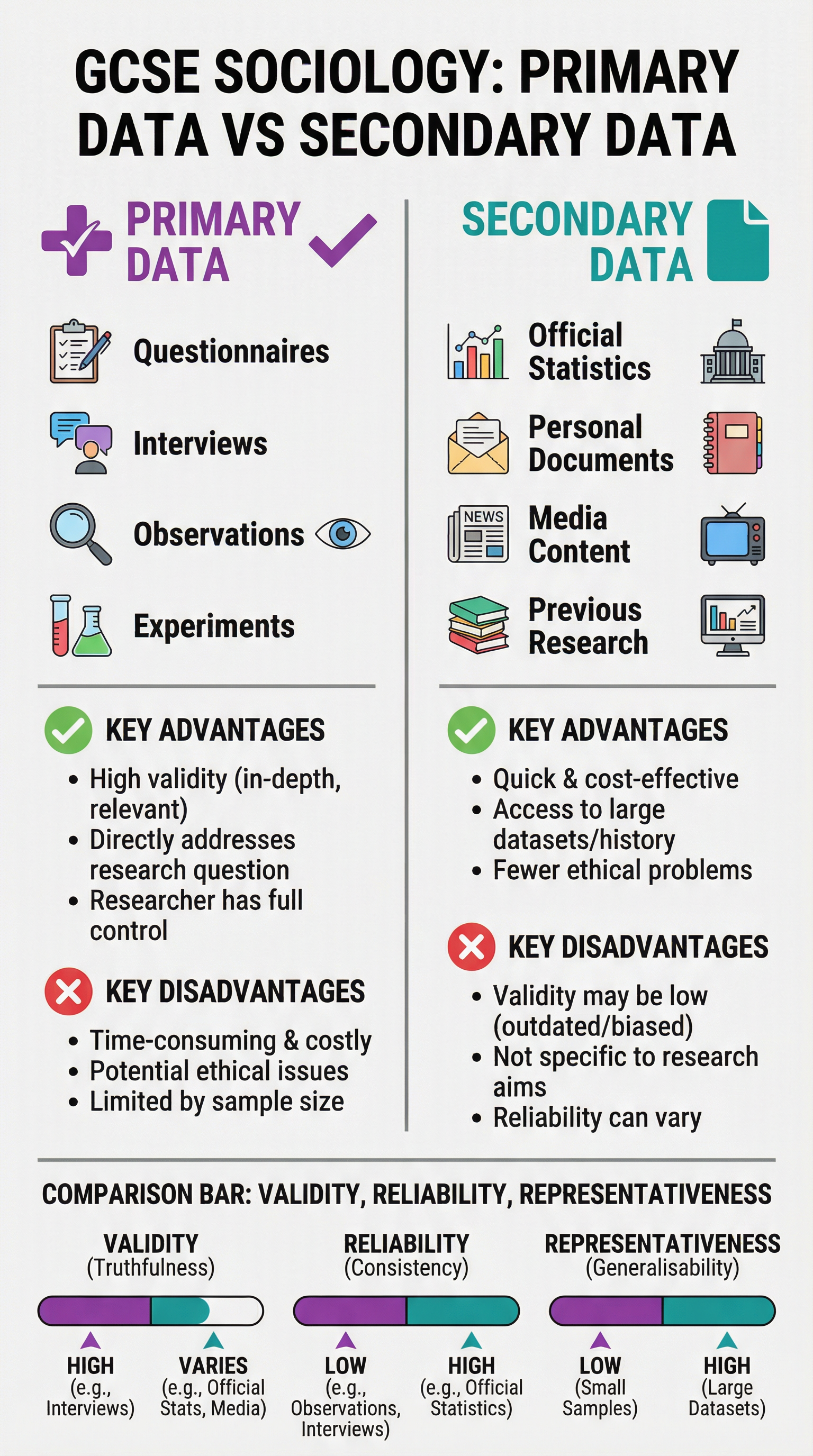
In sociology, the data we use is the bedrock of our conclusions. This guide focuses on the fundamental distinction between primary data and secondary data, a core concept for OCR GCSE Sociology. Primary data is original information collected first-hand by sociologists, tailored to their specific research questions. Think of it as a bespoke suit, made to measure. Secondary data, in contrast, is pre-existing information, collected by others for different purposes, which sociologists can then analyse. This is more like an off-the-peg suit; it's quicker and cheaper, but might not be a perfect fit. Examiners expect candidates to not only define these two types of data but also to critically evaluate their strengths and weaknesses using the PET (Practical, Ethical, Theoretical) framework. Understanding this topic is not just about memorising definitions; it is about developing the analytical skills to judge the fitness-for-purpose of any piece of sociological evidence, a skill that is rewarded heavily across the exam paper.
Key Concepts: Primary vs. Secondary Data
Primary Data
What it is: Primary data is new information gathered directly by the researcher. It involves creating data where none existed before. This is the frontline of sociological research.
Methods of Collection:
- Social Surveys (Questionnaires): A list of written questions. These can be closed-question (offering fixed choices, generating quantitative data) or open-question (allowing respondents to elaborate, generating qualitative data).
- Interviews: A conversation between researcher and respondent. They can be structured (like a questionnaire read aloud), unstructured (like a guided conversation), or semi-structured (a mix of both).
- Observations: The researcher watches a group's behaviour. This can be overt (the group knows they are being observed) or covert (the group does not), and the researcher can be a participant or non-participant.
Why it matters: The great strength of primary data is its direct relevance to the research aim. The sociologist has full control over the data collection process, which can lead to high validity (truthfulness). However, it is often time-consuming and expensive.
Secondary Data
What it is: Secondary data is information that already exists, having been collected by someone else. The sociologist analyses this 'second-hand' data.
Types of Secondary Data:
- Official Statistics: Quantitative data gathered by government bodies (e.g., the UK Census, crime rates, exam league tables). They offer a large-scale view of social trends.
- Personal Documents: Qualitative sources created by individuals that provide personal insights (e.g., diaries, letters, emails, photographs). A famous example is 'The Diary of a Young Girl' by Anne Frank.
- Media Content & Digital Data: Reports from newspapers, television shows, websites, and social media content. This data provides a snapshot of societal attitudes and representations.
- Existing Sociological Research: Using the findings and data from studies already published by other sociologists.
Why it matters: Secondary data is often cheap and easy to access. It can provide access to very large datasets that would be impossible for one researcher to collect, making it high in representativeness. However, the data was not created for the sociologist's specific purpose, which can lower its validity.
Second-Order Concepts: The PET Framework
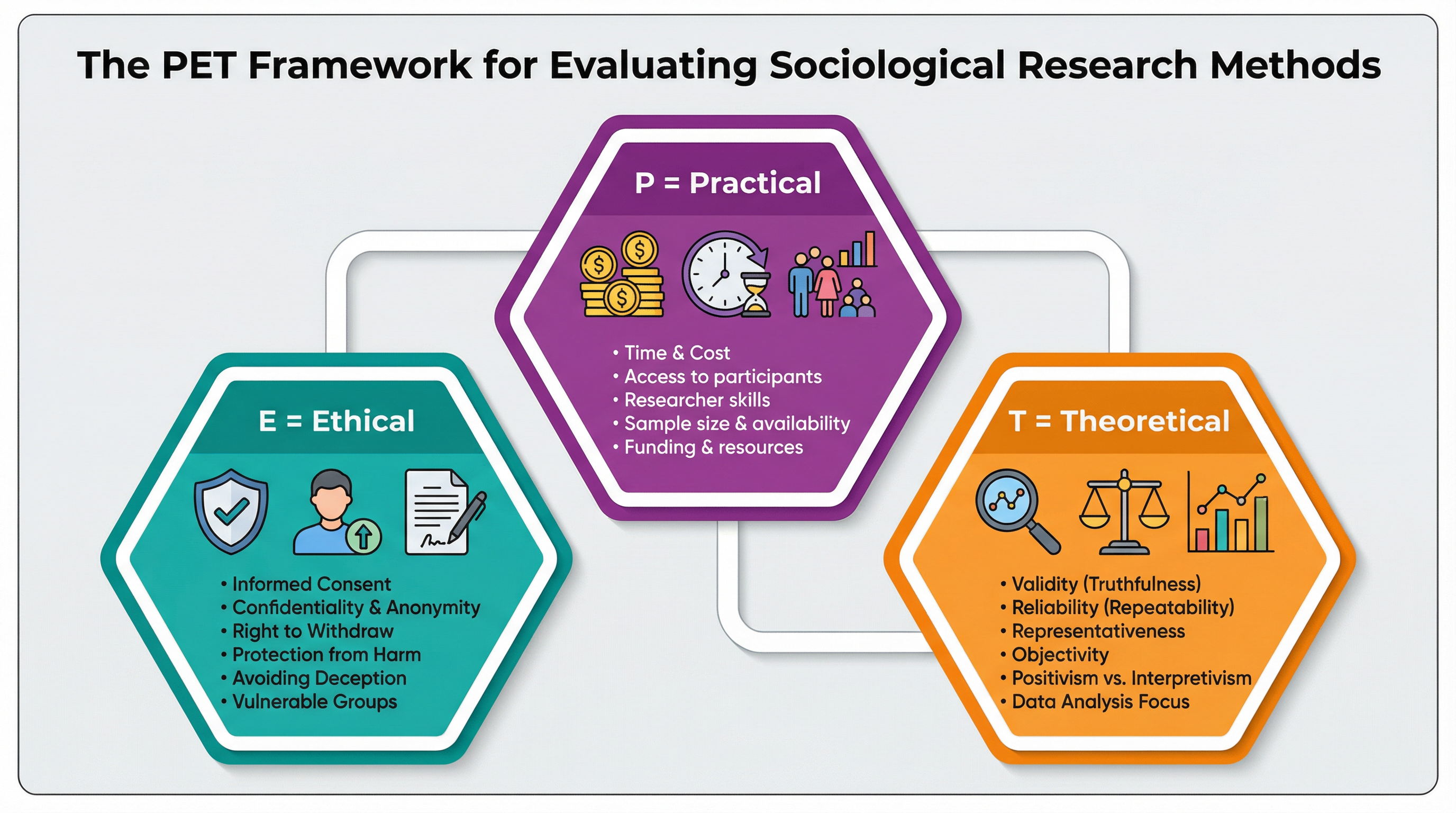
To evaluate the usefulness of any data type, you must apply the PET framework. This is a crucial skill for earning AO3 (analysis and evaluation) marks.
Practical Issues
- Time & Cost: How long will it take and how much will it cost? Primary research is often slow and expensive. Secondary data is usually quick and cheap.
- Access: Can the researcher get to the group they want to study? Some groups are difficult to access (e.g., criminal gangs).
- Researcher Skills: Does the researcher have the right skills? An unstructured interview requires more skill than a simple questionnaire.
Ethical Issues
- Informed Consent: Have participants agreed to take part, fully understanding the research?
- Confidentiality & Anonymity: Will the participants' identities be kept secret?
- Protection from Harm: Will the research cause any psychological or physical harm to participants?
Theoretical Issues
- Validity: Does the data provide a true and authentic picture of what is being studied? Qualitative data is often seen as high in validity.
- Reliability: Can the research be repeated by another sociologist and produce the same results? Quantitative data is often seen as high in reliability.
- Representativeness: Does the research sample reflect the characteristics of the wider research population? Large-scale surveys are more likely to be representative than a small case study."