Study Notes

Overview
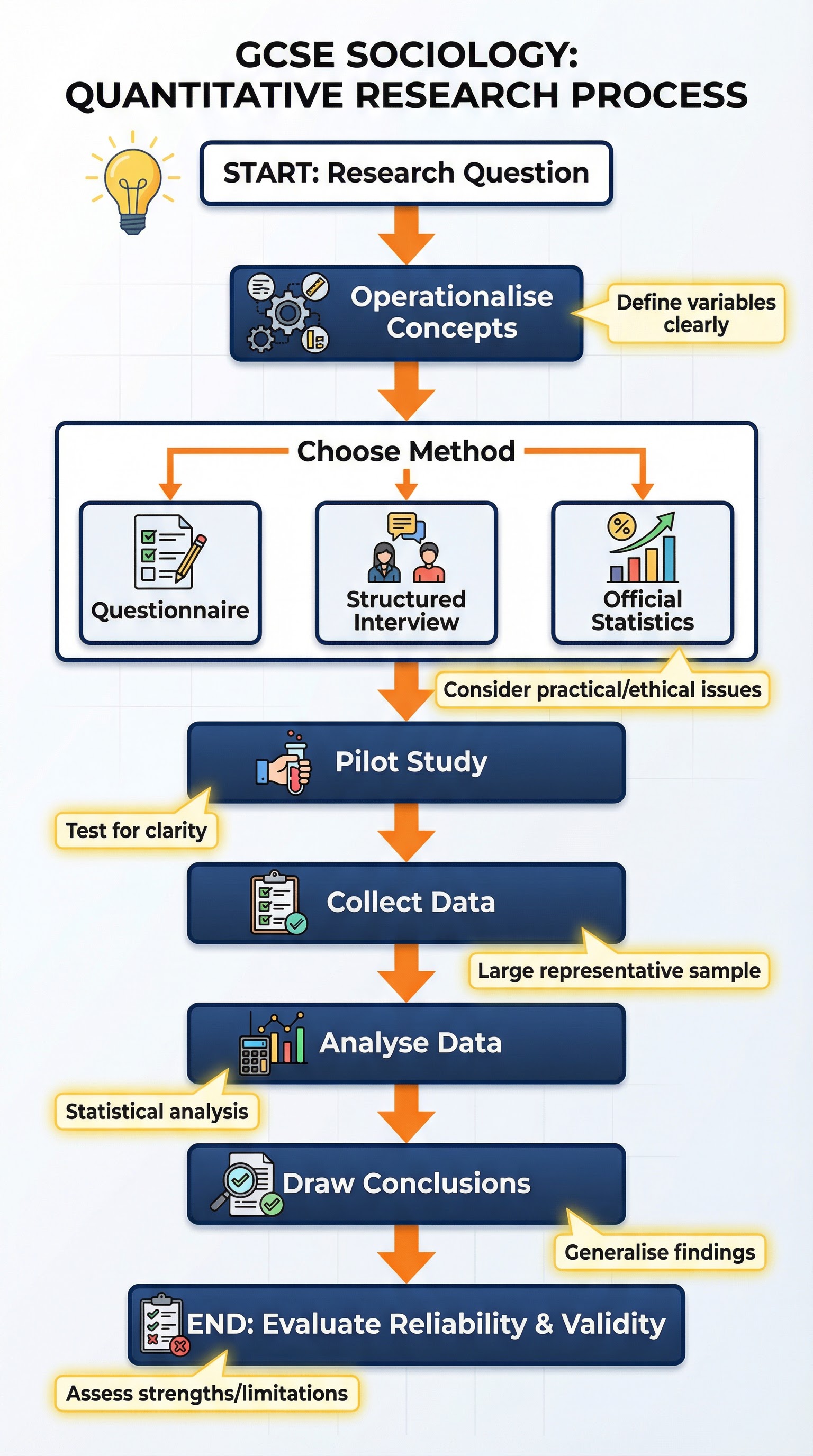
Welcome to your essential guide to Quantitative Research Methods for OCR GCSE Sociology (J204). This topic is fundamental to sociology, focusing on how we can use numerical data to identify large-scale social patterns and trends. Examiners expect candidates to not only understand the methods themselves—questionnaires, structured interviews, and official statistics—but also to critically evaluate their effectiveness. Marks are awarded for showing you grasp the crucial trade-off between the reliability and representativeness offered by these macro-level methods and their inherent lack of validity or depth. This guide will equip you with the concepts, examples, and exam techniques needed to analyse and evaluate quantitative data with confidence, ensuring you can explain not just what the data shows, but what it means for society.
Key Concepts & Methods
Questionnaires
What they are: A list of pre-set questions, typically with closed-question or scaled answers (e.g., 'Strongly Agree'). They can be distributed by post, online, or in person. This is a primary research method.
Why they matter: They are a cornerstone of quantitative research, allowing sociologists to gather data from large, geographically diverse samples relatively quickly. The standardised format makes the data easy to collate and analyse statistically, which is ideal for identifying trends.
Specific Knowledge: Positivist sociologists favour questionnaires because they produce reliable and objective numerical data. For example, the UK National Census is a type of questionnaire sent to every household every 10 years to gather demographic data.
Structured Interviews
What they are: An interview where the researcher reads out a list of pre-set, standardised questions and records the answers. The questions are closed, offering a fixed range of answers. This is a primary research method.
Why they matter: They combine the standardisation of a questionnaire with the personal touch of an interview, which often results in a higher response rate. The presence of the interviewer ensures all questions are answered and can clarify any misunderstandings.
Specific Knowledge: A classic example is the British Social Attitudes Survey, which uses structured interviews to track changes in public opinion on a range of social issues over time. The standardised nature allows for reliable year-on-year comparisons.
Official Statistics
What they are: Numerical data collected and published by government bodies. This is a secondary source of data.
Why they matter: They provide a vast, often free, source of data on a national scale, covering topics like crime, unemployment, and education. They are invaluable for identifying macro-level trends and making comparisons between social groups or over time.
Specific Knowledge: Candidates must know examples like the Office for National Statistics (ONS) which produces the Census, or Home Office statistics on police-recorded crime. It is crucial to evaluate their limitations, such as the 'dark figure of crime'—offences that are never reported or recorded.
Second-Order Concepts
Reliability
Quantitative methods are generally high in reliability. Because the questions and procedures are standardised, the research can be replicated by another sociologist to check the consistency of the results. This is a key requirement of the positivist scientific approach.
Representativeness
These methods are often used to produce representative data. By surveying a large and carefully selected sample, sociologists can make generalisations about the entire research population. For example, a sample of 2,000 young people can be used to make generalisations about all young people in the UK.
Validity
This is the major weakness of quantitative methods. Validity refers to the truthfulness or depth of the data. By using pre-coded, closed questions, researchers impose a framework that may not reflect the respondent's true feelings or experiences, leading to superficial data. Interpretivist sociologists argue this lack of depth is a fatal flaw.
Objectivity
Quantitative methods are seen as objective because the researcher's own values and biases are less likely to influence the results. The use of standardised questions and statistical analysis removes the element of personal interpretation, which is a key goal for positivists.
Source Skills
When presented with quantitative data in the exam (e.g., a table of statistics), you must treat it like a historical source. First, analyse its content: what does the data show? Identify the key patterns. Then, consider its provenance: who produced this data (e.g., ONS, a specific sociologist)? Why was it created? Finally, evaluate its limitations. For official statistics, question what might have been left out (the 'dark figure'). For survey data, consider who was asked and whether the questions might have been leading."