Study Notes

Overview
In OCR GCSE Sociology, Sampling Techniques are a cornerstone of the Research Methods topic, appearing in both Component 01 (The Sociology of Families and Education) and Component 02 (The Sociology of Crime and Deviance and Social Stratification). Understanding how sociologists select participants is fundamental to evaluating the credibility of any research. Examiners expect candidates to not only define the different sampling methods but, more importantly, to apply this knowledge. This means you must be able to assess the strengths and limitations of each technique in terms of its representativeness, potential for bias, and the generalisability of the findings. Marks are awarded for showing you understand that the choice of sampling method is a practical and theoretical decision that directly impacts the validity of sociological data. This guide will equip you with the precise language and analytical skills needed to secure high marks.
Key Concepts: The Building Blocks of Sampling
Before diving into the methods, you must be confident with the core terminology. Answering a question without using these terms correctly is like trying to build a house without bricks – it’s not going to stand up to scrutiny.
- Target Population: The entire group of people that the researcher is interested in studying (e.g., all GCSE students in the UK).
- Sample: A smaller, manageable subgroup selected from the target population to participate in the research.
- Sampling Frame: A complete list of everyone in the target population (e.g., a school register, the electoral roll). The existence (or non-existence) of a sampling frame is a critical factor in deciding which sampling method to use.
- Representativeness: The degree to which a sample accurately reflects the social characteristics (e.g., age, gender, class, ethnicity) of the target population. A representative sample is a micro-version of the macro-population.
- Generalisability: The extent to which the findings from the sample can be confidently applied to the wider target population. You can only claim findings are generalisable if the sample is representative.
The Great Divide: Probability vs. Non-Probability Sampling
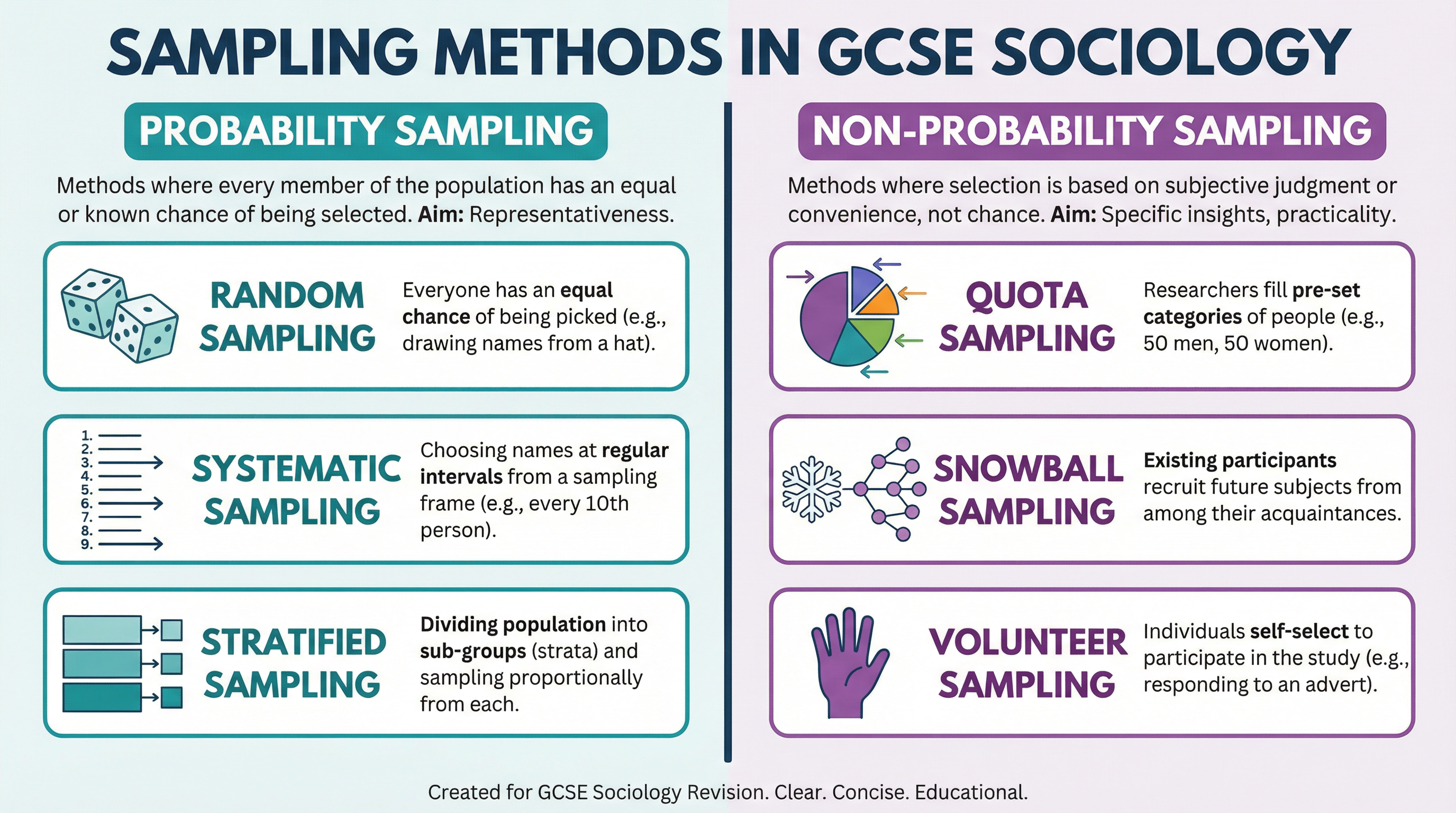
All sampling methods fall into one of two categories. Understanding this distinction is key to evaluation.
Probability Sampling (The Gold Standard for Representativeness)
In probability sampling, every individual in the sampling frame has a known and usually equal chance of being selected. This statistical approach minimises bias and is favoured by Positivist sociologists who seek to produce objective, quantitative, and generalisable data.
1. Simple Random Sampling
- What it is: Every member of the sampling frame has an equal chance of being selected. This is often done using a computer to randomly generate names or numbers from a list.
- Why it matters: It is the purest form of probability sampling and, if the sample is large enough, is likely to produce a representative sample.
- Evaluation: While strong in theory, it can be impractical. You need a complete and up-to-date sampling frame, which is often unavailable. Furthermore, by chance, you could end up with an unrepresentative sample (e.g., picking 20 students who all happen to be boys from a mixed-gender school).
2. Systematic Sampling
- What it is: Selecting every nth person from a sampling frame (e.g., every 10th person on a school register).
- Why it matters: It provides a more structured way to achieve a random-like sample and avoids the risk of clustering that can occur in simple random sampling.
- Evaluation: It is straightforward and quick once the sampling frame is established. However, it is not truly random, as not everyone has an equal chance of being selected once the starting point is chosen. If there is a hidden pattern in the sampling frame, the sample can be biased.
3. Stratified Sampling
- What it is: The researcher divides the sampling frame into subgroups (strata) based on key characteristics (e.g., gender, ethnicity). They then draw a sample from each subgroup in the same proportions as they exist in the target population.
- Why it matters: This is the most likely method to produce a truly representative sample. It guarantees that all important subgroups are included in the final sample.
- Evaluation: It is the gold standard for representativeness. However, it is very time-consuming and expensive. The researcher must have detailed, up-to-date knowledge of the target population's characteristics and a complete sampling frame to work from.
Non-Probability Sampling (Pragmatism Over Perfection)
In non-probability sampling, the sample is selected based on the subjective judgement of the researcher or the convenience of access, rather than random chance. These methods are often used in qualitative research where the goal is to gain in-depth insight, not statistical generalisability. They are favoured by Interpretivist sociologists.
1. Quota Sampling
- What it is: The researcher sets quotas for the number of people they want to interview from various categories (e.g., 10 men aged 20-30, 10 women aged 20-30). They then go out and find people who fit these categories.
- Why it matters: It's a practical way to ensure certain groups are represented without needing a sampling frame. It is commonly used in market research.
- Evaluation: It is quick, cheap, and easy. However, the sample is not random. The researcher might be biased (consciously or unconsciously) in who they approach, for example, by only approaching people who look friendly. This makes the sample unrepresentative.
2. Snowball Sampling
- What it is: The researcher finds one participant, and asks them to refer them to other potential participants. The sample grows like a snowball rolling downhill.
- Why it matters: It is extremely useful for accessing 'hidden' or hard-to-reach populations that do not have a sampling frame, such as criminals, drug users, or members of a specific subculture.
- Evaluation: It is the only viable method for certain groups. However, the sample is highly unlikely to be representative. Participants will share a social network, meaning the researcher is only accessing one small, interconnected part of the target population.
3. Volunteer (or Self-Selecting) Sampling
- What it is: Participants choose to be part of the study, typically by responding to an advertisement.
- Why it matters: It is a very easy and ethical way to recruit participants, as they have actively given their consent to take part.
- Evaluation: It requires minimal effort from the researcher. However, it is prone to 'volunteer bias'. The people who volunteer may be different from the general population (e.g., they may have stronger opinions on the topic, or be more unemployed and have more free time), making the sample unrepresentative.
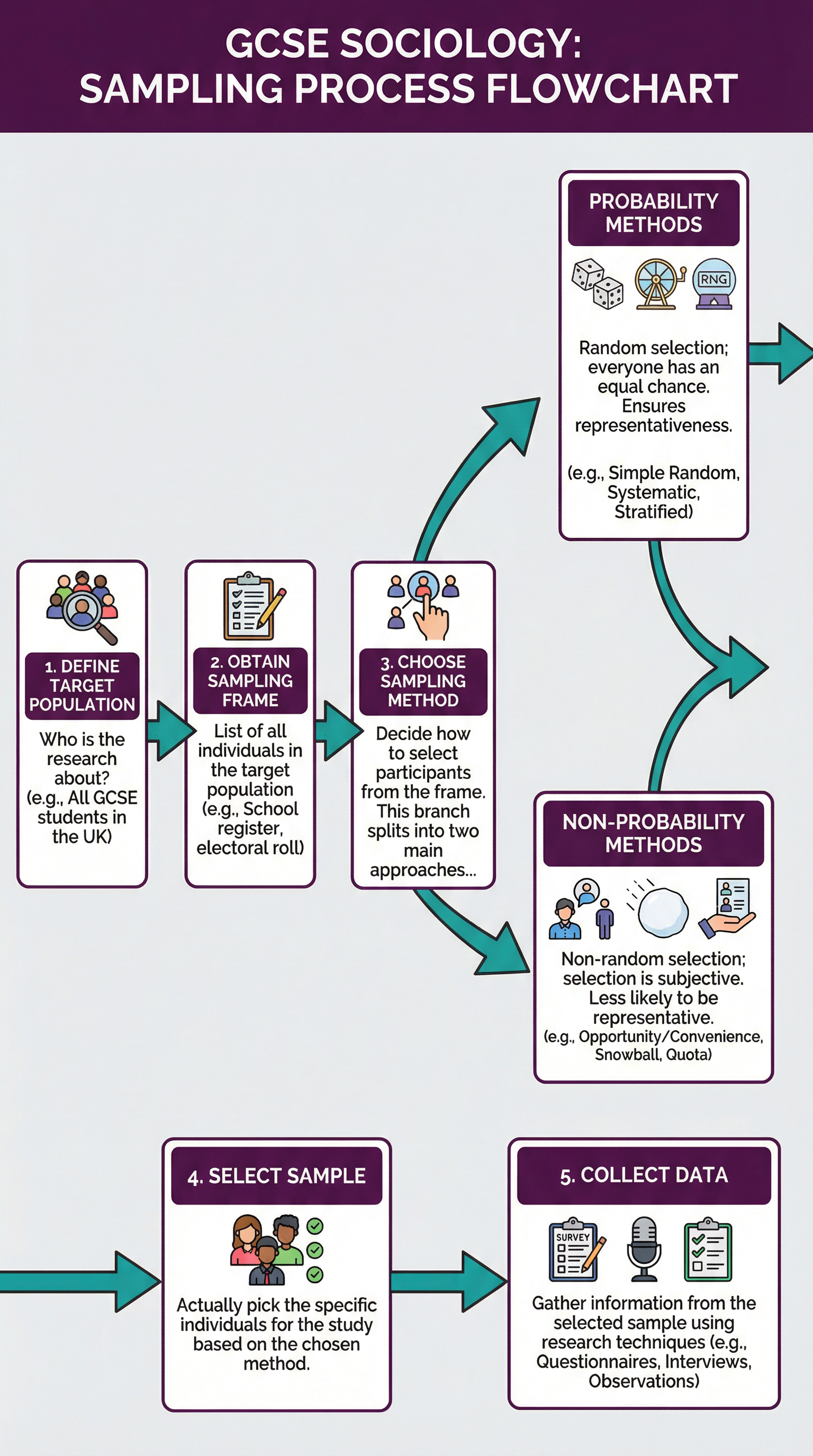
The Sampling Process in Action
Understanding the steps a sociologist takes is crucial for applying your knowledge in an exam.