Social mobility

    OCR
    GCSE
    Sociology

    This study guide explores the critical topic of social mobility in the UK, a cornerstone of OCR GCSE Sociology. It dissects whether society is truly meritocratic, where talent and hard work determine success, or if structural barriers related to class, gender, and ethnicity limit life chances. Understanding this is vital for top marks.

    4
    Min Read
    3
    Examples
    5
    Questions
    6
    Key Terms
    🎙 Podcast Episode
    Social mobility
    8:58
    0:00-8:58

    Study Notes

    Header image for OCR GCSE Sociology: Social Mobility

    Overview

    Social mobility is the study of movement within the social class structure. For OCR candidates, this topic is not just about defining terms; it's about evaluating the extent to which the UK can be considered an open, meritocratic society. Examiners expect you to engage critically with the optimistic Functionalist view that role allocation is fair, and contrast it sharply with the pessimistic views of Marxists and Feminists who argue that structural inequalities are deeply embedded in our society. This guide will equip you with the key theories, studies, and evidence needed to analyse patterns of intergenerational and intragenerational mobility, and to construct high-level arguments about the 'myth of meritocracy'. Credit is consistently given for candidates who can deploy specific evidence, such as data from the Sutton Trust or findings from Goldthorpe's Oxford Mobility Study, to support their claims. Mastering this topic means moving beyond common sense to a robust, evidence-based sociological analysis.

    Social Mobility: 10-Minute Revision Podcast

    Key Concepts & Theories

    Types of Social Mobility

    What it is: Social mobility is measured in four key ways. Understanding the distinction between them is crucial for earning AO1 marks.

    Why it matters: Examiners will penalise candidates who confuse these terms. Precision is key.

    Specific Knowledge: Vertical (up/down), Horizontal (sideways), Intergenerational (between generations), Intragenerational (within a lifetime).
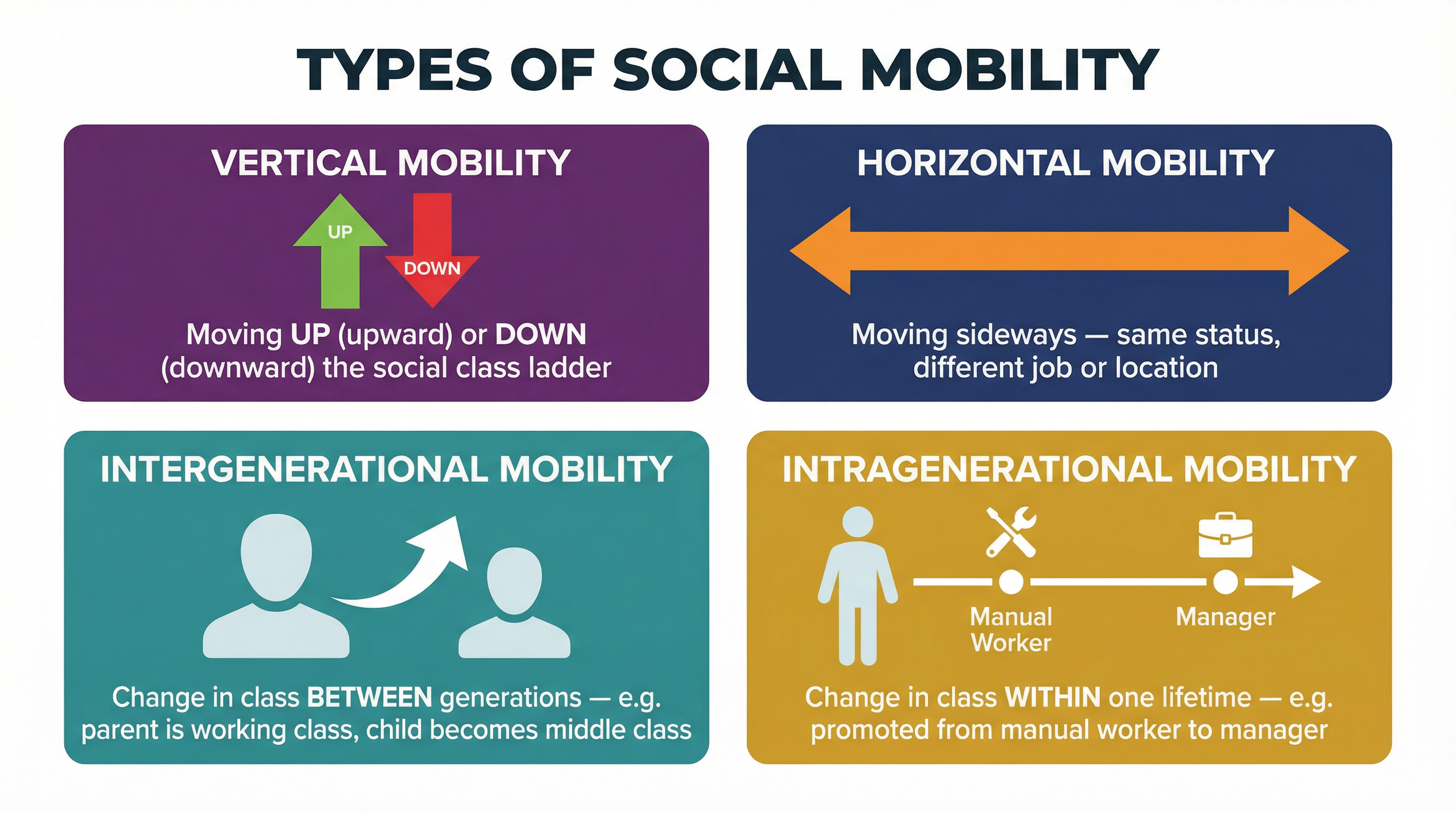
    The Four Types of Social Mobility

    Theoretical Perspectives

    What it is: The major sociological theories offer contrasting explanations for the patterns of social mobility we observe.

    Why it matters: The core of any high-mark essay on this topic is the debate between these perspectives. You must be able to explain and evaluate them.

    Specific Knowledge: Functionalism (Parsons), Marxism (Marx, Bourdieu), Feminism.
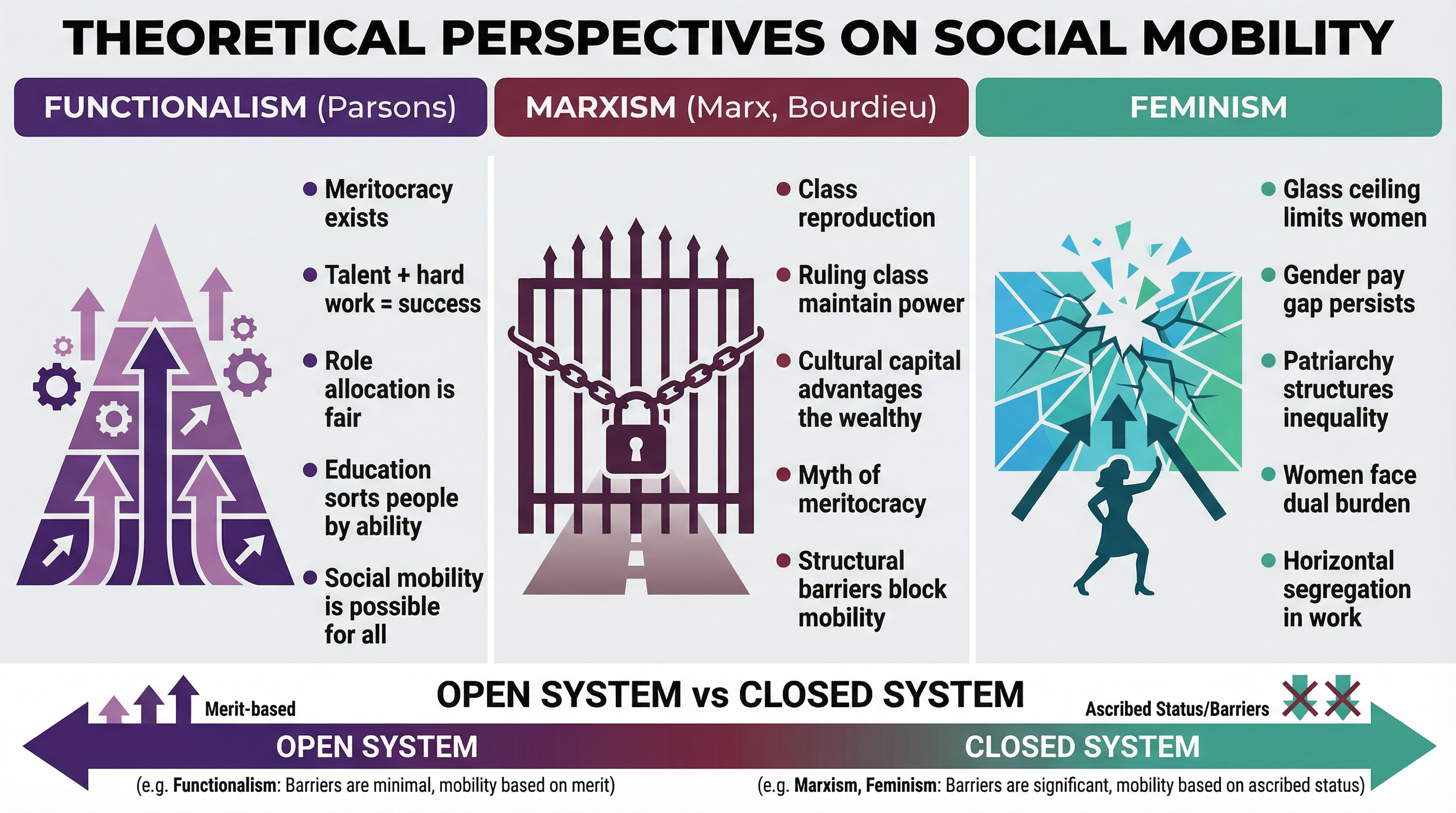
    Theoretical Perspectives on Social Mobility

    Key Individuals & Studies

    John Goldthorpe

    Role: Sociologist, lead author of the Oxford Mobility Study.

    Key Actions: Conducted a major study in the 1970s comparing the social class of fathers and sons to measure intergenerational mobility.

    Impact: His findings challenged the Functionalist view of meritocracy. He found that while 'absolute' mobility had increased (more middle-class jobs were available), 'relative' mobility rates (a working-class person's chances of reaching the top compared to a middle-class person) had not changed significantly. This supports the Marxist view of class reproduction.

    Pierre Bourdieu

    Role: French sociologist.

    Key Actions: Developed the concept of 'cultural capital'.

    Impact: Bourdieu argued that the children of the middle and upper classes inherit cultural capital – the knowledge, attitudes, and values that are prized by the education system and employers. This gives them an unfair advantage, making it appear that their success is based on merit when it is actually a product of their privileged background. This is a key concept for explaining the 'myth of meritocracy'.

    The Sutton Trust

    Role: A research charity focused on improving social mobility.

    Key Actions: Publishes regular, contemporary research on the relationship between educational background and elite professions.

    Impact: Provides powerful, up-to-date evidence to support Marxist and Feminist arguments. For example, their 2019 report 'Elitist Britain' showed that 65% of senior judges and 57% of senior civil servants were privately educated, despite only 7% of the population attending private schools. This is gold-standard evidence for your essays.

    Visual Resources

    2 diagrams and illustrations

    The Four Types of Social Mobility
    The Four Types of Social Mobility
    Theoretical Perspectives on Social Mobility
    Theoretical Perspectives on Social Mobility

    Interactive Diagrams

    1 interactive diagram to visualise key concepts

    1950-01-011960-01-011970-01-011980-01-011990-01-012000-01-012010-01-012020-01-01Davis & Moore John Goldthorpe Sutton Trust Reports Functionalist TheoryOxford Mobility StudyContemporary EvidenceKey Studies & Reports Timeline

    A timeline showing the publication of key sociological works related to social mobility.

    Worked Examples

    3 detailed examples with solutions and examiner commentary

    Practice Questions

    Test your understanding — click to reveal model answers

    Q1

    Evaluate the view that the UK is a meritocracy. (12 marks)

    12 marks
    hard

    Hint: Start with the Functionalist argument for meritocracy, then use evidence from Marxist, Feminist, and other research (e.g., Sutton Trust) to critique it. Come to a clear conclusion.

    Q2

    Describe two ways in which a person's social class background might affect their chances of upward social mobility. (4 marks)

    4 marks
    standard

    Hint: Think about the advantages a middle-class background might provide, or the disadvantages of a working-class background.

    Q3

    Explain what sociologists mean by the 'glass ceiling'. (4 marks)

    4 marks
    standard

    Hint: Define the term and state which social group it primarily affects.

    Q4

    Outline and explain one strength and one weakness of using official statistics to measure social mobility. (6 marks)

    6 marks
    hard

    Hint: Think about the advantages (e.g., scale, cost) and disadvantages (e.g., definitions, validity) of large-scale government data.

    Q5

    Explain the difference between absolute and relative mobility. (4 marks)

    4 marks
    standard

    Hint: Absolute mobility is about the overall number of jobs, while relative mobility is about your chances compared to others.

    Explore this topic further

    View Topic PageAll Sociology Topics

    Key Terms

    Essential vocabulary to know

    More Sociology Study Guides

    View all

    Family Structures

    OCR
    GCSE

    This study guide critically examines the diverse family structures in contemporary UK society, moving beyond the traditional 'cereal packet' ideal. It is designed to equip OCR GCSE Sociology candidates with the theoretical knowledge and analytical skills needed to deconstruct concepts of family, kinship, and household, and to evaluate the social forces shaping them.

    School organisation and culture

    OCR
    GCSE

    This guide dissects the inner workings of school organisation and culture, revealing how processes like the hidden curriculum, teacher labelling, and streaming directly shape student identities and life chances. For OCR GCSE Sociology candidates, mastering these concepts is crucial for explaining the persistent patterns of differential achievement between social groups.

    Socialisation

    OCR
    GCSE

    This study guide provides a comprehensive overview of socialisation for OCR GCSE Sociology students. It explores the lifelong process of learning norms and values, the key agencies involved, and the critical debate between nature and nurture, equipping candidates with the precise knowledge and analytical skills needed to excel in their exams.

    Values

    OCR
    GCSE

    This study guide provides a comprehensive, exam-focused breakdown of the concept of 'Values' for OCR GCSE Sociology. It explores the crucial distinction between values and norms, how values are transmitted, and the key theoretical debates between Functionalism and Marxism, equipping students to secure top marks.

    Theories of Crime and Deviance

    OCR
    GCSE

    Why do people break the rules? This guide delves into the core sociological theories of crime and deviance, exploring how society's structure and our interactions shape what we consider criminal. Master the essential arguments from Functionalism, Marxism, and Interactionism to secure top marks in your OCR GCSE Sociology exam."

    Identity

    OCR
    GCSE

    This study guide delves into the fascinating sociological concept of Identity, a cornerstone of the OCR GCSE specification. It explores how our sense of self is not innate but socially constructed, shaped by powerful forces like family, education, and the media. Mastering this topic is crucial for exam success, as it requires candidates to analyse complex theories and apply them to contemporary social life.